Wednesday, 11 September 2019

The Arrival of the Bee Box

I ordered this, clean wood box
Square as a chair and almost too heavy to lift.
I would say it was the coffin of a midget
Or a square baby
Were there not such a din in it.

The box is locked, it is dangerous.
I have to live with it overnight
And I can’t keep away from it.
There are no windows, so I can’t see what is in there.
There is only a little grid, no exit.

I put my eye to the grid.
It is dark, dark,
With the swarmy feeling of African hands
Minute and shrunk for export,
Black on black, angrily clambering.

How can I let them out?
It is the noise that appalls me most of all,
The unintelligible syllables.
It is like a Roman mob,
Small, taken one by one, but my god, together!

I lay my ear to furious Latin.
I am not a Caesar.
I have simply ordered a box of maniacs.
They can be sent back.
They can die, I need feed them nothing, I am the owner.

I wonder how hungry they are.
I wonder if they would forget me
If I just undid the locks and stood back and turned into a tree.
There is the laburnum, its blond colonnades,
And the petticoats of the cherry.

They might ignore me immediately
In my moon suit and funeral veil.
I am no source of honey
So why should they turn on me?
Tomorrow I will be sweet God, I will set them free.

The box is only temporary.

                   - Sylvia Plath

Tuesday, 10 September 2019

O Ubi Campi!


"O fortunatos nimium, sua si bona norint
Agricolas, quibus ipsa, procul discordibus armis,
Fundit humo facilem victum justissima tellus!"


                       Virgil, The Georgics, Book II


I had a brief conversation with the Poet Laureate last night, which is not a boast that one often sees in wargames blogs. Simon Armitage was reading from and discussing his latest book 'Still: A Poetic Response to Photographs of the Somme Battlefield'.  His 'poetic response' to the Somme was in fact a reworking of Virgil's Georgics, a poem first published in 29 BC on the theme of farming and animal husbandry. I will freely confess that his explanation of why he chose to do that and what it all means went completely over my head. Maybe it had something to do with the Roman road between Albert and Bapaume, maybe it was that Virgil's poem was really a celebration of the peace under the Emperor Augustus following years of civil war. You will get no enlightenment here.


What you will get from me, I suspect, is a series of poems about bees, starting for now with this translation of Book IV of the Georgics by Peter McDonald. My own interpretation of this is that it's a metaphor for how collective cooperation is the best way to run society, providing the most security for us all. Maybe I'm just seeing what I want to see. Bear in mind when you read it that, for reasons I have never understood, the Romans apparently believed that swarms of bees spontaneously generated from the carcasses of sacrificed cattle. 


The Bees 
1
When the last of the sunlight goes, and shadows stretching from the shade of trees and bushes, long hedgerows, join up together to invade wild grasses and the flat pasture, turning from shadow into night, then the bees, scattered far and near, take notice, and start on their flight back to those walls and roofs they know, beehives where their small bodies rest between dark and dawn; they go over the threshold, noisy, fast, massing in hundreds at the doors, and pour past into their close cells, cramming chambers and corridors while the last of the daylight fails: sleep silences the working hive and leaves it quiet as the grave.

2
For bees put no trust in the sky when storms come up with an east wind, and seldom venture far away from their stations when downpours impend: instead, they draw the water off and stick close to their city walls where any flights they take are brief; as the wind blows and the rain falls they steady themselves through turbulence by taking with them little stones (as frail boats, faced with violence of gales and tides, take ballast on), and hold their given course along the clouds, balanced, and balancing.

3
A wonder, how they reproduce: without courtship, or lovemaking, without letting their hearts unloose nerves and sinews like so much string, without the agony of birth, they gather offspring from the leaves and softer herbs, draw with each breath pollen and children for the hives, providing themselves with a fresh ruler, and tiny citizens, to take the place of some who crash against the earth, onto hard stones, brought level by their single love for flowers and honey-vintages (the glorious legacy they leave behind them, in trust for the ages), although the time that waits for them is short enough, and not beyond a seventh summer; yet the same nation and race will soldier on, deathless in spite of time’s attacks, in cells and palaces of wax.

4
All of these things have given pause to the bees’ watchers and guardians whenever they ascribe the cause to some influx, some influence over and above the natural, an exhalation from beyond or an element more ethereal than air itself - maybe the mind of God, that strengthens as it runs in earth and sky, or turns in deep acres of churning oceans, in herds of cattle, flocks of sheep, the wild beasts and the harmless beasts, in life that feels along a thread from its first movement to the last, finishing where it all started, and never reaching a true end; this keeps the bees away from death when, at the last, they all ascend into the skies they lived beneath,to fly between undarkened spheres in heaven, and the many stars.

Sunday, 8 September 2019

1 part PVA: 4 parts water

"You know, if they didn't have the model train, they wouldn't have gotten the idea for the big trains." 

And so to the theatre. I have been to see LipService ("The Laurel and Hardy of literary deconstruction" according to the Guardian) perform their new show 'Strangers on a Train Set'. This piece spoofs a whole series of train related films, although - presumably deliberately - not Hitchock's 'Stangers on a Train'. The parodies were framed by the concept of model railway enthusiasts demonstrating their layout, with the small figures that they placed on the table acting out the scenes and even in the end developing a level of self-awareness. And speaking of self-awareness, it was, shall we say, interesting to sit in an audience which was laughing at the idea of sad middle-aged men who seek to escape real life by recreating a world in miniature and by engaging in debates about the accuracy and authenticity of their models. I consider myself fortunate that I don't know anyone like that.


Peter and James realise the infantry's buttons are the wrong type of brass

It was all very funny, with non-anorak targets including 'The 4:50 from Paddington', 'Brief Encounter', knitting and the blue colour of energy drinks (apparently the secret ingredient is woad). I did wonder if one or two of the jokes weren't perhaps too niche for a general audience. There is a scene in which a character who has been bashed about by a rooftop chase along the train is removed for running repairs and then finds himself clutching a paintbrush much larger than himself and complaining that he mysteriously smells of varnish, which I found very amusing, but seemed to baffle my companion for the evening. Even more arcane perhaps was their take on 'The Railway Children'. According to them the landslip which causes Jenny Agutter to wave her underwear about was caused by the modeller using the wrong ratio of PVA glue to water and the cat litter therefore not sticking to the side of the hill properly. We've all been there.

Friday, 6 September 2019

York Army Museum

The UK government has, for its own low motives, adopted the language of war when discussing the subject of relations with our closest neighbours and most significant trading partners (there was a thought-provoking opinion piece on the subject by Simon Jenkins in the Guardian yesterday); it's all enough to make one wish that one wasn't interested in military history. However, I am indeed interested in the subject and so have been to York Army Museum, in particular to see their current D-Day exhibition before it closes.


The photo above explains the remit of the museum and they cover it in great detail. The regiments involved have antecedents dating back to the troops raised by James II to counter the Duke of Monmouth's rebellion in 1685 and in the subsequent three centuries been involved in actions across the world. I like a museum to have plenty of historical artefacts and here there are more than I can probably list: a standard carried at Dettingen in 1743, the flag that was raised over Quebec in 1759 to signify its capture by the British, the helmet worn by General Sir James Scarlett during the Charge of the Heavy Brigade at Balaclava (complete with dents made by Russian sabres), many medals and decorations including several Victoria Crosses, and much else besides.


There's a captured Great War German Machine gun, which looks exactly as mine do in miniature:


There is also a British Vickers machine gun of the same period, which looks nothing like mine do in miniature and of which I have therefore not included a photo. Captured equipment comes from a variety of sources such as an Iraqi AK47 from the second Gulf War, back through German, Italian and Japanese arms of the second war, Russian items from the Crimea, French uniforms from the Peninsula and Waterloo and so on. There are also souvenirs of Britain's colonial wars including a Maori axe, making one feel that perhaps the conquest of New Zealand wasn't a fair fight, and sufficient Boer weaponry to make one feel that to make one feel that perhaps that wasn't a fair fight either. I found the following especially interesting:


I had a surrogate grandmother (after whom the younger Miss Epictetus is, in part, named) and I can remember her telling me about the street parties that were held in the East End to celebrate the relief of Ladysmith when she was a child; yes, I am that old.

Returning to my opening theme, the museum contains tributes to two members of predecessor units to the Royal Dragoon Guards who seem to me to personify why we should treat the posturings of Boorish Johnson with complete contempt. Firstly that old favourite of this blog Sir Adrian Carton de Wiart VC. It is worth remembering that this man who won Britain's highest medal for bravery and had various bits blown off serving the country in colonial wars and the First World War (and of course memorably pulled his own fingers off at one point) and spent two years as a prisoner of war in the Second World War, was in fact Belgian. Secondly, Captain Oates of Antarctic fame, a man whose quiet self-sacrifice of himself for others stands in stark contrast to our current Prime Minister's bombastic determination that everything and everyone should be subordinate to his own ego and ambition. 

Thursday, 5 September 2019

Daniel Chapter 6 Verse 7

The Good Soldier Svjek (*) recently posted a comment on this blog to the effect that we really need Spitting Image at the moment. However, it seems to me that political life in Britain has transcended the ability of satire to mock it and so I am going to do something unexpected and write about wargaming.

Firstly an apology. I may have given the impression that I didn't think James would be able in the time allotted to come up with a hybrid of Classic Piquet and Field of Battle for use with his ever-growing Peninsular Napoleonic forces. Well he did, and they proved very playable. We are still in that phase of rule development where things change constantly (**), but to be fair the elements moving are either minor tweaks or are related to the bane of Napoleonic rules writers, namely skirmishers. It is period where, especially at a scale where each unit represents a battalion, one wants to be able to recreate all the different formations: line, attack column, square etc, an important element of most of which is clouds of skirmishers out in front. Nevertheless there is a very good reason why the designers of many sets of rules choose to abstract the skirmishers away, namely that it is all a bit difficult. Still, in our case one factor overrides them all: James has painted them and he is bloody well going to use them. Indications are that we'll end up with a compromise whereby they are physically present on the table, but more as a marker reflecting the state of their parent unit than anything else.

The game itself, played over two weeks, was a resounding British victory. One reason we wanted to move away from FoB was that we couldn't see how French columns could ever reach the British lines, let alone defeat them when they got there. Our first pass at the new improved rules seemed, to me at least, to suffer from the same issue, but hopefully it's more a question of fine tuning than anything fundamental. We shall try again next week with some refinements to the rally rule. The position of the French wasn't helped by my deciding to launch an impetuous cavalry charge in the belief that they could capture one of the objectives before British reinforcements arrived. They couldn't.

Going back to rules which don't bother with skirmishers, I have also had a game of C&C Napoleonics with Otley's other wargamer. We had intended to finish our game of the Möckern scenario which was still set up in the annexe, but it was so long since we played the first time that I simply reset it and we did it over again. It turned out very differently - always a good sign - but ended with the almost inevitable French victory. A good time was had by all, and now that Keith has started to get the hang of C&C the obvious thing to do is to move on to a completely different game. I think I shall reset the table for some To the Strongest!.


*  And I really hope that you have all been following the adventures of H.G Wells in Treboria on Tony's blog. That Miss Perkins is my sort of woman.

** Which of course we shall never leave.

Wednesday, 4 September 2019

Wahnschrank


"And do you think that unto such as you
A maggot-minded, starved, fanatic crew
God gave a secret, and denied it me?
Well, well—what matters it? Believe that, too!"

- Omar Khayyam

Wednesday, 28 August 2019

A statesman speaks

I'm Yertle the Turtle!
Oh, marvellous me!
For I am the ruler
of all that I see!


* * * * * * *


Your Majesty. Please…
I don't like to complain.
But down here below,
we are feeling great pain. 


                   - Dr Seuss

Monday, 26 August 2019

Thus it is...


“Thus it is our daughters leave us,
Those we love, and those who love us!
Just when they have learned to help us,
When we are old and lean upon them,
Comes a youth with flaunting feathers,
With his flute of reeds, a stranger
Wanders piping through the village,
Beckons to the fairest maiden,
And she follows where he leads her,
Leaving all things for the stranger!” 


- Henry Wadsworth Longfellow, 
fromThe Song of Hiawatha

Sunday, 25 August 2019

Hey, nonny, nonny

And so to the opera. Having seen a theatrical production of 'Much Ado About Nothing' earlier this year I have now been to see Charles Villiers Stanford's rarely performed opera based on the play. You might be starting to think that there are an awful lot of rarely performed operas being, well, performed; and you would be right. The summer is full of festivals whose main purpose seems to be to seek out obscure operas and stage them. In addition these things go in cycles; Handel for example was out of favour, in terms of his operas, until the 1990s and now they're everywhere.


As usual when I see something rarely done I thought it was perfectly good, and couldn't tell you why no one performs it any more. It's one of Shakespeare's more ridiculous plots and so lends itself to operatic treatment quite nicely. There's a balcony scene and the director placed Hero's traitorous maid on the actual balcony of the hall, but sadly chose not to have Borachio climbing a ladder up from the stalls to reach her. Professor Dibble, the world's foremost authority on Stanford no less, said before the performance that the composer was at his best in comic opera. Despite that I am sad to report that the whole Dogberry routine wasn't any funnier for being put to music than it is in the play. Perhaps that's what the Manchester Guardian had in mind when they wrote at the time of its first  performance: "Not even in the Falstaff of Arrigo Boito and Giuseppe Verdi have the characteristic charm, the ripe and pungent individuality of the original comedy been more sedulously preserved."


I can't tell you much about Stanford (1852-1924); the only book about him (by Professor Dibble naturally) is out of print and copies change hands for around £500, which speaking as an accountant suggests it might be worth reprinting. He taught composition to students who went on to be more well-known such as Holst and Vaughan Williams, plus others who no doubt would have gone on to great things had they not been killed in the Great War. He is undergoing a bit of a revival at the moment - if I understood Officer, sorry, Professor Dibble properly there are plans to stage another of his operas at Wexford - and there is plenty of his large output available on CD or indeed Youtube. I rather like this short setting of a poem by Mary Coleridge:


Mary Coleridge was of course related to Samuel Taylor Coleridge, but she wasn't in any way related to Samuel Coleridge-Taylor. To bring things full circle the latter studied under Stanford, who conducted the premiere of his pupil's most famous work 'The Song of Hiawatha'.


Incidentally, the librettist of 'Much Ado About Nothing', Julian Sturgis, also performed the same function for Sir Arthur Sullivan's single serious opera 'Ivanhoe'. However, perhaps what makes him unique amongst opera composers or librettists is that he also played in two FA Cup Finals. It was a different world in those days.


Friday, 23 August 2019

Potential whooshing noise

"Personally, I am very fond of strawberries and cream, but I have found that for some strange reason, fish prefer worms." - Dale Carnegie


These days what drives buzz around new wargames rules is the size of the marketing budget involved, usually promoting not just rules, but often an extensive range of miniatures as well. The denizens of the lower Wharfe valley are not immune to the effect of that. (I'm sure that we will at some point have a game of of Cruel Seas for example) but there is often a lag of a couple years before we get round to playing sets that have become fashionable (Black Powder being a case in point). One or two of these (To the Strongest! most notably) find a sufficient resonance to stick around as rules of choice for a particular period.


Nonetheless, we usually find ourselves returning to either original Piquet or its derivative, Field of Battle. Neither of those have ever had any sort of commercial push behind them or ever achieved a wide user base, although having said that, we are not the only ones still playing about with the toolbox: check out this for example (and incidentally he is using a variant of which I was previously aware, but have never tried). The reason for mentioning all this is that having had a few games with James' new Peninsular War collection using other rules we have now tried FoB a couple of times. Our decision? We weren't keen. And we weren't keen for a really quite old school reason: we didn't like the ground scale. 


In FoB there is the possibility of multiple moves - a bit like Black Powder (except that it actually predates the latter). We came to the conclusion that we were happy with this for the Crusades for example, because those battles were in fairly small areas and because one actually wants horse archers to sweep around the flanks of the Christians and the Saracens to be in peril from swiftly charging knights. In the Napoleonic era however the battlefields are much larger and one certainly doesn't want cavalry to be able to start on one flank and charge across to the other before the defenders have any chance to react. Our initial thought was to try classic Piquet, probably the version we use for the Seven Years War as amended for the peculiarities of Napoleonic warfare. However, there are a number of elements in FoB that we do like, so, after due consideration, Peter and I have tasked James with melding together the two versions of Piquet into a seamless, playable and period specific form and, oh, doing it by next week.

Tuesday, 20 August 2019

Don't Believe a Word

We're playing chase the comment a bit at the moment on this blog. However, I am going to ignore the opportunity to explore the difference between anarcho-collectivism and anarcho-syndicalism (and believe me I am tempted) and also ignore the rather hurtful suggestion that what I described as my 'sabre exploits' would have been better termed 'sabre antics'. Instead we are going to move from sabres to rapiers and mark the fact that it would have been Phil Lynott's 70th birthday today.


What about that Molly? Still, there's women for you, eh Phil?


Back to wargaming soon I promise.

Monday, 19 August 2019

Stranger, pause and look

“Because reading books and having them bound represent two enormously different stages of development. First, people gradually get used to reading, over centuries naturally, but they don't take care of their books and toss them around. Having books bound signifies respect for the book; it indicates that people not only love to read, but they view it an important occupation. Nowhere in Russia has that stage been reached. Europe has been binding its books for sometime.” 

- Fyodor Dostoyevsky

My sabre exploits (not rattling but waving?) took place in The Leeds Library, which is a fascinating place. It is older, both as an institution and a building, than the events whose bicentenary we were marking. Amongst its founding members was Joseph Priestley, discoverer of oxygen.


It doesn't however predate the oldest book in its collection, which I had been privileged to handle just a few days earlier. That was printed in 1483, less than thirty years after Gutenberg had invented the process by which it was produced (*). The book in question is in Latin and is religious in nature. I also was able to look at one printed a couple of decades later, and in that case my 'O' Level Latin was sufficient to tell me that whoever wrote it really, really didn't like Martin Luther. So, within a few decades the new technology of printing was being used in support of religious hatred and persecution; who'd have thought it?


The printed pages of both books were original, but they had been rebound several times. I have always found bookbinding a fascinating craft, although I doubt it's usually as exciting as it is portrayed in Arturo Pérez-Reverte's novel (which I recommend, but isn't as good as the Alatriste books). By an unexpected coincidence Conny Kreitmeier served an apprenticeship as a bookbinder before taking up music professionally. It has been too long (at least a week) since we had a video of Conny looking winsome, so here we go:


* As an aside, what was arguably the next major development in printing technology - the Wharfedale stop-cylinder press - was invented just round the corner from where I am writing this.

Sunday, 18 August 2019

Peterloo 3

Not many people have yet read yesterday's post, but the complaints have already started coming in. It has been pointed out that I didn't find space among my sub-Marxist class war diatribe to tell anyone what the speaker (Dr John Rumsby - didn't find room for that either) actually said about the actions of the 15th Hussars on August 16th 1819.


The 15th were an experienced regiment, many of whom had served in the Peninsula - most notably at Sahagún - and obviously at Waterloo as well. It was a time of significant unrest in Britain and troopers and officers had served in support of the civil power on many previous occasions, especially against protesting agricultural workers in East Anglia. They didn't relish the role, but had regularly dispersed crowds (although obviously none as large) without causing any injuries. Their tactics were controlled use of their horses (rather like a modern mounted police officer) together with striking the 'mobbists' with the flat side of their sabres. The reason for the Hussars to move into the crowd were, in his opinion, both to rescue the Manchester Yeomanry and to stop them inflicting further casualties.


Dr Rumsby - whose main issue with the recent film seemed to be the wearing of busbies - had with him a British light cavalry sabre of the period, and the width of the blade showed how effective using it as a surrogate truncheon might be. He very kindly allowed me to handle it and it was only the fact that we were in a library - and his rapid intervention - which prevented me from giving it the full swing that I was tempted to. However, it was very interesting to experience how it felt in one's hand. It only weighs about a kilogramme, but the length is such that it's easy to understand the momentum that could be developed cutting down from above one's left shoulder against someone on foot to the right side of the horse. Dr Rumsby quoted a French cavalryman as saying that the British might miss with nineteen out of twenty sabre slashes, but the twentieth would cut your arm off.

Saturday, 17 August 2019

Peterloo 2


I have been to a lecture on Peterloo from the perspective of the military; not of course the story as it is usually told. Entitled '15th Hussars: From Waterloo to Peterloo' it was the product of some detailed research into the officers and men present from that regiment, and also to some extent from the various other units present.

Despite being a military historian the speaker really had no alternative but to avail himself of the same type of class based analysis that all other commentators on the event employ. His thesis was that the divide between the working men in the ranks and the aristocratic officers didn't matter so much because the latter would have frequently come into contact with and therefore understood the equivalents of the former while managing their agricultural estates. He didn't stretch his hypothesis too far by claiming that the same officers also had any particular sympathy with the radical protesters, but he did the blame for what happened on the day firmly on the bourgeois members of the Manchester Yeomanry. To add to the usual accusations of panic and drunkeness he added one I hadn't heard before, namely that being shopkeepers and lawyers they couldn't ride sufficiently well to control their horses.

He told an anecdote which made it clear that the protesters were lucky it was the 15th Hussars and not the 7th who were on duty. Apparently the officers of the 7th were the Bullingdon Club of their day and on one occasion beat up 'Orator' Hunt while he was watching a play in Manchester, a criminal act for which - just like their modern day successors - they were never brought to account. Among the aggressors on that occasion was the Earl of Uxbridge, who of course had lost his leg at Waterloo (*). It is well known that Uxbridge had different false limbs for different occasions (riding, walking etc) so it rather begs the question as to whether he had a prosthetic leg specifically to wear when attacking people on a night out at the theatre.


* "By God, sir, I've lost my leg!", "By God, sir, so you have!"

Friday, 16 August 2019

Peterloo

It's the 200th anniversary. Others will write about it better and Shelley's poem will be reproduced widely so I thought I'd mark it with some obscure, but I think rather fine, prog rock:


And some Melvyn Bragg:


Thursday, 15 August 2019

FoB2

So, my venture back into the life of work has ended, not with a bang but with a whimper, and I am able once again to turn my attention to wine, women and wargaming; obviously, due to my teetotality, without the wine. So it was that I found myself in the legendary wargames room having another bash at Peninsular Napoleonics. When I was last there we were playing Lasalle, and it was looking promising. However, in my absence it has been found wanting and put back on the shelf. Scanning along those same shelves James' eye lit upon Field of Battle 2, and it was decided to give those a go.

I have mentioned before that the Piquet family has two main strands: the original, of which we use a heavily amended version for the Seven Years War, and a newer, simpler adaptation called Field of Battle (known as FoB), of which we use a heavily amended version for Italian Wars, Crusades etc. The reasons behind the development of the newer version are essentially reduced complexity leading to quicker games plus the elimination of the large initiative swings (for which read long periods of one side standing around doing nothing) to which the original game can be prone (*).

At some point Brent Oman, Piquet head honcho, developed and released FoB2, but I had never previously played them. James' email summons to the game made it plain that for the first run through we would play them as written, without introducing any house rules. Anyone for whom this isn't the first of my blog posts that they have read will naturally know what to expect. Peter and I arrived to find that he had in fact changed the musketry ranges. His reasoning for that was that in his view they are really written for a mid-19th century, American Civil War type game and need tweaking for the dynamics of Napoleonic warfare, the validity of which view also became apparent as various cavalry charges swept across the table before infantry had even had time to consider forming square.

I didn't find anything that particularly irritated me. They are faster moving - both in terms of distances covered and casualties incurred - than any of the Piquet versions we have been playing, but I'm sure one can adjust tactics when one gets the hang of it. Given that further house rules are inevitable (**) it almost seems redundant to comment in great detail, so just a couple of first thoughts:

  • There is a Peter Pig style pre-battle 'Fate' routine which affects setup etc. When we last tried the equivalent for 'Square Bashing' we rolled lots of dice and in the end there was not much impact on the game. Here we rolled somewhat fewer dice and there was not much impact on the game. Still, we rather liked it and will try it again.
  • The unit classifications and how they manifest as defence and attack dice are quite elegantly simple to use, if not to generate.
  • In what I think is a new rule, one can cause the withdrawal of units through ranged fire as well as melee. I think I approve, although the exact mechanics of their interaction with supporting units perhaps needs a bit of clarification.
  • The fighting of melees to a resolution (similar to a number of other sets of rules) is welcome, but the benefits of attackers outnumbering defenders seem a bit lightweight.
  • There isn't enough morale. I have an overall observation about Piquet which is that it is very difficult to judge what is the correct amount of morale chips that each side should have. However, whatever that level is, it's a lot higher than these rules say.


*    Although read here for an example of it happening in FoB as well.
** While compiling this post I have received from James a list of suggested house rules. As he says that he is going to make some new sticks for measuring ranges it would seem that the rules are going to be around for a while; having said that he made some beaten zone templates for Lasalle and they didn't last long.

Monday, 12 August 2019

Vor der Kaserne

Following the comments on yesterday's post there is only one way to go:


Sunday, 11 August 2019

Tausendsassa

I have a had a range of responses to my posting of the Heimatdamisch video. It was pointed out that the correct term is not Oompah, but rather Oberkrainer; there was a request to know what I was smoking because that particular reader wanted some too; and there were a number of enquiries as to whether I had access to any more videos featuring Conny Kreitmeier, Bavaria's answer to Elkie Brooks. Well, indeed I do.

The audio quality in the first isn't up to much, and frankly nor is the music, especially by the end. But it does show Fraulein Kreitmeier's talents to good advantage.


As does this:


I'm not sure this final one shows anyone in a positive light, despite the admirably odd time signatures and weird chords which would normally be very much to your bloggist's taste. I have no idea what she is wailing about and include it merely so we can all admire the guitarist's barnet.


Friday, 9 August 2019

Autobahn zur Hölle

Your bloggist attempts to be comprehensive in the type of music which he features, but has been remiss so far when it comes to posting videos recorded in a children's soft play area of lederhosen-clad Oompah Bands covering AC/DC . Never fear, that is about to be rectified:


Their version of 'Sweet Child o'Mine' is a belter as well.

Thursday, 8 August 2019

Featured posts

Nobody has ever said to me "Your featured post of the day is always so apposite, please tell me how they are chosen.", and yet I still feel the urge to reveal all. Well today's - and clearly this will be of no value unless you are reading it today - was chosen thus:


"Don't jump."

Of course I could have chosen this one or, more obscurely, this one, but a double Maxwell was hard to resist. And do remind me to tell you my Robert Maxwell stories sometime.

Wednesday, 7 August 2019

The snow goose need not bathe


“He who knows that enough is enough will always have enough.” -Lau Tzu


Thursday, 1 August 2019

Maybe it's all worthwhile

"I am a friend of the working man, and I would rather be his friend than be one." - Clarence Darrow


Working has once again got in the way of pretty much everything else for a few days. However, I have now been paid and for that reason alone find that I am somewhat happier with the situation than I was previously. Last time I had a similar windfall I made all sorts of promises that I was going to splash out on some new toys, but naturally never did. So, don't watch this space.

Friday, 26 July 2019

Lasalle de wargames légendaire

“When he worked, he really worked. But when he played, he really PLAYED.”  - Dr Seuss


If there's one thing you know about your bloggist by now it is that he likes to party; and by party I mean play with toy soldiers. It was therefore with great delight that I found myself once again in the legendary wargames room after a gap of some months. The delight was immediately tempered by the realisation that the room was the temperature of an oven; but we played on.


We were playing Lasalle, a game that I had never tried before. The turn sequence is slightly odd, but I have to say was extremely easy to pick up. And the game also moved along quickly enough, taking only two and half hours to arrive at a situation where neither of us could win. Still neither scenario design nor choosing which tactics to adopt are that easy with a new set of rules. My conclusion is that getting stuck in is much better than hanging about, but that gaining an advantage in terms of numbers of units when attacking is important as well. I haven't any advice to give on how one might achieve both at the same time, but there is not much in the way of command friction, so once you've worked it out it should be reasonably easy to replicate. So, I enjoyed them and would like another go in due course.

Thursday, 25 July 2019

Mi deh yah, yuh know

And so to the theatre. I have been to see 'The Merry Wives of Windsor' at the Globe, which got terrible reviews in the newspapers, but which I though was perfectly fine. I have also been to see 'Measure for Measure' at the RSC, which got absolutely outstanding reviews in the newspapers, but which I thought was perfectly fine.


The RSC had set 'Measure for Measure' in end-of-Empire Vienna and had rather effectively drawn on the work of artists such as Klimt and Schiele for their representation of the demi-monde activities which Angelo attempts to suppress during his period in power.


One thing the two productions had in common was for one of the actors in each to play their part in a broad West Indian accent. In both cases this had the paradoxical effect of enhancing the rhythm of the lines while simultaneously making them quite a lot harder to understand.

Wednesday, 24 July 2019

85 all out...

...and before lunch versus Ireland at that. Eyebrows may have been raised when I suggested that England's World Cup win wasn't all that impressive, but I rest my case. Congratulations to Tim Murtagh in particular:


Bring on the Aussies.

Sunday, 21 July 2019

Pot85pouri

So, I've been working a bit, going to the theatre a lot, and condoling with an old school friend about the Champions League final as well as more serious matters in his life. Amongst other things we had a wander round the Shaftesbury Avenue branch of Forbidden Planet which prompted my friend to express dismay at the lack of Fireball XL5 merchandise; strange that.

Mention of finals makes me realise that I haven't mentioned the cricket. Well, exciting or not I'm really not sure how anyone could get triumphalist about winning in that manner: a fluke followed by incorrect interpretation of the rules resulting in a tie, the nature of the tie-break being completely biased in your favour, still only managing another tie and then turning out to be the winner using a formula that makes the countback method in high-jump look positively scientific. I am unimpressed. I actually missed the climax of it all because I went to see Lisa Mills, last mentioned here, with a band this time and damned fine she was too. In case anyone is concerned, the lack of alcohol free beer has been rectified.

While I am here and complaining about triumphalism, let me write something about the anniversary of the first moon landing, which I am of course old enough to have watched live on television. Notwithstanding its underlying purpose of being cold war propaganda, I still regard it as perhaps mankind's greatest achievement in my lifetime and so full respect go to not just Armstrong and Aldrin but to the whole team behind them. It's just a shame about pretty much everything else that the human race, and especially our rulers, have done over the intervening period.

And finally here is Duane Jarvis covering Lucinda Williams' 'Still I Long For Your Kiss':


Monday, 15 July 2019

...and feed with the rich

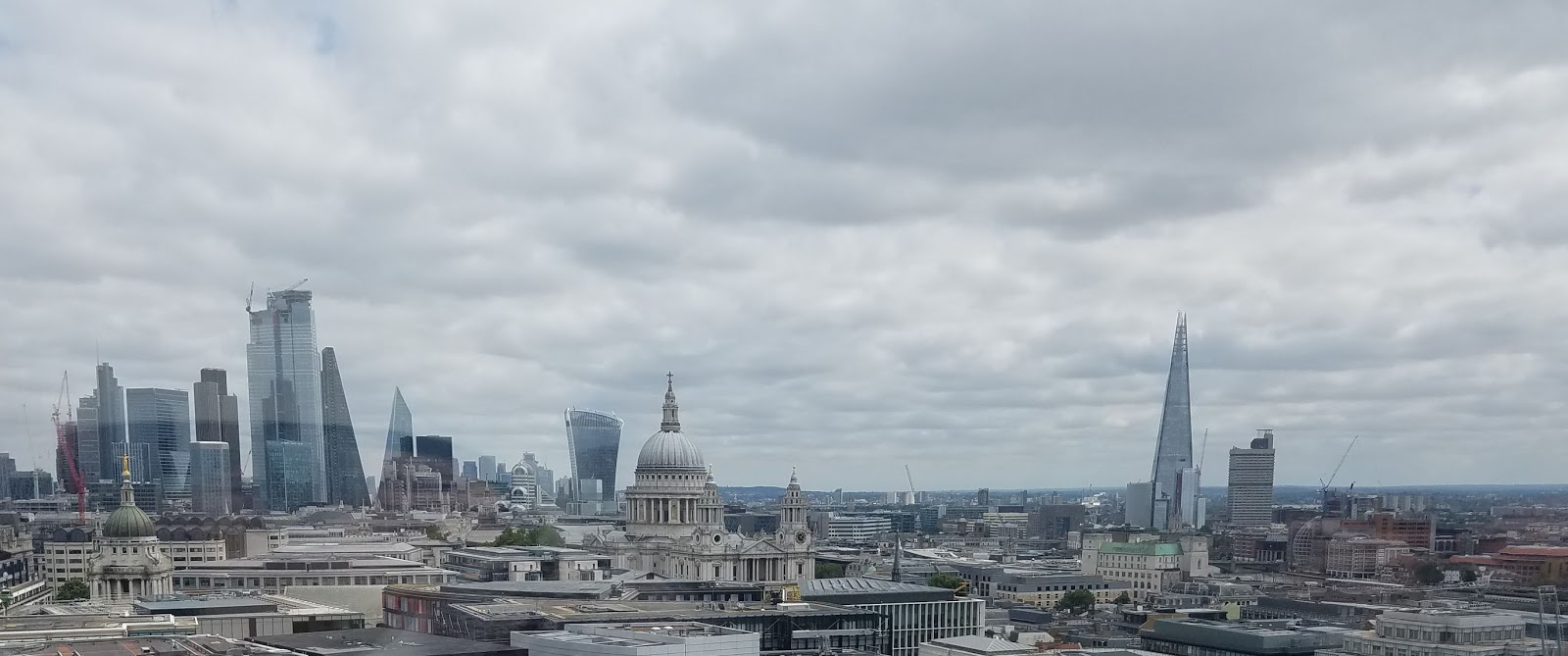
I am in that there London, as it officially known in the North of England. I was treated by one of the big accountancy firms to a very nice lunch not far from Dr Johnson's house, and here, in lieu of anything more interesting to say about it all, is the view from the room we ate in:


"A man seldom thinks with more earnestness than he does of his dinner." - Dr Johnson


Saturday, 13 July 2019

Hatt' ich auch recht hübsch Plaisir!

"That's one trouble with dual identities, Robin. Dual responsibilities." - Batman (*)


And so to the opera. I have returned to Leeds from Derbyshire, but an opera buff never tires of his opera bouff. So, another day, another operetta; this time 'Die Fledermaus'. Set in the roaring twenties with one slightly odd costume nod to the Ladyboys of Bangkok (in an interesting casting choice Prince Orlofsky was played by a man rather than a mezzo en travesti), it was good stuff and the singing in particular rather put the previous day's Offenbach in the shade.

I could personally live without the drunken antics of Frosch (although I would really like to have seen Frankie Howerd's take on it for the ENO) and I do hope that the actor involved really is Scottish otherwise there were some quite unpleasant racial stereotypes being displayed. But the staging was imaginative, the acting and singing was very good, and the dancing made me think that perhaps I'm not too bad on my feet after all. 


(*) The Adam West one obviously.

Friday, 12 July 2019

Aristaeus, ce n'est plus moi

And so to the opera. I have been to see Opera Della Luna's take on 'Orpheus in the Underworld'. Unlike the last time I saw it they actually set it on Mount Olympus, and the cast looked every inch like Greek gods:


Their version contains several heavy sideswipes at the Arts Council, and one does not need to check their website to work out that they don't get any funding from that body. If one does however visit the website you will see a quote by opera critic Rupert Christiansen displayed in which he says that operetta isn't funded because it appeals to middle class audiences. Ignoring for a moment the heavily subsidised Opera North's recent 'Merry Widow' I would also point to the fact that the group I was with on this occasion were pretty much all white, middle class and elderly, and far from loving the piece a large proportion of them hated it with a vengeance. I didn't think it was too bad myself - although the singing was nothing to, er, sing about - and the idea of David Cameron doomed to forever act as Pluto's butler for calling the EU referendum rather amused me. I also very much enjoyed the Galop Infernal being performed by skeletons; oh, and the dancing sheep were good.

Thursday, 11 July 2019

She turns me on, don't get me wrong


“He who has lived and thought can't help
despising people in his soul;
him who has felt disturbs 
the ghost of irrecoverable days;
for him there are no more enchantments;
him does the snake of memories, 
him does repentance bite.” 

- Alexander Pushkin


And so to the opera. I have been to see a production of 'Eugene Onegin' that was in complete contrast to the previous time I had seen it. Where that had been set on a domestic and familiar scale this had all the opulence of late Imperial Russia, just before they all got their just desserts. It is of course a wonderful piece of late-Romantic music and it got the full treatment from the Northern Chamber Orchestra, the principals and the chorus. I'm going to single out Joshua Bloom's Prince Gremin for special praise although they were all good. What really impressed me was the lighting design which made extensive use of reflection and, particularly, silhouette. All in all it was easy to see why no budget had been left over for the staging of the Caldara piece I mentioned yesterday.


I have to mention however that the behaviour of Onegin and Lensky is no more admirable or sensible when played out among the upper classes of St Petersburg than it is when set amongst the youth of North London. And I've always wondered why when Tatyana is rejecting Onegin in the final act she never mentions the impact his actions must have had on the life of her sister Olga. She is, sadly, no less selfish than the men.

Wednesday, 10 July 2019

Quinto McFabio

And so to the opera. Your bloggist is in the Peak District for a spot of walking and opera going and has been to see 'Lucio Papirio Dittatore' by Antonio Caldara. Don't waste any time searching your memories for when you last saw it because this was the very first performance for three hundred years. I rather enjoyed it, and who's to say that I wouldn't have enjoyed it at least as much had it been two thirds the length; in other words, it went on a bit. Baroque composers seem to have collectively taken the view that if a thing was worth saying then it was worth saying seven or eight times.


The director had a difficult task, after all what is there left to say about the Second Samnite War that hasn't been said already? Especially on a very low budget for scenery and props. For reasons that probably made sense to him everything was wrapped in the style of Christo and costumes ranged from basically none, through anachronistic Imperial armour to Quintus Fabius in what appeared to be a kilt. Quintus and his father were both countertenors (the former being the pick of the cast) and Cominio was a soprano in a trouser role, except that this being Ancient Rome she didn't actually wear any trousers. The music and singing were excellent and Buxton Opera House is lovely, but it did all rather reinforce the truism that sometimes less is more.


I know you all like a wargaming connection, and in this case (assuming the Samnites were insufficient) it is provided by Caldara's patron the Holy Roman Emperor Charles VI. He of course was basically responsible for both the War of the Spanish Succession and the War of the Austrian Succession, fought various other unsuccessful wars against enemies such as the Ottomans and bankrupted his country but that aside wasn't a particularly bad man. In his capacity as patron of the arts he gets a ten minute encomium at the end of the opera, which was performed in full on the night. This was not only rather unnecessary (he's been dead since 1740), but must have been very confusing to anyone who hadn't attended the pre-show talk by the musical director and wasn't expecting it.

Sunday, 7 July 2019

I'll be bum-swizzled


Jon Pertwee would have been 100 today. He was of course the Third Doctor, Wurzel Gummidge and Chief Petty Officer Pertwee, but was also well known to some us as the owner of a takeaway burger bar near Acton Town tube station around 1980.

This is the station, not the burger bar

My own doctor was the original, i.e. William Hartnell, and to be honest I had slightly lost interest by Pertwee's time. I can however recall being bemused as to why a Brigadier appeared to be in charge of a single rifle section, but given the size of the British army now it appears just to have been a case of the scriptwriters of a science-fiction series accurately predicting the future.


I was never a big Wurzel Gummidge fan, but it also starred Leeds born actor Geoffrey Bayldon, better known as Catweazle, which programme was much more to my taste. To complete the circle a little, Alan Rowe, Bayldon's life partner, appeared in Dr Who opposite Pertwee, and indeed opposite Patrick Troughton and Tom Baker too.


Friday, 5 July 2019

Hello Stranger

“There is no time for cut-and-dried monotony. There is time for work. And time for love. That leaves no other time.”  - Coco Chanel


And exactly as she describes, I have been hard at it; too much so to do any posting here. However, for one night only, I'm back.


Anyway, as previously predicted, wargaming has returned to Lower Wharfedale, both in its epicentre - the Legendary Wargames Room of James 'Olicanalad' Roach - and also in the annexe. Dealing with the latter first I had another game of C&C Napoleonics with the local chap I met a couple of months ago, this time with the more advanced rules. Once again it went very well and he enjoyed it. 


The above is the only photo  required because we both became obsessed with holding the town and every other one just shows different units in it. We had to break off with it all fairly even because I needed to leave to see a stage version of Ben Hur. We may return to finish it off at a later date and indeed I may also return to posting on the subject of the play. For now I will simply say that both the galley battle and the chariot racing were surprisingly well done considering that they only had a cast of four.

James has written on his first game of Lasalle here and you will immediately note my absence as I was, somewhat bizarrely, at a Nuclear Innovation conference. I shall also sadly miss next week because I am going, somewhat less bizarrely, to the Buxton Opera Festival. If you've read James' blog then you know as much as I do about it, but I must say that I was shocked, shocked!, to discover that he has been tinkering with the rules already.