Showing posts with label Donald Featherstone. Show all posts

Wednesday, 3 September 2025

George Macaulay Trevelyan

 I've been doing a little bit of research about the collection of model soldiers at Wallington in Northumberland. Unsurprisingly perhaps I discovered that this wasn't the first wargames blog in which the figures have featured. There's a bit more detail and a lot more photos on a post on Tom's Toy Soldiers from October 2013. The eponymous Tom seems to have found some notes about the collection, which is more than I did. Maybe he was extravagant and bought a guide book. It's interesting to note that the Trevelyan brothers seem to have bought whatever figures happened to be available and then used them to represent whatever they needed them to be; it seems nothing much had changed between the 1880s and when I started wargaming in the 1960s. It also explains why I thought there were figures from the Risorgimento.

I hadn't come across Tom's blog before, but it looks like it will be worth reading. In another of those happy coincidences which always intrigue me his post from last Monday also concerned model soldiers at a National Trust property.


The George mentioned solely by Tom in terms of his role as a substitute for dice rolling grew up to be the distinguished historian George Macaulay Trevelyan. This fact was picked up by an even earlier, and with all due respect to Tom, even more celebrated wargames blogger. In his Wargames Newsletter #114 (*) from September 1971 the late, great Donald Featherston says that Trevelyan credited this early study of war games with his ability to so vividly describe battles in his own writing. Among Trevelyan's major works is his trilogy about Garibaldi; I wonder if that interest was also inspired by the figures in the collection.


* This edition also contains a letter from Gary Gygax and the exciting news that Airfix are to release a set of French Napoleonic Infantry.

Wednesday, 10 March 2021

It Suffices

 I have been asked for my thoughts so far on 'Vauban's Wars'. Well, I don't like to sit on the fence, and so I am going to come right out and say that they seem "perfectly acceptable".


I shall certainly be exploring the rules further and am currently considering what I might make or paint next to facilitate this: a couple more siege guns for sure and, assuming that access to the laser cutter won't be long in resuming, some ravelines. Because, apart from anything else, I am grateful to these rules for keeping me occupied during lockdown and providing a route for me to try out resin casting. That context has undoubtedly provided a halo effect and made me feel warmer about them; on top of which, even if I say so myself, it all looked pretty good.

Nobody games sieges because...well, because they go on a long time and nothing much happens. So it is to the great credit of Eric Burgess that he has managed to develop a set of rules which extract the action from the tedium and, by moving things along fairly quickly, make it playable. Every turn represents a few days and the results of each are effectively a summation of all the digging, firing, moving about etc done during those days. Issues such as supplies of food and powder, weather, desertion, disease etc are dealt with, but at a level of abstraction that doesn't overwhelm everything else. It's a bit like a campaign fought out on a tabletop, a concept I'd never really thought about before; although if someone were to tell me that Donald Featherstone had written a book on the subject I wouldn't be that surprised.

 I enjoyed my solo run through, in which the balance between garrison and besieger tipped a few times backwards and forwards. The caveats mentioned in previous posts still apply, in particular this is all my interpretation of what is meant and how it should work. I believe that the author runs a Facebook group on the rules, but I don't have a Facebook account so that hasn't been of any help to me.

I do have one or two observations that I would be looking to confirm or otherwise in subsequent games:

  • The defender's role seems a bit reactive.
  • Many of the swings in fortune mentioned above stemmed from things other than the actions of either side; I like a random event as much as the next man, but you don't want the entire game determined by them.
  • The rules for sorties and assaults are limited and, while we never had either in my try out, my wargamer's common sense (shut up!) tells me they wouldn't work very well.
  • Some of the points and strengths ascribed to unit types - Coehorn mortars for example - look a bit odd. 
So, to sum up: passed the time perfectly pleasantly, and would seem likely to provide a sound base for the tweaks and house rules which will inevitably emerge in due course.

Monday, 1 February 2021

Amiable Indifferentism

"Having, then, once introduced an element of inconsistency into his system, he was far too consistent not to be inconsistent consistently, and he lapsed ere long into an amiable indifferentism..." - Samuel Butler

I have taken opportunistic advantage of a break in the weather to do some spray painting, including of the bastions currently being besieged. I have therefore abandoned my resolve of only a couple of days ago to play another turn of Vauban's Wars and instead I shall reset it and - once the bastions are dry - go again based on what I have learned. Speaking of which:

  • I think that there is an interesting game in there. I am aware of how patronising that sounds, given that the author spent quite a number of years developing and playtesting the rules, but it isn't meant to be. Just take it literally.
  • It's by no means the average wargame. That isn't just the asymmetry; lots of wargames - e.g. all colonial games - offer different challenges to either side. I also don't think it's just because the tactics required are unfamiliar to most of us. The game seemed to me to have a lot of similarities with some boardgames that I have played; and I don't mean board wargames, I mean boardgame boardgames. There are, for example, multiple routes to victory for both players and each has imperfect information about which is being pursued by his opponent and, often, how close the game might be to finishing.
  • It's not a solo game. That should be obvious from my previous point, but is slightly disappointing because Piquet games usually work well as such. The small card deck and the balanced initiative mean that it ends up comparatively close to being an IGo UGo game masquerading as Piquet. It would be interesting to see how it played out with a larger deck and using the initiative method from classic Piquet rather than Field of Battle. Having said that, it's almost inevitable that the defenders would get all the initiative and the thing would drag on for ever.
  • There is what looks like a well thought through and influential espionage element. Unfortunately I can't tell you any more because it's something that, as far as I can see, is unplayable solo. It is through this mechanism that players seek to understand what the other side is up to. Sadly, I think that even a Donald Featherstone tower of matchboxes wouldn't make it work for one person, so it will have to await a two player game. 
  • I still don't really know what the best tactics are for the besieger in particular. Furthering my analogy with boardgames, players have fewer actions that the things they would like to do, so prioritisation is important. This starts with assembling the forces, and I definitely went with too many infantry and too few siege guns for my run through. The surest route to victory is massing the guns close to the wall and trying to blast it down. Or is it?
  • I feel a bit more laser cutting coming on, when it is legal so to do of course. Ravelins would be straightforward enough. More difficult, but actually more important, is a glacis and counterscarp. The defenders need some secure way of moving troops around the front of the fort to mass either for a sortie or against an assault. In classic wargame blog fashion, I have some ideas.
So, another run through of a few turns will occur at some point. I have at least one small amendment which I shall make to make it slightly more solo friendly, but nothing that will distort the core game.


Wednesday, 9 January 2019

Ein Minenwerfer von Grund auf gebaut

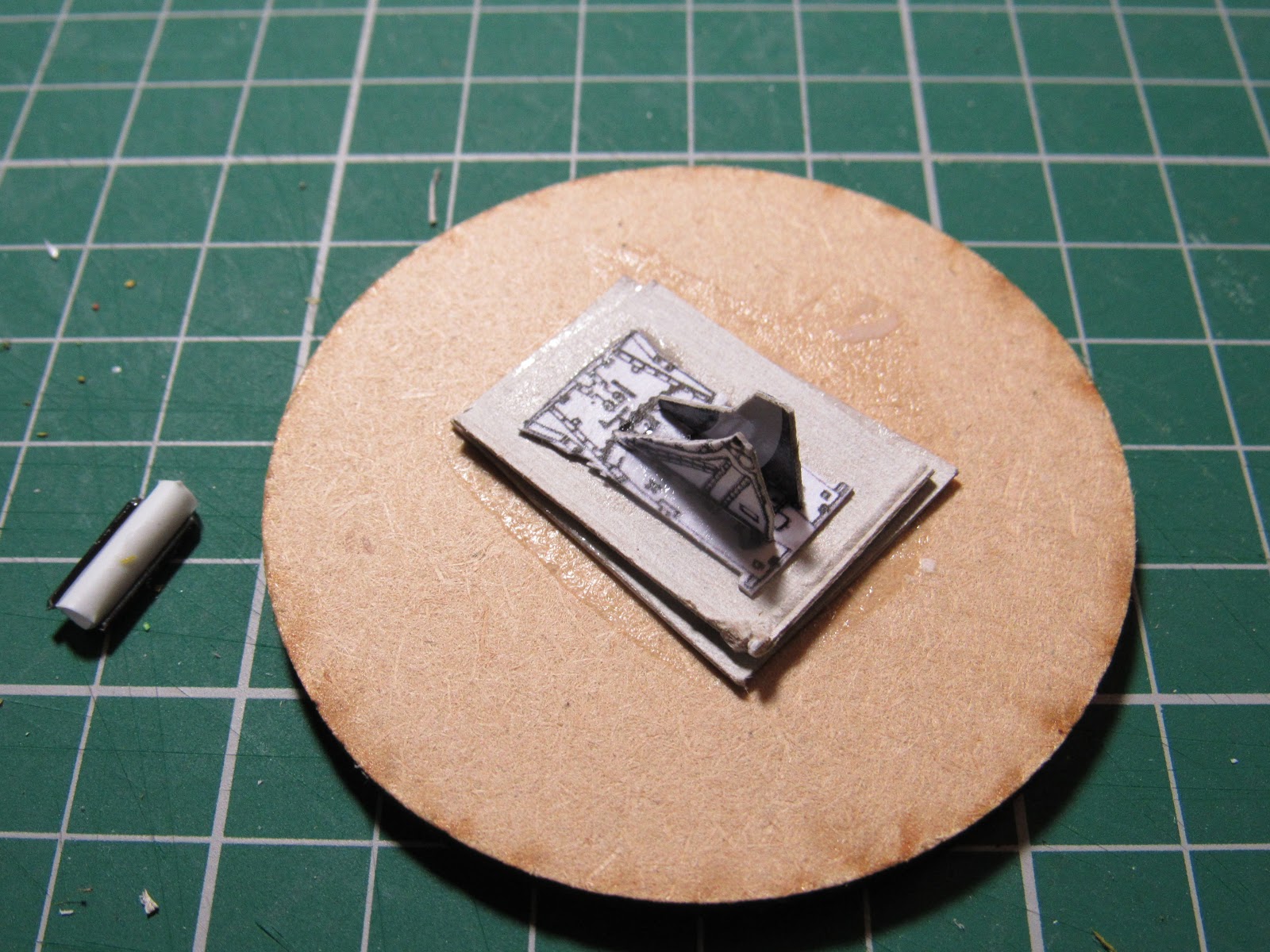
As previously advised there hasn't been much hobby related activity recently (although watch this space for the return of wargaming to the lower Wharfe Valley, following a message from James which included the instruction to forget everything we know because he has changed the rules), but I have been inspired by the excellent Tin Soldiering On blog to do some modelling. That link should take you a post about sticking bits of cardboard onto plastic soldiers in an Airfix Magazine stylie, and it gave me the irresistible urge to do some scratch building. I decided to make a second German 17cm minenwefer. Naturally I don't need one; indeed I have no rules that differentiate these from the smaller 7.58cm version of which I have many. But, as someone once said, what's that got to do with the price of fish?

The completed model I already have (and previously mentioned here) looks like this, with apologies for the excess flash lighting:


First step is to get a scale diagram from the internet and print it out. Obviously I would both like to give credit to whoever produced it and point you to it, but I originally downloaded it a year or so back and now can't for the life of me find the website again. Should anyone want a copy then ask and I'll send you one. With no expense spared I have glued it on to the back of an empty tissue box.


I then cut out the base plate and the two side pieces. Also required is an appropriate length of 3mm plastic tube and two pieces of stiff wire, all measured from the drawing.


The base is glued on to, as it happens, the base. The layers of cardboard are to raise it to approximately the level of the crew, who will of course be on, well, bases, thus making eventual application of filler easier. The two pieces of wire are fixed to the side of the tube.


The side pieces are glued in an upright position to the base. I use UV activated glue for all this as I find superglue impossible to cope with (see previous postings for details). The stuff used to be really expensive, but now isn't; I get mine from eBay.


The barrel is glued at an appropriately jaunty angle and a thin strip of cardboard is glued along the back edge of the baseplate. Details such as sights and controls (I tend to the impressionistic rather than the strictly accurate) are added in plasticine, hardened with an acetate based nail varnish. Please don't bother telling me that Donald Featherstone used banana oil; I know that he did and I also know that banana oil is an acetate.


At this stage one looks for suitable crew, finds one doesn't have any left and places an order online. Readers may choose to perform this step earlier if they wish.

For various technical reasons reporting on painting the model will be deferred.


Thursday, 8 March 2018

The dog's spillocks

Wargamers of a certain age will no doubt recall with the same nostalgia as me Chapter 26 of Donald Featherstone's 'Advanced Wargames', the one on Engineering that contained rules on arcane subjects such as 'throttling down earthen banks' and 'spillocking'. I'm pretty sure that, at least in my middle aged wargaming renaissance, I had never actually put any of this into use; bridges have been blown up, they have never been constructed. But now, the time has come, because James' pontoon bridge has reached the table, cards have been turned, dice have been rolled, and it has been erected across the raging river. Or, as it turned out in this case, not erected across the raging river.


In the inevitable way of new toys, the unit of Prussian pioneers entrusted with building it rolled up as poor, followed by a battery of Russian howitzers knocking down the bits they did complete. Still, there's always next week. James and I, as the Prussians, put in a pretty average performance all round. We nearly lost within the first half hour because I completely misunderstood which road exit the Russians needed to capture to win and didn't bother to protect it. We also did a most peculiar little dance with half of our cavalry which achieve nothing except to waste a lot of initiative and present a flank to the same howitzers, thereby incurring heavy losses. Still, as someone immensely wise once said, there's always next week.

I must mention that the Russian guns that did all the damage were commanded by Mark Dudley, making a welcome return to the legendary wargames room, and showing a remarkable facility with a set of rules that been changed quite significantly since he last played them.

Friday, 21 April 2017

It's Friday Night, Got To Go Home Now

As proof that people can reappear in one's life as well as disappear, I have heard from one of my closest friends at school (for our US readers I really mean school and not university) after a gap of many years. This has brought some sadness - inevitably bad things as well as good have happened in a couple of decades - but also some amusing coincidences. We shared many interests back in those days. I think I may have mentioned before that I played keyboards in the worst band of all time; Don was the bass player. Of more relevance is that he and Charlie (Charlie was the drummer) were my first wargaming opponents, using - naturally - Donald Featherstone's rules from the local library's copy of Advanced Wargames. I seem to remember refighting Waterloo as part of his CSE History project, although I also remember it being rigged so that Napoleon would win.


Anyway, it seems that in retirement he has returned to the one true hobby and spookily was already a fan of the blog. Not this blog obviously, that would be beyond coincidence even as we students of the higher mathematics interpret the word. No, he is a follower of James' blog, in common with the rest of the wargaming world. What I'm not clear about is why he didn't spot me in the photos of the legendary wargames room, after all I have hardly aged a bit in the last forty years.

Tuesday, 24 January 2017

I'm walking backwards for the Sultan


Culture is all very well, but there has also been a low level of wargaming related stuff going on in the background; a very low level. I have finished off the Roman casualty markers for To The Strongest!, although for some long forgotten reason I have never started the final batch of their Celtic equivalents. I have in addition painted and based a further unit of Janissaries for the Siege of Constantinople game that I've given up as a bad job while they were in progress, and I've started painting some of the fifteenth century longbowmen that I bought for no real reason and have no specific plans to use. Focus is the key.

I've never been any good at painting, but I seem to be losing such other modelling abilities as I once had. I believe that I previously mentioned an inadvertency with a Vickers machine gun and I now have to report another incident. One of the new Janissary bases turns out, upon closer inspection, to contain a figure facing in completely the opposite direction to his colleagues. Now I know at least one other wargamer who would have immediately started again and rebased everything, but I am pleased to say that I at least have my OCD under control. This base will - as will the Vickers - fight on regardless.

In one of Donald Featherstone's books he advised personalising ones troops - awarding battle honours to specific units, medals to individual figures and so on. When I read that I thought "Oh dear, he's lost the plot; it must be the paint fumes.", and until now have never given it a second thought. However I am tempted to give this particular unit the permanent ability to turn and face when attacked in the rear. Although of course if they did that, this poor sod would still be looking in the wrong direction. Altogether now:

"I've tried walking sideways,
And walking to the front,
But people just look at me,
And say it's a publicity stunt."

Monday, 19 December 2016

May 29th, 1453

My plans for the couple of weeks or so - the school holidays in effect - are up in the air for a variety of reasons, so I thought I would set up a solo game in the annexe which I could dip in and out of as time allowed. Something compact and small scale would seem to be in order and therefore I have chosen to have a go at the Siege of Constantinople, which I have promised myself for many years that I wouldn't do. As a digression, does anyone else remember that one of Donald Featherstone's books contained photos of a chap who was refighting Stalingrad at 1:1. Even as a naive and credulous youth I regarded that as a bit of a stretch.


My scenario is loosely based on that in the Siege & Conquest supplement for Warhammer Historical. I've only used one row of walls for no better reason than I've only got enough walls to make one row. My Hexon terrain does however allow for a fairly decent looking 3D moat to be laid out.


The scenario deals with the final assault in the area around the Gate of Saint Romanus. Sadly there is no place for many of my siege related toys such as the Ram, the Tower, the Pick and of course, the Crow. However, I couldn't resist finding room for the Boiling Oil.


The Great Gun of Orban naturally features for the attackers.


I'm going to play it using To the Strongest! and you can see the grid laid out using the markers which I use for the purpose. Piquet would normally be my ruleset of choice for solo games, but it's such a faff to prepare the cards decks for the first time, and I just wanted to get on with it and take my mind off things. I do own a copy of Warhammer Ancient Battles, but have never been tempted by them.


The attack will take place in three waves: Bashi Bazouks, Christian allies and finally the Janissaries. Each will continue until they reach the command becomes demoralised (is that the term?) at which point they will be removed to be replaced by the next. I have some ideas regarding crossing/filling the moat, escalade, the role of the Emperor, and not forgetting Hasan the Giant of Ulabad; but the advantage of playing solo is that one can change the rules as one goes along. Oh, hang a trout, that's what we do anyway.

Sunday, 2 October 2016

I will speak with the King or I will die

"In war there is no prize for runner-up" - Seneca

Or is there? I have been to the Derby Worlds wargame show to help James with his display game and he followed up last year's 'Best Display Game' with winning joint 'Best Display Game' this year. The concept of two games receiving exactly the same number of votes in a secret ballot of the hundreds of punters attending the show seems somewhat unlikely, so I suspect a stitch up somewhere along the line. Quite who got shafted and why must remain a mystery, but I doubt it was us; the co-winners were monumentally pissed (1) all day so perhaps there was a moral dimension to whatever happened.

My usual role at these affairs is to carry things from the car to the table and then back again, but my illness made this impossible so I switched to ensuring that history was reversed and the Prussians lost the Battle of Lobositz. The scenario opens with a futile cavalry charge, but somehow the attack actually did rather well, dislodging two of the infantry units in the sunken road. Sadly I got carried away with it all, pressed the attack too much and then the wheels came off. Frederick did a runner - I still have no idea how he came to be Frederick the Great - and things slowly disintegrated. I must spare a mention for the Prussian Garde du Corps. Normally guard units on the tabletop perform appallingly, it's one of the most well known laws of wargaming, but on this occasion they swept all before them and at the end remained the only Prussian unit not to have suffered a fall in morale.


I also had a quick go at the participation game of the Battle of Northampton put on by the author of the Wargaming for Grown-Ups blog, and thoroughly enjoyed it. It was quick, based on what happened historically, but also allowing for the 'military possibilities' beloved of Messrs Featherstone and Roach. For the record I won a major victory as the Yorkists, capturing and executing all of the leaders on the Lancastrian side, but sadly failing to seize Henry VI.

There was a small amount of shopping. I bought some Hexon slopes. I really struggle with the three dimensional thinking required when laying it all out, but I believe (hope!) that I have bought the bits necessary to put out some straight edge raised ground. I also bought some trees from the, er, tree man and a couple of German machine guns - one being fired, one being transported - from Early War Miniatures. Hopefully this will give a bit of impetus to the still sadly languishing Great War project.

So, a thoroughly enjoyable weekend. It left me tired, but I'm glad that I went. It's a good venue - the breakfast is astonishing value - and the organisers are helpful and efficient. I look forward to returning.


(1) for the benefit of Americans and others who don't have English as their first language that is pissed as in inebriated.

Saturday, 12 December 2015

Project required

I am in need of a painting project. I am in some ways reluctant to acknowledge this because since pitching my tent in Otley a couple of years ago I still haven't managed to get all my existing stuff onto the table. The Hussites in particular need an outing. However, having a certain amount of free time, and with the weather being truly appalling I could do with something to get my teeth into.

The last big project I was working on was of course the War of the Spanish Succession, but much of those completed units disappeared in all the disruption and I have no appetite to pick it up again. This is not to say that I haven't done any painting over the last two years, but it's been mainly aimed at filling out OOBs for games that I wanted to play:
  • I added some light cavalry to my Wars of the Roses forces and painted up all the longbowmen in the plastic mountain. I could no doubt do with some more of the latter.
  • In Napoleonics I added Imperial Guard to the French plus some Russian dragoons. An Austrian force would make sense, but options are strictly limited in 20mm plastic. I also have a pontoon kit that I was intending to use for the WSS; it would be a shame to see it go to waste.
  • I added more Roman auxiliaries, including cavalry, artillery and archers; indeed it is to some extent the completion of these archers that prompts me to ask what next. On the other side I added cavalry and a chariot. In the absence of any better ideas I suspect chariots will top the list.
  • I painted quite a lot of Roman civilians etc to expand the Romans in Britain version of Pony Wars. There's not much point in doing more - although I have a lot unpainted - until that gets played again, which in turn depends upon the acquisition of some more Hexon terrain.
  • I have most recently had a focus on markers. I upgraded all my numbers, added more letters, made some generic disruption/OOC markers and am just completing some ammunition chits to replace the beads we've been using for To the Strongest!. I got the idea for the ammo counters from the Tin Soldiering On blog, the author which tells me that he got it from one of Donald Featherstone's books. That, needless to say, is good enough for me. However, I'm all markered out. 
 I suspect that the next games in the wargames annexe at Casa Epictetus will be to try out the new expansion to C&C Napoleonics, which, as far as I'm aware, hasn't arrived in the UK yet. I certainly don't need any more figures to play that, so a painting project doesn't have any time or other constraints; although cheapness would be preferable, not because I'm poor, but because I am mean. While I am thinking about it here's some Grateful Dead. I can't remember if I've already posted this, but if I have then so what.


Tuesday, 22 October 2013

Pot15pouri

It has been drawn to my attention that in my last blog posting I merely listed the boardgames that I played rather than describing them and giving readers the benefit of my much sought after opinion. I shall rectify that immediately. I didn't like Phase 10 terribly much whereas I did like Tikal a lot. The former is a proprietary version of a Rummy variant (a brief trip to the mighty Wikipedia reveals it to be Liverpool Rummy) in the same way that Uno is simply a publisher's version of Twizzle. It passed the time, but one would have to be very bored - probably in a tent in the rain - to play all ten phases. It also seemed odd to me that the later phases are easier to get that the earlier ones. Shome mishtake shurely?


A random Liverpudlian plays Rummy

Tikal on the other hand appealed to me and not just because I won rather handily. Like most Eurogames the theme is rather lightly applied on top, but having been to both Chichen Itza and Tulum I am down with the Mayans. And explorer placement also floated my boat a bit more than worker placement even though it is quite clearly exactly the same thing. Add to that hex tiles and volcanoes reminiscent of Survive! and I was sold.


I have been ploughing my way through more wargames magazines; this time Wargames Illustrated 313. The theme of this edition is the Franco-Prussian War and I enjoyed those articles. I have only ever played one FPW game - which from memory involved Mark suddenly announcing that the gates of the city I was defending had been thrown open by the citizens - and don't know much about it. I do however know that no human has ever adopted the posture of the German officer in the painting on the front cover. There is also, fittingly, another fine tribute to Donald Featherstone and, not unexpectedly, a lot of guff about Flames of War.

Monday, 21 October 2013

Pot14pouri

It was with some interest, although not necessarily with approval, that I noticed Gerry Adams had tweeted the lyrics of 'Streets of London' just a couple of days after my blog posting about Ralph McTell. I have no stories regarding the Sinn Fein leader, certainly none to rival the one about the Reverend Ian Paisley and the giraffe; an anecdote that I must make room for sometime.

Mr Adams' words are tweeted by an actor

A certain amount of boardgames have been played at more than one location and with more than one group of people including Ice Flow, Love Letter, Revolver, Phase 10 and Tikal.

Miniature Wargames 367 was a mixed read as usual. The series on Salamanca doesn't push any boundaries, but is interesting and the article on Bruce Weigle's terrain was fascinating. The highlight was John Curry's tribute to Donald Featherstone. Neil Shuck continues to puzzle me though. In a review of a new book about Germanicus Caesar he suggests it would make a good basis for an HBO mini series without appearing to be aware of the existence of 'I, Claudius'.

"Why have they forgotten us already?"


Wednesday, 4 September 2013

Donald Featherstone

Well, I certainly didn't intend to post about death again so soon. I was watching 'Annie Hall' with my elder daughter yesterday - an attempt to counteract years of anti-Woody Allen  prejudice from her mother - and, as you will no doubt remember, the subject crops up frequently therein. Diane Keaton's Annie refers to 'Death in Venice' and in the ensuing conversation she complains that Allen only ever buys her books with death in the title. Allen replies to the effect that death is a serious business. Quite so.

I am not a religious man. By and large I'm with Marx on this subject (as with a surprisingly large number of other subjects, especially given what I do for a living) when he wrote "The first requisite for the happiness of the people is the abolition of religion.". However,  I envy the religious the strength their faith gives them during bereavement and, whilst I cannot share their belief in an afterlife, I often share the sentiments they express, but in a less literal way. And so when Conrad Kinch writes of Donald Featherstone that "In death he is reunited with those that were taken from him in life" I simply say "Amen".

Donald Featherstone's books gave me immeasurable pleasure both when I was young and upon re-reading more recently. I, like most of us, have moved on from the specific rules, but not from the enthusiasm engendered and for that I thank him. I also honour him, as I do his comrades-in-arms, for being one of those who served to defeat facism and save the world. And furthermore I note with no surprise at all that like many successful people he achieved that success in two completely disparate fields; in his case the other one being sports physiotherapy.

Marx also said that "Religion is the impotence of the human mind to deal with occurrences it cannot understand." and perhaps death is therefore the exception that proves that rule. For surely it is the knowledge that we shall at some point die that above all separates man from other sentient beings. As Hamlet says "if it be not now, yet it will come". As well as my own recent family bereavement, there have been a series of deaths of people that I only knew by their work and reputation and yet whose names I instantly recognised: Heaney, Frost, Jacobs and now Featherstone. As one read about their lives and the impact that they had made on others one common thread came across - a kindness and generosity with time and support. It seems to me quite clear that their success in life was not achieved despite this attitude, but because of it. By being nice to others, they caused others to be nice to them. If I were founding a religion then I might adopt that as a rule for my adherents to live by; one could do worse.


Monday, 20 May 2013

Old School Wargaming: A Phenomonological Interpretation

I've been to Triples over the weekend, and in the tradition of this blog I am not going to write about it just yet; not directly anyway. Instead I shall attempt a brief melete on the subject of old school wargaming. Now, I'm no real fan of the genre; I find it dull and it seems obvious to me why people moved on to more complex and rewarding rulesets. I have no doubt that the grand old men of the hobby - Featherstone, Grant, Young et al - enjoyed themselves and were themselves fun to play with. My own theory is that because they had all seen active service, with all its attendant horrors, they emphasised the game side of things by making the context cartoon like rather than realistic.


Old school and toy soldier style games increasingly appear at shows, or at least the ones that I go to, and always attract a lot of attention and favourable comment. However, I strongly suspect that no-one much is playing them at home. So why the dichotomy? I think we can best interpret this in terms of philosophy. Now you might be surprised at the concept of a two thousand year old philosopher suggesting that we view things philosophically. However, stoicism - which as you will remember is my particular speciality - just won't do in these circumstances. Those proponents of old school behind the display games are essentially taking a Cartesian, reductionist approach to what they are doing. "Old School is best" they chant as they roll their D6, knock over casualties and argue about what constitutes a flank attack; and they believe not just what they say, but that the best gaming experience is objectively determinable.


However, the experience of the show attendee is actually phenomonological. They view the game in the context of their personal Weltenschauung and their life experiences. When looking at the game they are inevitably drawn in to a miasma of vicarious nostalgia, remembering not the games thay used to play themselves, but the games that they read about others playing. They are not so much admiring the game they see in front of them as indulging in a false consciousness of how things 'should be' driven by an illusion of how things in fact never were.


Any of them who watch the game progress or, even more so, if they actually play it quickly find their subjective viewpoint becomes less one of comfortable homecoming and more one of dissatisfaction. They quickly contrast the crude 'roll a 4,5 or 6 and you're dead' bloodbath with the more nuanced ebb and flow of rules designed more recently. Moving single figures palls after the first couple of bounds (as does calling turns bounds) and knocking over figures to show that they are dead rather than removing them causes nothing but confusion every time someone bangs the table. The end result of this is that the observer now recalls that they didn't start playing with nicely painted  Spencer Smith 30mm figures, but rather with unpainted Airfix Romans and Ancient Britons and that the only thing they have in common is that they wouldn't stand up either. They shudder, think fondly of their current set-up and pass on.

Anyone know where I can get a copy of this boardgame? It looks interesting.

Martin Heidegger, a prominent phenomonological philosopher (and Nazi, but best not to mention the war) was clearly in favour of figures being based on stands rather than individually and can therefore be counted as an opponent of old school wargaming. "Every man" he wrote " is born as many men and dies as a single one."