Showing posts with label Miniature Wargames. Show all posts

Wednesday, 4 January 2023

Ramparts Unclimbed

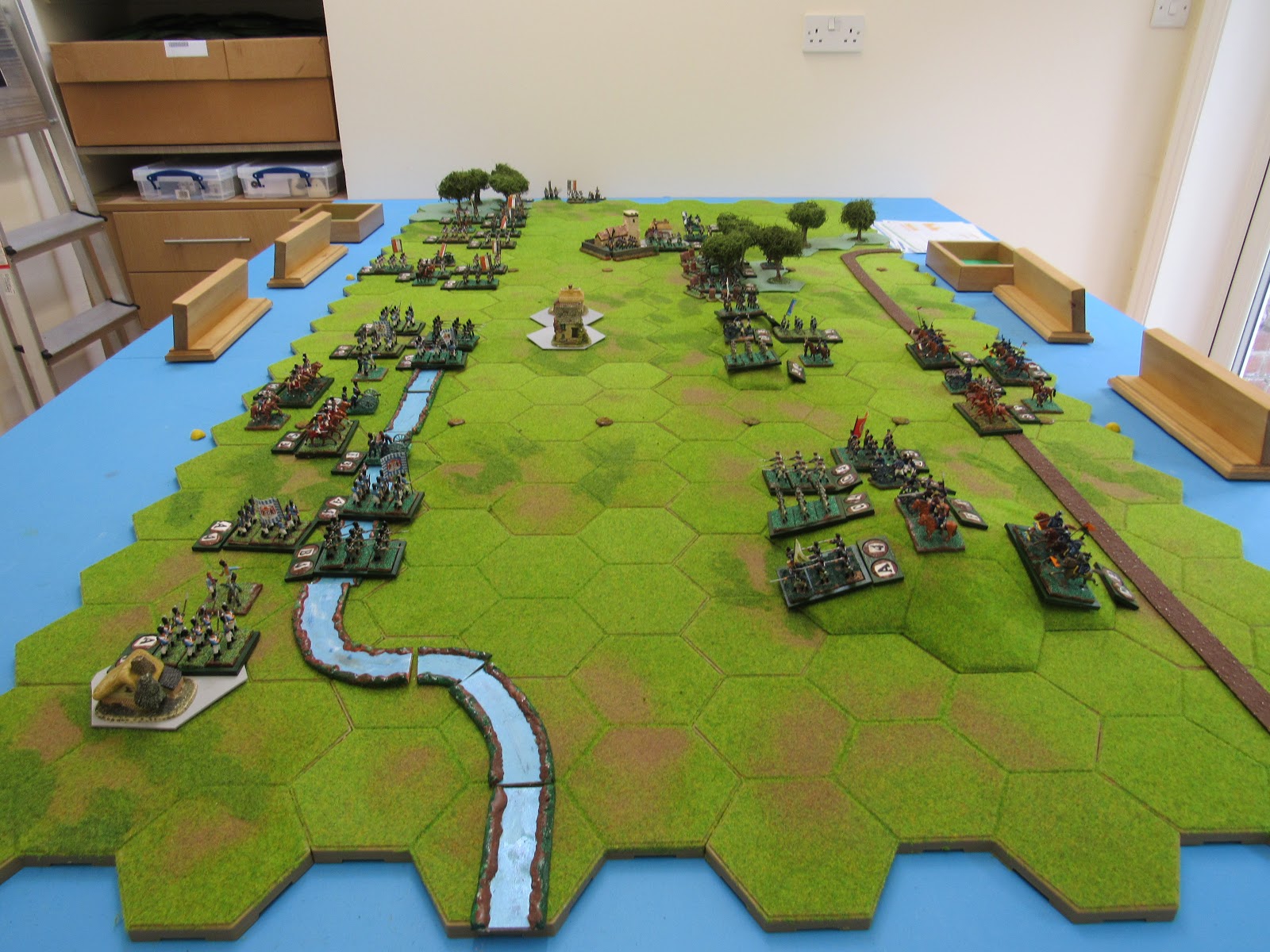
 A couple of months ago I posted photos of the forces laid out for the final assault in the siege game that has been clogging up the table in the annexe since the middle of last year. I have actually played it out, I just haven't written it up. The reason for that was that it became obvious fairly quickly that it was impossible for the attackers to succeed using the combination of the rules as written, the forces as chosen and the tactics which I was employing. 


A small part of the problem was that the defenders had won every one of the preliminary siege rounds, forcing the besiegers to attack before they had built all the siege equipment they otherwise might have and without the level of superiority of forces they would have wished for. Possibly also I had jinxed them a bit by writing in that last post: "I don't see how the attackers can lose". However the main problem is that assault by escalade is exceedingly difficult. Now, obviously it should be, but then again one wants a balanced game. I came away with a number of thoughts as to how to tweak things, for example I think more, but smaller, defending units might work better. The attackers also need to concentrate their efforts to gain local superiority. I had held off posting about it pending trying those out, but have decided to move on and do something else completely.

So, overall I thought the rules, which you will recall were published about a year ago in Miniature Wargames, were an interesting way to represent a medieval siege. They could also provide a platform to build on to include some of the aspects which Vauban's Wars introduced effectively e.g. food, spies, disease. The part that didn't work for me was the assault, but funnily enough that's the bit that isn't handled well by VW either. 

Monday, 7 November 2022

Stoptober

 Stoptober is all about giving up smoking, but I seem to have given up wargaming for the month instead. No particular reason, just the usual real life stuff getting in the way (*). Nothing particularly bad, although I had an injection in one of my legs at one point, which apart from being painful in itself left me rather immobile for a couple of days. Anyway, before the Rhetorical Pedant puts in an appearance let me acknowledge that I had a relapse mid-month, when I played out the game that had been sitting on the table in the annexe for quite a while. And that's where we pick it up again in November. Having lost a significant part of their food supply, and of course aware that help has been sent for, the besiegers have no option but to launch an assault.


One driver for playing this was to get some of my siege equipment on to the table, but due to the defenders feistiness the only one that has made it is the siege tower.


When I first read the 'Vauban's Wars' rules for 18th century sieges I had a think about whether they could be amended for the medieval period, before deciding that they probably couldn't. The little campaign from Miniature Wargames that I have been playing has been fine, but perhaps a little over-simplistic. I like the fact that there will definitely be a final assault, but would have welcomed a bit more to and fro between besieger and defender in the run up to it. For example, the besieger's bombard never got a look in. Maybe some of the relevant elements in VW - food, spies, disease all spring to mind - could be usefully incorporated. 


Just looking at the table I don't see how the attackers can lose, but I shall have to wait to see how the rules for ladders etc actually work in practice. To be continued - eventually.


* For those that know me well, on this occasion it wasn't actually 'the usual'.

Sunday, 31 July 2022

Rampant, but not relevant

I shall be using Lion Rampant rules for the siege game on the table for no better reason than they're what the article in MW is written around. I have forgotten pretty much everything I ever knew about LR, so thought it worth listing what I think I remember before reading them again. Apart from anything else it's an entry for the most pointless rules review ever. What I am describing is the first edition and the second edition is being published literally next Thursday. So, please ignore what follows.


Haven't got it

I don't think I bought the first edition, I'm pretty sure James passed them onto me having received them from Osprey in return for doing something or other. We had a couple of games and my memory tells me that most of the problems were self inflicted. There was no particular issue with using figures grouped on stands rather than single bases, or with the bookkeeping side of the game. I vaguely recall quite liking the combat resolution element, but I seem to remember being dissatisfied overall because:

  • The playing area was too big. The book suggest 6ft x 4ft, but says smaller would work. My table is 2.5m x 1.5m, we used essentially the whole thing, but everything was too far apart and it took far too long for anything to happen. There's an activation mechanism which provides a nice fog of war, but also slows things down on its own without adding in an oversize table as well. For this game I shall use 120cm x 90cm.
  • There wasn't enough terrain on the table. As I digression I've always found it a bit of a paradox that the larger the scale of the combat being modelled the more the terrain is abstracted away and the table bare, while for smaller scales the opposite is true. Basically, I ignored my own rule of thumb, left big open spaces and it was all very uninteresting. So, put more stuff out this time.
  • The 3" rule. There is a strict prohibition on units coming with 3" of each other, which we followed to the letter and which was a monumental pain in the arse without seeming to have any upside to compensate. Subsequently I saw a group playing the rules at a show and they ignored this rule totally, and, who'd have guessed, nothing bad happened. This rule is in the bin.
There you go, a list of the things I probably did wrong, but possibly may not have, quite a few years ago with a set of rules that have been updated since anyway. This blog remains at the cutting edge. 


Saturday, 30 July 2022

More Rampant Ramparts

 Having bigged up the 'Lion Rampart' article in the July Miniature Wargames I do have a slight complaint: it was a tad vague on one detail. "Surely not," I hear you cry "wargames rules that are ambiguous? Say it ain't so!". The issue relates to what I see as the key difficulty with gaming a siege on the tabletop, namely that sieges are clearly campaigns. They go on for a long period, with happenings in slow time punctuated by happenings in quick time. If one wishes to get all one's toys out on display - and what else are they for? - then one ends up with the table being the map and the map being the table. 


This typically means that the slow-time stuff works fine, but there is a problem when we need to move to the quick-time stuff, typically assaults and sallies. The 'Vauban's War' answer to this is to pretend there isn't a difference and that one can just switch to a tactical ruleset and carry on. This was so obviously bollocks that we didn't even try it. Instead I quickly knocked up an abstract high-level set using C&C dice, but they haven't been used to date because in our playtests everyone seemed to prefer the grind of bombardment and starvation. I think that the answer to this dilemma which has been decided on by the author of 'Lion Rampart' is to admit defeat and put the toys back in the cupboard. A lot of action will be pen and paper until there's a need to set terrain up, get the little men out and play a scenario. I say that's what I think because it would seem implicit, but he never actually comes out and says it. 


It all makes sense, but I rather like the look of how my home made town and castle all looks and want to leave it set up to be admired, although admittedly only by me and the window cleaner. So, I've chosen to go for two 'tables' side-by-side. The first is the town and is the one on which the final assault (*) will be fought; the other is a space on which scenery will be set up and taken down to fight out the smaller actions along the way. I think this is not only aesthetically pleasing, but actually beneficial based on what I remember of how 'Lion Rampant' plays in practice. More of this in due course.

* And one thing I really like about these siege rules is that there will definitely be a final assault come what may.

Friday, 29 July 2022

Lion Rampart

 Last year we played some horse and musket siege games in the annexe using 'Vauban's Wars'. It was the publication of those which had led me to laser cut a fortress and take up resin casting in order to make some saps. That was all a bit of a digression from what I was previously doing, which was using the laser cutter to make myself a modular castle and some town walls. That in turn had been driven to some extent by having owned models of medieval siege equipment for years and never really having got them on to the table.


My attention was therefore caught by an article by David Hiscocks in the July issue of Miniature Wargames entitled Lion Rampart, described as a siege campaign for Osprey's 'Lion Rampant' rules. I had briefly thought about trying to rejig VW for an earlier period, but had abandoned the idea as those rules are definitely written for the age of a structured and scientific approach to siege warfare. However, having read and played them was good background to reading this article because I could see how he was attacking the same challenge, but had come up with a very different approach. I was sufficiently impressed to think about trying it out. I've had a bit of a play around and have come up with the following:


I'll do another post as to how I ended up with that layout and what the marked off area is all about. Note that the sun is still shining in West Yorkshire despite it being late July.


Don't enquire too closely into the period or the place; let's just say late medieval, somewhere in Western Europe.

Sunday, 24 July 2022

Ooh, Mr Grimsdale

 I have stayed away from commenting on the current Tory leadership contest because it's obvious they're all headbangers without me having to point it out. However I do need to draw your attention to a letter in the Yorkshire Post earlier this week which declared: "Rishi Sunak should not be allowed to stand for Conservative Party leader because he wears Norman Wisdom suits".

"The public rightly expect government to be conducted properly, competently and seriously."

I get free access online to the Yorkshire Post through membership of The Leeds Library. Perhaps more surprisingly membership also allows me to read Miniature Wargames for nothing. An article in the July edition has unexpectedly led to a burst of activity in the wargames annexe. I hope to post about it here soon.

Friday, 14 May 2021

Test of Resolve - the unboxing

 Even in a world where one can't actually play any games, one can't own too many rule sets. In my case that goes double for Wars of the Roses rules. I have therefore acquired the newly published 'Test of Resolve' and given them the once over. Should I ever get to try them out I shall publish a more considered review, but they are currently fourth in the queue, and I'm an old man, so who knows.


They are perfect bound with 92 annoyingly sized pages plus covers, of which the rules proper take up some fifty or so, including three pages defined as optional. Half a dozen of the pages are the cards which drive the game and which need to be cut out or copied. Alternatively they offer a playing card style deck and I bought those. They are print-on-demand, which is fine, and done by Amazon, which I'm less keen on. They look well laid out; in particular they are replete with foot notes which provide cross-references for where terms are used in a different place to where they are defined. There are a couple of colour photos of figures, but nothing excessive. The diagrams illustrating how units are move, melee etc are clear enough. They look a bit like the units are represented by different coloured and sized Lego blocks, which is an interesting thought. I don't know the authors, but recognise Tim Couper's name from various Piquet forums and the influence of that set is apparent, primarily of course in being card-driven. The cards here form a single deck, but half red and half white; broadly speaking the Lancastrians act on the former and the Yorkists on the latter. It's a bit more sophisticated than that, but you get the gist. They claim to only require one D12 per side, so bucket-of-dice they ain't. I'd need to play them through to tell you how that works in practice.


I suggest that we can split the problems with gaming the Wars of the Roses into two parts: the macro and the micro. By macro, I mean all the politics, family feuds, revenge, treachery, misunderstanding etc. For those who like that sort of thing, there are rules for unreliable commanders and potential unexpected events, including the splendidly named 'Mind the Gap' event. By micro, I mean that no one (N.B. I mean no one at all) actually knows how the forces were structured on the day or what tactics they used. One of the things I always look for in a new set of WotR rules is how they have addressed the concept of mixed bill and bow units. The authors make a bold claim: "Archer behaviour in this period is quite well understood". Their interpretation of this 'understanding' appears to tally with that of Dr Lewis, whose book I reviewed recently, although they don't seem to share any of his other theories. (For those who haven't read enough poor reviews of the book in question, there is another in the current issue of Miniature Wargames.) They do however appear to share one view held by another dubious 'expert' i.e. me. I'm not speaking of the idea that the soldiers were all drunk, because why else would they put themselves through it - although I stand by that one - but rather the one about the big men seeking each other out on the battlefield. I've always thought - be warned that I offer no evidence whatsoever in support of this theory - that, given that the wars were kill or be killed for those at the top, then what I would have done if I were Edward IV for example is to gather all my heavily armed and armoured, professionally trained men-at-arms around me and go looking for the Earl of Warwick, and visa versa. As far as I can see, the rules encourage, indeed in certain circumstances force, you to to do that. Kudos.

To be continued, peradventure...

Wednesday, 19 December 2018

Do trousers matter? - slight return

                    "The four stages of acceptance:

                         1. This is worthless nonsense.
                         2. This an interesting, but perverse, point of view.
                         3. This is true, but quite unimportant.
                         4. I always said so."

                                      - J.B.S. Haldane

Yesterday's post went off - perhaps appropriately given its subject - a bit half-cock. I had meant to also note that I had bought a copy of the January edition of Miniature Wargames. You may recall that I eschewed purchasing the December issue because it had a picture of an elf on the cover. They still dedicate far too many pages to hobbitses for my liking, but issue 429 also contains a report on Fiasco, which is illustrated with three nice photos of the Ravenna game that we (i.e. James) put on. The reason that I was going to mention it becomes apparent if you study the main picture (on page 14 should you have a copy to hand). The principal figure shown, seated in the white shirt, is Bob, my fellow commander and let's face it pretty much the sole reason for our dismal failure in the refight; if you look carefully you can see him using his left hand to surreptitiously drop a D8 into his bag. But if you scan across to the left hand side of the page you can just make out above the marsh which runs to the table edge the very abductor muscle that has been causing all the problems at the Casa Epictetus. Or at least you could if I hadn't been wearing trousers at the time. Now, you might think that the concept of not having one's strides on at a wargames show is a bit, how can we put this?, odd. But I have actually written a blog post putting forward the suggestion before - here, albeit that it did not catch on either at the time or in the five years since. Perhaps revisiting the proposal is overdue; allow me, if you will, to do so now and to further develop my thinking.


"Do you wear trousers, Fozzie?"
"Why would I? I'd still have bear legs."

There are many different approaches as to what constitutes a sport and what doesn't. Various authorities would automatically eliminate anything that involves music; or petrol; or animals; or subjective evaluation of artistic impression, technical difficulty or some other nebulous term; and so on. I myself have always favoured the view that a sport is anything for which one is required to change one's shoes. Were a similar logic to be applied to hobbies we would find that they naturally fall into two categories: those which are carried out in trousers; and those where participants go without. The latter, and I am thinking primarily of course of the Finnish pastime of kalsarikännit, seem to be rather hip and happening at the moment. If wargaming wishes to hitch itself to this bandwagon then it is clear that a bare legs policy is imperative. This insight is my Christmas gift to the hobby and, once again, you are all welcome. But we need to be quick, other hobbies are beating us to it:


In the meantime I shall be off pursuing one of my other great interests, reading poetry. But first I need to get ready:

                                           "Shall I part my hair behind?
                                             Do I dare to eat a peach?"


Saturday, 1 December 2018

The Arctic Summer of Edwin Drood

"In hell there is no other punishment than to begin over and over again the tasks left unfinished in your lifetime." - Andre Gide

It has come to my attention that I somehow contrived to publish the previous post without its concluding paragraph. Obviously I could go back and edit it, but, let's face it, anyone who is interested has already read it and anyway it would involve me in extra work. So, either supply your own witty and insightful conclusion or delight in my flouting of blogging conventions as you see fit.

I am actually quite keen to write about wargaming, it's just that there hasn't been any. I have however been to Recon, probably the nearest show to me. I ran into Bob, my fellow Holy League commander in the Ravenna game at Fiasco. This time he was playing in the Lance & Longbow's Battle of Lewes game and I experienced a certain amount of schadenfreude to find that he was doing as badly on his own as he did alongside me. He also revealed what happened to the missing dice, so that at least is one less thing for me to worry about. I mentioned a couple of years ago not being able to take a picture of Euan in his re-enactment gear, but was better prepared this year. Here he is with a couple of camp followers; I think his luck is in:


I have now been paid for my recent piece of work and so the show was a good opportunity for me to start spending, an opportunity that I passed up on. I have decided, pro tem at least, to finish off some existing projects before I start a new one. I realise that it's  not wargaming as generally understood. With that in mind I have been painting some more heavy weapons for the Great War. I don't know if I mentioned the way that 'Square Bashing' marks casualties before, but it's a bit odd, being done by the half base. "Why not just have twice as many bases, each of them half the size?" I hear you ask, and that seems a very fair question. I have approached the basing of infantry in the manner of the farmer with seventeen cows and three sons (one of whom he doesn't seem to like very much), but that still left machine guns and mortars. There are plenty in the pile - one of the advantages/disadvantages of plastic - so I've finished off a few. I've even scratch built a second 6" Newton mortar for the British. And the sum total of my spending at the show was a copy of the Osprey on the Whippet medium tank which was going cheap for some reason.


I have also broken with my recent habit and bought a wargaming magazine; indeed I bought two. I was tempted to go for the full set, but this month's Miniature Wargames has an elf on the cover and there are limits, dash it all. I bought Wargames Illustrated because it has an article on Sir Adrian Carton de Wiart, previously featured on this blog, and Wargames Soldiers and Strategy has a scenario for Maloyaroslavets, previously, er, featured on this blog. WI also has an article on Medieval Sieges, and it is possible that buying some laser-cut MDF castle walls is the way that the money ends up getting spent. I have quite a large collection of siege weapons, which have very rarely seen any action.

Thursday, 8 June 2017

Ersatz Eckmühl

We played the sort-of Eckmühl game last night. The good news is that it was enjoyable and met the aim of getting a game that neatly filled the three hours available. The bad news is that I didn't take any photos, that I have prepared neither maps nor OOBs and that we got some of the rules wrong. One cannot have everything.

To recap, this was scenario that I translated to C&C from an article in Miniature Wargames, with the specific intention of playing a game with victory conditions different to the normal C&C option of (mostly) aiming to destroy a certain target number of units, that number being the same for both sides. I think the consensus was that it worked OK, only slightly undermined by James' perverse interpretation of what was meant by 'the road'. As Gertrude Stein would have said had she been a wargamer "a road is a road is a road". So, I shall definitely give this method of generating a scenario another try.

We used Prussians to replace the Austrians that I don't have, but played them as Prussians with appropriate national characteristics. Apart from anything else that was because I have prepared laminated sheets with all those details on them, and - not having Austrian figures - haven't done one for them. As previously featured on the blog their forces included the 6th Hussars. Traditionalists will be pleased to note that they were destroyed without achieving anything, as all newly painted units should be.

The key rule that we got wrong was the one whereby Command Cards with stars on them - there is a proper name for these, but I forget it - allow extra March moves in the section in which they are played. This would have allowed the Franco-Bavarian attack to develop more quickly, although given that James didn't know what he was trying to achieve in the first place it's unlikely to have made a great deal of difference. There was also a certain degree of rule rustiness, reminiscent of the games of Pike & Shotte over the last couple of weeks; it seems to be getting more and more difficult to retain information as I slip into my dotage. I think that next time we might perhaps try a bit of a variant on the use of specific cards such as Bombard and Fire and Hold. I shall explain our thinking in due course.

Anyway, I'm off to vote, with neither hope nor expectation. As someone once said "You don't need a weatherman to know which way the wind blows", a quote that is doubly apposite today.

Tuesday, 6 June 2017

'Eck as like

The time has nearly come to play the game I originally set up some weeks ago, which has undergone a couple of revisions since I last wrote about it. The official Epic scenarios for Expansion 6 of C&C Napoleonics include one for the second day of Eggmühl (they prefer the modern spelling) on April 22nd 1809. This covers a somewhat larger area than the one in Miniature Wargames which I am ripping off, and misses out a couple of the key terrain features from the latter and so isn't much use for validating force sizes. I have therefore had to once again resort to the higher mathematics and have revisited my previous mental calculations, this time writing things down and using a calculator. As a result both sides have lost a unit of cavalry, the remaining Bavarian cavalry units have become smaller, the Prussians are down a light infantry unit and up a foot battery. Getting correct proportions within each arm is straightforward; ensuring that the balance is right between infantry, cavalry and artillery is slightly less so.

The table is (re)set

Rules for the two terrain features not in standard C&C will be:
  • Forests with field works:
    • units and leaders must stop after crossing sides with fieldworks - in or out
    • units may ignore one flag if attacked via a side with fieldworks
    • infantry may not form square if attacked via a side with fieldworks
    • battle into via fieldworks: Inf -2, Cav -3, Art -1
    • battle out via fieldworks: Inf 0, Cav -3, Art -1
    • otherwise normal forest terrain rules apply
  • Two level hill:
    • top level is uphill of side slope hexes which are up hill of flat terrain
    • artillery are -1 for firing uphill two levels
In addition the stream is decorative except:
  • infantry cannot form square in a stream hex
  • passing through it or battling into it negates any cavalry charge bonuses.
  • units in a stream hex cannot play the following Tactician cards: Artillery Canister, Charge if Charged, First Strike, Infantry Combat First.
Bavarians cross the decorative stream

I have never cared for the victory conditions system employed by C&C which seems to consist of little more than eliminating as many opposing units as possible. In designing my own for this scenario (or more accurately porting across those in the MW article) I am constrained by not being able to think of a way of translating the playing of cards into the type of turns more usual in other rule systems, so we'll just play until the French win, until it's time to go home, or until someone gets fed up, whichever comes soonest. I shall attempt to keep things simple:
  • Napoleon's instructions to Davout were to clear the artillery from the Bettel Berg and to sieze control of the road. The French/Bavarian objectives are therefore:
    • ensure there are no Prussian foot artillery batteries on any of the seven hexes of the Bettel Berg
    • close the road by putting three units into contiguous hexes, at least one of which is on the road
    • if they have achieved both these at the end of any Prussian turn they win a major victory
  • The Prussian objectives are simply to prevent either happening by the end of the evening, thereby gaining a major victory.
  • Should the time allowed end with one of the French objectives met and the other not then the French will gain a minor victory if Prussian losses (in blocks not units) are at least 125% of French losses; otherwise it is a minor Prussian victory.
One outstanding issue is how to trigger the arrival of the French reinforcements; I am hoping that inspiration will arrive at some point in the next twenty four hours.

The newly arrived and dodgily varnished Prussian 6th Hussars; not as bad as their brown coated colleagues though

Thursday, 25 May 2017

The Forgetting Curve

"A poem is learned by heart and then not again repeated. we will suppose that after half a year it has been forgotten: no effort of recollection is able to call it back again into consciousness." 
- Hermann Ebbinghaus

Wargaming has returned a bit earlier than expected. James and I had a small Italian Wars game using the Renaissance version of Black Powder, the exact name of which escapes me. It wasn't only the name which escaped me however, because I could remember literally nothing about the rules despite having played them six months ago. Fortunately James' remembered slightly more than me, just enough to get us started. With much flipping through the (very badly written) rulebook we managed OK, and finished early enough to spend some time agreeing on exactly which bits we had got wrong. We also made use of a cheat sheet showing the effects of being either disordered or shaken; it turned out that I had prepared it last year, something else that had slipped from my memory. Another game has been scheduled for next week, which hopefully will be soon enough for some of it all to have stuck this time. For the record three Swiss pike blocks were thrown back by a couple of heroic Spanish colunellas lining a wall. James filled the role normally filled by Peter and threw bad dice repeatedly.


I've also bought a copy of Miniature Wargames for the first time in ages. I am possibly in a minority of one in thinking that it was at its best when edited by Andrew Hubback, but at least we can all agree that it's pretty poor nowadays. The June issue has a quite astonishing editorial in which the current incumbent tells the readers that they're wrong when they tell him they don't find the articles in the magazine interesting or relevant. I only bought it for the feature on using cards to generate unpredictability in Zulu wars games, which I thought might have some application to my Romans in Britain game, the one that is forever on the back burner. In fairness it did indeed contain one or two ideas worth thinking about. But in case you read it elsewhere and assumed they were joking, there really is an article about how to paint a realistic elven army, without the slightest hint of irony.

Tuesday, 2 May 2017

Tweetle Beetle Bettel Battle

 “I know it is wet and the sun is not sunny, but we can have lots of good fun that is funny.” - Dr Seuss

Whilst I have no immediate plans to play C&C Napoleonics - we will be back in the Holy Land this week - I have taken advantage of the traditional British Bank Holiday weather to set up another game. I had decided to create my own scenario both because there weren't any others on the website featuring the forces that I had available to fight the French (Russians and Prussians) and because I have always found the official C&C scenarios to be unbalanced. It is only logical therefore that the historical episode which I chose was part of the battle of Eckmühl on April 22nd 1809, specifically the action between the Bettel Berg and the village of Oberlaichling. This features Austrians - which I don't have - defending against a much larger French and Bavarian force. The Austrians will on this occasion be replaced by Prussians.


My record on creating scenarios is not good; I have a tendency to over elaborate somewhat. I am hopeful however that by restricting myself to simply translating someone else's scenario for a different ruleset I might have better luck. Thus I have based this entirely on an article in Miniature Wargames in October 2009, which in turn is reproduced from 'Battles for Empire - Napoleonic Wargames Scenarios 1807-1809' by James R. Arnold and Ralph R. Reinertsen, published by Napoleon Books.


The table layout is straightforward enough. The map is in the proportion 8x5 which translates closely enough into 20 hexes by 12, which is a convenient arrangement of Hexon tiles and is close enough to the C&C Epic playing surface (the latter is 20 x 11 hexes) to not require any rules revisions. It includes a double height hill and some woods defended by fieldworks. Neither appear in C&C, but common sense indicates what their effect would be if they did.


The forces indicated in the article are too big for a C&C game and need to be scaled down. After some thought I decided to take as a starting point the use of all the Bavarian infantry units that I own and make everything else proportional. Further adjustments are needed to reflect the fact that Prussian units are smaller than the Austrians were and, being a mix of front line, reserve and Landwehr, some of them aren't very good. I've also allowed for the fact that in C&C Prussian cavalry units are smaller than the French. I shall probably use plain vanilla combat factors for the Bavarians, with no national characteristics, thereby making them, as they should be, inferior to the French.


Defining victory conditions is one area that I have always found odd in C&C, particularly the fact that the target number of victory points is always the same for both sides; regular readers may remember this vexed me quite a lot during the Punic Wars campaign we played a few years ago. In this battle Davout's objective was to cut the Eckmühl to Ratisbonne road. The scenario as published mandates the defenders to counterattack against any unit which reaches the road. I think a better alternative is to offer temporary victory points to the French for any unit they can place across the road at the end of a turn. I'm not sure how many; perhaps a bonus for having units contiguous rather than separated.

Tuesday, 7 January 2014

Gavrilo Princip claims more victims

 There was an article on the First World War in the latest edition of Miniature Wargames that rather caused me to shake my head when I read it. Subsequently I have learned that it was written by Trebian, owner of Wargaming for Grown-Ups, a blog and indeed an approach to life of which I thoroughly approve. There has been much discussion in the comments section of said blog - some by me - as to whether a) he is right in what he writes in the article and b) whether anyone should be allowed to tell him that he doesn't know what he's talking about.

I make no comment on point a) except to quote Voltaire: "Cherish those who seek the truth, but beware those who find it."

Regarding point b) I must once again fall back on the words of others:

"The aim of argument, or discussion, should not be victory, but progress." - Joseph Joubert

"Let me never fall into the vulgar mistake of dreaming that I am persecuted whenever I am contradicted." - Ralph Waldo Emerson

I think the author is being somewhat disingenuous when being surprised that the article is interpreted as right-wing. Whilst I do not doubt his assertion that he had no such intention he cannot have been unaware of the attempt by certain politicians to use the anniversary of the Great War to strengthen the cultural and philosophical hegemony which they already enjoy. Whether some right wing historians such as Alan Clark take a different view or whether left wing historians are themselves at odds (as pointed out vociferously by Keith Flett, he of the Beard Liberation Front and the letters page of any newspaper that one opens) is irrelevant to that point.

As for Henry Hyde, I think the article a mistake. I don't like to be lectured in the pages of a hobby magazine. And the furore has deflected attention from what surely should have been the main talking point of this issue - the Royal Mail's ban on carrying paint. I've signed the petition, have you?

Monday, 21 October 2013

Pot14pouri

It was with some interest, although not necessarily with approval, that I noticed Gerry Adams had tweeted the lyrics of 'Streets of London' just a couple of days after my blog posting about Ralph McTell. I have no stories regarding the Sinn Fein leader, certainly none to rival the one about the Reverend Ian Paisley and the giraffe; an anecdote that I must make room for sometime.

Mr Adams' words are tweeted by an actor

A certain amount of boardgames have been played at more than one location and with more than one group of people including Ice Flow, Love Letter, Revolver, Phase 10 and Tikal.

Miniature Wargames 367 was a mixed read as usual. The series on Salamanca doesn't push any boundaries, but is interesting and the article on Bruce Weigle's terrain was fascinating. The highlight was John Curry's tribute to Donald Featherstone. Neil Shuck continues to puzzle me though. In a review of a new book about Germanicus Caesar he suggests it would make a good basis for an HBO mini series without appearing to be aware of the existence of 'I, Claudius'.

"Why have they forgotten us already?"


Saturday, 31 August 2013

Miniature Wargames issue 365

Well, no sooner have I pronounced portentously that Miniature Wargames is not what it used to be in my day than I find that I rather like the new issue. "Silence is safer than speech." as a great man (that would be me then) once said.

Firstly, I admire the stance that Henry Hyde has taken in his editorial against the use of the swastika as a decorative device. It is a symbol whose political connotations cannot and must not be ignored.


Secondly, there is the article by two Belgian wargamers, Phil Dutré and Bart Vetters, on the battle of Aspern-Essling in 1809. The twist in their participation game version of the battle is that the model soldiers act as the terrain while the scenery provides the playing pieces. I cannot begin to tell you how much pleasure that element of the game design gives me. Whilst you'll need to read the article (i.e. buy the magazine) in order to read the details, let me just quote Goethe (sneaking the pseudery back in there) to wet your appetite: "We will burn that bridge when we come to it".

All the above doesn't mean that there aren't bad bits. Neil Shuck is a columnist whose point escapes me. His view of wargamers is astonishingly simplistic and procrustean. I have a softer spot for Mike Siggins, although I don't know why. His column in this issue reads like, and quite possibly is, a reprint of one that was published in Wargames Illustrated a decade or more ago. He has had some sort of life-changing epiphany, is going to downsize his collection, focus his efforts more and paint more and game less. I'll bet you a pound to a penny that next month he has found a new period to champion - almost certainly with figures sculpted by the Perry twins - and decided that playing rather than painting is the thing. He is, let's be frank, Mr Toad. However, he is not without some charm. I have long suspected that his column is actually the work of Alan Bennett (a man surely never before mentioned in a wargames blog) and you will no doubt be aware that Bennett wrote an excellent version of 'Wind in the Willows' for the theatre. In the film of Siggins' life (already in pre-production or so I hear) he will be played by Thora Hird; and I defy MS Foy or anyone else to tell me that she's dead.

Mike Siggins gives his 'View from the Armchair'

Saturday, 20 July 2013

Pot6pouri

  • I have been looking more closely at the casualty markers that I bought from Warbases at Triples. They are the smaller ones - which is why I bought them - and are numbered up to 6. Mysteriously though, the order of the numbers is 1,2,3,4,5,0,6. No wonder they were on special offer.
  • Miniature Wargames - the verdict on the changes? I'm not that impressed. The graphic design is better, but that's basically down to having black print on white pages rather than white print on black pages. I don't think you had to be a genius to work that out. Otherwise the relaunch seems to entirely consist of Henry Hyde getting his dull mates to write dull articles. I don't know what wargaming universe this Shuck bloke lives in, but it bears no resemblance to mine.
  • Brentford 1 Celtic 2 - there's a score you don't see too often. I was in Glasgow last week and about the only shops airside in the airport were for the two football clubs. At 10:30 in the morning I was walking along Sauchiehall Street and outside a kilt shop I saw a woman drinking Special Brew from a can. It only needed a deep fried Mars bar and the scene would have been complete.
  • I was having dinner in a country house hotel outside Birmingham a couple of days ago and a helicopter suddenly landed on the lawn in front of us. The waitress happened to be serving us at the time and my companion for the evening asked her who it was. "Bruce Springsteen" the waitress replied confidently. It wasn't.


Saturday, 25 May 2013

The return of Albert

I had a ticket for yesterday for the Headingley Test.


And I don't have one for today.


Anyway, Triples - what did I think? I enjoyed it. I like the venue, although a bit more natural light would have been nice. Travel was easy by train and tram and the coffee was drinkable and a reasonable price. I bought two casualty markers from Warbases at 50p each so if everyone else was as spendthrift as me then the traders must have had a belting day out.

While we're on the subject, what do I think of the new Miniature Wargames? It's OK. The editor has made a big play of the layout and it's certainly clear and easy to read. An indicator on the top of each page tells you what sort of article that you are reading: a feature, a scenario an article on modelling etc. In the old, Ian Dickie days they used to have an indicator on the top of each page to tell you what sort of article that you were reading: ancient, medieval, Napoleonic etc. Plus ca change, plus c'est la meme chose.


Thursday, 23 May 2013

Old School Wargaming - a clarification

Firstly, an apology to my pining fans for the lack of posts. I have been in London for a few days and they do not yet have the internet there. But now I am back in civilisation normal service can resume.

Readers may remember that in my last posting I reflected on old school wargaming using a variety of philosophical tools. I should have remembered that when push comes to shove there is only one philosopher that we should look to at times like this, and that is my old mucker William of Occam. 'Keep it simple' was his motto and it should be yours too; not mine obviously for without intellectual pretentiousness I have no raison d'etre.


Shortly after penning my last pontification (I am experimenting to see if alliteration could possibly act as a substitute for philosophical pseudery as the backbone of the blog) the new edition of Miniature Wargames arrived. Don't worry, this is not another rant about my subscription, rather it acted as a reminder that I hadn't actually read the previous one. And so I did. And what do I find, but an article by Harry Pearson on wargaming in an olde worlde stylee with 30mm flats in which he uses leather bound books as hills, steel navigational dividers for measurement, bone dice thrown from a Victorian horn shaker and original Edwardian playing cards. And to think that this man used to write for the Guardian. Anyway, suddenly the scales fell from my eyes and all became clear. The reason people indulge in old school wargaming is purely and simply as an affectation. They are cultivating an eccentricity in the manner of countless Englishmen before them. 


Harry Pearson
 
Now, I am in no way judgemental. Live and let live, that's what I say. But, Oi, Pearson! No!


Tuesday, 30 April 2013

3D Printing

I have seen a 3D printer for the first time in the flesh as it were. And I was very impressed. Naturally on seeing something new my thoughts turn to its possible wargaming applications; and after the triumph of the non transitive dice who is to say that I am wrong. I don't think that the technology that I saw could produce figures to match the best plastic available from say Zvezda, but I would say that they could be easily as good as the lower end of the 20mm plastics market and most metal figures that I have seen. And I was only watching a demonstration of a portable set-up from a small local company that has extended into 3D printing from its core business or repairing photocopiers, inkjet and laser printers etc. Presumably there are more sophisticated machines elsewhere.

Who wants one?

 The big adavantage over moulding would appear to be the fact that one doesn't need to have a, mould. Obvious, but true. All of the sculptor's constraints regarding undercuts etc just disappear.  How the economics might stack up, I don't know. The business to whom I spoke mainly use it to reproduce parts for obsolete printers and copiers that are no longer available and so the cost of the produced part is not that relevant. My accountant's intuition (not as oxymoronic a concept as it sounds) tells me the issue will be running cost rather than the capital cost of the printers. Perhaps the use of recycled material in the feedstock will drive those down in due course.

On a different subject, Miniature Wargames have now sorted out my subscription problems. As I said all along Henry Hyde is clearly a saint like figure who has presided over the smooth succesful integration of two seemingly unreconcilable systems.

Henry Hyde