I want you to know
one thing.
You know how this is:
if I look
at the crystal moon, at the red branch
of the slow autumn at my window,
if I touch
near the fire
the impalpable ash
or the wrinkled body of the log,
everything carries me to you,
as if everything that exists,
aromas, light, metals,
were little boats
that sail
toward those isles of yours that wait for me.
Well, now,
if little by little you stop loving me
I shall stop loving you little by little.
If suddenly
you forget me
do not look for me,
for I shall already have forgotten you.
If you think it long and mad,
the wind of banners
that passes through my life,
and you decide
to leave me at the shore
of the heart where I have roots,
remember
that on that day,
at that hour,
I shall lift my arms
and my roots will set off
to seek another land.
But
if each day,
each hour,
you feel that you are destined for me
with implacable sweetness,
if each day a flower
climbs up to your lips to seek me,
ah my love, ah my own,
in me all that fire is repeated,
in me nothing is extinguished or forgotten,
my love feeds on your love, beloved,
and as long as you live it will be in your arms
without leaving mine.
- Pablo Neruda

Epictetus - Discourses on Wargaming
Tuesday, 31 October 2017
Monday, 16 October 2017
Two Minds
Your mind and mine are such great lovers they
Have freed themselves from cautious human clay,
And on wild clouds of thought, naked together
They ride above us in extreme delight;
We see them, we look up with a lone envy
And watch them in their zone of crystal weather
That changes not for winter or the night.
- Sara Teasdale
Have freed themselves from cautious human clay,
And on wild clouds of thought, naked together
They ride above us in extreme delight;
We see them, we look up with a lone envy
And watch them in their zone of crystal weather
That changes not for winter or the night.
- Sara Teasdale
Monday, 9 October 2017
Are we there yet?
I suspect that there are many people saying that they won't be going back to the Derby Worlds show in 2018 if it's at the same venue, and I am certainly among them. From my point of view the distance alone would be sufficient reason. If it takes twice as long to get somewhere from the Lower Wharfe Valley as it does from the Lower Lea Valley then it really can't count as a northern show. The last half hour of the journey was on narrower and narrower, but otherwise identical, country roads with no sense of getting any closer to anywhere worth going. The venue was - and if you follow many wargames blogs you are going to get fed up reading this - far too small for the number of traders and games squeezed into it, and became very noisy and very hot; admittedly the last bit was in contrast to the previous venue being far too cold. There also weren't enough toilets. On the plus side the light was a huge improvement, as could be seen if I had bothered to take any photos.
James didn't win best game this year, but then again nor did anyone else, the new organisers having apparently decided the concept wasn't worth the trouble. The game went down very well with the punters though and so I think he can claim a moral victory. We played it through once each day, with the same result both times - a French victory. Given that the original battle was an overwhelming defeat for the French who suffered forty times the casualties of the Spanish, it would seem that the scenario and/or the rules aren't quite doing what they were supposed to (1). It did make for a good game though.

There was a small amount of shopping: as usual at shows some trees from Last Valley (only another ten years or so of show attendance and I'll have enough to refight Hanau); Blandford's 'Army Uniforms of World War 1' at a very reasonable price from the Bring and Buy; and a copy of EWM's 'Crush the Kaiser' rules. These last are at a level that appeals to me, but do on first reading seem to have a number of areas which are not spelled out in much detail. However, I do seem to have enough figures to try them out, whereas I'm still way off being able to play 'Square Bashing'.
(1) For what it's worth I think that to make the scenario better reflect the battle (and as a corollary the game less fun to play) the French should be downgraded in some way to reflect their march to the town and their unpreparedness.
Wednesday, 4 October 2017
Pot70pouri
"The art of living is more like wrestling than dancing" - Marcus Aurelius
Autumn has arrived in the Wharfe Valley which must mean it's time for the Derby Worlds. As James has written in his blog a highly untrained scratch team will be putting on an Italian Wars game. In Peter's absence the role of crap dice supremo is still up for grabs, but driving duties have been passed my way. The Stoicmobile has seen better days, but with a full tank and some more air in the tyres it might yet get us there and back, wherever 'there' actually is this year; all I currently know is that it's even further away from Derby than ever. Someone more clued up that me tells me that we're 'just inside the entrance to the right' so feel free to come and chat about the impending launch of my new range of gender neutral wargames clothes.
Speaking of toxic masculinity, I have been in a fight (OK, scuffle) for, I think, only the second time in my life (1). I don't count giving the National Front a bit of a kicking from time to time during the seventies; that comes under the heading of public service. Nor do I include the occasion a fellow student thumped me in the union bar; sadly he's no longer with us and, on reflection, he had a point anyway. In this latest incident the owner of the local launderette upon discovering that he had misplaced my duvet lost the plot completely and tried to physically throw me out of the shop (2). A few brief moments of pushing and shoving was only brought to an end by the arrival of another customer. At that point the madman drew out a very fat wallet and started slapping down twenty pound notes on the counter with great force. Showing immense restraint I only took two and then walked around the corner and bought a replacement for £16; the rest is going into the Derby Worlds new toy fund. The whole thing was very funny.
(1) By coincidence one of those present at the first fight - which took place in 1975 and accounts for the shape of my nose - will be helping out with the game on Saturday.
(2) It is possible that I had first expressed my dissatisfaction with the level of customer service in a fairly trenchant manner.
Sunday, 1 October 2017
Repent, Harlequin
And so to the opera. I have been to see the traditional verismo pairing of Pagliacci and Cavallieri Rusticana; a double dose of beautifully sung adultery and murder. It is encouraging to know that should I ever meet a sticky end at the hands of an outraged husband that it will all be accompanied by some top tunes. Musically, Cav is surely the stronger, but for sheer non-stop in-your-face passion and drama I think one has to go with Pag. The Commedia dell'Arte of the original here became the rehearsal of an Opera North production, in a very meta self-referential interpretation that worked very well apart from not making any sense at all. Still, the audience were carried along by the central thrusts of the plot, and there was indeed much thrusting, not to mention writhing. The attractive and voluptuous faithless wife and her, it must be said, rather handsome and dashing lover, were perhaps not as discreet as they thought they were being, are dobbed in to the husband by a jealous male rival and pay the inevitable consequence. Cav on the other hand is completely different. Transposed from post Risorgimento Sicily to Communist Poland, the cheating wife and her lover aren't very discreet, are dobbed in to the husband by a jealous female rival and pay the consequence. Contrast and compare.

It's worth noting that the male rival, Tonio, is a nasty piece of work, whereas the female, Santuzza, is both wronged and, frankly, completely bonkers. I wouldn't like to get too close to either of them, nor indeed to either of the husbands. The lover's mother in Cav was basically Dot Cotton with a somewhat more melodious voice and the evening was a bit like a scrambled Christmas Day afternoon in front of the TV where the picture was back to back Eastenders specials and the soundtrack was the carol service from Kings College. Verismo indeed.
One last point. I am not sure - and can't be arsed to find out - if I have ever made clear this blog's position vis a vis clowns, but for the avoidance of doubt: they are not funny.
Saturday, 30 September 2017
And are you grown so high in his esteem;
And so to the theatre. I seem to have neglected to mention that I went to see an enjoyable, 1960s themed production of 'A Midsummer Night's Dream' earlier in the month. There were the usual cross gender characters, including Puck and Aegeus, though the strangest casting choice was surely to have Hermia taller than Helena; very odd. The actor playing Oberon/Theseus played the former as Dennis Hopper in Easy Rider and the latter as Che Guevara, a man about whom I predict we will hear an awful lot more over the next couple of weeks.
More recently I have seen Bazza's farewell in Northern Broadsides' 'For Love or Money', an adaptation of Lesage's 'Turcaret' by Blake Morrison. It's very funny, especially the second act where all the plot contrivances - it's a farce - come to fruition. Morrison has placed what he enticingly describes as a "horribly recognisable world of avarice, deceit and sexual shenanigans" in 1920s Yorkshire. If the West Riding had a Jazz Age - and I think we must assume that it didn't - then this is it. I have often referred to Rutter's tendency to overact, but it was surprisingly emotional knowing that it was the last time I'd see him leave the stage, and I'm pleased to say that he got the ovation his record deserved.

 |
| "Ill met by moonlight" |
More recently I have seen Bazza's farewell in Northern Broadsides' 'For Love or Money', an adaptation of Lesage's 'Turcaret' by Blake Morrison. It's very funny, especially the second act where all the plot contrivances - it's a farce - come to fruition. Morrison has placed what he enticingly describes as a "horribly recognisable world of avarice, deceit and sexual shenanigans" in 1920s Yorkshire. If the West Riding had a Jazz Age - and I think we must assume that it didn't - then this is it. I have often referred to Rutter's tendency to overact, but it was surprisingly emotional knowing that it was the last time I'd see him leave the stage, and I'm pleased to say that he got the ovation his record deserved.

Friday, 29 September 2017
The village was burned
Belated spoiler alert, but the Romans won, although only just. It looked at first as if it was going to be all too easy for them - despite one of their three commands repeatedly refusing to cross the river - but one of the Britons' warbands got on a bit of a roll and coupled with the late arrival into action of the chariots made a bit of a game of it.

The scenario worked well enough. I was rather pleased with the mechanism for burning the village, which seemed to hit the required Golidlocks spot and was neither too easy nor too difficult. Once again we came to the conclusion that the Army Lists are too kind to the Romans; I shall definitely change that next time. And perhaps it would be better if next time was reasonably soon, as there was a very large amount of rules rustiness. The other grid based game that we play most often is C&C and there was lots of confusion between the two: can you fire at an adjacent unit? does terrain affect the hex or the boundary? etc. Perhaps we should be grateful that no one tried to perform a diekplous. I'm always reluctant to criticise the tabletop tactics of others - it would seem to imply a claim to some toy soldier acumen on my part when all the evidence tends to suggest the opposite - but I have to say that I might have sent the chariots across the open terrain rather than through the woods and over the river.

Anyway, for my reference rather than yours, these are the changes I will consider next time:
- Celtic commanders can be detached
- Warbands and chariots to be a point or two cheaper
- Warbands to be allowed a (once per game?) charge of two squares, perhaps with a penalty if they don't succeed.
Wednesday, 27 September 2017
We're going to need a bigger boat
There wasn't much boardgaming in August, but September proved to be the first month in a yonk during which I played more games than in the same period last year. Here's a catch up:
7 Wonders: I remain no good whatsoever at this game. I do however continue to be a fan of its design, especially the fact that adding more players in (up to the maximum of seven obviously) doesn't add to the time taken.
Abluxxen: It's a baffling game for those new to it, but it's worth persevering with, because it's a nice filler.
Castle of Caladale: When I saw that this involved pattern matching I knew that it wouldn't end well. When I learned that players could constantly rearrange their tableau during the game it was obvious it would be really bad. And so it proved.
Codenames: I have nothing more to say about this. Even those gamers who claim they don't like it can't help getting sucked in when they think they see the answer to the clue.
Condottiere:I also have nothing more to say about this. If you don't own it, buy it.
Le Havre: The original game from which Harbour was developed as a slimline version. I think I prefer the latter, but only with our house rule scoring system.
Ice Flow: I really like this game and whenever others are foolish enough to delegate the choice to me this is what they end up with. It's much deeper than it appears to be as the rules are being explained.
Junk Art: A sort of reverse Jenga, but with the components providing a range of different dexterity games, all well beyond your bloggist's capabilities. Good fun.
The King is Dead: I've now tried it with two players and it worked rather well. I am enjoying this, with no element of post-purchase dissonance having appeared yet.
Libertalia: Only the second time that I've played this pirate themed game, but I enjoyed it more than I remember doing the first time. We played with a full complement of six, which may have had something to do with it by increasing the opportunities for second guessing what everyone else will do.

Lords of Waterdeep: A really enjoyable worker placement game that, as I know I have mentioned before, can be played without ever giving any thought to the D&D type theme.
Neue Heimat: A couple of those with whom I played this hated it with a vengeance, which put a bit of a downer on the whole thing. Personally I wouldn't mind giving it another go now I've got my head round the possible strategies. The auction mechanism requires putting in at least some effort to anticipate other people's moves.
QuartermasterGeneral: 1914: Any game of QG is a rare treat. I think I prefer this to the original, but sadly don't play either enough to be absolutely sure.
Red7: A reliable filler.
Skull: Ditto, although I for one am a bit jaded with this at the moment.
Space Alert: A cooperative sci-fi programming game that did nothing to warm me to any of those genres. It made me want to have games of Grizzled and/or Colt Express instead.
Splendor: I like this enough to be seriously thinking of buying the expansion. It's an engaging, easily taught, game that makes you think without lasting too long.
Spyfall: It hasn't been on the table for many months and hasn't improved in the meantime. It does seem to have spawned a number of in jokes, so there is some upside.
Survive: Escape from Atlantis!: A most enjoyable 'take that' game which has to be played in a cutthroat manner. On this occasion I thought it was a piece of cake until my boats were all sunk by whales and my men were all eaten by sharks; c'est la vie.

Thebes: The part of the game in which one moves around Europe collecting archaeological expertise and equipment works very well. The bit where one excavates for treasure, and during which one scores, involve far too much luck. It is also possible to quite early on fall behind to such an extent that the remainder of the game becomes pointless. I do like the way the time track works though.
7 Wonders: I remain no good whatsoever at this game. I do however continue to be a fan of its design, especially the fact that adding more players in (up to the maximum of seven obviously) doesn't add to the time taken.
Abluxxen: It's a baffling game for those new to it, but it's worth persevering with, because it's a nice filler.
Castle of Caladale: When I saw that this involved pattern matching I knew that it wouldn't end well. When I learned that players could constantly rearrange their tableau during the game it was obvious it would be really bad. And so it proved.
 |
| Mine did not look like this. |
Codenames: I have nothing more to say about this. Even those gamers who claim they don't like it can't help getting sucked in when they think they see the answer to the clue.
Condottiere:I also have nothing more to say about this. If you don't own it, buy it.
Le Havre: The original game from which Harbour was developed as a slimline version. I think I prefer the latter, but only with our house rule scoring system.
Ice Flow: I really like this game and whenever others are foolish enough to delegate the choice to me this is what they end up with. It's much deeper than it appears to be as the rules are being explained.
Junk Art: A sort of reverse Jenga, but with the components providing a range of different dexterity games, all well beyond your bloggist's capabilities. Good fun.
The King is Dead: I've now tried it with two players and it worked rather well. I am enjoying this, with no element of post-purchase dissonance having appeared yet.
Libertalia: Only the second time that I've played this pirate themed game, but I enjoyed it more than I remember doing the first time. We played with a full complement of six, which may have had something to do with it by increasing the opportunities for second guessing what everyone else will do.

Lords of Waterdeep: A really enjoyable worker placement game that, as I know I have mentioned before, can be played without ever giving any thought to the D&D type theme.
Neue Heimat: A couple of those with whom I played this hated it with a vengeance, which put a bit of a downer on the whole thing. Personally I wouldn't mind giving it another go now I've got my head round the possible strategies. The auction mechanism requires putting in at least some effort to anticipate other people's moves.
QuartermasterGeneral: 1914: Any game of QG is a rare treat. I think I prefer this to the original, but sadly don't play either enough to be absolutely sure.
Red7: A reliable filler.
Skull: Ditto, although I for one am a bit jaded with this at the moment.
Space Alert: A cooperative sci-fi programming game that did nothing to warm me to any of those genres. It made me want to have games of Grizzled and/or Colt Express instead.
Splendor: I like this enough to be seriously thinking of buying the expansion. It's an engaging, easily taught, game that makes you think without lasting too long.
Spyfall: It hasn't been on the table for many months and hasn't improved in the meantime. It does seem to have spawned a number of in jokes, so there is some upside.
Survive: Escape from Atlantis!: A most enjoyable 'take that' game which has to be played in a cutthroat manner. On this occasion I thought it was a piece of cake until my boats were all sunk by whales and my men were all eaten by sharks; c'est la vie.

Thebes: The part of the game in which one moves around Europe collecting archaeological expertise and equipment works very well. The bit where one excavates for treasure, and during which one scores, involve far too much luck. It is also possible to quite early on fall behind to such an extent that the remainder of the game becomes pointless. I do like the way the time track works though.
Tuesday, 26 September 2017
Burn the village
As previously mentioned the twin drivers for the latest game to be set up in the annexe were the receipt of a To the Strongest! Quick Play Sheet from Don and finishing off the three chariots that had been languishing for months.

I was looking for something different to the usual line up the Romans up on one side and the Ancient Britons on the other and after a bit of casting around for inspiration (eventually found here) have set up a punitive raid scenario:

The conceit is that a small Roman detachment has been sent to burn the village. There are only two small units of skirmishers on table to defend it at at the moment; in game terms they positioned to prevent the attackers' lead command from using march moves. The rest of the Celts, having been caught unawares, will arrive in due course. Two warbands will emerge from the village via the gate, one after the other. Two further units will emerge from the wood and the chariots - having been elsewhere for some unspecified reason - will enter from the end of the table nearest the camera.
 |
| Which ones are crap? They all are! |
We are playing with the very latest iteration of the rules and my advice would be to remember the following rules in particular:
- March moves: make you get there quicker; can be thwarted by appropriate use of skirmishers.
- Group moves: help keep units in command.
- Light troops: don't actually need to be in command and don't cause morale tests when they break.
- Melee from the flank: two chances to hit and no response from unit being attacked.
- Firing from the flank: reduced saving throw.
- Be in a square orthogonally adjacent to the village
- Not be in a warband zone of control
- Defeat the occupants of the village (who count as a mob and may not leave the village) in melee.
- In the same turn start the fire by passing a simple activation.

I am hoping for a game of manoeuvre. We shall see.
Monday, 25 September 2017
The Model Makers
I have not been doing any modelling or painting recently and it's been a while since the blog touched on the visual arts. Let's bring both those missing themes together with this by Norman Blamey:

Is he using cornflake packets?

Is he using cornflake packets?
Thursday, 21 September 2017
I could do without my warhorse; I could drag about in a skirt;
I've just come across this in a bookshop:

I have no doubt that posts are already being written on many wargaming blogs condemning its publication. It's a good job that no woman has ever combined both outrages - that of wearing men's clothing and that of going to war - at the same time.


I have no doubt that posts are already being written on many wargaming blogs condemning its publication. It's a good job that no woman has ever combined both outrages - that of wearing men's clothing and that of going to war - at the same time.

"I was admonished to adopt feminine clothes; I refused and still refuse."
Wednesday, 20 September 2017
Theft
"The robb'd that smiles, steals something from the thief." - William Shakespeare, Othello
And so to the theatre. The previous post mentioned the sitcom about Selwyn Froggitt. At exactly the same time that was being made in YTV's Kirkstall Road studios they were also making the far superior 'Rising Damp'. It is fitting therefore that I have just been to see a play by Eric Chappell, the man who put the words into the mouth of Rigsby, and who was obliged to write a lot more of them because Leonard Rossiter spoke so quickly.

'Theft' is described as a comedy thriller, but turns out not to involve any thrills at all. However, it provides sufficient laughs and so we'll let that pass. One doesn't have to be a devotee of Priestley to see that Chappell had 'An Inspector Calls' in his mind when he wrote it, with an outsider who may not be what he seems to be disturbing a superficially comfortable bourgeois status quo. The writer is mostly known for his dialogue, but here he also provides the main character with a most amusing entrance. I saw Northern Broadsides use a similar coup de theatre in their production of Dario Fo's 'Accidental Death of an Anarchist' a few years ago and once again it was most effective here.

And since we're on the subject of theft:
“And America, too, is a delusion, the grandest one of all. The white
race believes - believes with all its heart - that it is their right to
take the land. To kill Indians. Make war. Enslave their brothers. This
nation shouldn't exist, if there is any justice in the world, for its
foundations are murder, theft, and cruelty.” - Colson Whitehead
Monday, 18 September 2017
Oh No, It's Selwyn Froggitt!
It has been drawn to my attention that the performer whose act at Batley Varieties was interrupted in 1969 by the late arrival of the pies was in fact Bill Maynard rather than Stan Boardman.


I feel it is important to make this correction because whereas Boardman is best known for making racist jokes about Germans, Maynard was a film actor of some distinction, featuring in movies of the calibre of 'Carry on at Your Convenience'. Among other Carry On films in which Maynard appeared was 'Carry on Henry VIII' which I mentioned here, and in which Maynard played a somewhat out of time Guy Fawkes. Maynard, who believe it or not was in contention to sing the UK's entry in the inaugural Eurovision Song Contest in 1957, stood as an independent Labour candidate against Tony Benn in the Chesterfield by election of 1984, in my view a bigger black mark against him even than his appearing in 'Confessions of a Window Cleaner' (although obviously there is a political connection there as well, in that the actor playing his son-in-law in that film later had a real life son-in-law who became prime minister). I mentioned a while ago that 'Gentlemen Prefer Blondes' was partly shot in my home town. Less
impressively, so were the Confessions films.
Speaking of films, I find that I have seen some and not bothered to write about them yet:
Speaking of films, I find that I have seen some and not bothered to write about them yet:
- Logan Lucky: I went thinking it was about motor racing, in the opening five minutes it seems as if it's going to be a searing indictment of the lack of universal health provision in the US and then it turns into an amusing enough caper movie, with a good joke about Game of Thrones which is understandable even to those like me who have never seen the show. Overall it's probably most notable for Daniel Craig's accent.
- The Big Sick: A fairly average romantic comedy which is nevertheless better than its name suggests. The unanswered question is why there is apparently only one comedy club in the whole of Chicago.
- Wind River: It's a cowboy film pretending to be a present day murder mystery. It passes the time nicely; just don't think too hard about the plot or the unresolved loose ends.
Sunday, 17 September 2017
Taking things as they come
"The lot assigned to every man is suited to him, and suits him to itself." - Marcus Aurelius
And so to the theatre. I have been to see 'Eden End', a relatively rarely performed play by one of this blog's heroes J.B. Priestley. I rather unexpectedly found myself sitting next to Tom Priestley, the great man's son. Whilst we didn't exchange more than pleasantries it certainly caused me to think that I'd got top value for my ticket money, and I commend the idea to theatres everywhere. I'm seeing some Ibsen soon and I trust that the West Yorkshire Playhouse are already scouring Norway for a descendant of the playwright so as to add that little bit extra to my visit. In the event family influence on my enjoyment of 'Eden End' didn't stop there, because after the show, over coffee and cake, Nicolas Hawkes, Priestley's stepson asked me what I had made of the play, politely listened to my interpretation and then equally courteously told me that I had got it completely wrong. That didn't bother me in itself - no one is more aware than me of the shallowness of the intellectual foundations on which this blog is built - but there is one element that does cause some lingering embarrassment. His take on it, the official view if you will, is that the moral of the play is that one must take things as they come. Given that your bloggist's major affectation is to hide behind the name of an eminent Stoic philosopher you might be forgiven for supposing that I ought to have worked that out for myself.

Going back to Ibsen, Stella Kirby was played here by the same actress who played Nora Helmer in the production of 'A Doll's House' that I saw a few months ago. This production takes Priestley's play and gives it an additional prologue and epilogue in the form of music hall routines featuring her, the purpose of which is to allude to her character's backstory, to reference other works by the author such as 'The Good Companions' and to presage the Great War which shortly followed the play's 1912 setting (*). In the finale she sings and dances while wearing male military uniform, a costume choice which I know some blog readers find titillating, but which others have recently indicated that they see as an abomination of such horror that violence is the only appropriate response. You pays your money and you takes your choice.
(*) In case you think I'm being foolhardy in venturing my own opinions despite having earlier been shot down by someone who knew what they were talking about, be reassured that I got all that from the director, to whom I also spoke at the post show reception.
Saturday, 16 September 2017
Same Blues, Different Decade
"Do I want the Seventies to come back? No. The haircuts were terrible. Everyone stank. The food was awful." - Douglas Coupland
To which he could have added the clothes of course. But what about the music? I ask the question because I have been to see the Maas and Moody Band, who seem to share my views on the subject. Micky Moody (MM senior that is - MM junior is the drummer in the band and indeed in the clips below) was in Whitesnake and, before that, Juicy Lucy and so he was there. But while he might be a near contemporary of mine, Ali Maas is clearly somewhat younger; nevertheless her vocals fit right in. So, if you like female fronted, riff-driven, guitar-solo heavy, British blues rock of the sort that one might have seen at St Albans Civic Centre most Saturday nights forty years ago - and let's face it who doesn't - then look no further.
I'm not sure about the stand up bass though - I'm glad to say that had disappeared by the time that I saw them. Moody also told an amusing anecdote about playing at Batley Variety Club as part of Gene Pitney's band which involved Stan Boardman and some meat pies; you don't get that from Eric Clapton.
They finished with a cover of Dylan's 'Gotta Serve Somebody', and so shall we. This is by the marvellous Etta James:
Friday, 15 September 2017
Crap chariots redux
I confidently predicted last week that we would be playing Italian Wars in the legendary wargames room until the show at Derby. It will therefore be no surprise to anyone familiar with my forecasting track record that we shall be in the wargaming annexe at the Casa Epictetus for a game next week. I have rather fallen out of love with the Great War, or at least with Through the Mud and the Blood, so have had to cast around for something else to do. The timely receipt from my erstwhile bandmate Don of some much improved Quick Play Sheets for To the Strongest! which he has prepared tipped things in that direction, with the added benefit of giving me an incentive to finish off the chariots which have been languishing half painted in the cupboard under the boiler for far too long.
That reminds me of a recent post on the Palouse Wargaming Journal blog which not only featured some very nicely painted Assyrians, but also posed the question as to which looked the best: more chariots or more chariot units? I have no hesitation in plumping for the former, but then 20mm plastic are somewhat cheaper than 28mm metal. So the scenario will feature, for the first time, five chariot units at two chariots per unit. At the moment that's the entire plan; possibly more thought is required.
 |
| Apparently he fell off when he did this while in motion |
That reminds me of a recent post on the Palouse Wargaming Journal blog which not only featured some very nicely painted Assyrians, but also posed the question as to which looked the best: more chariots or more chariot units? I have no hesitation in plumping for the former, but then 20mm plastic are somewhat cheaper than 28mm metal. So the scenario will feature, for the first time, five chariot units at two chariots per unit. At the moment that's the entire plan; possibly more thought is required.
Thursday, 14 September 2017
Are we getting the hang of this?
A brief reappearance to mention what was for me the best game that we have played so far with the Black Powder family of rules. Sadly that doesn't mean that I won. I think that all was lost when the dice roll determined that I should set up first. Then of course I put my guns in the wrong place, sent half my cavalry the wrong way and rallied the wrong unit when opportunity finally arose.
But we are starting to be familiar with the rules sufficiently to both get most of them right most of the time and to play in a way that make sense within them. I still think that both the broken battalia rule and the flank/enfilade rule are ridiculous, but there is nothing there that can't be fixed. I do wonder though whether it would be possible - and better- to graft the good bits of these rules on to Piquet.
But we are starting to be familiar with the rules sufficiently to both get most of them right most of the time and to play in a way that make sense within them. I still think that both the broken battalia rule and the flank/enfilade rule are ridiculous, but there is nothing there that can't be fixed. I do wonder though whether it would be possible - and better- to graft the good bits of these rules on to Piquet.
Thursday, 7 September 2017
Chotusitz Pt 2
It is with relief on all sides that we are able to leave behind discussion of gender specific clothing and return to topic, because last night I put on my wargaming frock and went round to James' house for some proper manly men rolling dice against men action. The first surprise of the evening was that, fed up with me wandering around the legendary wargames room in my socks, James had thoughtfully arranged for some fluffy white slippers to be provided for me; he's a sweetie.
Anyway, I find that neither he nor I had written about the first evening's play, so anything I say here will be lacking context. As usual, it was an enjoyable game and once again proved that winning isn't everything. It's hard to point specifically to where it all went wrong for Frederick the Great. One hypothesis was that it was when the second line of Austrian infantry blundered (i.e. rolled a double six) and ended up back on their own base line. What this meant that was when they came forward they could be targeted at the schwerpunkt rather than being strung out in front of the Prussian infantry as another juicy target when the first line was broken.
More likely is that collectively we still don't get the rules right and that many of the outcomes relate to that rather than anything else. The most overlooked rule has to be the penalty for trying to order units which are close enough to the enemy to qualify for an initiative move. In our defence the rules are appallingly written and disappointingly they vary in significant details from Pike & Shotte. On top of that the first house rule of wargaming club is that when someone (that's a euphemism for James) thinks of a new house rule it must be introduced immediately. The net outcome can be a bit difficult to deconstruct sometimes, but it looks good and passes the the time pleasantly - what more does one want?
We are back in the Renaissance next week, where we may remain until Derby Worlds,
Wednesday, 6 September 2017
Stormy Weather
I have been listening to Joni Mitchell - readers will recall that I am very much in touch with my feminine side - including her fine cover of Stormy Weather. However I thought I'd share this version from Derek Jarman's 'The Tempest':
And here's a quote from Jarman himself:
And here's a quote from Jarman himself:
"All men are homosexual, some turn straight. It must be very odd to be a straight man because your sexuality is hopelessly defensive. It's like an idea of racial purity."
All men are homosexual,
some turn straight. It must be very odd to be a straight man because
your sexuality is hopelessly defensive. It's like an ideal of racial
purity.
Read more at: https://www.brainyquote.com/quotes/quotes/d/derekjarma158575.html?src=t_defensive
Read more at: https://www.brainyquote.com/quotes/quotes/d/derekjarma158575.html?src=t_defensive
Tuesday, 5 September 2017
Clothes Maketh The Man
"For the apparel oft proclaims the man" - Polonius
I have been genuinely surprised by how many writers and readers of wargaming blogs are so insecure in their masculinity that they feel threatened by the children's clothing policies of a department store chain. The following is dedicated to them (this particular version chosen because apparently I was there):
Perhaps it shouldn't have come as a complete shock to me, as the following home video of a wargamers' dinner party would suggest:
Of course, what they're all really worried about is this:
Monday, 4 September 2017
My Philosophy of Life
Just when I thought there wasn't room enough
for another thought in my head, I had this great idea--
call it a philosophy of life, if you will. Briefly,
it involved living the way philosophers live,
according to a set of principles. OK, but which ones?
That was the hardest part, I admit, but I had a
kind of dark foreknowledge of what it would be like.
Everything, from eating watermelon or going to the bathroom
or just standing on a subway platform, lost in thought
for a few minutes, or worrying about rain forests,
would be affected, or more precisely, inflected
by my new attitude. I wouldn't be preachy,
or worry about children and old people, except
in the general way prescribed by our clockwork universe.
Instead I'd sort of let things be what they are
while injecting them with the serum of the new moral climate
I thought I'd stumbled into, as a stranger
accidentally presses against a panel and a bookcase slides back,
revealing a winding staircase with greenish light
somewhere down below, and he automatically steps inside
and the bookcase slides shut, as is customary on such occasions.
At once a fragrance overwhelms him--not saffron, not lavender,
but something in between. He thinks of cushions, like the one
his uncle's Boston bull terrier used to lie on watching him
quizzically, pointed ear-tips folded over. And then the great rush
is on. Not a single idea emerges from it.It's enough
to disgust you with thought. But then you remember something
William James
wrote in some book of his you never read--it was fine, it had the
fineness,
the powder of life dusted over it, by chance, of course, yet
still looking
for evidence of fingerprints. Someone had handled it
even before he formulated it, though the thought was his and
his alone.
It's fine, in summer, to visit the seashore.
There are lots of little trips to be made.
A grove of fledgling aspens welcomes the traveler. Nearby
are the public toilets where weary pilgrims have carved
their names and addresses, and perhaps messages as well,
messages to the world, as they sat
and thought about what they'd do after using the toilet
and washing their hands at the sink, prior to stepping out
into the open again. Had they been coaxed in by principles,
and were their words philosophy, of however crude a sort?
I confess I can move no farther along this train of thought--
something's blocking it. Something I'm
not big enough to see over. Or maybe I'm frankly scared.
What was the matter with how I acted before?
But maybe I can come up with a compromise - I'll let
things be what they are, sort of.In the autumn I'll put up jellies
and preserves, against the winter cold and futility,
and that will be a human thing, and intelligent as well.
I won't be embarrassed by my friends' dumb remarks,
or even my own, though admittedly that's the hardest part,
as when you are in a crowded theater and something you say
riles the spectator in front of you, who doesn't even like the idea
of two people near him talking together. Well he's
got to be flushed out so the hunters can have a crack at him--
this thing works both ways, you know. You can't always
be worrying about others and keeping track of yourself
at the same time. That would be abusive, and about as much fun
as attending the wedding of two people you don't know.
Still, there's a lot of fun to be had in the gaps between ideas.
That's what they're made for! Now I want you to go out there
and enjoy yourself, and yes, enjoy your philosophy of life, too.
They don't come along every day. Look out! There's a big one...
- John Ashbery
Sunday, 3 September 2017
Don't lose that number
It's beginning to seem as if I shall be constantly posting videos in memoriam until, eventually and inevitably, my own number comes up:
Still, as the man said:
Still, as the man said:
Any major dude with half a heart surely will tell you my friend
Any minor world that breaks apart falls together again
When the demon is at your door
In the morning it won't be there no more
Any major dude will tell you
Any minor world that breaks apart falls together again
When the demon is at your door
In the morning it won't be there no more
Any major dude will tell you
Saturday, 2 September 2017
Be kind
we are always asked
to understand the other person's
viewpoint
no matter how
out-dated
foolish or
obnoxious.
one is asked
to view
their total error
their life-waste
with
kindliness,
especially if they are
aged.
but age is the total of
our doing.
they have aged
badly
because they have
lived
out of focus,
they have refused to
see.
not their fault?
whose fault?
mine?
I am asked to hide
my viewpoint
from them
for fear of their
fear.
age is no crime
but the shame
of a deliberately
wasted
life
among so many
deliberately
wasted
lives
is.
- Charles Bukowski
Friday, 1 September 2017
The odd uneven time
That was how Sylvia Plath described August, and this year at least she was proved right. It's probably easiest to sum it up by saying that my blogging muse disappeared for a while.
There was some wargaming however: mid-eighteenth century in the legendary wargames room using Black Powder. I continue to enjoy the rules, although the effect of broken battalia seems a bit odd to me. I will no doubt return to this in due course; I bet you can't wait. I have also been trying to work out how I feel about 'Through the Mud and the Blood' now we have had a few games and, finding that I wasn't coming to any conclusion, have decided to put the period on the back burner and do something different next time we are in the annexe.
Cultural life always takes a dip at this time of year, but there have been events in places as diverse as Keighley (Ayckbourn) and Salzburg (Mozart funnily enough). Conversely there has been a fair bit of walking and visits have been made to Bracken Ghyll, the Seven Arches and various other places. And I can't leave without alluding to the very funny goings on at the relaunch of river boats on the Wharfe in Otley, although the same political considerations which stopped the local paper printing the photos also preclude me from providing details.

There was some wargaming however: mid-eighteenth century in the legendary wargames room using Black Powder. I continue to enjoy the rules, although the effect of broken battalia seems a bit odd to me. I will no doubt return to this in due course; I bet you can't wait. I have also been trying to work out how I feel about 'Through the Mud and the Blood' now we have had a few games and, finding that I wasn't coming to any conclusion, have decided to put the period on the back burner and do something different next time we are in the annexe.
 |
| Your bloggist walks it off |
Cultural life always takes a dip at this time of year, but there have been events in places as diverse as Keighley (Ayckbourn) and Salzburg (Mozart funnily enough). Conversely there has been a fair bit of walking and visits have been made to Bracken Ghyll, the Seven Arches and various other places. And I can't leave without alluding to the very funny goings on at the relaunch of river boats on the Wharfe in Otley, although the same political considerations which stopped the local paper printing the photos also preclude me from providing details.

Saturday, 19 August 2017
Friday, 18 August 2017
Thursday, 17 August 2017
Wednesday, 16 August 2017
Tuesday, 15 August 2017
Arrows
Transformed into arrows
let's all soar together, body and soul!
Piercing the air
let's go soaring, body and soul!
With no way of return
but transfixed there
rotting with the pain of striking home,
never to return.
One last breath! Now, let's quit the string,
throwing away like useless rags
all we have had over the years
all we have enjoyed over the years
all we have piled up over the years
happiness
and whatever else.
Transformed into arrows
let's all soar together, body and soul!
The air is shouting! Piercing the air
let's go soaring, body and soul!
In dark daylight the target is rushing towards us.
Finally, as the target topples
in a shower of blood,
let's all just once as arrows
bleed.
Never to return!
Never to return!
let's all soar together, body and soul!
Piercing the air
let's go soaring, body and soul!
With no way of return
but transfixed there
rotting with the pain of striking home,
never to return.
One last breath! Now, let's quit the string,
throwing away like useless rags
all we have had over the years
all we have enjoyed over the years
all we have piled up over the years
happiness
and whatever else.
Transformed into arrows
let's all soar together, body and soul!
The air is shouting! Piercing the air
let's go soaring, body and soul!
In dark daylight the target is rushing towards us.
Finally, as the target topples
in a shower of blood,
let's all just once as arrows
bleed.
Never to return!
Never to return!
- Ko Un
Monday, 14 August 2017
Broadsword calling Danny Boy
I have been to Austria for a few days, mainly to the Salzkammergut. I have, as this post's title would indicate, been to the castle which features as Schloss Adler in 'Where Eagles Dare'. In anticipation of this I bought a cheap, second-hand DVD and a couple of days before I flew out, after putting it off several times, forced myself to watch it. I would first have seen the film when I was thirteen and seem to remember enjoying it enormously. However, not surprisingly my tastes have changed in the intervening decades and this time round I had to give up 45 minutes in. According to the ever-reliable interweb the film - supposedly referred to by Clint Eastwood as 'Where Doubles Dare' - came about because Richard Burton was getting divorced and, needing some money quickly, persuaded Alistair MacLean to knock something up in a couple of weeks; frankly I'm surprised it took him that long.
Burg Hohenwerfen can also apparently be seen in a much better film, briefly appearing in the background of one of the shots during 'Do Re Mi' in the 'Sound of Music'. The tour guide who told me this went on to complain that the various locations during that sequence were many kilometres apart and that it was physically impossible for the von Trapp family to have got from one to the other while singing the song. I took advantage of the ride up to the castle in the funicular railway to teach her the difference between diegetic and non-diegetic film music. In return I learned that Austrians use a different facial expression from us when showing interest and gratitude. Anyway, mentioning the funicular obviously draws attention to the fact that there are no cable cars. Hollywood lied to us; who'd have thought it?
 |
| The view from the bell tower |
Burg Hohenwerfen can also apparently be seen in a much better film, briefly appearing in the background of one of the shots during 'Do Re Mi' in the 'Sound of Music'. The tour guide who told me this went on to complain that the various locations during that sequence were many kilometres apart and that it was physically impossible for the von Trapp family to have got from one to the other while singing the song. I took advantage of the ride up to the castle in the funicular railway to teach her the difference between diegetic and non-diegetic film music. In return I learned that Austrians use a different facial expression from us when showing interest and gratitude. Anyway, mentioning the funicular obviously draws attention to the fact that there are no cable cars. Hollywood lied to us; who'd have thought it?
Sunday, 13 August 2017
The Battle of Lewisham
“If you cannot convince a Fascist, acquaint his head with the pavement.” - Leon Trotsky

The fortieth anniversary of the Battle of Lewisham, which falls today, has been given some unwanted context by events in the US. I was there of course, and the pictures in yesterday's Guardian and the others I include here certainly bring back memories.

"Are you a communist?"
"No, I am an anti-fascist."
"For a long time?"
"Since I have understood fascism."
- Ernest Hemingway, For Whom the Bell Tolls
Wednesday, 2 August 2017

Tuesday, 1 August 2017
Several Boardgames in July
Before I get on to the games played this month - which will not only show a marked improvement in both quality and quantity but also contain something of interest to those who like Condottiere - there are some other bits of boardgaming news. Firstly, the annual Spiel des Jahres has been announced and the winner was 'Kingdomino'. I've played this a couple of times and enjoyed it. It requires more spatial awareness than I possess to be any good at it, but I'd certainly play it again. The length of game - twenty minutes or so - is very much in its favour.
Secondly, among the goodies that my recent wargaming visitor brought with him was a copy of 'Napoleon in Europe', which he very kindly passed on to me. Let's not kid ourselves though, the reason he has never played it is the same reason that I shall almost certainly never play it either: it requires seven people and takes six hours.
Celestia: An amusing push your luck game with nice 3D components. We (i.e. the person who owns it) have abandoned the expansion, which change sped things up a bit for no discernible loss of enjoyment.
Condottiere: This isn't the news flagged up above. Indeed, this month's one play of the game was a big disappointment. One player had two keys (there are only three in total), the rest of us couldn't believe he would have the second, and he won in the shortest time for a game that I can ever remember.
Discoveries: This is the dice version of 'Lewis & Clark' and is, in my opinion, the better game.
Elysium: I am glad that this now seems to be getting reasonably regular outings again, battling its way through the cult of the new.
Istanbul: This is another game that I would recommend. As I may have said before, it is rather looked down on by many of those who consider themselves serious gamers, but I'd ignore them if I was you and check it out.
The King is Dead: This is it. I have been looking around for another game like Condottiere and I think I have found it in one that, interestingly enough for wargamers, is published by Osprey. The obvious similarities are that it's an area control game played on a small map using small wooden cubes of various colours, but it also has that element of judging when to play your cards and when to hold back for a better opportunity. The king in question is Arthur and his demise has led to Britain being fought over by the Scots, Welsh and Romano-British with the Saxons hovering opportunistically offshore. Players seek to use diplomacy - represented by cards - to gain influence over those factions during a sequence of eight power struggles, one for each region on the board. I have only played with three players so far and it's quite possible that the dynamics in the two and four player versions may be rather different. There is also an interesting solo variant on boardgamegeek, which was very useful for learning the powers of the cards, but which I suspect is actually impossible to win.
The Manhattan Project: Energy Empire: This is another extension of the themes and mechanics in the original game. I rather enjoyed the card re-implementation which did away with the air forces and the bombing. This one does away with building weapons at all, instead of destroying the world in a nuclear conflagration players pollute it to death generating power. It was OK.
Orléans: For some reason I had never previously played this game from 2014, but I can see it becoming a firm favourite. It's a Euro rather than a wargame and the theme is completely irrelevant, but if you like thought provoking, sometimes frustrating games then you'll like this. One of my three plays in the month was of the cooperative Invasion expansion, which to my surprise I enjoyed as much as the competitive version.
Snowdonia: A fine game about building a railway up the Welsh mountain. The interesting - to me at least - twist is that unlike most railway games all the players are competing to build the same track, as indeed is the game's AI, resulting in one's plans constantly being thwarted.
Sol: Last Days of a Star: "It's physics Jim, but not as we know it." as someone might have said. The game made one of the other players think of "The Hitchhiker's Guide to the Galaxy" and reminded me of the only Pink Floyd song on which all five members play. However nonsensical the theme - and every physicist from Newton onwards must be turning in their graves; except for Professor Brian Cox, who is presumably on location somewhere exotic - it does add a bit of flavour to what would perhaps be a somewhat dry abstract game. It is however something that I'd like to have another go at now that I know how it works.
Stroop: This a new filler card game based around the psychological effect of the same name. It was quite a funny experience playing it, although I do wonder whether that would fade on subsequent playings. It also may fall into that category of games where a minor advantage in ability translates into a player winning 90% of the time (like 'Panic Lab' for example). Recommended for at least one play though.
Vanuatu: I also enjoyed my first play of this. It's a Euro with a somewhat greater link between theme and scoring than normal, although the mechanisms - which are good - are just mechanisms. What it does have that appeals greatly to me is the ability to dick over the other players; in fact it left me with a burning desire to play 'Survive!'.
Monday, 31 July 2017
Through the flashing bars
"Deep summer is when laziness finds respectability." - Sam Keen
Which is another way of saying that the painting total for July stands at the magnificent total of not a lot. Following the recent game of To the Strongest! I have colour coded the sabot bases used for Celts and Romans, to make it easier to keep track of which command things are in, but that's it I'm afraid.
Idleness has also extended to the blog, if you will excuse my self indulgence, I would like to catch up with other things that I've seen:
Idleness has also extended to the blog, if you will excuse my self indulgence, I would like to catch up with other things that I've seen:
Dan Baird and Homemade Sin: Their website claims that they are 'classic hard rock', but actually there are significant country music influences. Baird used to be in the Georgia Satellites, although judging from his on-stage comments the split wasn't exactly amicable. It happened in 1990 so, if I may be so bold as to offer some advice: let it go, mate, let it go. The lead guitarist is the spitting image of Steven Toast, but not only could he really play, but he did a neat trick of swinging his instrument over his shoulder and back around in mid-solo, which I had never seen done before. The support band - the exact identity of whom remain a mystery to me - certainly are classic rock, right down to the haircuts and the loon pants. I'm pretty clear that four of them were at university with me and have been cryogenically frozen ever since in the style of Austin Powers. The drummer is a modern day imposter; perhaps something went wrong during the thawing process.

You know, the more I looked at the bass player the more certain I was that we had once put him up for election as treasurer of the student union without telling him about it; a story for another day.
The Graduate: Having recently seen a stage production I took the opportunity to catch a 50th anniversary screening of the film, which I had last seen many years ago. I can report that it's much better than the play, with Benjamin being a substantially more sympathetic character, although the tassel twirling did lose something from not being in the flesh, as it were.
The Temperature of Sculpture: This collection of the work of the late Jiro Takamatsu is, like pretty much every show at the Henry Moore Institute, mostly complete tosh. I did however rather like this:

I've already mentioned one of the month's visitors, but the Casa Epictetus was also graced by the presence of this blog's Luxembourg correspondent. He has responded to last year's referendum result in the only sensible way and become a citizen of the Grand Duchy. Sadly my own search for an Irish ancestor has drawn a blank.
Saturday, 29 July 2017
You can practically see it from here
"We must be very careful not to assign this deliverance the attributes of a victory. Wars are not won by evacuations." - Winston Churchill
The reputation of the film 'Dunkirk' has been rather tarnished, at least in the circles in which I move, by Nigel Farage praising it and urging all 'youngsters' (sic) to go and see it. Clearly in Farage's fantasies he imagines that had he lived at the time he would have been one of the few, heroically dog-fighting in his Spitfire; whereas most other people assume that he would have been interned on the Isle of Man as a Nazi sympathiser. In any event, I don't think one can blame the film simply because of the delusions of one unpleasant shit.
What one can blame it for is being somewhat soulless and clichéd, which I'm afraid was rather my impression. It is technically accomplished and I was very impressed indeed by the cleverness of the way that the three time strands (an hour in the air, a day on the sea and a week on the land) are meshed together and interact one with another. But I didn't engage with the characters, felt no sense of threat or menace and was tempted to laugh out loud on a couple of occasions, especially I'm afraid at Sir Kenneth Branagh, or at least at his character. As others have observed he seems to be channelling Kenneth Moore, but even the man who sank the Bismark (and, of course, actually saw active wartime service in the Royal Navy) would have struggled to convince with the character's final speech.
For the rivet counters amongst us there are plenty of oddities. Spitfires don't seem to have too much fuel but do apparently have unlimited ammunition. Mark Rylance's character can tell the difference between Spitfires and Hurricanes just by the sound of the engine, despite - as any fule kno - them both having the same one; a point which is made to look even more ridiculous when it is revealed that he has a personal link with Hurricanes. In fact the air section of the film plays most obviously to the myth and, right at the end, is the vehicle for the clunkiest metaphor that I can remember seeing in a film since the whole of 'Life of Pi'.
Having said all that, it passed a couple of hours pleasantly enough and gave me something to write about. The elder Miss Epictetus enjoyed it and despite her youth didn't seem any more likely to vote UKIP when we came out.
The reputation of the film 'Dunkirk' has been rather tarnished, at least in the circles in which I move, by Nigel Farage praising it and urging all 'youngsters' (sic) to go and see it. Clearly in Farage's fantasies he imagines that had he lived at the time he would have been one of the few, heroically dog-fighting in his Spitfire; whereas most other people assume that he would have been interned on the Isle of Man as a Nazi sympathiser. In any event, I don't think one can blame the film simply because of the delusions of one unpleasant shit.
What one can blame it for is being somewhat soulless and clichéd, which I'm afraid was rather my impression. It is technically accomplished and I was very impressed indeed by the cleverness of the way that the three time strands (an hour in the air, a day on the sea and a week on the land) are meshed together and interact one with another. But I didn't engage with the characters, felt no sense of threat or menace and was tempted to laugh out loud on a couple of occasions, especially I'm afraid at Sir Kenneth Branagh, or at least at his character. As others have observed he seems to be channelling Kenneth Moore, but even the man who sank the Bismark (and, of course, actually saw active wartime service in the Royal Navy) would have struggled to convince with the character's final speech.
 |
| "Get off my bridge, Branagh." |
For the rivet counters amongst us there are plenty of oddities. Spitfires don't seem to have too much fuel but do apparently have unlimited ammunition. Mark Rylance's character can tell the difference between Spitfires and Hurricanes just by the sound of the engine, despite - as any fule kno - them both having the same one; a point which is made to look even more ridiculous when it is revealed that he has a personal link with Hurricanes. In fact the air section of the film plays most obviously to the myth and, right at the end, is the vehicle for the clunkiest metaphor that I can remember seeing in a film since the whole of 'Life of Pi'.
Having said all that, it passed a couple of hours pleasantly enough and gave me something to write about. The elder Miss Epictetus enjoyed it and despite her youth didn't seem any more likely to vote UKIP when we came out.
Thursday, 27 July 2017
The Hun is at the Grate!
One of the unimportant things that has been bothering me about the Through the Mud and the Blood scenario which we have just played, is the nature of the papers that the Germans were so intent on burning that they couldn't simply get up and go. I have come to the conclusion that they were probably sets of wargames rules, whose ambiguities, inconsistencies, gaps and errors had driven them to such levels of despair that they would rather be caught by the British than leave the publications in existence. In the event they had nothing to worry about because, in a first for us, the Germans won; and that despite the handicap of me not bothering to put the token for one of their sections in the bag for at least two turns.

The game ebbed and flowed a bit - as games need to - but suffered from a long gap since either of the players had used the rules, although I, as umpire, had played them a couple of weeks before. We are, of course, still in the 'training' section of the scenario book and so would expect to be still getting to grips with both rules and tactics and I think one could say that neither part worked particularly smoothly on the night. Points of note:
We might skip scenario 4 for now. We have a work around for the tanks required (I don't currently have any), but am rather put off by the need for seventeen British big men compared to the very small German force involved. I rather think it would all take a long time for not much game. Scenario 5 is a small German stormtrooper attack on a bunker. I can almost do it - with British defenders replacing the French in the book - and just need the addition of a couple more figures (German light machine guns) and a bunker.
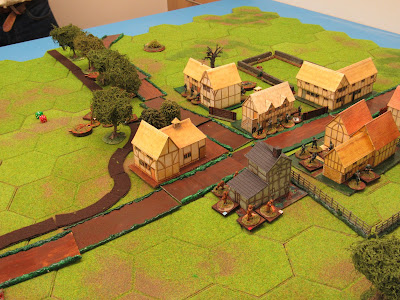
In the meantime I continue to very slowly paint up more Great War figures with the eventual aim of playing some Square Bashing.

The game ebbed and flowed a bit - as games need to - but suffered from a long gap since either of the players had used the rules, although I, as umpire, had played them a couple of weeks before. We are, of course, still in the 'training' section of the scenario book and so would expect to be still getting to grips with both rules and tactics and I think one could say that neither part worked particularly smoothly on the night. Points of note:
- For the first time we used the mechanism for close assault against buildings and, more specifically, it became clear how not to do it.
- We also used the sniper rules for the first time, but not for long. Peter rolled a double on his first shot and that was that. Still, the Lewis gun never jammed.
- Ironically, having complained about the underwritten nature of the scenario, I should have been much more specific about terrain definitions.
- This might be stating the bleeding obvious, but the game is all about the Big Men, whereas, as a generalisation, most other games are about units. A mental adjustment is necessary if one is to make it work properly.
- The blind mechanism increasingly seems more trouble than it's worth - at least for attackers. I'm still keen to try it for defenders in a situation where they could be anywhere in the scenery. The process apparently adopted in Chain of Command has been recommended as an alternative and I shall give it a butchers.
- One suggestion that came out in discussion which we shall try is that the British bomber section should be represented on the table by a rifle section until they start actually bombing.
 |
| The British prepare for a futile gesture |
We might skip scenario 4 for now. We have a work around for the tanks required (I don't currently have any), but am rather put off by the need for seventeen British big men compared to the very small German force involved. I rather think it would all take a long time for not much game. Scenario 5 is a small German stormtrooper attack on a bunker. I can almost do it - with British defenders replacing the French in the book - and just need the addition of a couple more figures (German light machine guns) and a bunker.

In the meantime I continue to very slowly paint up more Great War figures with the eventual aim of playing some Square Bashing.
Sunday, 23 July 2017
Scenario 3 one more time
These are the scenario notes for our game this week. I promise that I will now shut up until we have actually played it. Note that I have changed the layout of the drainage ditch slightly. The spotting rule below refers to hexes, which is just for simplicity. Each hex is actually one twelfth of the the distance between the table edge and the sentry line.

British forces:
- The British will enter the southern edge of the table on six blinds in any formation and place they wish. As usual there are no limitations as to how the Big Men may be allocated between blinds.
- The rifle grenadier section will operate as riflemen
- Each of the two rifle sections will have one scout each
-
· When blinds containing scouts are deployed these may be placed up to the command distance of the relevant Big Man away from the group, but not closer than 12” to any German forces.
Terrain:
- All of the land enclosed by the drainage ditch is light cover for spotting and saving throws, as is the area to the south of the ploughed field. Neither have any effect on movement.
- The ditch itself is free to jump into, but costs one movement dice to exit. Movement along it is in single file, counts as heavy terrain and offers medium cover against being fired at.
- The ploughed field is heavy terrain for movement, medium cover for spotting and light cover for shooting.
- Areas containing trees are medium cover for both spotting and firing.
- All fences, walls etc. take one movement dice to cross.
- Entering or exiting an unoccupied house uses one movement dice.
- The occupancy limit for defenders in each house is 12 men; they count as medium cover.

Sentries:
- There are six sentry blinds already placed out.
- The German player will mark which two contain the sentries.
- These blinds cannot move and do not activate on the German Blinds token.
- The British cannot attempt to spot the sentry blinds.
Spotting: When the Sentry
token is drawn, or the Time for a Snifter token if that is drawn first, the
Germans roll 2D6 adding 1 for each hex from the southern baseline that the
furthest British blind has moved plus a further 3 if any of the blinds are on
the road. On a roll of 14 or more the arrival of the British has been noted and
the alarm sounded:
- The British remain on blinds, needing to be spotted or deployed as normal.
- The actual German sentries are now put out and the blinds removed.
- The main German force can now be activated (see below)
Sentries (slight return): The German sentries now act as per
the core rules. Note that after leaving their post they move on the Snifter
token and not the Sentry token.

German forces:
- There are eight German blinds at the start - one per house – which never move.
- The German player will secretly mark which house is the command centre.
- When the alarm is raised by the sentries the German Blind token is added to the bag and the Germans are allocated four extra blinds to be placed anywhere subject to neither being nearer to the British than either sentry nor being with 12" of the British.
- The German player now marks which of the twelve blinds represents which sections, with a limit of one per blind. The German officer is not placed on a blind.
- The four new blinds can now move as normal on the German Blind token
- NB after this point any section allocated to one of the original eight blinds must deploy in order to leave a house.
- The German officer’s token is also added to the bag. When it is drawn he may be – but does not have to be - deployed anywhere. That uses one of his initiative points and he can then use the other two in that turn. Subsequently to being deployed he acts as per the core rules.
Victory Conditions:
- Either side win if they force the other to leave the table
- The British win if at the end of any turn they have uncontested control of the command centre; the two non-combatants burning documents do not count for this purpose.
Subscribe to:
Posts (Atom)