Showing posts with label Hundred Years War. Show all posts

Tuesday, 30 September 2025

Boardgaming Q3 2025


I wrote earlier in the year about how one member of my regular boardgaming group had been named Lemon Curd champion of Otley. Subsequently one of the others has been crowned Fruit Scone king of Addingham. What a talented bunch they are. I'm pleased to say that when we are not stuffing our faces with their baked goods we are still able to find time to play a few games. Here are some of them:


Azul: A very good game, which I have played remarkably few times.

Bomb Busters: I really enjoyed this cooperative deduction game in which players seek to collectively defuse a bomb by 'cutting' various wires using mechanisms that are a bit Hanabi meets Trio. I've only played a couple of the training scenarios, but apparently there are 66 in all. It's much less frenetic than the similarly themed Fuse. Do you know, I might actually have to put my hand in my pocket and buy this one.

Calico: A tile laying game where the aim is to lay out patterns and colours in certain combinations in order to create a quilt which cats can lay on. Like many such games it gets really annoying when the right piece doesn't turn up at the right time and I spent the game thinking that it was all luck However, the two players who had played before absolutely thrashed the two who hadn't, leading me to believe that there must be some strategy in it. I'd certainly play again.

Canvas: A drafting game in which what the cards drafted are mostly transparent, but with a small amount of screen printing. Three of these are combined in a special sleeve with a background card to create a 'painting'. It's a gimmick in search of a game, but plays very quickly so doesn't particularly outstay its welcome.

Distilled: Highly thematic and way too complicated game about making various types of spirits. There are something like half a dozen rounds. As we completed scoring for the first of these the person teaching the game gently told me that I had misunderstood what I was supposed to do and had in fact ended up with nul points. "Never mind" I thought, I understand it properly now. However, the same thing happened again at the end of the second round when I once more didn't trouble the scorers. I did manage to break my duck later in the game, but ended up being so far behind the eventual winner that, despite my being teetotal, I was sorely tempted to turn to one of the drinks we had been distilling.

Flamme Rouge: Astonishingly it had been eight years since I last played this excellent cycle racing game, although I have played the closely related Heat: Pedal to the Metal many times since. Nothing about my performance had improved and once again both my riders failed to cross the finish line.

The Gang: A cooperative version of poker. Just think about that for a moment. It's as terrible as you would imagine. The worst game I've played in a long time.

Lancaster: I had to teach this again, and once again that wasn't ideal. Still, this time it had only been 18 months rather than ten years. It's a good game, but I need to find someone who owns the expansion. Apparently that introduces a mechanism which can penalise those players who don't do their duty and  fight the French.

Let's Make a Bus Route: The Dice Game: I've never played the original, so can't say whether this matches my usual rule of thumb: dice/card versions of games are usually worse than the game they are based on. I thought that this was over-complicated, but possibly repeated playing would make things clearer. There are two maps to choose from. One is a random city (in which every tourist attraction is the Eiffel Tower) and the other is Mars. Odd,

Mountain Goats: A perfectly fine filler about climbing up mountains and pushing other goats off the top.

Northwest Passage Adventure: Clever enough game about racing through snow and ice. The rule book is terrible so I'm not clear how correctly we were playing it.

Prey Another Day: Eat or be eaten in  a sort of Citadels combined with Love Letter. Quick and fun.

Project L: A polyomino tile layer where you get to choose difficulty level of the puzzles you try to solve. It was OK.

Scythe: I had a disastrous first game of this a couple of years ago and it's taken this long for me to be persuaded to try it again. It went much better, but I still don't see why it is so highly rated. 

War of the 3 Sanchos: When I mentioned this last year I said that, while obscure and probably hard to find a copy, many wargamers would enjoy it. I still think so. Hopefully it won't be as long before El Cid rides out again in Otley.

Western Legends: Another game that might appeal to wargamers is this one. Take on the character of a famous figure of the old west and swan around either rustling cattle, robbing banks and shooting people or alternatively arresting those who do so. Add in prospecting for gold, playing poker and visiting the bordello and you have all the ingredients for a lot of fun. I got arrested more times than I would have wished by the NPC sheriff, but perhaps I'm just not cut out to be a black hat. Great fun.
Sunday, 26 February 2023

My WotR Collection

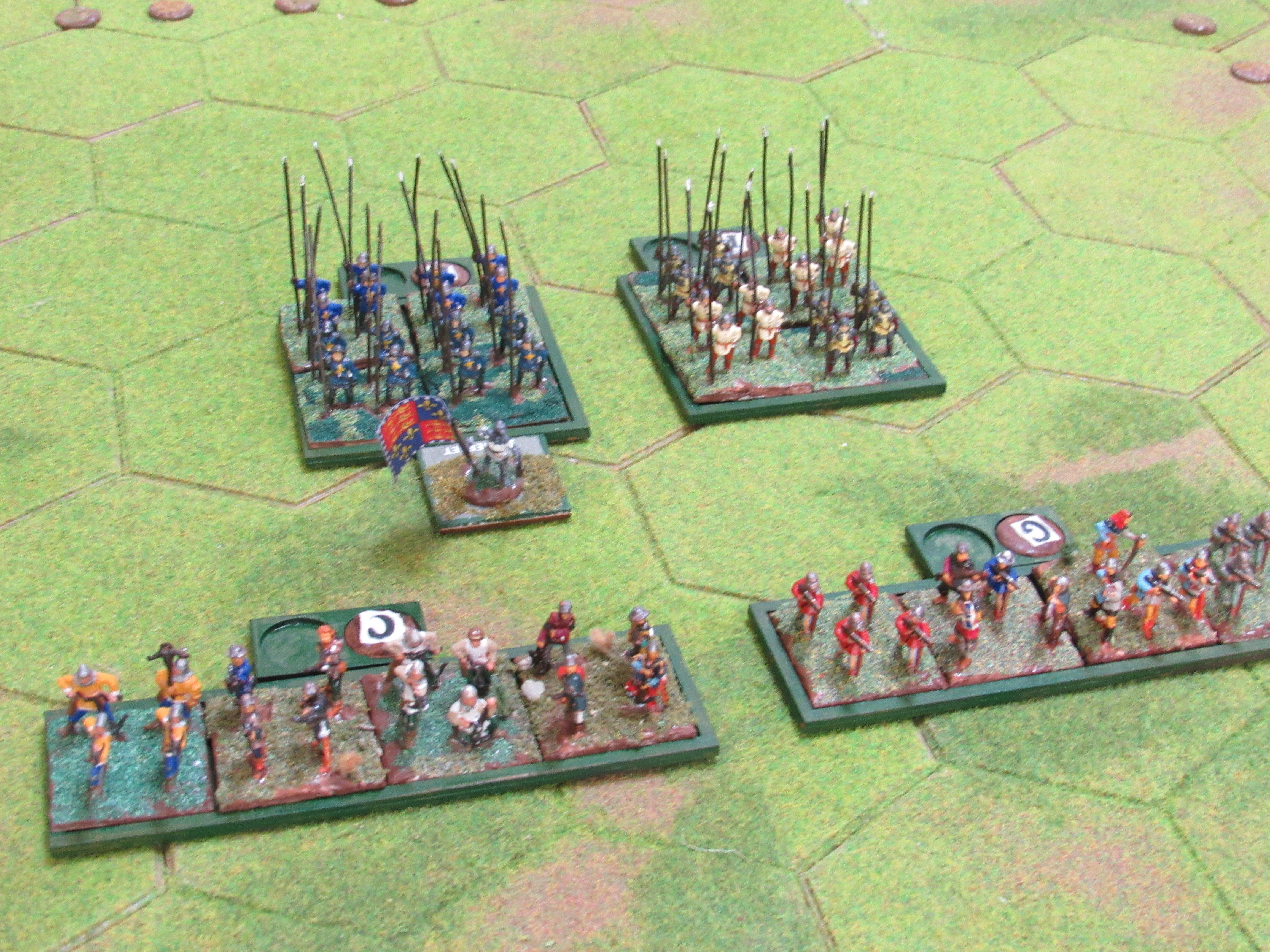
 That title makes it sound as if I am going to post photos of them all, but I'm not. I'm actually responding to a couple of questions that I've had: are the figures Perry plastics, and are the new Irish kern that I have ordered, er, Perry plastics. In both cases it's a no. My figures are 20mm, and most of them are actually Hundred Years War figures deployed anachronistically with no shame whatsoever.

This was the first period that I painted when, in my forties, I was looking for a hobby which I could pick up and put down in the periods between professional assignments. I chose 1/72 soft plastic because one key criterion was not spending much money. (As an aside, that worked out well didn't it.) I had always been interested in the Wars of the Roses, there weren't any figures available, so I bought those for the HYW instead. I had no thought of gaming and no one else would ever see them so it didn't matter. As time went by more specific 15th century figures became available labelled variously as WotR, Burgundians, Swiss, Hussites etc, but I didn't replace anything. Instead I simply mixed them in, as I did a few metal figures from Tumbling Dice's range. The latter were often for things that it wasn't at the time easy to find in plastic: hand-gunners, pikemen etc. 


For the kern I have ordered a mixture of the Redbox Irish Troops and Tumbling Dice figures, just for variety really. The Redbox set also contains some Galloglass, which clearly I don't need, but will no doubt find a use for in due course. When everything arrives I shall tell you what I think.

Next week's game isn't going to be a refight of a specific combat, rather we shall have a go at the sample scenario in the rulebook which the authors use to introduce various troop types that we haven't employed in our games so far. These include mounted household troops, the rules for whose use I still haven't quite got my head around. 


Monday, 9 August 2021

The Laws of War in the Late Middle Ages

 Fate decreed that there would not after all be a game last week. But the upside is that I am free to bring you another review of a book which you will never read. Today we feature 'The Laws of War in the Middle Ages' by Maurice Keen, first published in 1965.


The first thing to point out is that this is a rigorously academic book, whose footnotes are both copious and also often in either Latin or medieval French. I've pulled that trick myself on this blog from time to time, but it must be noted that while it's funny when I do it, it isn't funny at all when others do. Notwithstanding that, it's a very interesting read. Keen describes a world (OK, half a continent - this is entirely about Western Europe) in which there can be overarching 'laws' without any supranational organisation to draw them up, let alone police and enforce them; indeed for much of the time there aren't any nations either in the sense that we would understand them. The context is that all the relevant people (i.e. the warrior caste) consider themselves bound by the rules of chivalry, and it is their sense of honour alone that ensures that fair play is observed even if it is only amongst themselves for some of the time. Because Keen also demonstrates fairly effectively that everyone else - with the possible exception of the church - are protected by no laws at all, and that even those supposedly bound by their code quite often ignore it when it suits them.

I don't think there is much direct read across to the wargaming table, although chapter VIII on sieges is required reading for anyone interested in that aspect of medieval warfare. There is a quite a lot on the role of heralds, and it filled in some of the gaps that I felt were missing from the book I recently read on that subject. There was also an unexpected overlap with another book I have been reading: 'Debt: The First 5000 Years' by anthropologist David Graeber. One small part of that book considers the differences and similarities between 'a debt of honour' and 'honouring a debt', a nuance which turns out to be very pertinent to the medieval practice of ransoming noble prisoners captured in battle.

Tuesday, 1 June 2021

Bloodied Banners

 It's time for another book review. It makes a pleasant change to be able to say that this one gets an unequivocal thumbs up. The book in question - "Bloodied Banners: Martial Display on the Medieval Battlefield" by Robert W. Jones - isn't new, having first been published in 2010. I was keen to read it at the time, but was quite a lot less keen on the £50 price tag of the hardback. I have now managed to pick up the paperback for a fraction of that price.


Dr Jones is a historian, for those who set great store by these things, and the book contains footnotes galore referring us to primary and secondary sources, including the full version of translated text in the original language in case anyone wants to challenge his grasp of Norman French. He still manages a lightness of touch though; one of the quotations he uses to introduce each chapter comes from Terry Pratchett. The author covers a pretty full range of visual display: arms and armour are considered alongside heraldry, banners, badges and religious images. He also includes a chapter on aural display: drums, trumpets and the like. I found his approach both comprehensive in scope and nuanced in conclusion. Whilst he is big on psychology and symbolism, he doesn't lose sight of the implications for what warriors of the time actually did in practice. And he doesn't stop there; there are several comments as to where the lingering effects of medieval practice can be seen in the seventeenth century and later.

He begins and ends with the sad tale of Sir John Chandos at Lussac in 1369. Apparently he dismounted and strode alone towards the French proclaiming "I am John Chandos: look at me well and, if God please, we will now put to proof your great deeds of arms which are so renowned". Unfortunately for him he then tripped over his surcoat - on which were emblazoned his coat of arms so that everyone would know it was him who was performing great deeds - and a Frenchman struck him with his lance while he was lying on the ground and killed him. God, presumably, did not so please. 


Friday, 19 March 2021

Agincourt Diorama

I've mentioned the Royal Armouries talks a few times, including yesterday in fact now I come to think about it. They continue to be (mostly) excellent; my own favourite over recent months was the one on firearms forensic science. Anyway, this is not part of their normal lecture series, but next Thursday, the 25th March, at 17:00 GMT the Royal Armouries will be hosting an online discussion about the building of their splendid Agincourt diorama. The discussion will feature, amongst others, the Perry twins, whose figures those are. Booking details are here.


Because, under normal circumstances obviously, I visit the Royal Armouries several times a year I have perhaps become a tad blasé about the model, but it is very good. I do sometimes find myself standing there wishing it would move. It's a bit like one of those demonstration games at a show that manufacturers set up, but never actually play.


Thursday, 13 April 2017

Trial by Bloody Big Book

I have been reading Trial By Battle, the first volume in Jonathan Sumption's history of the Hundred Years War. By which I mean that I have been reading it for months; it's a whopper. I shall not review it, partly because if you are interested in the period then reading it is a necessity regardless of what I think, and partly because it's so long since I read the opening chapters that I can't remember how or why it all started.


I shall therefore simply concur with the reviewers quoted on the back who basically say that he is as good on the detail as on the big picture and visa versa. I have previously noted his bizarre assertion that one used to be able to hunt monkeys in the forests of Brittany (before the last ice age possibly, but certainly not in the fourteenth century) but otherwise all seems in order. He appears to describe Isabella, Edward III's eldest daughter as his son at one point, but I suspect sloppy editing is the real culprit there. Or perhaps editing was also responsible for the first mistake and the king and his party were really hunting donkeys. Who knows?

I intend to read the next volume in due course, but will need to build up my stamina first. In the meantime I shall turn my non-fiction attentions to the Great War.

Monday, 27 February 2017

Pot67pouri

So, another month draws to a close, and once again many things have gone unreported in this blog. I went to Lincoln, although on reflection that was pretty dull. The big bouncy woman and I were this close to going out walking before storm Doris intervened (and apropos of nothing, the the name of that weather system has been bringing back uncomfortable memories of someone I used to go out with some decades ago). I also saw a performance of Return to the Forbidden Planet that I can best describe as troubling. The group involved seem to consist of middle aged men and much younger women. Normally this is a membership policy that would be right up Epictetus' street, but in this case it verged into the uncomfortable, not to say creepy. Miranda (the piece is very loosely based on The Tempest via the 1950s film) was played by a young girl not much older than the fifteen that Shakespeare ordained, and her love interest must have been at least twice her age; very wrong. The band were good though.

Wargaming has been covered mostly as we have gone along, but there was a small amount of painting: eight stands of longbowmen, four Celt casualty markers and half a dozen or so Great War Tommies. A number of 1914-18 field guns have arrived in the post so I hope to be more productive in March. I also returned some figures to Mark that he had originally passed on to me many years ago and with which I had done absolutely nothing in the meantime. It did mean however that he finally came to take a look at the wargaming annexe; I hope to fix up a game with him sometime soon.

A monkey with a beard

I am still ploughing through Trial by Battle, the first volume of Jonathan Sumption's massive history of the Hundred Years War. I am enjoying it, despite the long and somewhat dry lists of things like place names, people and so on. One such list that caught my eye this week is on page 404 and details the things that Edward III enjoyed himself by hunting in the forests of Brittany in November 1342: "deer, foxes, bears, monkeys and other beasts plentiful beyond measure". Now Sumption is clearly a very clever man and ordinarily I would not dare to cast aspersions regarding his scholarship, but monkeys? Monkeys? In the forests of northern France? Come on, your Lordship, get a grip.

Sunday, 19 February 2017

La pucelle

"Martyrs, my friend, have to choose between being forgotten, mocked or used. As for being understood - never."  - Albert Camus

And so to the theatre. Continuing (anticipating actually) the Hundred Years War theme of the previous post, I have been to see Shaw's Saint Joan in another of the National Theatre's live broadcasts, this time from the Donmar. I am pleased to report that on this occasion the Nobel Laureate has been well served by director and actors.  Gemma Arterton is superb as the Maid, and the rest of the cast were excellent. Like the recent production of Pygmalion that I saw this is mostly in modern dress with a shortened script that retains the original language. For me this works well here and was unnecessary there. GBS himself wrote "It is difficult, if not impossible, for most people to think otherwise than in the fashion of their own period."; I would assert that one century ago is 'our period' in a way that six centuries ago is not.

The set is a boardroom, although thankfully not one of the many such that I have sat in has ever revolved; a design decision I found less grating than for, example, much of the action in Pygmalion taking part in a fish tank. For me the parallels between then and now - not least those with power conspiring with each other against everyone else - work better because the nobility are dressed like, as well as acting like, bankers of the last thirty years. John de Stogumber's outraged rhetorical question "How can what an Englishman believes be heresy? It is a contradiction in terms." is all the more recognisably relevant if he looks as if he's in UKIP, as is the response from the more cultured and educated Frenchman to whom he is speaking that Stogumber will be forgiven on the basis that the 'thick air' of England breeds 'invincible ignorance'. The chosen setting also made one inevitably think of 'Yes, Minister': self-interest, hypocrisy and circumlocution in beautifully crafted dialogue.


Enigma of the evening: who did steal the bishop's horse?

Saturday, 18 February 2017

Once more unto the breach, dear friends, once more;

Thanks to all those who have wished me well. I am slowly recovering, although I am still rather fragile. But, let's face it, given the nature of my current affliction it would not really be appropriate to dwell on it for the purposes of a blog post; most distasteful. So - swiftly moving on - why don't I take the opportunity to show you a wargames figure from my collection?

Regular readers will know of my interests both in sieges and in the fifteenth century. Let's kill two birds with one stone and have a look at one of the English besiegers of Harfleur in 1415. This chap having obviously been affected by the outbreak of dysentery which has swept through the camp, claiming many lives, is urgently manoeuvring his clothing as he hurries to the place of easement.

Tuesday, 13 December 2016

Pot63pouri


"Time is a circus, always packing up and moving away." - Ben Hecht

I have been pottering along here at the Casa Epictetus doing nothing very much. I am not retired and yet I don't work. I am in what Dorothy L. Sayers referred to as 'that time of life when a man can extract an Epicurean enjoyment even from his own passions - the halcyon period between the self-tormenting exuberance of youth and the fretful carpe diem of approaching senility'.

There has been a low level of wargame related activity. I have established that with a couple more trench sections - junctions specifically - I can play the second scenario from the Stout Hearts book. I have come to two conclusions: that I can't be arsed to build them myself and that the first game was successful enough to warrant the investment of a few quid more, and therefore I shall place an order for said trench sections to be collected at Vapnartak. On the painting front I have completed more casualty markers for To The Strongest and quite a few light infantry and Commander/Hero figures for the Ancient Britons that I don't actually need. I also did a couple of the druids from the Hat Gallic Command pack which inevitably led me to consider whether it was time to revisit the Pony Wars rip off rules and convert them to hexes. I don't currently have enough Hexon hills to put on a game, but I don't think they are going to find their way into this order.

On the music front I've watched quite a few local bands in pubs ranging from the blues of the ever reliable Dr Bob & the Bluesmakers, the excellent soul covers of the Solicitors, the poppy folk originals of the Ale Marys and the zydeco of Bayou Gumbo. The last of those seemed to rather misjudge their audience. The lead singer introduced one song with a joke that made perfect sense if you were familiar with 'À la recherche du temps perdu'. The Frenchness so eagerly embraced by Otley in the days of la Tour de France has obviously dissipated, and the Tuesday night crowd in la Jonction had clearly not got round to reading their copy of Proust's masterpiece quite yet.

Speaking of reading, I have been doing quite a bit. I have just started on Jonathan Sumption's history of the Hundred Year's War. It's a big book (and that's just the first volume) and so it's left at home rather than being taken about with me. That's probably for the best because of course he is one of the members of the Supreme Court hearing the appeal about triggering Article 50, and presumably when the judgement goes against the government even the sight of his name on a book cover will be sufficient  to provoke anger in the streets. When I do venture out I rely on my kindle. Recently I have read Priestley's 'Bright Day' (which, given my love of coincidence, I was pleased to see includes a trip to a thinly disguised Malham) and McBain's 'King's Ransom'. The latter has found a place on the - very short - list that I keep of books where part of the plot turns on a cost accountancy issue. I accept that this is perhaps a niche interest, but it appeals to me. Should you wish to read them, the others in this limited category are 'The Rise of Silas Lapham' by William Dean Howells and 'Angel Pavement' by, coincidentally again, J.B. Priestley. I omit Eli Goldratt's 'The Goal' and Roger Jones' 'The Carpetmakers' for reasons which I'm sure will require no further explanation.


And finally I was sorry to hear of the death of former cabinet minister Jim Prior. As I think I have mentioned before he was the only Tory MP or former MP that I have ever met. I had dinner with him twenty years ago in Abu Dhabi while we were both selling weapons of mass destruction to Johnny Foreigner. He was very, very drunk. We discussed a number of relatively trivial things including the recent giant killing exploits of Brentford (my team) over Norwich (his team) in the 3rd round of the FA Cup, but I can remember that we also touched on one of the big political issues of the day -  the proposed third runway at Heathrow; plus ça change.

Wednesday, 21 October 2015

From Rameses II to Henry V


 I don't know if anyone else ever takes any MOOCs. I've got into the habit of watching a video or two while I'm having a cup of coffee and a slice of home-made cake (this week's is Pear & Chocolate Loaf and is rather good, even if I say so myself; if you follow the recipe add a heaped teaspoonful of baking powder) and am finding them all very interesting. Obviously as a wargamer what one really needs is constant temptation to start up yet another period and MOOCs provide a steady stream of possibilities to be enthused over and then discarded when something better comes along. For example, I've just completed a short course on the ancient Near East which included much material on Kadesh plus the fighting techniques of the combatants. I hope that my willpower is strong enough to resist the lure of the massed chariots of Rameses II, but the best way to ensure that is so is by quickly moving on. It being October 2015 then where better to go next than Agincourt, and so I'm going to be taking a look here at a brief course being led by Professor Ann Curry to mark the 600th anniversary.


Tuesday, 3 February 2015

The vasty fields of France?

Boardgaming has returned to l'Arbre d'If (although the venue is still suffering from the hasty departure of the previous landlord - unspeakable things in the kitchen were was what was being, er, spoken about this week) and I played some enjoyable games that I had not come across before.


6 Nimmt was roundly and loudly denounced by one of the attendees who refused to have anything to do with it, but I rather liked it. I had absolutely no idea of how to approach it though, despite having both the 102 and 104 cards in my hand.


Ice Flow was as usual a hit with those who played it for the first time, with it's deceptively deep strategic play catching them out. I am pleased to report a return to winning form for your bloggist, with December's sound thrashing by some random young person being exposed as the aberration it undoubtedly was.


Archaeology was  a rather fine card game filler, one of many that I have come across in recent weeks. I came a fine last, having suffered heavily from sandstorms and thieves and managing only to sell two pieces of broken pot to the museum. Poor stuff.


New game of the night for me was Lancaster. Now this is a medium complexity Euro game with elements of both worker placement and area control, and I wouldn't want to mislead anyone by suggesting that it is anything else. However, within the context of a straightforward mechanic-driven game, the theme manages to come across quite strongly, giving plenty of opportunity to intimidate one's rival barons in early 15th century England by displays of martial strength as well as racing across the channel to fight the French. The fighting was of course very high-level, although it was carried out by pieces reminiscent of a block wargame, but it also allowed stitching-up of the other English barons while one was at it. Indeed I won right at the death when one of my main rival's knights got captured and he couldn't afford the ransom. Shame.