Showing posts with label Richard III. Show all posts

Sunday, 3 September 2023

Berwick

 I've been to the Scottish Borders for a few days. I spent some of that time in Berwick-upon-Tweed, which of course isn't in Scotland and hasn't been since Richard of Gloucester captured it in 1482. I was vaguely aware that ownership of the town had been keenly contested for centuries prior to that, but would have been hard pushed to tell you why, beyond the normal willy waving of medieval monarchs. However, as soon as one sees the place, all becomes obvious. Obviously any wargames blogger worth his salt would have taken plenty of photos to illustrate that, possibly featuring how its Elizabethan bastions allow artillery to dominate the mouth of the Tweed. Unfortunately this blog is written by me and all I've got is a picture of a cunningly disguised secret entrance from which the defenders could launch a surprise attack on unsuspecting besiegers.


The town's museum is in the former barracks, which incidentally may have been designed by Nicholas Hawksmoor, and had some interesting exhibits. We haven't had a photo of a gibbet for a coiuple of weeks, so let's start with this:


For those of you wondering about the fish, don't - it's a red herring. This rather fine diorama was in a case with, as far as I could see, not much in the way of explanation. It could be Berwick Castle, but there's not much left of that, as the stone was robbed to build, amongst other things, the barracks.


In addition to the town museum, there is a large exhibition about the British Army from its formation to the colonial wars at the end of the 19th century, which was rather well done. I was pleased to see that it included some toy soldiers. My photo manages to include the colour party, but at the expense of showing either of the flank companies or the battalion guns, all of which are faithfully replicated. The 25th Regiment of Foot became, I believe, the King's Own Scottish Borderers, hence their being chosen for the display.


I did venture into Scotland, mainly for a spot of walking. This is what's left of  Roxburgh castle, which I include only because it was here that in 1460 James II of Scotland paid the price for playing too active a part in a siege. 'Haveng sik plesure in discharging gret gunis' he was killed when one of them 'brak in the fyring'.


Monday, 13 June 2022

Medieval Military Combat (slight return)

 Just over a year ago I reviewed Dr Tom Lewis's 'Medieval Military Combat' and so too, albeit in a more dismissive fashion, did Graham Evans over at 'Wargaming for Grown-ups'. In Volume XXXII of The Ricardian, journal of the Richard III Society and hot off the presses, is another review. This one is by Peter Hammond, Research Officer of the society, and author of many books on the period himself. 

He is of much the same mind as me on Lewis's tome. His concluding paragraph reads:

"This book is an interesting mixture. As described it contains some interesting practical points which are not usually discussed. It is not well written, being badly organized but it is worth reading for the discussion of battle aspects not often covered. Unfortunately there are very few illustrations, all in black and white and very badly reproduced and the index is poor."

So, worth a read, but borrow don't buy.

Wednesday, 6 April 2022

Nugas Vitae

 Concerns have been raised about whether all this snow that I referred to yesterday actually ever existed. Well, firstly, there was indeed a lot of snow, although it disappeared quite quickly. And, secondly, it is possible that readers have mistaken this blog for some sort of accurate historical record of what's going down. I, on the other hand, have always seen myself as the equivalent of a medieval chronicler.

"So, there was the Rev Ian Paisley and there was a giraffe"

Gabriel Ronay explains the approach of such chroniclers in his 'The Lost King of England':

"Readers liked to have a succession of bright incidents and adventures well seasoned with supernatural prognostications, but the reliability of facts did not concern them unduly. Chroniclers therefore paid more attention to amplifying their stories with anecdotes and strange occurrences than to the veracity of their sources. Closely reasoned argument, well-grounded facts and chronological cohesion did not suit an episodic style of narrative."


The lost king in the book, incidentally, is the son of Edmund Ironside, who had to flee along with his brother after their father was murdered by Canute. It's an interesting read, although the author's prose style is not particularly to my taste. It's also one of those irritating class of books which keeps telling the reader that is correcting a long-standing historical misapprehension which no one knew existed in the first place. I might have to re-read it now that I've dug it out. The bit that struck me most when I first read it was the assertion that when Thomas Moore wrote the story of the Princes in Tower - the ultimate source for Shakespeare - both he and his readers would have understood that he was merely rehashing the story of the æthelings and thus disparaging Richard III by comparing him to Canute. In the context of world events today, it is noteworthy that when the princes escape to the sanctuary of the Russian court (their maternal aunt being the wife of Grand Duke Yaroslav) the capital of that country is Kyiv.


Friday, 8 October 2021

Vellem nescire literas

 As befits a wargaming blog, no wargaming has equalled no posts. Reasons for not gaming have been various, but this week appear to have been related to a Brigadoon-like canal, which is sometimes there and sometimes isn't. I can't paint either because, whilst my balance problems have largely abated, the remnants make close focus work inadvisable. An ideal time therefore to design some scenarios, knock a few rules into shape (e.g. the hex-based version of Pax Romana) or perhaps even just tidy up the annexe (the mice having ceased to be, I am pleased to say). But no, instead I have been gadding about.


I have been to the Nero exhibition currently on at the British Museum, which poses the question: "Was he a young, inexperienced ruler trying his best in a divided society, or the merciless, matricidal megalomaniac history has painted him to be?". I think we all know the answer to that, although the exhibition stressed that he was very popular until he, well, wasn't. I came away conscious that pretty much my entire 'knowledge' of the period comes from watching 'I, Claudius'. Anyway, it's well worth visiting, especially for the Boudiccan revolt section. A bit of rank bad planning meant that I was there the day before the Hokusai exhibition opened, but one could now combine the two.


I also found myself in Leicester, and took the opportunity to go to the Richard III Visitor Centre, which I thought was very well done. The ground floor is given over to concisely explaining the Wars of the Roses, with major figures projected onto the walls and telling us their side of the story. It's a complicated subject, and the museum hasn't got a great deal of space, but they have a reasonable and balanced stab. It's not their fault that pretty much everyone is either called Edward or Richard. The first floor recounts the story of the search, the find and the scientific analysis required to establish that it was indeed him. It's a fascinating story, well told and again worth a visit. One's trip round culminates, as it should, standing by the hole in the car park itself, or more accurately the hole which used to be in the car park.


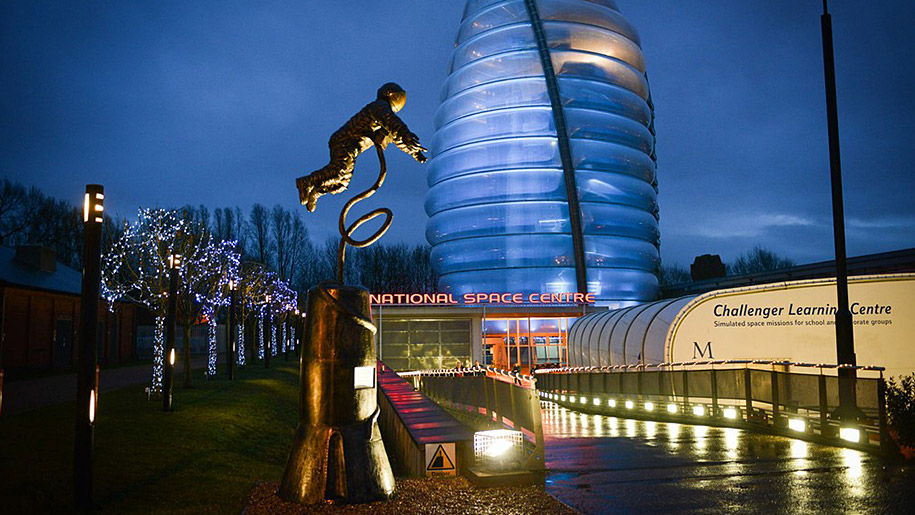
Yet more bad planning meant that I didn't manage to visit the tomb in the cathedral - it was shut - but while I was in the city I also went to the National Space Centre. It's not Cape Canaveral, but nonetheless was a worthwhile way to spend a morning. It's full of rockets, spacecraft, artefacts etc with plenty of informative and hands-on displays. Visiting the planetarium wasn't perhaps all that advisable for someone suffering from vertigo, but I closed my eyes and it all went away. My companion for the trip crashed in her attempt to land the lunar module, but as I had experienced her driving I wasn't entirely surprised. One of the most entertaining aspects for me was the timeline of the space age (which is almost entirely congruent with my own lifetime) which included many non space-related events, both significant and ephemeral, none of which seem to have happened in the order that I would have said that they did. Memory is a funny old thing.


Sunday, 14 February 2021

Bosworth 1485

"He said, ‘Give me my battle-axe in my hand,
Set the crown of England on my head so high!
For by Him that shope both sea and land,
King of England this day will I die!"

- from The Ballad of Bosworth Field


I own some half a dozen books about Bosworth, so obviously I was in need of another. As luck would have it Osprey have just published one. It is Bosworth 1485, number 360 in their Campaign series and is written by Christopher Gravett and illustrated by Graham Turner, and not to be confused with Campaign series number 66, entitled Bosworth 1485, written by Christopher Gravett and illustrated by Graham Turner. Of course, a lot has been uncovered since their first attempt was issued, not least the location both of the battlefield and of the loser.


Astonishingly, I don't own the original version so I can't be specific about the changes in either test or pictures, except to point out that the subtitle has changed from 'Last Charge of the Plantagenets' to 'The Downfall of Richard III'. I have been teasing away at that switch, all the time clutching my copy of 'L'écriture et la différence', and must conclude that I have no idea what we are meant to understand by it.


Jacques Derrida deconstructs the bowling

The book - the one on Bosworth not the one on structuralism - starts rather poorly. In the first paragraph following the introduction the author makes the bizarre claim that John of Gaunt was Edward III's eldest son. It might, I suppose, be interesting to speculate what difference it might have made to 14th and 15th century English history if he had have been. As Derrida used to say while opening the batting for the École normale supérieure: "Posed in these terms, the question would already be caught in the assurance of a certain fore-knowledge: can “what has always been conceived and signified under that name” be considered fundamentally homogeneous, univocal, or nonconflictual?"

Anyway, back to the book. It's fine. It adequately summarises all the newly available information alongside what was always known. The maps in particular are plentiful and clear. I don't think anyone reads such a work expecting to be enlightened as to the definitive version of what happened. It was all a long time ago and, in any event, the interesting question about the events of 1483 to 1485 will always be why, rather than what or where, and that is ultimately unknowable. So, a useful addition to the bookshelf, but it still leaves room for others.

Friday, 7 December 2018

Who dun it?

"A fool sees not the same tree that a wise man sees" - William Blake


I have always taken the view that as a wargamer one is in no position to mock other people's hobbies. However, as a long time member of the Richard III Society (which I joined at time of the quincentenary of Bosworth) I have always felt able to chuckle at the foibles of the membership. This has become harder as the research into events of 1485 led first to the discovery of the Bosworth battlefield and then to the almost unbelievable finding of the man himself. I was beginning to think that things were moving in the direction of solving the biggest mystery of them all, but perhaps instead the cranks are making a comeback.


This blog has shown the above painting ('Edward's Children' by Paul Delaroche) before, when mentioning the interesting, though possibly speculative, theory that it was the dog which was responsible for murdering the princes in the Tower. This quarter's Ricardian magazine has an equally conjectural piece drawing attention to both the colours of the drapery and the carvings on the bedposts. These, asserts the author, mean that Delaroche wanted to indicate that the princes had survived into the reign of Henry VII and been done away with on his orders; why he didn't just say that or show their evil brother-in-law in some more overt way isn't explained. Nor is the possibility considered that he simply painted from life and oldish looking bed and it never occurred to him that it was from the time of the next dynasty.

The Ricardian magazine is full of this sort of stuff (in fairness they also produce a more learned annual journal) and well worth reading even if the only result is to make you shake your head at the thought of otherwise sensible people spending their time and money in this way. Also in the current issue is the revelation that Richard de la Pole, la Rose blanche, was a bit of a tightwad and an article on Elizabeth 'Jane' Shore, mistress of Edward IV and god only knows who else, which ably demonstrates that she was your bloggist's sort of woman and no mistake.


After the death of Edward she was made to do penance for her carryings-on by Good King Richard, a scene later somewhat freely interpreted by William Blake in the painting above. Blake himself was of course a firm believer in free love (sources differ as to whether this was from political or religious conviction, but there seems to be a consensus that Mrs Blake took a dim view of the idea in any case) and was widely regarded as mad during his lifetime.


Thursday, 15 November 2018

Meantime we shall express our darker purpose

A while ago I saw a broadcast of Sir Ian McKellen's recent 'King Lear'. It was, of course, superb (Sinéad Cusack played a female Kent - I know you like to hear about the cross gender casting), but it was also very long. It started at 7 o'clock and the interval was at ten past nine. A fair number of punters never made it back afterwards. I stuck it out on the basis that if he could do it on stage at his age then I could certainly do it in the audience at mine. The reason for mentioning all this is not to dwell on my numb bum, but because I feel that it behoves me to pass comment on the current omnishambles of a government that we have here in the UK. I find I can do no better than quote Gloucester speaking in that play: "Tis the time's plague, when madmen lead the blind".


It has seemed apparent to me for some time that we are living through is actually a worked example of the Condorcet Paradox. My recent viewing of 'Twelve Angry Men' obviously brought to mind Condorcet's Jury Theorem, and so I sought out a cheap second hand copy of Szpiro's 'Numbers Rule' an interesting book dealing with the mathematics of democracy. I have to confess that I hadn't previously recognised that the balloting system used by the Richard III Society to allocate tickets for the re-internment of a somewhat later lord of Gloucester in Leicester Cathedral - a process which you will recall left me without an invitation - looked suspiciously like one described by Plato in his 'Laws'; yet another reason to dislike the man.

Let's finish with a qualitative rather than quantitative take on democracy: 

"The theory of democratic government is not that the will of the people is always right, but rather that normal human beings of average intelligence will, if given a chance, learn the right and best course by bitter experience." - W.E.B. Du Bois

We shall see.


Tuesday, 3 July 2018

Another part of the field

And so to the theatre. Taking advantage of the hot weather I went to York to check out the pop-up Shakespearean theatre that has sprouted in the car park next to Clifford's Tower. Made of scaffolding rather than wood (they are at pains to point out that it's German scaffolding; whether that it is to reassure us of its quality or to make a political point I don't know) it is, to my eye at least, not as open to the sky as the Globe. The seats looked more comfortable - they had backs rather being just benches - but they are quite pricey so, being a tightarse, I was a groundling. There were drawbacks to that in a couple of ways: firstly the large pit area was very empty with only a few dozen occupants, most of whom sat on the floor thereby greatly reducing the atmosphere; and secondly it went on a bit. They chose to present almost the whole of "Richard III" instead of an edited version as is more usually performed. Every indication is that that's what they will also do with the other plays in repertory over the summer - be warned. In this case as far as I could see the only part they omitted was Act 5, Scene 4; which contains possibly the best known quote in the whole work and is, probably not coincidentally to its removal, pretty much the only scene which shows the man in a good light. Overall, and acknowledging the slight lack of atmosphere at this early stage in the season, I thought it wasn't bad at all.

"Wibble"

Commemorations of the Great War continue of course in this, the centenary year of its end, and as a counterpoint to the recently seen production of "Journey's End", I have also been to see "Blackadder Goes Forth". The idea of putting TV sitcoms on the stage is not new (When I recently saw "100 Ways to Tie a Shoelace" in the studio at Harrogate Theatre most punters were there to see Joe Pasquale in "Some Mother's Do 'Ave 'Em" in the main house; you pays your money and you takes your choice), but is obviously a risky undertaking given the inevitable comparisons with the original cast that will arise. I thought that Baldrick worked the best, my companion for the evening plumped for George, but they all had as good a stab at it as one was entitled to expect. The show consisted of four episodes with the original scripts (all royalties to Comic Relief which co-author Richard Curtis co-founded) and I laughed a lot.  The design and staging coped admirably with the quick changes of scene required until the very end where, as you will no doubt recall, they go over the top for the big push. That bit, I am sad to report, was terrible; still, one can't have everything.

Wednesday, 31 May 2017

Lolling on a lewd love bed

And also to the theatre. Northern Broadsides are celebrating their twenty fifth anniversary with a limited season of the play with which it all started, Richard III. It's only playing in Hull, as part of the UK City of Culture programme, and at their home base of the Viaduct Theatre. It has been many years since I visited Dean Clough and my first recommendation is to leave plenty of time to find the entrance which is carefully positioned so as not to be visible to anyone approaching on either foot or by car. Once inside however, I was welcomed to the auditorium by Bazza himself; the personal touch always goes down well.

Actually auditorium is pushing it; what we have is a large workspace within what a century and a half ago was the world's largest carpet factory, with a low central stage overlooked on two sides by banks of seating, with entrance and exit for the actors taking place from either end. This was the production's first night in Halifax and the layout caused some slight confusion. Buckingham gestured grandly in one direction for Catesby to head off to importune Lord Hastings only for the man himself to stride off rapidly in the other, to the general amusement of cast and audience.


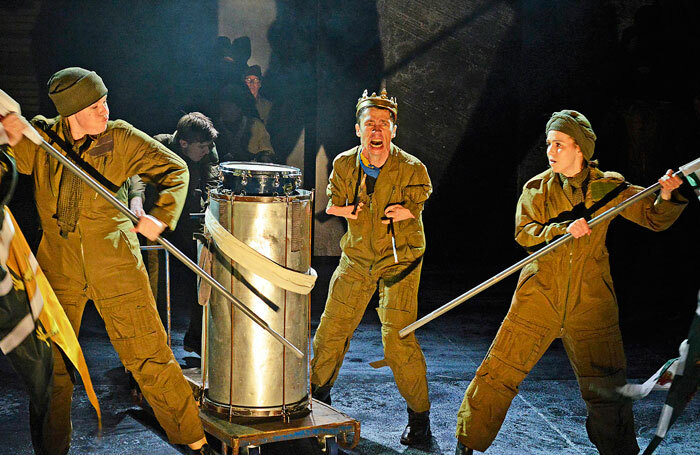
Aside from the celebratory aspect, much of the publicity has highlighted the casting of an actor with a physical disability, Mat Fraser, as the title character. It's interesting that it is this rather than the alternative of someone able bodied affecting a disability which is seen as noteworthy, especially compared with the fact that it has been many years since the part of Othello became restricted to black actors, such as Sir Lenworth in Northern Broadsides' own version. I don't think it makes any difference in and of itself. Fraser makes the most of it by stripping to the waist in the Tower scene - the one where Hastings comes to regret not being more amenable to Catesby's entreaties and which this blog has had cause to reference previously - but no doubt a different casting would have resulted in a different bit of business; it's called acting. The central performance has to stand on its own - "to prove a villain" - and I'm pleased to say that it does.

In a first for a production that I have seen, the princes in the tower are played by adults. This worked well enough except that the same actor played both Edward V and Tyrell; I lost concentration for a bit while pondering how he had managed to smother himself off stage. There is no cross gender casting - more difficult to carry off in the History plays of course - unless one counts the reappearance towards the end of the actresses who have played the various queens, this time in male military uniform as standard bearers. And speaking of the queens, Flo Wilson is especially venomous as Margaret; get cursed by her and one will stay cursed. The battle of Bosworth provides one of two opportunities which are taken to shoehorn in a bit of clog dancing - the other is the coronation - and given the prominence of that art in their opera omnia one can forgive them this. Michael Jones thinks it was Frenchmen armed with pike who caused Richard to cry "A horse, a horse...", but apparently it was northerners wearing clogs; who knew?

Tuesday, 1 March 2016

Pot53pouri

The hunt for za'atar is over. The bearded hipsters of Otley have transferred their attention to something else for long enough for Waitrose to be able to restock their shelves. It's time for some baked eggs, or perhaps some flatbread, or possibly both. That is obviously the highlight of the week, but there has been other news. I saw a goldcrest in the garden, and given that previous live fauna spotted there was a rat, it was rather wonderful.


I mentioned in the context of the 600th anniversary of Agincourt that I had taken a very interesting online course about it. I've watched a few more since on a variety of subjects and have always found them worthwhile, although the one on gravity was pretty heavy going. Anyway, there's another potentially relevant one starting next week called England in the Time of King Richard III, which among other things promises to look at the soldier's experience in battle during the Wars of the Roses. It can be found here.

I've struggled with my WWI reading, and not just because Osprey find printing on both sides of the page to be too challenging. I gave up - at least temporarily - on Wyndham Lewis because I didn't warm to him at all; he seems to be attempting to give pretentiousness a bad name, which is my job thank you very much. I turned with relief to the next in the 87th Precinct novels by Ed McBain only to find that was no bloody good either. I shall persevere with the series because I've enjoyed the others so much, but I hope they buck up soon. In the meantime I can feel some P. G. Wodehouse coming on; he won't disappoint.

And finally, I have been meaning to post this link about unbalanced dice ever since it appeared on the Piquet mailing list. It certainly explains a lot. As my old mucker Sophocles put it: "The dice of Zeus will always fall luckily."

Sunday, 6 December 2015

The New Rock & Roll

I have been to a talk on the Battle of Towton given by Chris Murphy of the Towton Battlefield Society. It was informative and entertaining, and in particular was very strong on the context and personalities. Murphy is given to a colourful turn of phrase and I was taken both with his assertion that the Wars of the Roses is the new Rock & Roll and that Edward IV was Elvis. I was less convinced by the idea of Henry VI as Stephen Fry, but one can't have everything. He included a special section on local notable John, 9th Baron Clifford (the 'Flower of Craven' or ' Butcher Clifford' according to one's taste). Otley wasn't actually on Clifford's land, being owned by the Archdiocese of York, but he was the nearest big cheese. There is one obvious problem with focussing on the Flower/Butcher in a talk on Towton; as discussed on this very blog quite recently he died the day before. It probably didn't matter because the majority of the packed out hall - the sight of which prompted the bon mot about Rock & Roll - appeared to have only come to get away from Storm Desmond which was raging outside. As with the previous year's talk on Richard III - also a sell out, although against a background of snow that time - their grasp of what was going on appeared to be slim. There were no actively racist questions this time, but the first one to be asked, after two hours of bigging up the events of Palm Sunday 1461, "Isn't it true that the 28,000 casualties are a huge exaggeration, that it's all myth and that it wasn't a very important battle after all?" was unsurprisingly met with a curt "No!". In fact it is only modesty that prevents me from pointing out that for the second year running the only sensible question was asked by me.

The storm had abated sufficiently today for the annual Victorian Fayre; indeed it was about 15˚C warmer than last year when the reindeer were the only things looking at all comfortable. It's a big event with the entire centre of the town closed off and interesting to see how my great grandparents would have celebrated the time of year. I entered into the spirit of things by having a samosa.

The weekend also included a bit of old Rock & Roll with an excellent gig by Steve Phillips and the Rough Diamonds. Phillips, a long time friend and sometime bandmate of Mark Knopfler, is really a blues musician - his set included the usual list of McTell, Broonzy, Jefferson, Johnson, Waters, Wolf plus a couple of obscure Dylan covers - but he opened with Heartbreak Hotel, first made famous by that son of York, Edward Plantagenet.

Wednesday, 7 October 2015

To prove a villain

And so to the theatre. "Thank God," you all cry "five days wargaming in a row is not why we read this blog". That begs several questions, but we shall ignore them and plough on; and at least it's a play about a soldier. Accompanied once more by the elder Miss Epictetus - the younger Miss Epictetus does exist, but is far too cool to be seen in the company of her aged parent - I have been to the West Yorkshire Playhouse to see Reece Dinsdale give his Richard III.


The last time I saw him was in the same theatre last year where he played Alan Bennett. In a sense he is again playing another familiar character - although, unlike Bennett, this one is thankfully dead - because his Richard is quite clearly Hitler. As the Guardian review points out "in the early 1930s, the British press often made fun of Hitler, misled by his appearance into believing that he posed no real threat" and Dinsdale produces more than a few moments of real laugh-out-loud humour. I was wondering what his performance reminded me of, but I think that Jo Haywood has it right in the Yorkshire Life review: he's channelling Leonard Rossiter. Imagine a serial-killing Rigsby only using one arm and wearing one built up shoe and you're there. The WYP seems to be having a season of shoe based disability productions. In 'The Glass Menagerie' the actress represented lameness by only wearing one shoe wile the rest of the cast wore none. That felt crass, frankly walking with a limp would have sufficed, but Richard does need a bit more visible deformity.


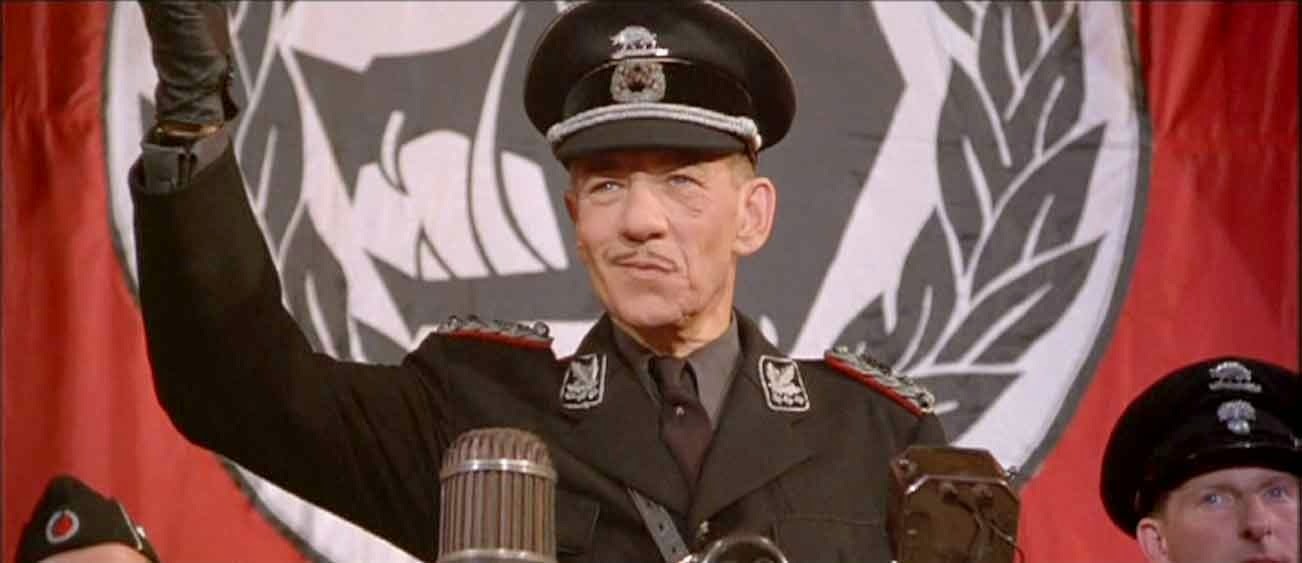
The Richard as fascist dictator theme is not new - the last modern dress version that I saw was Sir Ian McKellen's iconic production twenty five years ago at the National Theatre where he played the part as Moseley - but that's because it works very well. So too does the stark stage design and the sound effects and intermittent background music. Less happy is having parts of the dialogue literally telephoned in from offstage, and some of the doubling up of parts caused a little confusion. Overall though it provided an excellent finale to my late summer and autumn of Shakespeare.

Friday, 29 May 2015

To do the right deed for the wrong reason

And so to the theatre. I have been to see 'Murder in the Cathedral', T.S. Eliot's examination of, among other things, the dichotomy between man's loyalty to his conscience and the duty he may be considered to owe to authority. I prefer to interpret it as a product of its time - having been written during the rise of fascism - but that may just be because I am constitutionally incapable of any empathy with the inner struggles of god-botherers. There are obvious parallels with Thomas More that other egotistical Lord Chancellor who allowed himself to be martyred, although in fairness to Thomas a Becket he never told lies about Richard III.


I wasn't entirely convinced by the production, the opening scene in particular seemed to drift on for ever before anything much happened. Some of the costume decisions were also questionable. Becket himself wore motorcycle leathers for no reason that I could discern and while Reginald Fitz Urse (crazy name, crazy guy) had a bit of a Herr Flick, Gestapo vibe going on, the other three knights appeared to be ninjas. The music managed to be both odd and predictable - Cohen's 'Hallelujah' was inevitable - and was at times too loud. However the verse was crisply and powerfully spoken, transcending all the other inadequacies to make it a memorable evening.


Tuesday, 10 March 2015

Pot38pouri

My mug - see postings passim - has arrived. It is too good to actually use and now resides in my trophy cabinet next to my award for being Yorkshire Interim Finance Director of the Year, 2011; and very little else. A small wargaming context is provided by the adjacent Mambise flagbearer that I bought in Havana's only model soldier shop. Given the concern expressed by General Fwa over the likelihood of the mug being transported without damage it is ironic to note that it is in pristine condition while both award and figure are much knocked about.


Peter and I returned to Richard III last week having familiarised ourselves with the rules the previous week. I was once again much impressed by the game, despite receiving a fairly sound thrashing. It deserves a proper review; but it's not going to get one. Suffice it to say that Peter recognised the importance of persuading nobles in the other faction to switch sides earlier than I did. The Yorkists took two campaigns as invading pretenders to seize the throne, but after that they were never going to be removed. Henry VI was reduced to making vain, and historically implausible, heroic battlefield charges.

Other boardgames played recently include:

  • Abluxxen: Enjoyed it, but have no idea what strategy to follow
  • Archipelago: A fairly heavy game. In theory, although not practice, it's semi-cooperative. I think I'd get more out of it on a second run through, especially the range of possible victory criteria.
  • Red7: I really like this.
  • One Night Ultimate Werewolf: I don't really like this. I feel even more stupid than usual sitting in the pub with my eyes closed listening to an American voice on someone's smartphone pretentiously intoning drivel - including the truly ridiculous "Insomniac, wake up".
 Musically, it's all been a bit folk and roots. The Luke Daniels Trio were showcasing their leader's own songs, but for me the most memorable moment was their version of 'Baker Street' with the iconic saxophone replaced by melodeon. Diamond Dac, playing in aid of the local food bank, are also a trio, this time of fairly mature chaps playing fairly mature music. Still, there is nothing wrong with a repertoire heavily biased towards Mississippi John Hurt with smatterings of Big Bill Broonzy and Blind Boy Fuller.

Friday, 27 February 2015

As long as there are games to play...

"As long as there are games to play it's not over" - Sir Alex Ferguson

I have been fortunate enough to be able to play some board games over the last couple of weeks. (And I am still intending to devote a post to the broader subject; as soon as real life becomes a little less complex.)


Lewis & Clark: Everything that I know about the Lewis & Clark expedition comes from the notes on the box of the Imex set so I can't really comment on the theme. It's a worker placement game, but with the benefit of very simple victory conditions; reach the objective first and you win. If this was an Olympic sport it would be the 3,000 metre steeplechase and Keyflower would be dressage. I enjoyed it. For the record, most of my Imex Lewis & Clark set is still unused, but various components are spread between a Celt village, the crew of The Crow (not yet featured in this blog as it hasn't yet appeared on the table in the wargaming annexe) and a unit of Opolchenie.

6 Nimmt: Still completely random, but rather good fun.

Guillotine: Who wouldn't enjoy executing the parasitic nobility of France, not to mention the Piss Boy? We certainly did.

Hanabi: Still a good game, but this run through was a disaster with all the 2 cards being bunched at the end.

Harbour: Apparently this is Le Havre light, but I wouldn't know about that. It was quite enjoyable, and being essentially an accounting game, I wasn't surprised when I won.

K2: I really enjoyed this despite coming last by virtue of being the only one to lose a climber to oxygen deprivation. I was much reminded of the ill fated 1986 expedition to the mountain. The board is very similar to the progress wallcharts that Fullers, Smith & Turner put up in all their pubs so drinkers could monitor the progress of the mountaineers that the brewery had sponsored, while toasting them in the specially created K2 lager. The untimely deaths of so many people rather limited the success of this as a marketing campaign.

R-Eco: I enjoyed a second run through of this although we seemed to be playing completely different rules to last time. The theme is still rather obscure though.

Sail to India: I continue to rate this elegant and minimalist game. I tried a different strategy to my usual and managed to narrowly win.


Richard III: James has gone walkabout so Peter and I decided to dig out this two-player block wargame. I hadn't played it for years and we struggled to get the rules straight at first. It's a fine game, effectively reproducing of the swings of fortune found during the Wars of the Roses, full of decision making and prioritisation and very bloody - especially on the heirs to the throne. Having sussed how it works we shall have another crack next week.

Monday, 19 January 2015

CSI: Bosworth

I have been to a talk entitled "Killed the boar, shaved his head - the violent death of King Richard III" by Bob Woosnam-Savage, Curator of European Edged Weapons at the Royal Armouries. The lecture, lavishly illustrated by Graham Turner paintings as well as photographs, was by way of a fund raiser for Otley Courthouse (Savage is a local resident), but even so I was astonished to see around two hundred people turn out on a very cold and snowy evening. Less surprisingly I was easily in the lower quartile of the age range.


Savage didn't present any new theories (although I was intrigued by his suggestion that it was the dog that killed the princes in the tower), but did give a clear - and very graphic - account of Richard's wounds. He then outlined what he described as the team suggestion as to how events unfolded; having himself became involved after the discovery of the body with the specific task of interpreting the wounds with regard to type of weapon, direction of attack, sequence of events etc. He was particularly keen to stress the sheer unlikeliness of the whole thing. The survival of the grave, the synchronicity of both its discovery and that of the true site of the battlefield, the discovery of DNA and development of techniques for matching it, the identifying of descendants of Richard's sister through the female line before the line died out: any of these on their own were improbable - all together and one is getting close to being able to power the infinite improbability drive.


Zaphod Beeblebrox - long time Ricardian

The gist of the team theory is that Richard charged with his household of around 300 well armoured men in a planned charge, got caught up in boggy ground and unhorsed (no French mercenary pikemen involved) where he was surrounded and beaten down to his knees, his helmet torn off and then he was finished off by the halberd of a Welsh foot soldier. There is naturally a book coming out in a couple of months - just after the re-internment, to which I have unaccountably not yet been invited - and so you can all check my version against the official line at your leisure.


One point of particular interest to me as a wargamer was when he discussed his involvement in the Channel 4 documentary featuring Dominic Smee. Smee has the same type and degree of scoliosis as Richard and was trained to ride and fight in armour to see how the condition might have affected the king. The documentary is well worth watching and is available online so I won't repeat any of it. However, Savage covered some aspects that didn't make the final cut, or at least if they did I've forgotten them. In particular he said that based on measurements of the newly discovered battlefield and on the team view of what happened when Richard was unhorsed, that the charge would have taken four minutes and from the point it was halted to Richard's death would have been a further two minutes. I find that a fascinatingly and poignantly short time.


The Simpletons

The audience asked a number of questions afterwards, most of them complete nonsense. Just to give a flavour, the first asked about the size of the penis on Richard's heraldic emblem of the boar. [As an aside, if anyone can identify the relevance the above - somewhat obscure - picture then there is absolutely no prize whatsoever, but you will be have the pleasure of knowing that you are as pretentious as me.] The whole thing deteriorated to such an extent that the organiser stepped in and stopped it when Savage himself, having squeezed the last bit of fun out of talking about bollock daggers, launched into a bit of a rant about the historian Mary Beard.


Saturday, 2 August 2014

How great an ill is love to man

And so to the theatre; the National Theatre no less. I think the last time that I went to a performance there was to see Sir Ian McKellen give his Richard III and that was a long, long time ago. But now it was to see Helen McCrory as Euripides' Medea. Obviously Jacobean tragedy hadn't been bloodthirsty enough for me so I needed a fix of the Greek. You will recall that back in November I saw Il Giasone by Cavalli which also features Medea and Jason, but any resemblance between that story and this one is entirely...well there isn't one.

Nor with this one

 Firstly, I cannot praise McCrory enough for a powerful performance that gripped the audience, she is ably supported by Danny Sapani as Jason and you should see it if you can. And as it's being live streamed to cinemas, you can. Be warned though; it's heavy stuff, dealing with what is possibly the most unthinkable of crimes.


However, I did have some reservations. Firstly, I didn't like the translation. I don't want to imply that I am familiar with the original Greek text - for the avoidance of doubt Epictetus is merely a nom de pseud - but Ben Power's version lacked the poetry necessary to carry it off as Tragedy and relegated it to merely tragic. And secondly there was the music (by Alison Goldfrapp) and, even more, the use made of it by the director. If they were making a music video it would have worked, albeit that Michael Jackson would probably have sued for plagiarism, but in this context it didn't. Disco infanticide, I don't think so.


Friday, 13 December 2013

"Come, lead me to the block; bear him my head"

Back in 1991 I was privileged to see Sir Ian McKellen give his Richard III at the National Theatre. The renowned Richard Eyre production translated the action to the 1930s with the king as a Mosley type fascist - only somewhat more successful than the leader of the Blackshirts.


I mention this because recent events in North Korea naturally remind me of Act 3 (one of the most historically accurate elements of that play), and the peaked caps point directly to the McKellen version. One can imagine Chang Song-thaek calming his associates with words similar to those of Hastings:

"Where nothing can proceed that toucheth us
Whereof I shall not have intelligence
Tell him his fears are shallow, wanting instance
And for his dreams, I wonder he is so fond
To trust the mockery of unquiet slumbers"


Later of course,as he is being dragged away by the guards, he reflects (in Korean one must assume):

"O momentary grace of mortal men
Which we more hunt for than the grace of God!
Who builds his hope in air of your good looks,
Lives like a drunken sailor on a mast,
Ready, with every nod, to tumble down
Into the fatal bowels of the deep."

The rest of us might be somewhat taken aback by the goings on of the family Kim, but Shakespeare wouldn't have been. Now that's art.

Monday, 7 October 2013

Known for: Swingometer

I observed in my last post that the Ilkley Literature Festival was in the grip of a clique. Such complaints must now be put behind me because it transpires that James' wife Lucy is connected in some way to the clique and she managed to blag two free tickets to Peter Snow's talk tonight on the War of 1812 and, more specifically, the burning of the White House. Even better, one of the tickets found its way to me.


And so, James and I attended a very entertaining talk along with a fair number of, mostly elderly, Ilkleyites (although less than for Richard III). Snow, who is 75, delivered what was in effect an hour long lecture without notes. His immense enthusiasm, well known to election night viewers in the UK, causes him to speak rather quickly. At times it was as if Stanley Unwin had been a professor of History instead of Basic Engly Twenty Fido.


After the talk we didn't queue for a signed copy of the book because we were obliged to discuss - at some length - a burning and t(r)opical issue that has been mentioned in these pages before: namely, is the day always twelve hours long at the equator. I can tell you, we got some pretty admiring looks from the others leaving the talk as they were impressed by the scientific rigour of our debate; or possibly it was the way we illustrated out theories with extravagant hand gestures. It would indeed be a great shame if we ever met someone who actually knew anything at all about this subject.

Saturday, 5 October 2013

In Search of Richard III

My move to Ilkley has coincided with the start of this year's Literature Festival. I've been to a few events over the years (Billy Bragg and Joe Boyd amongst others), but the complex ticket purchasing system and the rather cliquey and exclusive nature of it have meant that most years I haven't bothered. However, in an attempt to throw myself into le bon ton I ventured this afternoon to the Kings Hall to hear Philippa Langley and Michael Jones talk about the quite astonishing finding of Richard III's remains last year and, naturally enough, to plug their new book.


They didn't say anything that one hasn't heard before, but they - and the other speaker Robert Woosnam-Savage - were entertaining and convincing. Langley thankfully played down the 'psychic' aspects of the search and paid proper due to the others who helped her, especially John Ashdown-Hill.


Michael Jones was best known to me before as the author of 'Bosworth 1485: The Psychology of a Battle', which is an excellent, thought provoking read even if one doesn't agree with all his conclusions. Apparently this latest book (I didn't queue afterwards to buy one and get it signed) contains alternate chapters of a biography written by him and of the story of the search itself written by Langley. He declared himself a Ricardian, but was reasonably even-handed in his talk and in his responses to questions from the floor.


Woosnam-Savage was, for me, the most interesting speaker. He, as an expert on wounds, took part in the examination of the skeleton and his interpretation of what that told us about both Richard and Henry Tudor was revealing. He wasn't terribly complimentary about the latter. His dress sense left something to be desired though.

A chap with a beard

On a similar subject, I have a letter published in the latest Ricardian Bulletin. Sadly the subject is less obscure than I would have liked, but even so - watch out Keith Flett!