Showing posts with label Alan Bennett. Show all posts

Thursday, 1 January 2026

2025

 It's time for the review of the year. (N.B. The wargames are right at the bottom for those who wish to skip the cultural bits.) One theme running through the year was Bradford 2025, City of Culture. I confess that I was somewhat sceptical before it started - I don't live in Bradford so was viewing it as an outsider - but I must say that I thought it was all very successful indeed. There were thousands of events, of which I went to a mere couple of dozen, albeit that they included most of the major ones, but had a good time when I did. 


Opera: I've seen 21 operas this year, one more than in 2024. For the second year running the best was a concert  performance of Simon Boccanegra, this time Opera North's contribution to Bradford 2025 at St George's Hall. Honourable mentions go to Owen Wingrave at the RNCM, Mozart's Impresario at the Buxton Festival and The Secret of the Black Spider by ON's youth company. The libretto for the last of those is a touch barking, which was also the case in various other productions seen this year. There was one in which one the characters was literally a turd, one in which someone fell in love with three oranges, one in which an AI powered robot took over the world (maybe because the Luddites had failed 200 years before, but then again maybe not), and one in which someone had to keep turning a handle to prevent the end of the world, but decided to take a bit of break instead.


Theatre: Seventeen plays this year, the best being The Railway Children, once again part of Bradford 2025. An honourable mention must go to Wise Children's North By Northwest, but other good stuff included Mary Poppins, Animal Farm and an odd but very enjoyable circus version of Tess of the D'Urbervilles.


Music: Only nine gigs this year, the best being Bywater Call. I am, as ever, contractually obliged to mention Martin Simpson and the same would be true for Fairport Convention except that shockingly I didn't see them. I do have a ticket for a gig in Harrogate in April, so normal service will be resumed this time next year.


Film: I saw 18 films this year, the most for many years. My favourite was the documentary Becoming Led Zeppelin, but the best non-documentary was probably Hamnet, which I saw at a festival although it doesn't officially come out in the UK until next week. I highly recommend it, but take some tissues. Other good stuff included The Ballad of Wallis Island, A Complete Unknown and Sunlight. The last of those is on very limited release, but catch it if you can. It was directed by Nina Conti, of whom more later. I also enjoyed The Choral which was of course not only filmed very locally to where I live, but also the screen play was by the very much still alive Alan Bennett.


Talks: Nine talks, the best of which was on William Morris and Islamic Art. It was a connection which is obvious when someone points it out but which I'm embarrassed to say had passed me by before.

Comedy: I went to sufficient comedy gigs to add a new category this year. The one I'm going to highlight is Nina Conti and, naturally, Monkey; very, very funny. The aforementioned film also features Monkey, but this time she's inside it. OK, I know she's inside the one in the picture below, but the film she's really inside it.


Exhibitions: I viewed a select number of exhibitions this year, i.e. not many at all. My favourite was certainly not the Turner Prize finalists show, which was inevitably terrible. I concur with those who say that the choice of the winner was nothing more than virtue-signalling. The best was probably We Will Sing at Salts Mill although next time I visit the top floor there I shall take the stairs more slowly. An honourable mention must go to Pigeobition in Keighley and that on gladiators at the Royal Armouries.


Books: I read 163 books in 2025, which is a good indication of how much of it was spent being ill. They include a large number of detective novels and thrillers from the past, perfect for not having to think very much. My favourite was a toss up between Passage of Arms by Eric Ambler or A Kiss Before Dying by Ira Levin. There were lots of the type of non-fiction books which are actually relevant to wargaming, but nothing leaps out as demanding recommendation. If I was forced to pick one it would be The Mexican Revolution: A Very Short Introduction by Alan Knight, but whether that is truly relevant to this particular blog is a moot point.


Boardgames: I logged 208 playings of 110 different games. I'll do a separate post on these, but my favourite game remains Dune Imperium and I continue to think that wargamers in general would like it.


Wargames: I managed 29 games in the year including half a dozen or so which I hosted in the annexe. Many of those were multi week games so all in all I spent quite a lot of time playing toy soldiers, which I have to say wasn't the way it felt at the time. Looking back I think the cowboys were what I enjoyed most; even more regression to childhood than usual.


Event of the Year: I lied, wargaming is not right at the bottom. I'm tempted to choose the carwash breaking down with car covered in lather with me inside. Having got out while the necessary fiddling with the controls was performed by the operative, I stayed outside until the wash completed. As I waited another car drew up behind me and the the look on the driver's face as I got back in and drove off was very amusing. He was obviously worried that he had been doing it wrong all his life. 

I also won £25 on the Premium Bonds, which is never to be sniffed at. However I'm going for the day I spent visiting the Andy Goldsworthy Hanging Stones in Rosedale, which now I think about it I could have included under the Exhibitions heading. Access is limited and the location is a bit remote, but it's a great combination of art and a walk in the Yorkshire countryside.. 

Tuesday, 9 May 2023

Brutus Is An Honourable Man

 All this talk of politics reminds me that I have been to see the Royal Shakespeare Company's current touring version of 'Julius Caesar'. I've always seen the play as being about what sacrifices one is willing to make in order to achieve political success. In Shakespeare's view such sacrifices are always those of other people rather than oneself, starting with one's enemies but when push comes to shove also including one's friends and allies. It was a fairly average production although I did think that the assassination itself was done very well.


I've also been to see 'Pride & Prejudice (sort of)', Isobel McArthur's very funny adaptation of the Jane Austen classic. I'd seen it before, it was one of the last things I'd been to before the first lockdown, and if anything it was even better this time round. I highly recommend it if you get a chance.


Also very funny was Alan Bennett, reading from his diaries and answering questions on subjects ranging from T.S. Eliot to the ironmongers of Settle via a rant about the current government for which he got a rousing round of applause. Mind you, he also got clapped when he said that he always lays down on the floor when Jehovah's Witnesses knock on his door. He's a genius, although you don't need me to tell you that. He's 89 today; so happy birthday to him.

Sunday, 8 November 2020

Life imitates art

 "Life imitates art far more than art imitates life" - Oscar Wilde

Lockdown has so far consisted of nothing much more than sitting around eating Heston Blumenthal's Spiced Mince Pies with a Lemon Twist, perfectly pleasant without being remotely worth the money, and chuntering about Windows 10, the October update of which has disabled a number of features on my laptop. You would not believe how many tickets I had booked for events in November: ranging from Beethoven to Buster Keaton via Alan Bennett. I was even going to see 'Citizen Kane' on the big screen to mark the 75th anniversary of its release. Coincidentally, the following clip has been forwarded to me more than once over the last couple of days; people seem to think it captures the zeitgeist.


Thursday, 17 October 2019

First, bell the cat

One staple of wargames blogs is the story of how gaming has been disrupted by cats. My being  bit of an ailurophobe has led to that sort of posting not featuring here - until now....

I had intended to post today about a rare double wargame Wednesday, with firstly Keith visiting the annexe for some To the Strongest!, followed by visiting the legendary wargames room to conclude the game that James and I had enjoyed so much the previous week. The first half of the plan worked fine, with Keith taking a liking to the rules, with which he was able to draw a number of parallels with the DBMM that he usually plays. I set up a simple Romans v Celts game on a featureless tabletop and suggested he played the latter as, while they would probably lose, they were were more interesting. He did so, but ignored my instructions to lose by routing the Romans in double quick time. The replacement morale rules in Ever Stronger can be very unkind to formations who stand in a couple of lines on the defensive against attackers arriving piecemeal depending on the vagaries of initiative. I think another game with more complex terrain is in order. The chariots are still crap.

Events were then disrupted by the unexpected arrival of Coral Laroc - previously mentioned on this blog more than once, but whom I hadn't seen for about eighteen months - with her cat, demanding a shower (Coral not the cat). There is naturally an interesting and immensely complicated backstory as to why she arrived out of the blue after such a long gap, why she wanted to perform her ablutions at the Casa Epictetus, and why she brought the bloody cat with her. However, this blog is dedicated to, and focused on, wargaming and has no space for digressions such as that. The part that is germane to us is that when she came downstairs after her shower it transpired that the cat had disappeared. There followed a lot of finger wagging in my direction before she produced a cat-finding app on her phone, which rather led me to believe she (the cat not Coral) is a bit prone to sloping off when she feels like it. Anyway, said app identified that the cat was either behind or underneath one of the fitted cupboards in the kitchen. It was at that point that I decided to phone James and tell him not to expect me. 

So what we had was a cat that we could neither see not hear and which we didn't know whether was alive or dead. Now, some readers may be feeling the same sense of recognition about this scenario that I was. We were, it seemed, repeating Schrödinger's famous thought experiment about the Copenhagen interpretation of quantum mechanics, in my kitchen. My main conclusion from the available evidence was that my own Verschränkung with Ms Laroc and Daizee was greater than I wished it to be. Sadly the distinguished physicist was not very specific about how one got the cat out of its box and so we were left very much to our own devices. The former Mrs Epictetus owns a Jack Russell and so my suggestion was that we commandeered that and set it to flush out the cat. However, I was persuaded of the dangers that we might end up in an 'old lady who swallowed a fly' situation with ever larger mammals needing to be introduced into the house in order to reach a conclusion. In the end therefore I reached for the toolbox and partially dismantled the kitchen, allowing cat and owner to be reunited. Instead of throttling the beast, as it deserved, Coral appropriated a tin of tuna from one of the cupboards still standing and fed it "to try to help it overcome its trauma". The world has gone mad.

Monday, 14 October 2019

“Life? Don’t talk to me about life!”

I am afraid that this blog has done it again. My recent post about W.B. Yeats contained an allusion to a quote by Marvin the Paranoid Android from Douglas Adam's The Hitchhiker's Guide to the Universe. No sooner had it been published than Stephen Moore, the voice of said Marvin on radio and television, sadly died. He was of course a most distinguished actor - I remember seeing him as Hector in the NT's touring production of 'The History Boys' - but I'm afraid he will forever live in an awful lot of memories as a depressed machine.


Speaking of distinguished actors I have been to see David Suchet speak about his life. Just as Jeremy Brett is the definitive Holmes, so surely there is no other Poirot (who, just like Marvin, had a brain the size of a planet) to rival Suchet's.


He either finds it very easy to slip in and out of character as the Belgian detective or, despite having played many other parts in his career, the boundaries between life and fiction are beginning to blur for him. In fact he told one story about one lady who encountering him in costume just off set on location expressed a fervent hope that there hadn't been a murder locally, and when being told by him in Poirot's accent that he was merely on holiday replied by thanking him for choosing her hometown in which to vacation. It was all very entertaining and it is always thought-provoking to note what a contribution migrants to the UK and their families have made to national life: as well, of course, as his broadcaster brother John, his father was one of Sir Alexander Fleming's assistants in the early days of penicillin and his grandfather was the Fleet Street photographer who took the first photograph of Edward VIII and Mrs Simpson.


Sunday, 20 January 2019

The Art of Coarse Figure Painting

I quite regularly go to watch amateur theatre companies. Some of the productions are very good indeed - Alan Bennett's 'The History Boys' at Ilkley Playhouse springs to mind - but it's fair to say that many of them don't quite reach those heights. In 1964 Michael Green wrote the very funny 'The Art of Coarse Acting' about amateur dramatics and those who participate in them. He defined a coarse actor as, among other things, someone who can remember the pauses, but not the lines and whose hope is for his character to be dead by Act II so that he can spend the rest of his time in the pub.

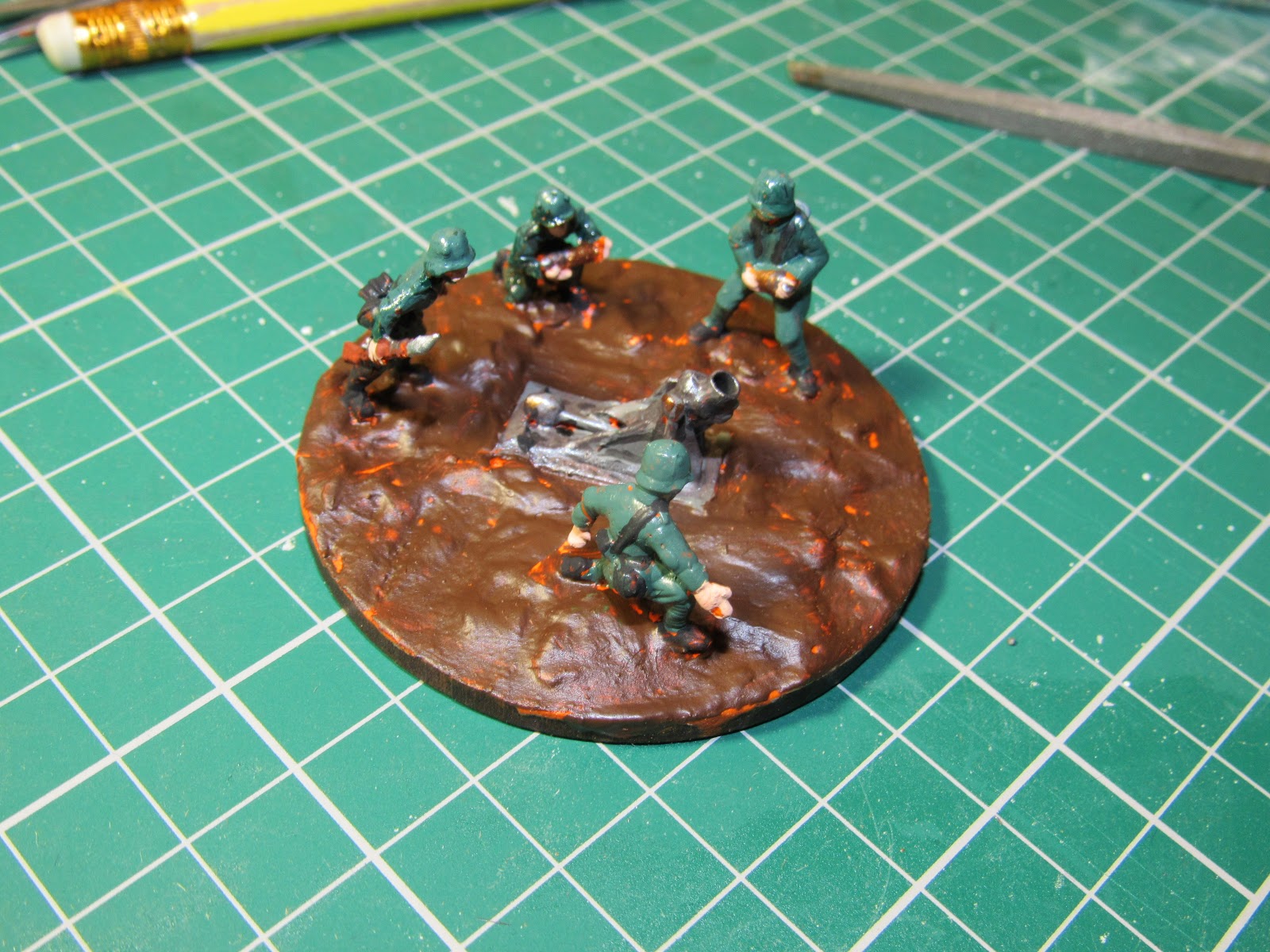
A short while back Iain foolishly asked to see the painted version of my scratch built WWI German 17cm Minenwerfer. And more or less simultaneously Prufrock wrote about common tropes of wargames bloggers. Now I happily put my hand up to most of those he featured, but not as it happens to the one about promising to paint any better in the coming year. I know that I am not a terribly good painter, but I also know that actually my standard of painting is perfectly adequate for what I do with it. So, responding to both Iain and Aaron (beware a man with two, or even three, consecutive vowels in his name - that's my advice), and with due apologies to the late Mr Green, here is an illustrated guide to the art of coarse figure painting, complete with no jokes whatsoever.

My first point is a boring, but necessary one; decent brushes are just as essential to coarse painting as they are to professional standard. I'm sorry, but there it is. I decided to treat myself to some new ones for the New Year and hastened to the establishment of a local artist's supplies entrepreneur (and wargamer). With hindsight the trip was overdue, not so much because the quality of work produced has improved dramatically, but because the pleasure of painting has increased with better tools in my hand.


So, it turns out that I did have plenty of German artillery figures after all and didn't really need to order any. Now I have more. The plastic ones are Hat and the metal ones are Frontline; and they are stuck down with PVC glue. I appreciate that they would be closer to the weapon in action, but that would leave the base looking a bit empty, and they are easier to paint this way. Couldn't I put them on smaller bases? If I'd have thought about things like this before I came up with my basing standards, then yes. Couldn't I paint the figures separately and then base them? I will simply point out that that would involve more work.


Next step is to cover the base with filler, this being where the basing of the weapon on a couple of layers of cardboard comes in to its own. I have abandoned my experiment with lightweight filler, which I found wouldn't stay where I put it, and gone back to the original.


The same dogmatic chap who used to lecture me about banana oil also had a bee in his bonnet about Rustoleum, which he had read on the internet was the only product to use to prime plastic figures. I told him repeatedly that was simply the US brand name of stuff readily available in the UK, but he wouldn't have it and at one point was trying to source some imported cans. He has long since moved on to collecting the shapeless metal figures of his childhood, and I have no idea whether he ever got any. For the record I use Halfords own label, which works fine. For this quantity of figures I don't spray it directly on, I spray some into a pot and brush it on. Choose your vessel carefully. The primer melts the type of plastic used for disposable food bowls; don't bother asking how I know.


I believe that there is a hotly contested debate about the various advantages of undercoating in either black or white, which is why I have always used terracotta. The two strong points for me are firstly that I can see the surface detail to paint the next coat, and secondly that if you miss a bit and the undercoat shows through, then terracotta is very bland and not easily noticed. You may be thinking that the lighting for the photograph is making the terracotta look a bit garish and, well, orange. In fact it is orange. I ran out of terracotta and all I could find quickly was some cheap tubes of artist's acrylic orange in Captain Value. I'm going to put a wash on when I've finished and a matt varnish; it will be all right on the night.


I seem to have forgotten to photograph a few steps. Anyway, I use a method which I have seen described as 'imagining that the little chap is getting dressed'. I paint the flesh first, then the main uniform colour, then the various accoutrements. Apart from Valejo German Uniform, everything is craft acrylics, with no shading, highlighting or any of that arty-farty carrying on.


I then apply a diluted Humbrol enamel wash, black in this case for Germans. The level of dilution is a good question. On this occasion I thought it was much too dark, wiped it off, diluted it some more and reapplied. I appreciate that isn't very scientific, but there you go. As a digression you may notice that the surface of the cutting mat has undergone a bit of damage between the last two photos, following one of those domestic inadvertancies which seem to occur a lot in Casa Epictetus, especially when modelling is going on. This blog doesn't have the budget for competition prizes, but if any wants to take part just for the fun of it, there is huge kudos to the first person to leave a comment correctly identifying what I did.


And here's the finished article, varnished and flocked, with a couple of random sandbags for visual effect. To end where we started, I know it isn't very good, but it is quick and easy to do and entirely fit for the purpose intended. I shall not be attempting to improve.


Friday, 31 August 2018

Tonight, Matthew, I am going to be W.H. Auden

And so to the theatre. I have been to see 'The Habit of Art' by the very much alive, alive, oh, Alan Bennett. This production features David Yelland and Matthew Kelly. You may recognise the former as an actor (he was the Prince of Wales in 'Chariots of Fire' - the Nazi sympathising one, not the chap who speaks to plants) more than you do the latter. However though Kelly is perhaps best known for lowbrow television that was always by way of a diversion from his career on stage (*). He trained with Richard Griffiths, much esteemed by this blog and a frequent actor in Bennett's plays and films, indeed he was the originator of the part played here by Kelly.


The play is, of course, very funny and very clever; certainly too clever for me to be able to give much insight in to what it's really about, beyond the imaginary meeting portrayed between Auden and Britten in Oxford some thirty years after they fell out and stopped speaking to each other. The nuances of gay identity examined are somewhat beyond me, although I did get the impression that Bennett is more sympathetic to Auden's more straightforward approach to trade than to Britten's penchant for young boys. There was some discussion of 'Death in Venice' (astonishingly Thomas Mann turned out to be Auden's father in law; much of the surprise obviously coming from the idea of him having been married in the first place) and the judgement on the composer's intention was somewhat harsher than mine. Bennett also finds time, via a play within the play, to poke fun at actors. This mise en abyme - in which the fictitious meeting takes place - is called 'Caliban's Day' reflecting Auden's apparent view that the end of 'The Tempest' could have been improved. Interestingly the way that Bennett chooses to end his play is with what is essentially a quote from Macbeth.


I know it's from Macbeth because I've just seen that as well. I saw the remaining three plays at the pop-up Shakespeare's Rose in York. As well as the Scottish play these were A Midsummer Night's Dream and Romeo & Juliet. I and the elder Miss Epictetus, on holiday from university at the moment, rather enjoyed them all, although the critical reaction elsewhere was mixed. The place didn't have as much atmosphere as the Globe, but I rather enjoy standing up to watch Shakespeare. If I have criticism it would be that they staged the full version of each play; there is undoubtedly a good reason why an edited text is normally used.


(*) I had only seen him once before, giving his Malvolio to an audience that seemed to consist entirely of me and several hundred convent schoolgirls. It was disconcerting even for someone of my experience and sang froid, but at least I didn't have to queue for the toilet during the interval.

Saturday, 31 December 2016

2016

At the beginning of the year I thought I'd be clever and keep track of things that happened in a draft blog posting, thus making the inevitable - assuming that the Lord spared me - year end review much easier. Obviously it was too clever for me, because at least twice I accidentally published the draft post before hurriedly taking it back down again. Anyway, for those of you who haven't seen it as we've gone along, here are the highlights of the year:

Opera:  I've seen fifteen operas this year, which is possibly some kind of record for me. I'm going to nominate the one that wasn't really an opera as my favourite, namely 'Into the Woods'; it's my list and I shall do what I want. If one wants to be difficult and exclude it then I would go for 'Aida' in the amphitheatre at Verona; quite spectacular. The least effective moment for me was the title character's backside being flaunted in 'Suor Angelica; quite ridiculous.

Theatre: I've seen twenty seven plays, the best being the revival of 'An Inspector Calls', followed by the charming 'Simply Ballroom' and the RSC's 'A Midsummer Nights Dream'. Worst by some way was the execrable science fiction dramatisation of 'Villette'

Film of the year: I've seen ten of these, which is certainly a step up in number on previous years and, apart from the very average 'A Streetcat Named Bob' they were all excellent. I'm going to plump for Tarantino's 'The Hateful Eight' as the best with honourable mentions for Alan Bennett's 'The Lady in the Van' and Jane Austen's 'Love & Friendship'.

Gig of the Year : I've lost count of the gigs that I've been to, and can only say with any certainty that it's more than thirty five. Van Morrison was the best with a shout out for the Jon Palmer Acoustic Band supported by Yan Tan Tether (the night they recorded their live album not the night they sang all the Christmas songs) and also the Jar Family. On a less happy note, for the second year in succession I had a ticket to see Graham Parker and didn't make it.

Book of the Year: The least surprising category of the lot. If you hadn't worked out that it was going to be Heretic Dawn, the third volume of Robert Merle's Fortunes of France series, then you haven't been paying attention.


Walk of the Year: As the big bouncy woman and I didn't get to walk anywhere this year - and how sad is that? - I'm going for a visit to Buckden, Cray and Hubberholme that the elder Miss Epictetus and I made shortly before the onset of adult life proper took her away from me. A Ramblers walk to Crummockdale also sticks in the memory.

Event of the Year: There were many candidates, quite a few revolving around ambulance trips to A&E; the first CT scan that I had was a very odd experience as well. The great base fire deserves a mention as does the time that the kettle exploded; nothing much resulted on either occasion, but they were very disconcerting. The training day before May half term was a real highlight, not least because the rest of the year was crammed with things getting in the way. However, I'm going to choose my 60th birthday when my daughters took me to Whitby for the day, and didn't we have a lovely time.


Sunday, 4 September 2016

Une piece bien faite

And so to the theatre. I have been to see Alan Ayckbourn's 'Relatively Speaking'. Whilst there is an overlap with the themes of 'Deep Blue Sea' and both are 'well-made' plays - Rattigan's because that's what he did and Ayckbourn's because Stephen Joseph told him to write one - this piece isn't trying to make any particular point; the author fully abides by the limits that farce places on character depth and development. He's just trying to make people laugh and, as usual with this playwright, he succeeds. It's a very funny play, despite essentially being one joke stretched over two hours. And as it happened the largest laugh came in response to the suggestion that a husband's shame at finding out that his wife is having an affair would apparently be all the greater if it was discovered that the man in question was very much older than her, albeit coupled with admiration for the fact that the lover was still up to it at his age.

The stars were Robert Powell and Liza Goddard. I don't wish to diminish Goddard's career, but surely the most interesting thing about her is that she has been married to both Doctor Who and Alvin Stardust; she should be a pub quiz question. Powell on the other hand will always be, at least for someone of my vintage, the Son of God in Zeffirelli's 'Jesus of Nazereth'.


Possibly the least followed of all Christ's teachings, although there are many contenders

Powell had no problems delivering Ayckbourn's lines though; after all he had long ago demonstrated his comedic chops in 'The Detectives' with Jasper Carrot. If you've never seen it then you're in for a treat; it can be found on YouTube.


Possibly the funniest of the episodes of 'The Detectives'; although there are many contenders

I can't remember whether I mentioned it, but the Carmen I saw in Verona was also directed by Zeffirelli. He is, and like Alan Bennett he is still thankfully with us, a man of huge influence and range of achievements. My own personal favourite is that he was reputedly the inspiration for Uncle Monty in 'Withnail and I' as played by the late, great Richard Griffiths: "There is a certain je ne sais quoi - oh, so very special - about a firm, young carrot...Excuse me..."

Wednesday, 6 July 2016

I think sexual intercourse is in order, Gilbert.

And so to the theatre. Readers may recall the film 'A Private Function' from thirty odd years ago, featuring a pig-napping of the sort which often appear in P.G. Wodehouse's Blandings novels. The film has particular resonance with this blog because the screenplay was written by one of our heroes, the thankfully still very much alive Alan Bennett; because much of it was filmed in Ilkley, the epicentre of wargaming in lower Wharfedale; and because the most sympathetic character, played by another of our heroes, the sadly no longer with us Richard Griffiths, is an accountant. I have now been to see the stage musical version, 'Betty Blue Eyes'.


I'm not really, despite what the lady in the kitchen shop may think, much of a fan of musical theatre, but I have to say that I enjoyed it enormously. In translation from the big screen to the stage and from comedy to musical some things have been added and some lost. It's a while since I have seen the film, but I don't recall dancing girls (and I mean full-on Moulin Rouge style dancing girls) appearing in anyone's front room, nor indeed cameo appearances from Princess Elizabeth and Prince Philip.  And, spoiler alert, the fate of the pig has been, how shall we say, made more suitable for family audiences. But it all hurtles along nicely, there are still references to Lady Macbeth for the the intellectually inclined and fart jokes for everyone else, and the cast gave it their all.


Star of the show is the animatronic pig - how could it be otherwise - which is better behaved than one assumes a real one would be. Indeed there are stories of Dame Maggie Smith being chased round a kitchen by one of those used in the film. The pretend pig followed the script perfectly until right at the end when, after taking its bow, it suddenly careered into the scenery and knocked one of its ears off. They should have stuck to that old showbiz rule: never work with children or radio-controlled animals.

Friday, 15 January 2016

Bennett is back

And so to the cinema. I'm on a roll with my resolution to see more films, although to some extent I'm still in catch-up mode. I have been to see 'The Lady in the Van', and was most entertained. It's been out for a few weeks now and I was the only person in a 250 seat screen, which was somewhat disconcerting; although I'm sure I could get used to private screenings in due course. As regular readers will know I like a bit of Alan Bennett and this is a fine example of his work. He actually makes a cameo himself - possibly to dispel rumours of his death - and for added value the actor playing him doubles up, often appearing on screen with himself. On top of that we have the marvellous Maggie Smith in the title role. Excellent stuff which I was pleased to say included a chunk of untranslated French dialogue.

'Allo, 'Allo

Speaking of readers, this blog's have declined significantly in number. I'm not referring to the arbitrary peak at the time of the sultry woman in uniform video. I'm talking about the fact that the numbers have suddenly halved from the previous normal run rate. This doesn't actually bother me. I am - how shall we say - philosophical. Ceux qui restent sont évidemment la crème de la crème.


And speaking in turn of philosophy, I should like - as a leading Stoic thinker - to offer some advice. This is intended mainly for the boyfriend of the younger Miss Epictetus, but may possibly find some resonance with a few of my remaining readers. It is this: the best way to avoid having one's money stolen from one's trousers while dancing and singing onstage at a ladyboy show is not to take one's trousers off in order to dance and sing on stage at a ladyboy show. You're welcome.

Wednesday, 7 October 2015

To prove a villain

And so to the theatre. "Thank God," you all cry "five days wargaming in a row is not why we read this blog". That begs several questions, but we shall ignore them and plough on; and at least it's a play about a soldier. Accompanied once more by the elder Miss Epictetus - the younger Miss Epictetus does exist, but is far too cool to be seen in the company of her aged parent - I have been to the West Yorkshire Playhouse to see Reece Dinsdale give his Richard III.


The last time I saw him was in the same theatre last year where he played Alan Bennett. In a sense he is again playing another familiar character - although, unlike Bennett, this one is thankfully dead - because his Richard is quite clearly Hitler. As the Guardian review points out "in the early 1930s, the British press often made fun of Hitler, misled by his appearance into believing that he posed no real threat" and Dinsdale produces more than a few moments of real laugh-out-loud humour. I was wondering what his performance reminded me of, but I think that Jo Haywood has it right in the Yorkshire Life review: he's channelling Leonard Rossiter. Imagine a serial-killing Rigsby only using one arm and wearing one built up shoe and you're there. The WYP seems to be having a season of shoe based disability productions. In 'The Glass Menagerie' the actress represented lameness by only wearing one shoe wile the rest of the cast wore none. That felt crass, frankly walking with a limp would have sufficed, but Richard does need a bit more visible deformity.


The Richard as fascist dictator theme is not new - the last modern dress version that I saw was Sir Ian McKellen's iconic production twenty five years ago at the National Theatre where he played the part as Moseley - but that's because it works very well. So too does the stark stage design and the sound effects and intermittent background music. Less happy is having parts of the dialogue literally telephoned in from offstage, and some of the doubling up of parts caused a little confusion. Overall though it provided an excellent finale to my late summer and autumn of Shakespeare.

Wednesday, 26 August 2015

Your questions answered

 I have found it easiest to collect all the questions received from readers and answer them in one post:
  1. I did know that the story about George Brown isn't actually true. Surprisingly enough, many things on this blog should be taken with a pinch of salt. Indeed, even when it comes to wargaming the only facts contained herein which you can truly rely on are that Peter will roll lots of ones, that James will change the rules half way through, and that no one will ever be able to agree on the definition of a flank attack.
  2. I did not know that carved mice by Mousey 'Bloody' Mouseman could be found absolutely everywhere. I am now considering writing the definitive guide to places that they aren't; which obviously won't include Peter's house.
  3. 'love is more thicker than forget' is not a grammatical error; it is a quote from e.e. cummings
  4. Ælfric's warning came in his introduction to the homiletic writings of Archbishop Wulfstan.
  5. Alan Bennett is still alive. (I know, me too.)
  6. K.T. Tunstall was born on June 23rd, 1975. (I know, me too.)
  7.  Потому что я претенциозный пизда
  8. a) Mind your own business, but see Robert Crumb's cartoon as a reference point. b) A courgette, a marrow, runner beans and some rosemary..Oh, and some Italian espresso coffee beans, but no octopus.
  9. Belgium, again. Or, to be more precise, again not.
  10. Job Chapter 19 Verse 23 

Friday, 21 August 2015

Of Mice and Men

I have been walking again, this time in Langstrothdale, where the Wharfe rises.


Mention must be made of the church of St Michael and All Angels at Hubberholme, pretty much at the point where Langstrothdale meets Wharfedale. Whilst the building is 12th century the pews were made by Robert 'Mouseman' Thompson and bear his distinctive motif. I'm afraid the photo is culled from the interweb rather than being taken by me. You all by now know the story of my camera and the Young Farmers Ladies Tug-of-War contest, so I won't repeat it (although I may just take a break for a moment's quiet personal reflection). Anyway, I think was the first time I'd seen such mice in the flesh as it were and they were fascinating.


The other noteworthy fact about the church fits into my recent theme of heavyweights of the past. It is the resting place of the ashes of John Boynton Priestley. One can't say that he is forgotten - in the past few years years I've seen productions of both 'An Inspector Calls' and 'When We Are Married'  and one of my daughters studied the former for her GCSE - although his novels don't seem to be read much any more. That's a shame, because 'The Good Companions' is a lovely, charming book and the plot of 'Angel Pavement' depends on a very accurately described accounting twist; possibly a minority interest that last point.


But as well as his literary output, and not overlooking the serious injury he received during the Great War, he held a place as a sort of public intellectual, making morale boosting broadcasts during the second war (credited by many with setting the scene for the post-war introduction of the welfare state) and campaigning against nuclear weapons. During my period as an undergraduate in the 1970s he was regarded as the greatest living Bradfordian in the same way that Alan Bennett might currently be regarded as the greatest living Leodensian. I can however proudly state that, while a student, I never once set foot in the J.B. Priestley library on campus.

Monday, 17 August 2015

Superthunderstingcar

Yesterday's post inevitably reminded me of this:


The late Peter Cook and Dudley Moore, also known for their work with the very much alive Alan Bennett, in fine form.

I used to have one of the ping pong ball firing guns featured in the clip. Happy days.

Tuesday, 21 April 2015

Epicurism and Lust

And so to the theatre. I have always thought that Lear was the part that Barrie Rutter was born to play. So it was with much anticipation that I went to Northern Broadsides latest touring production. My hopes were completely vindicated although perhaps not in the way that I had expected. Rather than giving it both barrels, Rutter's performance is restrained and, dare one say it, dignified. Whilst I was initially somewhat disappointed by the lack of ham or fireworks I must admit that he and director Jonathan Miller (1), not unsurprisingly, knew better than me. The production is of high standard throughout, from Fine Time Fontayne's Fool, through the excellent nastiness of Regan and Goneril, to the campest of Oswalds, and indeed the rest of the cast.


He loves a hat

I was accompanied by my elder daughter and, despite her being only twenty, this was the second time we had seen King Lear together, perhaps an indication of my cruelty to my children in the name of culture. On the previous occasion we had been to see it, with Tim Piggot-Smith giving us his take on the role, the lady sitting next to us died half way through the first act, at considerable inconvenience to all, except for those on stage who carried on regardless in the finest traditions of show business. This time nothing untoward happened, the empty seat to my left maybe indicating that someone had had the courtesy to pass away before setting off instead of spoiling the day for everyone else.


(1) Originally known of course for Beyond the Fringe alongside Peter Cook, Dudley Moore and Alan Bennett. Cook and Moore are sadly no longer with us, but thankfully Bennett is still around to keep Miller company.

Saturday, 21 March 2015

Pass it on

And so to the theatre. I have been to a very fine performance of 'The History Boys', written of course by the thankfully-still-with-us Alan Bennett. I've seen the play in the theatre before, as well as having watched the film, and admire it for many reasons. Its ability to transcend being set in the 1980s without any references to that decade - indeed with all the detail about Oxbridge entrance being well out of date even at that time - and still not annoy even the most pedantic members of the audience (i.e. me) shows how dramatically strong it is. Plus it addresses the value or otherwise of the various ways of engaging with culture. Does one allow it inside oneself, to change one as an individual slowly over time, or does one simply acquire 'gobbets' to be regurgitated to impress?

Not dead yet

Salvador Dali disparaged the performing arts because of their ephemeral nature. It has been suggested that Bennett was in this play drawing a parallel between history and theatre; both existing only for a moment and then living on solely in the memories of those who witnessed it and what they pass on to others. I think that, in its own small way, wargaming is also like that. I shall in future classify my opponents into the Lintott-like sticklers for fact, the Irwin-like cynical win-at-all-cost types and, my own clear preference, the poetic Hectors (minus the ball-cradling obviously).


A dog in a hat


There has been some comment on your bloggist's tendency to include passages and quotations in foreign languages, and his possible motivations for so doing (*). The History Boys contains a longish scene early in the first act which is entirely in French. Bennett clearly sees no need to translate or explain and it didn't seem to affect the enjoyment of the audience last night. Discuss.


(*) For once Monsieur Fwa is incorrect; I don't do it to annoy. I do it because I am a superficial pseudo-intellectual regurgitating my gobbets.

Sunday, 15 June 2014

Ragnarøkkr

And so to the Town Hall, Leeds Town Hall to be precise, for Götterdämmerung, the culmination of Opera North's four season run through Wagner's 'Das Ring des Nibelungen'. It was performed there rather than at the Grand Theatre because like the whole series it was a staged concert, meaning that the singers perform in evening dress (except for the chap playing Siegfried who appeared to share a stylist with Meatloaf) with orchestra on stage and with the surtitles expanded into full audio/visual splendour, full of rippling Rhine and blood coloured flames.


Anyway it was good stuff with the band being in spectacular form as they have been throughout the whole affair. It's a good venue too and was referenced to in "Untold Stories", the Alan Bennett play I saw a couple of weeks ago. The author recounted his introduction to classical music had come from the cheap seats on stage behind the double basses: "like watching the circus from behind the elephants". For this performance these seats were for part of the time occupied by the chorus. I myself have been gradually working my was backwards over the years since 'Das Rheingold' and was on this occasion at the end of the back row thus enabling a quick getaway to the pub for the second interval. (The whole performance lasted six and a half hours and featured two intervals; the first was spent in Wagamama with my daughters in an early Father's Day celebration.) I arrived in the Victoria Hotel ahead of my fellow audience members, but still found myself in a queue for service behind the said chorus whose exit had been even speedier and who were now lubricating their vocal chords prior to the final hour and a half. Don't worry though, I did manage to get a pint of London Pride in.


The story makes no sense whatsoever of course and, as an aside, I can't for the life of me see why the Nazis were so keen on it; apart from anything else the hero is out-witted and then killed before fulfilling his destiny to become ruler of the world. Virtually all the characters are unsympathetic and behave appallingly (perhaps that's a clue as to why Hitler approved). Following Siegfried's death towards the end, Brünnhilde performs suttee on his pyre to demonstrate the intensity of her love for him. Now call me pedantic ["You're pedantic!"], but if I've got the chronology right she'd only known him two days. And while I would normally have no truck with bourgeois morality, I find it hard to see beyond the fact that she's his aunt; that's just wrong.

Monday, 9 June 2014

Every leaf speaks bliss to me

So, once again I have been wasting time on women, beer and revolutionary socialism that could have been more profitably spent blogging. Actually, revolutionary socialism has taken a bit of a back seat for the last forty years or so; and, now I think about it, I don't drink any more. Still, something somewhere has got in the way.

Anyway, what about the Punic Wars? In the strategic turn just ended I had a hand like a foot and was therefore rather relieved to record a victory on the battlefield. I had no naval move cards at all so my adventure in North Africa was short lived. This time round - only one card played so far - I have a stonking good hand and the Carthaginians better watch out because their boys are in for one hell of  beating. Oh yes! Anyway, the only card played so far caused Hannibal to advance on Scipio Africanus who has just turned up and is his match in every regard. Or at least was, because he is wounded and hors de combat along with one of his commanders, a fact which I think puts the current odds at about 4-1 against a Roman victory in a battle that is nearing its end.


In addition I have been to the theatre to see some Alan Bennett, who - may I just remind you all - is very much still with us and has not yet ceased to be. In fact he was very much sort of there because the play, 'Untold Stories', features him as a character. It was naturally very funny, somewhat poignant (dealing as it did with the death of his parents) and altogether excellent stuff. It even featured a cameo appearance from the ghost of J.B. Priestley.

A number of boardgames have been played including Revolver, Carcassonne, Love Letter and one new one, Sail to India. The last is another minimalist Japanese design, packs a lot into a small, relatively inexpensive box and is recommended.

Saturday, 9 November 2013

Il Gattopardo - not!


And so to the theatre. The National Theatre production of Alan Bennett’s latest play is on at the Grand in Leeds. Now, as you may or may not be aware, there are some other wargames blogs which would like you to believe – for some no doubt nefarious end of their own – that Mr Bennett is no longer with us, that he has ceased to be, that he has shuffled of this mortal coil. Happily this is not the case and he continues to amuse us. He is furthermore, and certainly since the demise and disgrace of the other chap that we don’t mention any more, Leeds’ most famous son and the theatre was suitably packed.


"I write plays about things that I can't resolve in my mind"


The large audience was rewarded with some fine acting and a lot of laughs. Whether there was any deeper message is more debatable. The main character spent so long proclaiming that her story wasn’t a metaphor for the state in which England (sic) finds itself that one must surely assume that in fact that’s exactly what it was supposed to be. However, personally I don’t have either empathy or sympathy with the rich fallen on hard times so it all rather passed me by. The author scored points at the expense of relatively easy targets such as Thatcher, the National Trust, oligarchs, but I can’t have been the only one to be uncomfortable with his benign view of pornography; those scenes were however rather funny and very well staged.


The National Trust is a Nazi trust, smash the National Trust

 So, an entertaining night out, but not – for me anyway - a classic. For a genuine classic on a similar theme try reading Lampedusa’s ‘The Leopard’; “Si queremos que todo siga como está, es preciso que todo cambie”, which I think is probably the point that Bennett is trying to make..