Showing posts with label Lion Rampant. Show all posts

Wednesday, 4 January 2023

Ramparts Unclimbed

 A couple of months ago I posted photos of the forces laid out for the final assault in the siege game that has been clogging up the table in the annexe since the middle of last year. I have actually played it out, I just haven't written it up. The reason for that was that it became obvious fairly quickly that it was impossible for the attackers to succeed using the combination of the rules as written, the forces as chosen and the tactics which I was employing. 


A small part of the problem was that the defenders had won every one of the preliminary siege rounds, forcing the besiegers to attack before they had built all the siege equipment they otherwise might have and without the level of superiority of forces they would have wished for. Possibly also I had jinxed them a bit by writing in that last post: "I don't see how the attackers can lose". However the main problem is that assault by escalade is exceedingly difficult. Now, obviously it should be, but then again one wants a balanced game. I came away with a number of thoughts as to how to tweak things, for example I think more, but smaller, defending units might work better. The attackers also need to concentrate their efforts to gain local superiority. I had held off posting about it pending trying those out, but have decided to move on and do something else completely.

So, overall I thought the rules, which you will recall were published about a year ago in Miniature Wargames, were an interesting way to represent a medieval siege. They could also provide a platform to build on to include some of the aspects which Vauban's Wars introduced effectively e.g. food, spies, disease. The part that didn't work for me was the assault, but funnily enough that's the bit that isn't handled well by VW either. 

Monday, 7 November 2022

Stoptober

 Stoptober is all about giving up smoking, but I seem to have given up wargaming for the month instead. No particular reason, just the usual real life stuff getting in the way (*). Nothing particularly bad, although I had an injection in one of my legs at one point, which apart from being painful in itself left me rather immobile for a couple of days. Anyway, before the Rhetorical Pedant puts in an appearance let me acknowledge that I had a relapse mid-month, when I played out the game that had been sitting on the table in the annexe for quite a while. And that's where we pick it up again in November. Having lost a significant part of their food supply, and of course aware that help has been sent for, the besiegers have no option but to launch an assault.


One driver for playing this was to get some of my siege equipment on to the table, but due to the defenders feistiness the only one that has made it is the siege tower.


When I first read the 'Vauban's Wars' rules for 18th century sieges I had a think about whether they could be amended for the medieval period, before deciding that they probably couldn't. The little campaign from Miniature Wargames that I have been playing has been fine, but perhaps a little over-simplistic. I like the fact that there will definitely be a final assault, but would have welcomed a bit more to and fro between besieger and defender in the run up to it. For example, the besieger's bombard never got a look in. Maybe some of the relevant elements in VW - food, spies, disease all spring to mind - could be usefully incorporated. 


Just looking at the table I don't see how the attackers can lose, but I shall have to wait to see how the rules for ladders etc actually work in practice. To be continued - eventually.


* For those that know me well, on this occasion it wasn't actually 'the usual'.

Wednesday, 12 October 2022

Keep them dogies movin'

 "Whatever happened to the siege you were playing using Lion Rampant?" asked absolutely no one. Well, it fell victim to the double edged sword that is having a dedicated wargames room, or in my case a dedicated wargames outhouse. The great thing about them is that you can leave stuff set up for as long as you like, whereas on the other hand if you are, like me, easily tempted away by other ways of spending your time then out of sight out of mind. Anyway, the other stuff having come to a natural and inevitable conclusion I have returned chastened to the world of toy soldiers vowing never again.

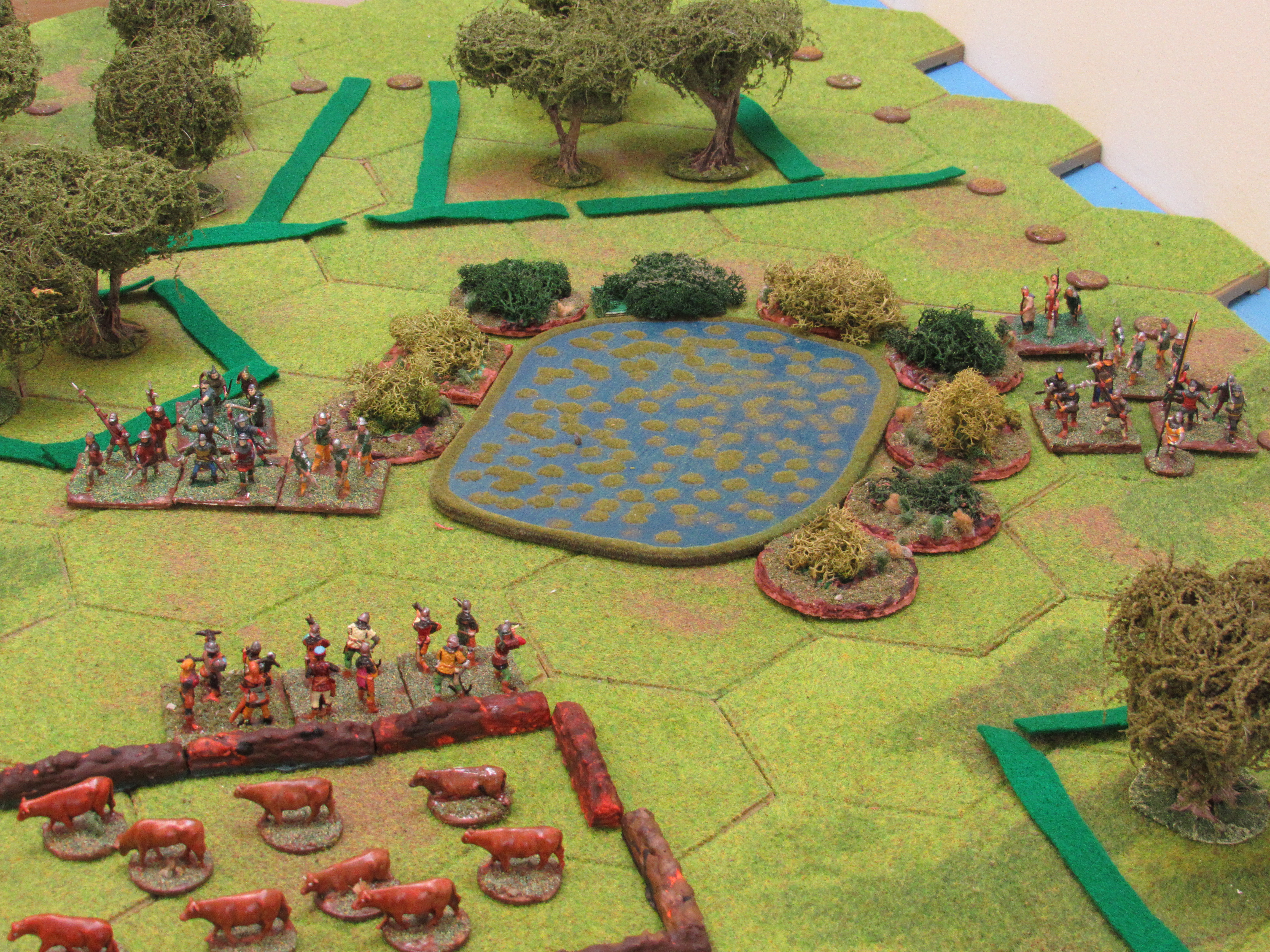
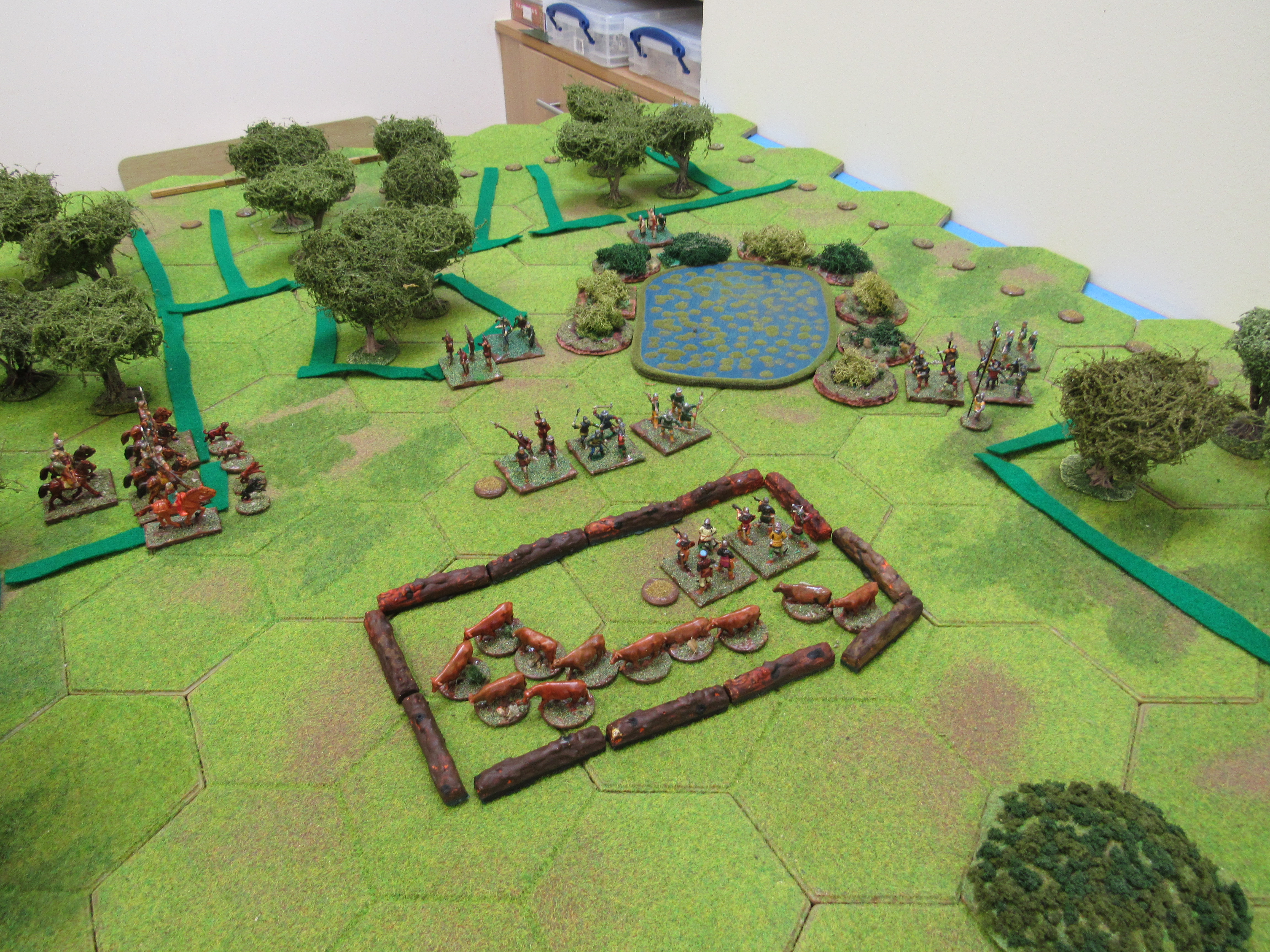
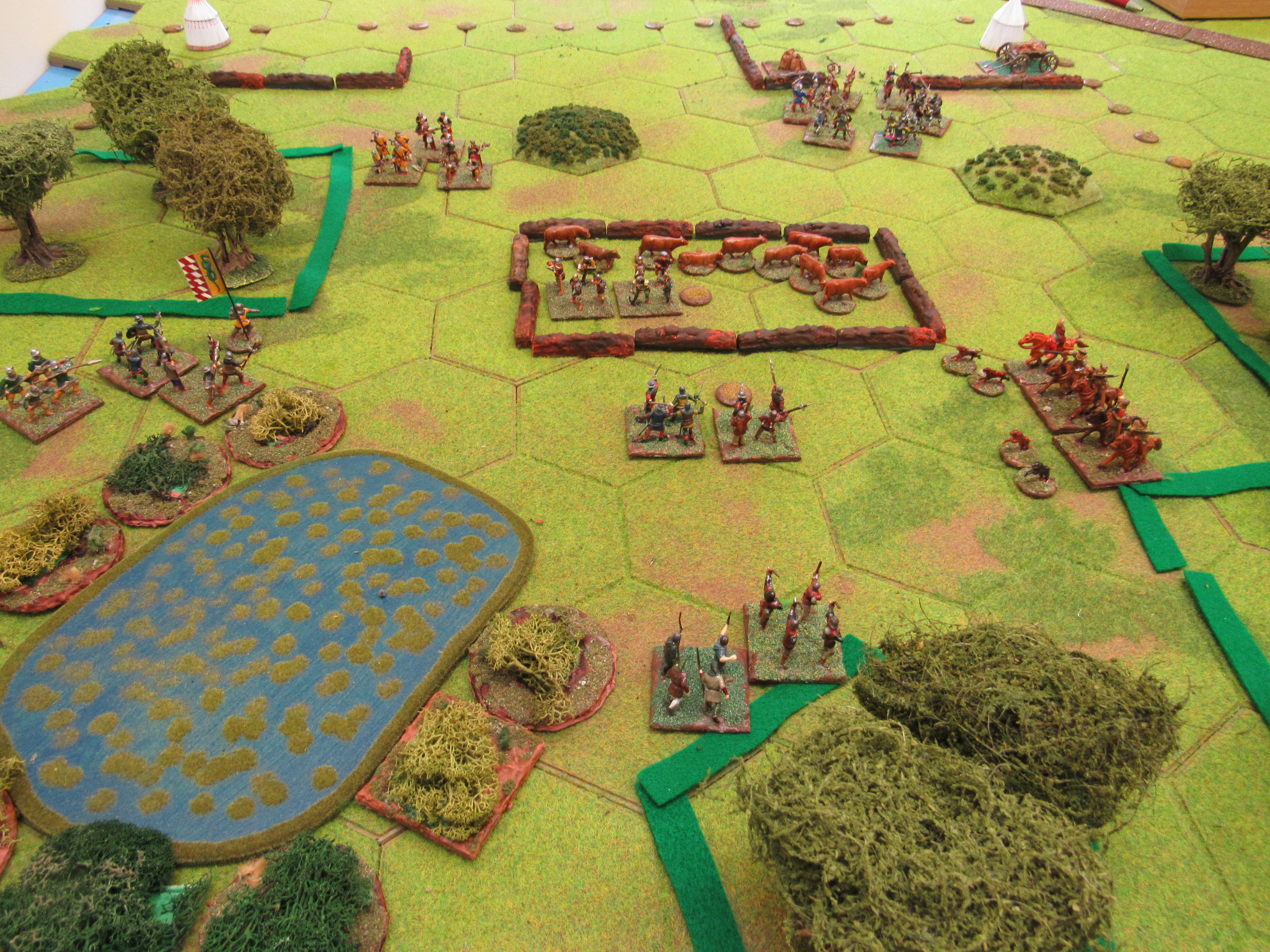
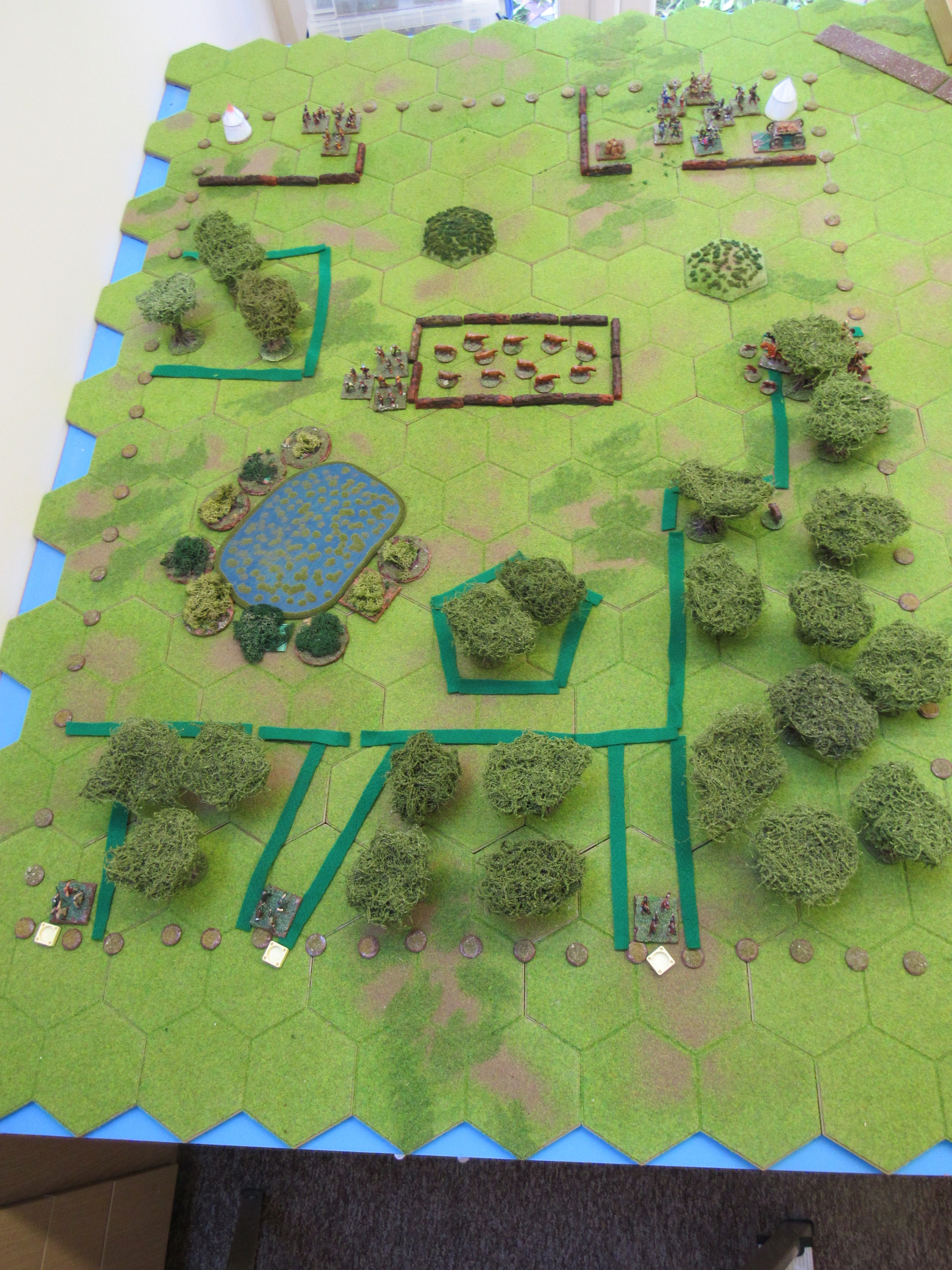
You may recall, although if you do then you're doing better than me, that the game languishing for the last couple of months was an attempt by the defenders to drive off the besiegers' cattle herd. In the photo above the raiders have been successfully guided out of the woods by their local associates, the hunting party is making its way towards them (top right) and those in the camp haven't stirred. The following notes are for my own future reference really:

  • The three parties of attackers all got a chance to activate each turn whilst still in the wood regardless of any failures. As it happens there weren't any failures.
  • The besiegers in the camp had to activate once to be, as it were, aroused before they could move. This proved to be an important factor.
  • As in previous games I tweaked the base unit stats in the rules (and as a digression I played this game with version 2 of the rules, having acquired those since I last pushed plastic) to match what was on the table. Oddly enough the rules don't cover such basic troop types as an early-morning boar-hunting party. I was too lazy to write these tweaks down; this was a mistake and caused me no end of confusion.
  • I had decided to have a couple of the units start the game split up e.g. half a unit of crossbowmen were on guard and half were asleep in the camp. The base rules give twelve combat dice until the unit is at half strength and six thereafter. To accommodate my half units I switched to two or four dice per stand left, depending on troop type, which seemed to work OK. It does mean that eventually a unit won't be able to inflict any hits and that this will happen sooner the more armoured the unit which they are facing. I figured that I could live with that. In retrospect though I clearly forgot to make a corresponding change to the courage test rules, so need to remember to do that next time.


It is now revealed which of the raiding parties are real, which was the blind and also the location of their insipid leader.


The crossbowmen guarding the herd have been driven back (if I'd changed the courage test properly they may well have been destroyed), but the raiders have to look to their flank as the hunting party emerges from the wood. There are no combat dice for the dogs; perhaps there should be. To win the game, the raiders have to be in contact with the pen at the end of the turn, without any enemy presence.


The hunting party charged home, honours were fairly even in the melee, but then they rolled very badly in the courage test and had to retreat. Those in the camp have belatedly started to move forwards.


In fact, they have moved so far forward they have reached the pen just in time. This is just as well because the hunting party has had trouble rallying themselves.


They eventually did so and with a total reversal of their dice rolling they completely wiped out one of the raiding parties, at the cost of once again failing their own courage test. The infantry bottom left are similarly broken and the melee just about to happen will see the same happen to the crossbowmen, whose retreat leaves the raiders having achieved their victory conditions. The defenders in this siege have now won every round.


Sunday, 14 August 2022

Lard Workshop

 The lack of postings here, and the fact that medieval cattle raid hasn't been played yet, are of course due to scorchio. Indeed the only reason I am writing this now, is that the cumulative effect has all been too much and I have retreated indoors. This is not to say that there has been no wargaming. We completed our second game of 'Soldiers of Napoleon', about which rules I have nothing to add to what I have said previously. We shall have a go next week with move distances tweaked to match the specific size of table and bases, and I shall report back. It was fairly sweaty in the legendary wargames room on Wednesday, but nothing to compare with the sauna that was the Old Chemistry Theatre at Nottingham Trent University on Saturday for the inaugural Lard Workshop (*).

The Workshop, which took place alongside the BHGS Britcon show, was organised by Don, my old (very old) school friend and bandmate, despite which it was a great success. I for one thoroughly enjoyed it, and had a blast. And no one could say that it wasn't excellent value for money. For £15 one got a £5 voucher to spend with the traders, a free sandwich lunch (which was rather good I thought) and to play two games; what's not to like? The one thing wrong with it was the heat, plus it was very noisy. So the only two things wrong with it were the heat, the noise and the fact that the toilets were a long walk given that middle aged men need to visit fairly often. Having said that, there were a couple of gamers involved who clearly didn't have prostates, which was the first time I've seen so many female wargamers since, well, since forever; another good thing.

I was travelling light and didn't bring a decent camera, which I regret because the eighteen games on offer were all worth photographing. There was a Far East set game of Chain of Command (possibly run by Richard Clarke himself; I wish I'd taken some notes as well as some pictures) which had more terrain crammed on to one table than I can remember ever seeing before. Very sadly I only took one photo of David Hunter's game of 'Infamy, Infamy', which I played in the afternoon, and that is very far from doing the table justice.
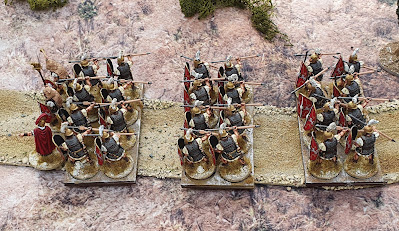

I'm playing the chap at the front left, tasked with getting my men along the road to a camp manned only by some unreliable slaves. The game was set in the civil wars of the early first century BC and, while I didn't get anywhere near the camp my Gallic ally and I had killed enough Italian rebels en route to win the game. I had played Infamy once, pre-publication and pre-pandemic, and despite reading through them again was feeling a bit lost at the start. However, as the game progressed I found it all began to make sense (**). Maybe I should get the chariots out before I forget it all again. 

You've got to love a measuring stick

I took more - and more useful - photos of the game I had played in the morning, Sidney Roundwood's 'Flashing Blades'. It wasn't hard to get a larger amount of the action into the picture because everything happened in a 2ft x 2ft square. It's not obvious from the above, but it's mounted on a Lazy Susan (£14 from Amazon according to Sidney) and players seated around the table can easily turn it to allow them to move their musketeer. Because the Mousquetaires du Roi, opposed inevitably by the Cardinal's Red Guards, are what this cracking little game is all about. The rules are not yet published (***), but they are in a pretty polished state already. The rules have quite a lot of the boardgame about them - and I mean that in a good way - and produce a result that, at least in our game, was a positively cinematic narrative arc. I loved the game, almost, but not quite, with the same passion that James has for SoN. And that was only a little bit helped by it being one of my characters, Monseigneur d'Eclair, who rescued the Comtesse de Chablis from the scaffold and spirited her away.
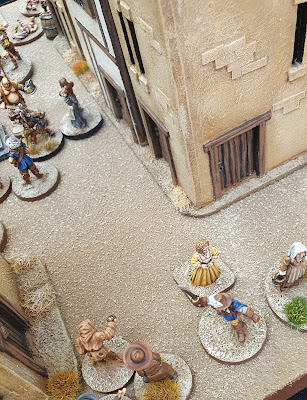

D'Eclair leads la Comtesse away through a crowd of Parisians

Interestingly, in the afternoon Sidney ran a Samurai scenario using the same mechanics. As for what I spent my £5 on: a copy of the second edition of Lion Rampant, of which more when I have read it. To conclude, thanks to David, Sidney, my various teammates and opponents, Richard Clarke and, in particular, to Don for a most enjoyable, albeit hot, day of wargaming.


* If you are going to Google that, then I would try to be precise in your search terms unless you genuinely wish to find out the best way to render lard, which is a very different thing and quite possibly smells even worse that a hot room full of wargamers.

** Except perhaps the close combat rules, which are, shall we say, convoluted.

*** Next year possibly, depending on the rest of TFL's publishing schedule.

Saturday, 6 August 2022

Let Loose The Cows Of War

 "Cow-slaughter and man-slaughter are two sides of the same coin" - Mahatma Gandhi

On the second turn the besiegers start to construct some siege equipment, mainly because the original purpose of this whole thing was to get mine out on the table. However, they were obviously too close to the walls because on their turn the defenders were able to destroy it with missile fire. On the next turn the attackers started over again with the sawing and nailing, this time a bit further away. The defenders, who are apparently a feisty bunch, decided to 'Sally Forth'. After a bit more dice rolling their target was revealed as the besiegers' food supply, more specifically their herd of cattle. If they can kill or drive off sufficient of them the besiegers' ability to sustain an extended siege will, not for the first time, be impeded.


The friendly foresters, who have made a remarkable recovery after being ridden down by their social superiors during the previous fracas, are leading a couple of parties of soldiers through secret paths in the woods known only to them. The tiles at the bottom will be turned over when the relevant group is sighted: 1 means it's the group with the leader attached (although he has rolled up as Insipid, so probably not a great deal to be expected from him), 2 will be the other group, and 0 is a blind. The target is the pen in the middle of the table. 


Unfortunately for the raiders, a few of the besiegers' leaders are having an early morning boar hunt, and their dogs, smelling something strange (perhaps the town is already running short of water for washing), have given the alarm. The boar himself seems quite unperturbed by it all. That chap who looks a bit like the messenger in the previous scenario (note to self: get some more medieval civilian horsemen) is their leader, and rolled up as a Braveheart. The hunters will have an activation penalty and be restricted to moving within the wood for the first couple of turns while they work out what's going on. There is half a unit of crossbowmen standing guard over the cattle and they will joined by others from the camp as they respond to all the noise.


Thursday, 4 August 2022

Help is sent for

 "You that way, we this way." - Shakespeare

Lion Rampant has an activation mechanism which poses a similar dilemma to, for example, To The Strongest!. Does one try to move the most useful unit if it is more difficult to do so than activating something which will be of less value? Of course one does, silly question. And so the besieger's Men-at-Arms failed to activate on the first turn, and the defenders' messenger quickly moved twice to the pursuers once.


I diced to see which way that the MAA went, but in any case I think logic says that after failing to move and with the light cavalry screening the other route then what they did was appropriate. A Rash leader attached to unit which already has the Wild Charge attribute means that they must charge at anything in reach. However, I decided that they couldn't see the foresters lying in ambush and so didn't have to.


Elsewhere the besieger's infantry had moved to block the route of the cavalry hoping to delay them until their own heavy cavalry turned up. That unit, right at the top of the next photo, was about to be fired on by the foresters.


The ambush caused no casualties, but now the MAA were aware of the bowmen  they were forced to charge them.


Unsurprisingly they caused many casualties and the foresters fell back Battered (*). They carried on falling back and getting weaker for the rest of the game. One LR rule which I rather like is that Battered units get an automatic chance to rally each turn, but if they fail they retreat further and take another casualty, which in turn makes it less likely they will rally next time.


On the other side of the stream from the watermill there were a couple of cavalry versus infantry melees. The unit with the messenger attached got thrown back, but despite the leader's Vulnerability (which made it three times more likely that he would be a casualty) he survived, as did the messenger. The infantry themselves failed their courage test and fell back Battered. The light cavalry had similarly pushed back and Battered the other infantry unit.


The same light cavalry then destroyed the Battered infantry blocking the way to the exit point allowing through the unit with the messenger. I called the game at that point because the Rash leader will be forced to charge the cavalry behind them (no facings in this game) and the messenger will get three attempts at least to move off table. 

So, the siege game is underway with a victory for the defenders which makes it more likely - but not certain - that the besiegers will have to storm the town before making as many preparations as they would wish. It took an hour or so and passed the time quite nicely. If I was going to do it again I would make the stream a more significant barrier than the basic rules suggest.

* I know that term just means the same in context as Shaken, Broken or Disordered, but it really is a ridiculous word to have chosen.

Wednesday, 3 August 2022

Send for Help!

 Having listed the flaws I'd previously come across in Lion Rampant, I have now been reminded of the good bits: they are really simple and really quick to play. Inevitably they (and we're still talking about the first edition; second edition out imminently) are a bit too simple in some ways.

Our siege starts with the defenders sending out a messenger to request reinforcements. That's him at the back of those troops in the bottom left, who are his bodyguard. If he can get off the board in the top right between the wood and the stream then the siege may possibly be shortened by the arrival of a relief force. This is where the over-simplification starts to affect things. There are no rules for light cavalry without them being missile armed, but that doesn't fit my conception of the admittedly vague period in which the game is set. So the two flanking units are Mounted Yeomen without bows, and the middle one is Mounted Sergeants, being assumed to be a mix of the leader - a knightly sort of chap presumably - and some more light cavalry. I've also given them a small unit of local foresters (Bidowers in LR terms) who, having found out by some unspecified means of the impending breakout, have gathered in the wood in the centre to assist if they can. These are the only troops on the board who have any ranged fire capability.

The besiegers, having been alerted to the messenger's mission have chased after him with a unit of Mounted Men-at-Arms. That's them in the bottom right corner of the first photo. They would appear to have used the tactic beloved by sheriffs and their posses in Hollywood westerns of trying to 'head him off at the pass' by taking a shorter route, despite in this case the messenger being the one with local knowledge. We must suspend disbelief. Their forces are rounded out by some infantry who have been foraging in the surrounding countryside. Because of this they are considered not to be fully armed and armoured and are rated as Foot Yeomen.

The defender's leader has rolled up as Vulnerable, and the besieger's as Rash. This latter attribute will prove to be decisive in the skirmish.

Sunday, 31 July 2022

Rampant, but not relevant

I shall be using Lion Rampant rules for the siege game on the table for no better reason than they're what the article in MW is written around. I have forgotten pretty much everything I ever knew about LR, so thought it worth listing what I think I remember before reading them again. Apart from anything else it's an entry for the most pointless rules review ever. What I am describing is the first edition and the second edition is being published literally next Thursday. So, please ignore what follows.


Haven't got it

I don't think I bought the first edition, I'm pretty sure James passed them onto me having received them from Osprey in return for doing something or other. We had a couple of games and my memory tells me that most of the problems were self inflicted. There was no particular issue with using figures grouped on stands rather than single bases, or with the bookkeeping side of the game. I vaguely recall quite liking the combat resolution element, but I seem to remember being dissatisfied overall because:

  • The playing area was too big. The book suggest 6ft x 4ft, but says smaller would work. My table is 2.5m x 1.5m, we used essentially the whole thing, but everything was too far apart and it took far too long for anything to happen. There's an activation mechanism which provides a nice fog of war, but also slows things down on its own without adding in an oversize table as well. For this game I shall use 120cm x 90cm.
  • There wasn't enough terrain on the table. As I digression I've always found it a bit of a paradox that the larger the scale of the combat being modelled the more the terrain is abstracted away and the table bare, while for smaller scales the opposite is true. Basically, I ignored my own rule of thumb, left big open spaces and it was all very uninteresting. So, put more stuff out this time.
  • The 3" rule. There is a strict prohibition on units coming with 3" of each other, which we followed to the letter and which was a monumental pain in the arse without seeming to have any upside to compensate. Subsequently I saw a group playing the rules at a show and they ignored this rule totally, and, who'd have guessed, nothing bad happened. This rule is in the bin.
There you go, a list of the things I probably did wrong, but possibly may not have, quite a few years ago with a set of rules that have been updated since anyway. This blog remains at the cutting edge. 


Saturday, 30 July 2022

More Rampant Ramparts

 Having bigged up the 'Lion Rampart' article in the July Miniature Wargames I do have a slight complaint: it was a tad vague on one detail. "Surely not," I hear you cry "wargames rules that are ambiguous? Say it ain't so!". The issue relates to what I see as the key difficulty with gaming a siege on the tabletop, namely that sieges are clearly campaigns. They go on for a long period, with happenings in slow time punctuated by happenings in quick time. If one wishes to get all one's toys out on display - and what else are they for? - then one ends up with the table being the map and the map being the table. 


This typically means that the slow-time stuff works fine, but there is a problem when we need to move to the quick-time stuff, typically assaults and sallies. The 'Vauban's War' answer to this is to pretend there isn't a difference and that one can just switch to a tactical ruleset and carry on. This was so obviously bollocks that we didn't even try it. Instead I quickly knocked up an abstract high-level set using C&C dice, but they haven't been used to date because in our playtests everyone seemed to prefer the grind of bombardment and starvation. I think that the answer to this dilemma which has been decided on by the author of 'Lion Rampart' is to admit defeat and put the toys back in the cupboard. A lot of action will be pen and paper until there's a need to set terrain up, get the little men out and play a scenario. I say that's what I think because it would seem implicit, but he never actually comes out and says it. 


It all makes sense, but I rather like the look of how my home made town and castle all looks and want to leave it set up to be admired, although admittedly only by me and the window cleaner. So, I've chosen to go for two 'tables' side-by-side. The first is the town and is the one on which the final assault (*) will be fought; the other is a space on which scenery will be set up and taken down to fight out the smaller actions along the way. I think this is not only aesthetically pleasing, but actually beneficial based on what I remember of how 'Lion Rampant' plays in practice. More of this in due course.

* And one thing I really like about these siege rules is that there will definitely be a final assault come what may.

Friday, 29 July 2022

Lion Rampart

 Last year we played some horse and musket siege games in the annexe using 'Vauban's Wars'. It was the publication of those which had led me to laser cut a fortress and take up resin casting in order to make some saps. That was all a bit of a digression from what I was previously doing, which was using the laser cutter to make myself a modular castle and some town walls. That in turn had been driven to some extent by having owned models of medieval siege equipment for years and never really having got them on to the table.


My attention was therefore caught by an article by David Hiscocks in the July issue of Miniature Wargames entitled Lion Rampart, described as a siege campaign for Osprey's 'Lion Rampant' rules. I had briefly thought about trying to rejig VW for an earlier period, but had abandoned the idea as those rules are definitely written for the age of a structured and scientific approach to siege warfare. However, having read and played them was good background to reading this article because I could see how he was attacking the same challenge, but had come up with a very different approach. I was sufficiently impressed to think about trying it out. I've had a bit of a play around and have come up with the following:


I'll do another post as to how I ended up with that layout and what the marked off area is all about. Note that the sun is still shining in West Yorkshire despite it being late July.


Don't enquire too closely into the period or the place; let's just say late medieval, somewhere in Western Europe.

Sunday, 3 February 2019

So, Vapnartak then

A trip to Vapnartak in the days when I was married meant that my wife would drop me off at the racecourse and drive into York with the kids and the au pair of the moment. After an hour or so looking around I would walk in to the city centre and meet them for lunch. For those who don't know York, it's a good couple of miles and, given the time of year it was always perishing. You basically walk along the river towpath and the wind comes whistling along. I was reminded of all that this morning because it was once again several degrees below zero as we arrived at the Knavesmire.

The reason an hour is sufficient to look round the show is that despite the excellent, well lit location, there isn't ever that much to see. I took a camera this year and couldn't be bothered to get it out of my bag because most games looked exactly like they did last year, notwithstanding the fact that the displays claim they are different scenarios. And if one has an idea what one wants regarding purchases then they can be completed swiftly, always assuming that three fat blokes haven't chosen the front of that particular traders' stand to have a chat. However, it's always a pleasure to bump into people one knows and there were a few things of interest.

There was a Cruel Seas participation game and I spent some time listening to the explanation of the mechanics. Peter is keen on this, indeed so keen that he mumbled something about having a game before he had painted the boats; that would be radical. Apparently Warlord Games didn't have much by the way of stock on hand, which is perhaps surprising. Then there was a Lion Rampant game featuring Romans vs Celts of some sort (including chariots). What interested me was the fact that the figures were grouped on stands rather than being individually based, showing that it can be done. I enjoyed our couple of goes at Lion Rampant, and perhaps when I have finished with the Great War we'll have another play. I also looked at a demo of a forthcoming game from Peter Pig about pirate era ship to ship battles. It was on a hexed mat, but I couldn't work out whether it needed to be. I suppose I could have asked, but that's not very British is it.

I picked up a small Kallistra order: slopes and some forest base hexes to replace the green felt that I have been using on a fairly long lasting temporary basis. In addition I bought a British WWI howitzer, really just to give a bit of variety to the field guns on the table. While I was at the Early War Miniatures stall I also bought a German anti-tank rifle team. There don't appear to be any rules for them in Square Bashing, and they weren't very effective anyway, so I thought that was pretty good value for money. For the first time at a wargames show for many years I didn't buy any trees from the tree man. I have to reluctantly admit to probably having enough already.

Monday, 17 September 2018

Pot82apouri (or possibly Pot82pouria)

I am really disappointed that having scraped the barrel for a wargaming related post in the middle of a period with no wargaming actually taking place, that I forgot something. Not something interesting, but something nonetheless.

I gave up subscribing to wargames magazines back during the time when I was of no fixed abode and have never felt the need to start again. I am however still on various mailing lists and was sufficiently tempted by an email from the publishers of Wargames Soldiers and Strategy to venture into W.H. Smith and buy a copy of the latest issue, which has a Wars of the Roses theme and promised a scenario for the Battle of Stoke Field. Sadly, it's pretty poor stuff.

As well as a perfunctory and somewhat patronising introduction to the period there are articles on running a WotR campaign, skirmish battles in the period, and the Stoke Field scenario. The 'campaign' isn't anything of the sort, it's a mechanism for generating forces for a game; NB for one game. The skirmish suggestions are at least proper skirmishes rather than punch-ups, but there is no real period detail or in fact any detail at all really. This is a direct quote: "Forces can be chosen in any form from an appropriate army list with a mix of troop types". Indeed so. And the OOBs for the Stoke Field scenario are based on Lion Rampant. Now I rather like those rules - I fully intend to pinch chunks of them for my Romans vs Celts version of Pony Wars, as I have been saying for some years now without actually doing anything about it - but they aren't what I'd choose for refighting a pitched battle.

The non-15th century stuff included in the magazine wasn't much better, although in fairness the rules reviews drew my attention to things I would have otherwise been unaware of. So, it may be quite a while before I buy another copy.

Having said all that, I do own some pikemen who have never seen any action (keep it to yourself, but the pikes aren't very good and could do with replacing) who would do very well for Martin Schwarz's mercenaries, so Stoke Field is a distinct possibility at some point; just not with Lion Rampant though.

Friday, 13 January 2017

The Analytical War Engine

"The public character of every public servant is legitimate subject of discussion, and his fitness or unfitness for office may be fairly canvassed by any person" - Charles Babbage

The distinguished mathematician's views are as valid now as they were well over a century ago. However that's not why we're here. I have been reading the newish set of rules published by Osprey: "The Men Who Would Be Kings". They are by Daniel Mersey, who wrote "Lion Rampant", which I rather liked despite being unable to set up a scenario that works properly. These new rules cover 19th century colonial wars, which are very low down on my list of possible periods to spend time and money on. James claims that he's going to do the Sudan at some point, but I'll be long dead by the time he gets round to it. These rules aren't really the sort of thing that I'd be looking for in any case, and can anyone imagine James putting up with only three troop types?


My real reason for taking a look was because the book contains an artificial intelligence engine allowing them to be played solo; this being given the name Mr Babbage, presumably in honour of the man who first proposed the programmable computer (1). My particular interest in this is in it's applicability to my Roman vs Celts Pony Wars rip off and, sure enough, Mersey acknowledges that what he has done was inspired by Ian Beck's original, but that he has purposefully set out to simplify the process. It certainly looks straightforward enough, although, as before, the big difference from what I want is the centrality of ranged fire. I like the dice driven concept for the introduction of new tribal units anywhere on the table rather than just at the edges or at ambush points. It shouldn't be beyond my imagination to work out a way of integrating that with the other elements activated by cards in the current approach. Indeed, it may be time to get out the Romans in Britain rules and take a look, as I now have three possible areas of revision:
  • The AI approach from these rules
  • The melee mechanism from Lion Rampant
  • Hex based movement 
I shall try to free up some time in what is, as you will appreciate, a hectic social life.

(1) I have seen it reported that Babbage wrote a letter to Tennyson complaining that the lines

Every moment dies a man
Every moment one is born

    did not reflect the world's growing population and suggesting that they be replaced with the more accurate

Every moment dies a man
And one and a sixteenth is born

    This is another of those stories the accuracy of which I have no desire to check.


Friday, 9 December 2016

Pillage and Loot


"Pillage, rape, and loot and burn, but all in moderation. 
If you do the things we say then you'll soon rule the nation. 
Kill your friends and enemies, and then kill your relations. 
Pillage, rape, and loot and burn, but all in moderation."

- to be sung to the tune of Supercalifragilisticexpialidocious 


According to the interweb to loot means to steal, especially in time of war, whereas to pillage means to loot, especially in times of war. The war James chose for the pillaging and looting in his game this week was the Seven Years War, but sadly it could have been any of them.


I do like a small scale game; we played a very interesting game set around bridge demolition - also in the eighteenth century - a while ago and also a couple of fifteenth century games using Lion Rampant. These latter suffered a bit because lack of familiarity with the rules adversely affected the translation to the table. No such problem here: James makes the rules up as he goes along anyway, and the scenario was designed by one of the Charles Grants; I couldn't offhand tell you which one. I'm not entirely sure that the Prussian artillery are much use, but otherwise it all seems to work to me.

I am playing the Prussian defenders - we are half way through - and may have been overly influenced by James' description of how, when playing the same role, he ended up with no forces at all for several turns. I adopted a rather cautious strategy until my reinforcements turned up. However they are here now and so the Prussians will be need to be on the offensive a bit more next week. I wasn't helped by being short on initiative early on, but I did get the luck of the cards when a Heroic Cavalry Move allowed me to charge and see off the Russian's only line cavalry unit.

That's the only routed unit so far, which brings me to my main point. The rules could probably do with some adjustments to allow for the smaller scale of the action. The standard Major Morale test doesn't make any sense at all. Peter failed when he rolled a one on a D20 - such a common occurrence for him that no one even batted an eyelid - but James' explanation of what that meant in the circumstances didn't seem to convince even him, let alone Peter or me. My other suggestions ["Hang on," interjects the Rhetorical Pedant "you haven't made a suggestion in the first place."] are allowing an automatic rally attempt on an Officer Check regardless of where the officer is and allowing wider options on move cards. I'd be happy to expand on my logic, but most people don't know the rules we play and James never reads my blog anyway.

Monday, 24 October 2016

Handing on the baton

"Every new beginning comes from some other beginning’s end." - Seneca

Time for a quick wargaming round-up. Firstly, and rather unexpectedly, someone has asked me for the rules of my Romans in Britain rip off of Pony Wars. I have to admit that I never updated them after our last game although copious notes were made at the time. This was partly due to the arrival of the Hexon terrain which made me think that all the movement rules etc needed switching to hex based, partly because having played Lion Rampant I thought I might steal the melee rules from those, and partly because I am bone idle. Anyway I have sent them off as they stand and I hope they are useful. We enjoyed the couple of games that we had despite them being typical of any rules that I write by being rather over complex. Notwithstanding having bought some more slopes at Derby I would need quite a few more before having another go.

Speaking of Hexon terrain, I have ordered some more, but bits of trench rather than hills. I have cleared the annexe and set up the Through the Mud and the Blood scenario I'm planning to run in due course in order to see what elements I was short of. I had thought about making some, but the energy levels haven't returned after my illness so I bought them instead. I had to revolve the alignment of the terrain by 90 degrees from the standard C&C layout in order to get it to work. My order including the missing rifle grenadier has arrived and painting is underway. (As an aside, this morning the big bouncy woman managed in essentially the same breath to ask to see what I was painting, assert that I wouldn't show it to her in case she called it crap, and then deny - erroneously - that she ever said such a thing about the chariots in the first place; still, it was good to see her again) The other order, the one with the casualty figures for the shock markers, is delayed due to a broken arm.

The latest order - the Hexon one; please keep up - is to be picked up at Fiasco on Sunday where I am helping James run a Seven Years War game. It won't be Lobositz because we are using my car and it isn't that big. It also isn't that reliable so I hope we make it. Assuming we do then please feel free to come and say hello to James and, if you must, me.


Friday, 14 October 2016

Pike & Shotte

"Fashion wears out more apparel than the man" - William Shakespeare

And so it is with wargames rules; new ones displacing old more perhaps because they are new than because they are better. One set that has definitely been fashionable for a while is Black Powder, but I personally hadn't played any of the family of rules before this week. We actually used the period specific Pike & Shotte supplement that James had picked up at Derby, with his Italian wars figures as pictured here.


As a first game we obviously got things wrong, especially the best tactics to use, but I enjoyed the game and was left with a positive impression. They contain a number of elements familiar from other newish rulesets that we have tried such as To the Strongest! and Lion Rampant. We shall have another crack next week and hopefully will have a better grip on things thereafter. In the meantime:

Good points:
  • They are a toolbox. They will stand up to the inevitable tinkering which we (for which read James) will inflict on them.
  • They were definitely quick play; we finished a sizeable enough game with a completely new set of rules in less than three hours.
  • The movement rules definitely appealed to me. There isn't much measurement and manoeuvering is treated - in most circumstances - in a very broad brush fashion.
  • I quite like the fact that you can't ever rally stuff back to full strength.
Bad points:
  • The rulebook is not well written or proofread. The reference sheet and the rulebook are not always in agreement with each other.
  • The rules for the restricted movement of units in close proximity to each other are difficult to understand; or at least they were difficult for me to understand. 
Sort-of-in-the-middle-there points:
  • There doesn't seem to be scope for the sort of fire, cause morale downgrade and then charge type of tactic to which I am used. It's probably that I just haven't worked out the correct combination of actions.
  • There are a variety of special rules (skirmish, elite etc etc) and we didn't really get to grips with these. One must assume that they add to the game.
  • One of James' criteria for judging rules is whether they allow - or indeed demand - that one 'wangle the angle'. These don't when opposing units are far apart, but seem nothing but angle wangling when they are close together. Once again, it may just be that I haven't got my head round it yet.
I won the game, as the Imperialists. I had a plan based on the rules for breaking command groups, and which didn't work at all. In the end my victory came because of rather good luck both in a cavalry melee where I got charged both in the back and the front and still came off best and in the final clash of pike blocks. I prefer games which are unpredictable, but hope that the way this game turned on a few dice rolls isn't what always happens. I should also mention that I lost a Gendarme vs Stradiot melee by rolling five dice and getting five ones, a less than 7,500 to 1 chance; I'm prepared to write that one off as a fluke.


Sunday, 28 August 2016

Samosa, samosae, samosam

"If anything has happened to one who ever yearned and wished but never hoped, that is a rare pleasure of the soul." - Catullus

I hope that you're all having as good an August Bank Holiday weekend as Epictetus is. Although there were some less happy elements - I was approached about a job which turned out to be in the Falkland Islands and the farmers market ran out of samosas before I got there - most of it was pretty good. There was walking in the dales, the big bouncy woman stopped by to nibble on my biscuits and I even painted some figures. Yes, having had to make some more markers (specifically those reading '3') at short notice the mojo settled on my shoulder and on my soldiers (1) and was inspired to make some progress on the Great War project. So it was with some shock that when retrieving the painting tray from the special drying cupboard under the boiler I discovered that I was in the middle of some Roman legionaries. I forget quite why, but no matter - Romans it is.

As it happens the walk took us in part along the Roman road between Olicana and Virosidum as it rises up out of Langstrothdale. This is precisely where my Romans in Britain rip off of Pony Wars is set so perhaps there is some synchronicity at work. I've been thinking of redoing the rules to make them hex based and perhaps amending the combat rules to steal those in Lion Rampant. Perhaps I'm being sent a signal. Funnily enough I've just been reading Mary Stewart's rather fine trilogy about Merlin and the fort at Olicana plays a role in the development of the plot. Stewart identifies Olicana directly with Ilkley; there is some debate, but I think it would be all too much of a coincidence if they weren't the same place.

(1) I've been listening to Traffic's 'Hole in my Shoe' which uses that very rhyme, presumably because it was written under the influence of drugs

Thursday, 17 March 2016

Do your worst, for I will do mine

And so to the wargaming table, and about time too. However, although we brought to an end the recent barren spell, we didn't break the sequence of somewhat disappointing scenarios. We had the Seven Years War battle where no one wanted to attack (least of all me); then there was our first try of Lion Rampant where is was obvious from the very beginning that the convoy should have started on the table instead of off; just before our break we played an X-Wing game where the rebels (or possibly the Empire - I am hazy on the details of all this) didn't have the manoeuvrability to shoot down the razor blades; and now we had another Lion Rampant set-up which wasn't robust enough to cope with a series of extraordinarily bad activation rolls by the Ottomans very early on.

The 18th century stalemate was just one of those things, but the others were caused by unfamiliarity with the rules. In the case of Lion Rampant I continue to be impressed with their simplicity and playability. We need to make some clarifications and/or tweaks because of using multiple instead of individually based figures, but that's no real issue. In this particular case I think I hadn't sufficiently adjusted the basic messenger scenario (a) to allow for the larger table. If I were to replay it I think I would add to each side a unit of cavalry who had been sent ahead to seize control of the bridge and I would restrict the crossbowmen to the ramparts of the town wall, perhaps giving them a range extension in return. I'd also be specific that the Timar's wild charge needed to be tested for. Clearly none of that means anything to anyone in the absence of OOBs, scenario notes, maps or photographs, but it's my blog and I don't care.

In other wargaming news I have moved on to painting a British bombing section. The figures that I bought only contain two bombing poses (b) so I have been busy with the Stanley knife and the superglue. I'm quite pleased with the results, although as usual with 20mm plastic we find that kneeling figures would be seven feet tall were they to stand up. I particularly like a couple of my conversions which look as if they are throwing the grenades downwards into a trench. On top of all that the Great War project got a further boost with first of my second hand Ospreys arriving. It looks very new for a previously-loved book and, even better, has printing on both sides of every single page.

(a) we actually played the messenger as a kidnapped princess solely in order to get some use out of my kidnapped princess figure, one of many I own to not yet have seen any action.
(b) both of them pretty stereotypical; one 'third man throwing back to the wicket keeper' pose (first figure second row here) and one 'off-spinner planting his left leg on the popping crease' (second figure top row here)


Monday, 8 February 2016

Some griefs are med'cinable

Another day, another storm with a middle class name. However, yesterday saw a brief gap in the weather, allowing Peter to ride the range, herd 'em up and move 'em out. This meant that I fired up the Polo (which reached 90,000 miles last week) and gave James a lift to Vapnartak. It was all most enjoyable although, as at other shows, the number of display games seems to fall steadily year on year. It seemed busy enough with the usual quantity of six-packs and washboard stomachs to be seen. James claims to have bumped into the entire Ilkley wargaming community (individually of course, because as schism builds on schism - they really could give the Judean People's Front a run for their money - they might more accurately be referred to as the Ilkley solo wargaming community), but being a miserable git I saw no one and spoke to nobody.

One game that was being demonstrated was Lion Rampant. We had enjoyed our try out of the rules the other week, but couldn't understand why friendly units couldn't be closer than 3" to each other. There were two theories proposed: either a zone of control issue or simply to stop individually based units getting mixed up together (we of course were using stands). The game on show was a Crusades participation game (someone please correct me if I got the period wrong) and the first thing I noticed when looking at it was the units weren't three inches apart. Sure enough as soon as they activated there was much moaning from the various players that others were moving their troops. Given that the use of stands neatly eliminate that issue I think we shall quietly drop that rule.

The main purpose of my trip - apart from buying some khaki paint; mission accomplished - was to collect a large order of Hexon terrain from the Kallistra stand. I now have much of this laid out in the annexe and I am very pleased with it. On reflection I would have bought more slopes and in different proportions to those in the packs they sell. Building this terrain is a three dimensional puzzle and my brain, magnificent in so many other ways, struggles hopelessly to visualise how it goes together. Still, as I say, I am very pleased with how it all looks.

I also stopped off at the Early War Miniatures stand to check out their 20mm WWI stuff. I did try to do the same at the Tumbling Dice stand, but it was always very busy. I bought a token pack of a Lewis gun team on the move, but feel that I might well be adding some of their other stuff in due course. I also snapped up a set of the out of production Revell WWI Germans at a very reasonable price.

So, a very pleasant trip during which I spent a lot of money, but at least my car, unlike others I saw, didn't need a push to get out of the mud.


Thursday, 21 January 2016

Mercy sakes alive

Last night we played the convoy scenario from the Lion Rampant rule book. The result was positive for the rules, but negative for my translation of the scenario to the tabletop.


The picture above is extremely uninformative on both counts, but, alas, I still have no camera. My mistake was - as Peter pointed out as soon as he saw the set up - to have the convoy start off table. I did try to ameliorate this, but it didn't work; I should have stuck more closely to the version in the book. The game pitched some undefined central European Holy Roman empire types trying to take a convoy of equally vague  treasure across the table while some Ottoman raiders tried to steal it. We used most of the special rules, and while James' braveheart leader saw off the head sipahi following a personal challenge it was too no avail. He ran out of missile troops and faced being whittled away as he moved forwards without being able to reply.

The rules appealed to me for a number of reasons when I read them, all of which were, I think, validated upon playing them:
  •  I could play them with stuff that I already had. Though written for singly based figures there didn't seem any real reason why they shouldn't be played with stands. We simply counted each element of two cavalry or four infantry as two hits and marked units which were carrying one. We had a bit of debate about the required gap between units, but I think that's also no real problem.
  • They address a scale of game that appeals to me. I read a number of blog reviews of the rules before playing them and was taken by one observation - sadly, and as usual, I can't remember where from - that historical skirmishes involve dozens of figures and that most 'skirmish wargames' are really pub fights. Now I love a large scale battle in the legendary wargames room of James 'Olicanalad' Roach as much as the next man (1), but I also like the raid/ambush type of game and haven't always been convinced that the same rules - facings, formations, manouvre, etc - work for both levels.
  • They give a chance to get out some toys that I have enjoyed modelling, but which don't really fit into a large battle environment. In this case it was wagons and pack animals, but believe me I have some strange stuff stored in the annexe. My Janissary marching band may make it to the table yet.
  • They seemed easy to play. Whilst there was the usual rifling through the book looking for the appropriate section, I can't remember playing a new set of rules where we had less retracing of steps because of an obvious mistake we had made. 
  • They would appear to be easy to tweak for different periods. I think the melee combat mechanism will work for my Romans in Britain rip off of Pony Wars better than the one we were using, and I've seen, for example, an ECW version.
 So, they were - in my book at least - a success. As ever, I'm not sure when they will be back on the table because James has some rubber roads to test, and the next game in the annexe will be likely to feature the new C&C Napoleonic expansion.

(1) except possibly Sidi Rezegh, which I reserve the right to like slightly less than the next man.