Tuesday, 28 February 2017

hotvlee-hv'see

Not that many boardgames were played in February, partly because of food poisoning and partly because whenever I did get a chance I seemed to end up playing a game that went on for ever. There was, as previously reported, one excellent experience.

6 Nimmt!: The gamer's choice if one has to play a mainly random game.

Airlines Europe: A sort of precursor to Ticket to Ride which I would suggest needs a couple of house rules to reduce the length somewhat. Thematically it's all over the place - the only time you ever get a dividend on your shares is when you declare that you own them and the most valuable airline for victory point purposes has neither aeroplanes nor routes - but it's not a bad game.

Battlestar Galactica: Not really my sort of game, I've never seen the show on which it's based and it went on way too long, but reasonably enjoyable despite all that.

Codenames: Does 'photosynthesis' suggest 'bark'? Indeed not.

Fabled Fruit: Pretty average set collection card game. Apparently the gimmick is that the game changes each time you play it in some sort of narrative style - I have no idea how - but I can't imagine anyone bothering to play it again.

Flamme Rouge: I got both my racers over the finish line; I'm going to count that as a moral victory.

Herbaceous: Another set collection card game game, this time about planting herbs, that worked really well, proving that theme doesn't really matter. It also proves that dressing up Rummy with proprietary cards is a good way to make money.


Quartermaster General 1914: Great game; loved it.

Raise your Goblets: Not the gamer's choice if one has to play a mainly random game.

Roll for the Galaxy: I'm always happy to play this. We were playing an expansion; I can't remember which one and it didn't seem to add much.

Russian Railroads: German Railroads: Crazy name, crazy game. It passes the time, but there are too many ways to score, so no one ever knows who's winning.

Skull: Reliable filler.

Splendor: Reliable slightly more than filler. I usually take this along and more often than not someone plays it at some point, which must prove something.


Monday, 27 February 2017

Pot67pouri

So, another month draws to a close, and once again many things have gone unreported in this blog. I went to Lincoln, although on reflection that was pretty dull. The big bouncy woman and I were this close to going out walking before storm Doris intervened (and apropos of nothing, the the name of that weather system has been bringing back uncomfortable memories of someone I used to go out with some decades ago). I also saw a performance of Return to the Forbidden Planet that I can best describe as troubling. The group involved seem to consist of middle aged men and much younger women. Normally this is a membership policy that would be right up Epictetus' street, but in this case it verged into the uncomfortable, not to say creepy. Miranda (the piece is very loosely based on The Tempest via the 1950s film) was played by a young girl not much older than the fifteen that Shakespeare ordained, and her love interest must have been at least twice her age; very wrong. The band were good though.

Wargaming has been covered mostly as we have gone along, but there was a small amount of painting: eight stands of longbowmen, four Celt casualty markers and half a dozen or so Great War Tommies. A number of 1914-18 field guns have arrived in the post so I hope to be more productive in March. I also returned some figures to Mark that he had originally passed on to me many years ago and with which I had done absolutely nothing in the meantime. It did mean however that he finally came to take a look at the wargaming annexe; I hope to fix up a game with him sometime soon.

A monkey with a beard

I am still ploughing through Trial by Battle, the first volume of Jonathan Sumption's massive history of the Hundred Years War. I am enjoying it, despite the long and somewhat dry lists of things like place names, people and so on. One such list that caught my eye this week is on page 404 and details the things that Edward III enjoyed himself by hunting in the forests of Brittany in November 1342: "deer, foxes, bears, monkeys and other beasts plentiful beyond measure". Now Sumption is clearly a very clever man and ordinarily I would not dare to cast aspersions regarding his scholarship, but monkeys? Monkeys? In the forests of northern France? Come on, your Lordship, get a grip.

Sunday, 26 February 2017

Who are the real crooks?

“When plunder becomes a way of life for a group of men in a society, over the course of time they create for themselves a legal system that authorizes it and a moral code that glorifies it.” 
- Claude-Frédéric Bastiat

 I have been to a lecture on organised crime in the middle ages, given by Chris Murphy of the Towton Battlefield Society. In his day job he is a customs officer so one must assume that he knows whereof he speaks.

The talk mainly focussed on the fifteenth century, with an inevitable nod to Robin Hood. The speaker was at pains to point out that much of the aristocracy was engaged in such activities: Warwick the Kingmaker was a pirate, the fortune of the de la Pole family was based on smuggling and so on. He also, through detailed analysis of the careers of the Lancastrian Sir Thomas Tuddenham and the Yorkist Sir Henry Bodugan, made clear how those in power were willing to turn a blind eye to apalling criminal behaviour in return for political and military support.

His final conclusion indeed was that the real organised criminals were the kings, which certainly fits with my worldview. As Shelley put it "monarchy is only the string that ties the robbers bundle". Given that four out of the six monarchs during the 1400s were usurpers in form or another perhaps the most apposite quote is from Schiller: "It is criminal to steal a purse, daring to steal a fortune, a mark of greatness to steal a crown. The blame diminishes as the guilt increases.".


Saturday, 25 February 2017

I am excessively diverted

And so to the theatre. I have been to see LipService Theatre's 'Mr Darcy Loses the Plot', which starts, exactly as one would imagine, as a spoof on Pride and Prejudice , and then spirals off imaginatively. The Cinderella story is reflected throughout Austen's work - Mansfield Park being the most direct version - but even I can't pretend that there is any real link to my previous post. Instead this piece explores the idea that women writers, unlike men, were historically not given the luxury of being able to write full time, but had to also juggle domestic responsibility. So when Austen goes off to attend to her sister Cassandra, Darcy, becoming bored and somewhat unhappy that George Wickham seems to have taken over as romantic lead, wanders off to do his own thing. Surreally, but very amusingly, he turns up as Max de Winter, Daphne du Maurier having been similarly diverted by looking after her family (*). He finds that he prefers this new life, especially the opportunities it affords for outdoor swimming. In a a parallel adventure Wickham himself turns up as the fox in The Tale of Jemima Puddleduck, Beatrix Potter being busy looking after the sheep farm. It's a two woman show which I found to be very funny and very clever; nice programme too.


(*) In a desperate attempt to give this blog some much needed wargaming credibility can I point out that du Maurier's husband commanded I Airborne Corps during Operation Market Garden and that it was he who coined the phrase 'a bridge too far'; Dirk Bogarde played him in the film.

Thursday, 23 February 2017

Bibbidi-Bobbidi-Boo

And so to the opera. The third, and for me the best, of the season of fairy tales was Rossini's Cinderella. Whilst sharing the same source as Disney's version this is rather different in that there is no fairy godmother, no glass slipper, no talking animals, no magic at all in fact; the songs are better as well. The principle is the same though: hard done-by but kind and virtuous posh girl is restored to her 'rightful' place in society by vacuous but privileged pretty boy despite the machinations of those around her.


The production is well served by its leads  - including a Prince Charming with the rather excellent first name of Sonnyboy - although they are both perhaps outshone by Quirijn de Lang as Dandini. As mentioned before this run of productions all share a simple set and here it serves in the opening scenes as a dance school. This is an interesting, though one assumes coincidental, nod to the recent production of Strictly Ballroom at the West Yorkshire Playhouse, the main narrative arc of which is itself of course a version of the Cinderella story. Were I really keen to bang on about everything being connected if you look hard enough I would also point out that when Rossini met Salieri in the 1820s he is reputed to have teased him about his reputation as Mozart's poisoner.


Wednesday, 22 February 2017

Johnny and Maggie

And so to the opera. The next of Opera North's fairy tales is Engelbert Humperdinck's 'Hänsel und Gretel'. The age of austerity has reached even into the opera house and the whole season is sharing one functional set. What was a garment factory now becomes what most reviewers have described as a council house, thereby proving that they have been asleep since at least the time of Thatcher. Wherever it is, the children are left alone there with electronic gadgets, but no food. As in the Snow Maiden back projection plays a big part in the design, although perhaps scoring an own goal here; showing giant blow ups of their faces on a feed from a video camera rather undermines the conceit that the adult singers are children.

Susan Bullock doubled up in a sort of Freudian way as both witch and mother; think the way that George Darling and Captain Hook are always played by the same actor in a pantomime. It worked well enough, although she was more entertaining than frightening as she chased them round her gingerbread house.

It's another opera I'd never seen before - I think I was overseas last time Opera North did it - but it's lovely - and varied - music.


Enigma of the evening: why does the witch keep Fray Bentos pies in her fridge? Surely the main point (only point?) of a Fray Bentos pie is that one can store it at ambient temperature?

Tuesday, 21 February 2017

Oh, What a Lovely War

Posting has been restricted for a few days, not just because of the two bob bits, but also because of intermittent problems with my broadband. I have finally tracked down the cause of the latter to sun shining on to the router; anyone who has ever lived in the north of England will forgive me for that not having been one of the first things that I thought of.

I have now had the chance to play the newish Great War version of Quartermaster General, and was very impressed. Indeed, I think I preferred it to the original, which is high praise. This game requires precisely five people as opposed to the previous need for exactly six, with players representing Russia, Germany, the Austro Hungarian/Ottoman Empires, France/Italy, and the UK/US. Players representing two participants have one deck of cards - although individual cards are only playable for one force - but separate armies and navies. It is the way these cards are used that makes the difference. Some are played directly from hand and some can be saved for playing later, but each can be used in one of three ways: to cause special events, for carrying out attrition (essentially reducing another player's capabilities, but at a cost to oneself) or for supplying reinforcements to a battle in progress. To succeed the last of these one must have prepared in advance better than one's opponent. The emphasis on planning before acting is what, to me, improves the game. On top of that, the fact that many cards are used other than to cause the special event on them - or simply discarded due to attrition - will surely mean that each game plays out very differently. Our game went the whole way, rare in the original, and resulted in a very narrow victory for the Central Powers notwithstanding the fact that we had run out of cards and could do nothing for the last two turns. Recommended, chaps, highly recommended.

In other WWI news, I have set up the scenery for the second of the Through the Mud and the Blood scenarios:


One minor problem with representing trenches in this way is that line of sight isn't as intuitive as it might be. The machine gun pit just visible in the centre of the rear trench actually commands the whole table. Subsequent to taking the photo I laid the forces out and discovered, inevitably, that I didn't have quite enough troops after all. Cue the longbowmen being muscled to one side on the painting table by half a dozen British bombers. I've also had to rush through a couple more Big Man bases.

And to wrap up action here regarding 1914-18, having read Square Bashing I think that they will do nicely as an alternative way of using the same figures at a different level of game. I have therefore ordered some field artillery plus a few sabot bases to check how the infantry will look.

Sunday, 19 February 2017

La pucelle

"Martyrs, my friend, have to choose between being forgotten, mocked or used. As for being understood - never."  - Albert Camus

And so to the theatre. Continuing (anticipating actually) the Hundred Years War theme of the previous post, I have been to see Shaw's Saint Joan in another of the National Theatre's live broadcasts, this time from the Donmar. I am pleased to report that on this occasion the Nobel Laureate has been well served by director and actors.  Gemma Arterton is superb as the Maid, and the rest of the cast were excellent. Like the recent production of Pygmalion that I saw this is mostly in modern dress with a shortened script that retains the original language. For me this works well here and was unnecessary there. GBS himself wrote "It is difficult, if not impossible, for most people to think otherwise than in the fashion of their own period."; I would assert that one century ago is 'our period' in a way that six centuries ago is not.

The set is a boardroom, although thankfully not one of the many such that I have sat in has ever revolved; a design decision I found less grating than for, example, much of the action in Pygmalion taking part in a fish tank. For me the parallels between then and now - not least those with power conspiring with each other against everyone else - work better because the nobility are dressed like, as well as acting like, bankers of the last thirty years. John de Stogumber's outraged rhetorical question "How can what an Englishman believes be heresy? It is a contradiction in terms." is all the more recognisably relevant if he looks as if he's in UKIP, as is the response from the more cultured and educated Frenchman to whom he is speaking that Stogumber will be forgiven on the basis that the 'thick air' of England breeds 'invincible ignorance'. The chosen setting also made one inevitably think of 'Yes, Minister': self-interest, hypocrisy and circumlocution in beautifully crafted dialogue.


Enigma of the evening: who did steal the bishop's horse?

Saturday, 18 February 2017

Once more unto the breach, dear friends, once more;

Thanks to all those who have wished me well. I am slowly recovering, although I am still rather fragile. But, let's face it, given the nature of my current affliction it would not really be appropriate to dwell on it for the purposes of a blog post; most distasteful. So - swiftly moving on - why don't I take the opportunity to show you a wargames figure from my collection?

Regular readers will know of my interests both in sieges and in the fifteenth century. Let's kill two birds with one stone and have a look at one of the English besiegers of Harfleur in 1415. This chap having obviously been affected by the outbreak of dysentery which has swept through the camp, claiming many lives, is urgently manoeuvring his clothing as he hurries to the place of easement.

Thursday, 16 February 2017

Deuteronomy Chapter 28 Verse 61


"It's only a flesh wound"

You may recall me writing here back in September last year a lighthearted post about losing my voice. You may further recall that this was followed within days by my ending up in A&E on oxygen. Moving forwards, to last week in fact, we find me attempting a humorous response to the news that I'd eaten a product being recalled by a supermarket because of possible contamination during the production process. Well, and it may be that you are ahead of me here, since posting that I have been taken ill and am currently undergoing various tests for salmonella infection. Egosyntonia is the word you are looking for.


Wednesday, 15 February 2017

Bananas

Not just a clever and completely planned link back to yesterday's post, but also a reference to the death a couple of weeks ago of Deke Leonard, of which I have only just become aware. You already know that your bloggist likes a bit of 1970s progressive, bluesy music, so turn your speakers to eleven and rock on.


"I like to eat bananas, cos they got no bones...". They really do not write lyrics like that any more.


"Night has a way of getting colder."

Tuesday, 14 February 2017

Monday, 13 February 2017

Oneirocriticism

I had a strange dream last night. Not on this occasion the one about the harem and the raincoat, but instead one wherein a visitor arrives unexpectedly at my house both to service my 5¼" floppy disk drive (a) and to sing jazz standards in the style of George Melly. This song may or may not qualify as a standard, but the words ring true nevertheless:


(a) not a euphemism

Friday, 10 February 2017

Pot66pouri

I've just had a rather disconcerting, but not terribly timely, email from Sainsbury's warning me about the possible presence of salmonella in something which I bought four days ago and ate the following day. I think it's fair to say that I would rather forgo all the bonus nectar points in the world in return for untainted food. However, if this is indeed to be the end of Epictetus then I had better bring things up to date; your grief will only be heightened for not knowing that not only have I been to see the very excellent Dr Bob and the Bluesmakers once again, but that I also won £25 on the Premium Bonds. That should take the edge off a painful death by food poisoning.

Speaking of poisoning, I also saw the latest live broadcast from the National Theatre: Peter Shaffer's Amadeus, a play that takes a Shakespearean approach to the relative importance of historical verisimilitude on the one hand and the dramatic narrative on the other. I've always liked the ironic way in which Shaffer underlined the lesser esteem afforded by posterity to Salieri - and what a performance by Luciani Msamati - compared to Mozart by naming a play in which the former is the main character after the latter. This production  was moving and engaging in a way that the other plays I saw last week most certainly weren't.

I've also been to the seaside, St Annes-on-Sea in fact, improvidently choosing one of the coldest days of the winter for the purpose. I had fish and chips for lunch in the pier café - full name: Cafe on the Pier - at a table overlooking the beach; a cliché I know, but, as I pointed out to the Tofu Lady, one sometimes one just has to let oneself be swept along by the moment. Nearby was this statue, which I photographed with the camera kept in my manbag for just such an opportunity.


There is no point in having a competition because a quick web-search would identify it for you, but I wonder if many people will immediately recognise who it's supposed to be. The first words that I ever heard my ex-wife say - on our first day at business school - were to explain that although she shared this chap's name she definitely wasn't him (a); and yet I still married her. And on the subject of wives, on our visit to Vapnartak James came up with the hypothesis that the second wives of wargamers are far more sympathetic to their husbands' hobby than first wives. Much of the evidence seems to point in precisely the opposite direction, but I have no current intention of putting it to the test.

As the subject of wargaming has been raised I should report that we had another crack at Blitzkrieg Commander II. We had a better grasp of the rules this time and Peter at least seemed to have worked out how to use them to properly coordinate his attacks. They are certainly quicker than Piquet for handling large numbers of units. I'm not an expert on second world war gaming, but then nor am I that big a fan. The problem seems to be that, in the minds of the rule designers at least, the Germans had by far the best equipment; the implication presumably being that tactical superiority was undermined by strategic over-stretch. That may well be true, but it doesn't always make for a particularly satisfying game on the table.

Anyway, that's as may be; I more pressing matters on my mind, namely imminent diarrhoea, fever and abdominal cramps followed by death. Vale!


(a) This was shortly followed by another student asking if despite his surname being Ogden we would refrain from calling him Hilda. Naturally he has been known as nothing else for the last twenty five years.

Monday, 6 February 2017

You made me

And so to the theatre. By coincidence two of the plays that I have seen in the last week seem to be loosely linked in theme, being concerned with the responsibility of creator for creation. As creations in their own right neither were that good, but Frankenstein was better than Pygmalion, the latter being fairly dreadful if truth be told. Victor Frankenstein also came across as a more sympathetic character than Henry Higgins; and, considering that we first meet the scientist as he pursues his creation to the ends of the earth with the intention of destroying it, that reflects rather poorly on the Edwardian phoneticist.

I've never read Frankenstein - my taste doesn't really run to the Gothic - and although I suppose I must have seen dramatisations based on the original novel at some point I was still surprised at just how ridiculous the story is; indeed it makes no sense at all. The creature was manifested by a Bunraku style puppet,a device which worked extremely well. The five young actors switched duties as puppeteers and musicians seamlessly and effectively. In fact the acting itself was the weakest link. Victor, for example, comes across like a teenager who has had a disappointing experience on his gap year instead of someone who has played at God and come to grief.


But at least it was entertaining, whereas Pygmalion was a complete mess, full of gimmicks which didn't work. Virtually all of the original West Yorkshire Playhouse productions that I have seen recently have been really poor and this is no exception. I went back for the second act - many didn't - so I suppose it must have been better than Villette, although not by much. Shaw's play is social commentary on inequality of power between classes and sexes, something just as relevant as when he wrote it. A modern dress version could without doubt be made to work, but this farrago lost everything and gained nothing. The only parts that did work were Alfred Doolittle's two extended speeches about the undeserving poor and about middle class morality, and that's perhaps because they were played almost straight. I came away thinking that if they didn't have any faith in the play as written then they should have just put on My Fair Lady and had done with it. Mind you, I had spent most of the performance fervently wishing that they would burst into song.

Sunday, 5 February 2017

Blitzkrieg bashing

I have enhanced further my growing reputation as the grumpy old man of wargaming. We had a crack at Blitzkrieg Commander II last week and when my tactics didn't work I may possibly have complained a bit. My irritation drove me to re-read the rules, searching for confirmation that I had been wronged by our errant interpretation thereof. Instead I found that what I had done was not just ineffective, but was actually specifically forbidden. As anyone who remembers our (many) refights of Sidi Rezegh can testify I have never pretended to be an expert on the Second World War. Anyway, expect James' blog to contain much ranting about artillery drift, about which he is prone to carry on like a drunk in a pub looking for a fight. Speaking of which, whilst we were en route to Vapnartak he regaled Peter and I with amusing and colourful stories of his life as a young man in the Channel Islands.

The organisers of the show have apparently made the decision to switch from demo games to participation games, the net effect of which was that there wasn't a great deal to look at. I'm rather partial to having a go at participation games, but there wasn't time as it was a flying visit; Peter being keen to return in order to muck out his horse. There was some meeting and greeting of those others who had made the journey from Ilkley - epicentre of wargaming in the lower Wharfe Valley - across to York, and I was somewhat impressed to be introduced to the author Angus Konstam; certainly more impressed than he was to be introduced to me. As it happens I have been reading his new book on The Barbary Pirates, and very interesting it is too. I have some half baked ideas for games based on their raids on southern England using my small fleet of Zvezda medieval life boats; none of which have seen the light of day so far. But then again I have all sorts of projects in hand, and my shopping reflected that. I picked up some pre-ordered trench sections for the next trench raid scenario, some MDF bases (admittedly with multiple possible applications), some ladders from Irregular (for the Siege of Constaninople, a game that you will remember I couldn't make work and actually packed away) and a copy of Square Bashing (with the intention of using my existing stuff to game at a different scale). Add in the wish to test the new C&C Napoleonics rules and rewrite the Romans in Britain rules and it's a bit of a long list. You won't surprised therefore to hear that I continue to paint 15th century English longbowmen, which address no item appearing on it.

Saturday, 4 February 2017

Tone deaf, paranoid and unable to read music

This blog is in one of those 'normal service will be resumed as soon as possible' hiatuses that overcomes even the best, let alone me. In the meantime, and apologies for being a day late, here's something to mark the fiftieth anniversary of the death of Joe Meek.


Another staple of the jukebox in the Shearbridge.

Tuesday, 31 January 2017

The Hardest Moon

I've come to the conclusion that many of the people I play boardgames with are actually pursuing a slightly different hobby to me. Whereas I like playing boardgames for the sake of doing it, they seem to get their kicks from being able to express an opinion on the very latest game to have been released. As with all addictions the buzz they get seems to wear off increasingly quickly as time passes. Hence the fact that I seem to play an awful lot of games only once, with the consequence that it's not uncommon to find one has got the rules wrong, but never to get to try again with the correct interpretation. On the plus side, I never spend any money on buying boardgames, because I know a load of people who spend hundreds a month satisfying their habit . In any event, it's been a bit of a bumper month for playing:

6Nimmt!: Not as arbitrary as people claim, although all the strategic play in the world isn't going to help you if you have a bad hand of cards.

Apples to Apples: Why? Seriously, why?

Celestia: Very entertaining, and doesn't outstay its welcome. There is a rather nice 3D airship from which your meeple can descend if, as is often the case, you don't like the look of the captain.

Codenames: Really good. Now, once again, the game that I have played more than any other.

Codenames: Pictures : I'm really not a fan; the original word based version is so much better.

Colt Express: A bit random, but great fun if played infrequently. Once again the 3D model of the train really adds to the experience.

Crisis: The first time I played this the lack of crisis made it boring. This time the economic circumstances were much harder, but I didn't enjoy it any more really.

Diamant: This is a push-your-luck game, in the mould of Celestia, but inferior. The mechanics of choosing whether to push on or turn back by revealing a card are clumsy when playing with lots of players.

Evolution: Climate: There is supposed to be the threat of crisis here as well, driven in this case by climate change. It never seems to happen though. Still, and also despite the fact that it has very little in common with the way that evolution actually works, this is a very good game.

Finca: I'd never heard of this before. It is about growing vegetables on one of the Balearics and then transporting them to market on a donkey cart; astonishingly it is not the only game that I have played with exactly that theme. I enjoyed it and, having learned about the impact of the set up phase on the functioning of the rondel mechanism, I think I'd do better next time.

Five Tribes: Good game, although the playing mechanics are simpler than those for scoring at the end.

Flamme Rouge: I do enjoy this cycle racing game. One day I shall get one of my team members across the finish line.

Great Western Trail: One of the big games of the moment. In common with Terraforming Mars I can't really see what the fuss is about. Whilst there are various ways of scoring victory points, the purchase of better and better cattle is the one that will always win.

Fuji Flush: I like this, and it works reasonably well with eight players. However, while there is strategy and skill in reducing one's hand to one card - the winner is the first to get rid of all their cards - thereafter luck takes over and the individual can have no effect whatever on whether they win or not. That seems a bit of a design flaw to me.

Kingdomino: Another good game that doesn't play to my strengths. One of these days I shall complete my tile layout without embarrassing gaps in it.

La Granja: No Siesta: This is another of that unexpected rash of games relating to agricultural produce and donkey carts in the Balearics. This is the dice version of the original La Granja; I preferred that with its multi use card system.

Lanterns: This is a short, colourful tile laying game that passes the time very pleasantly.

Mombasa: This was a big game of last year, which I've only just got round to playing and very much enjoyed. It has an interesting mechanic which I would describe - badly - as a card version of the mancala. Of the games new to me this is the one to which I would most like to return. (If anyone can think of a more complicated and less readable way of writing that last sentence please let me know; let's see what the Russian spambots make of that.)

New Angeles: Another game about which there has been much buzz and yet about which I had never heard. It's a semi-cooperative negotiating game, with an element of hidden role. I found the design very clever because there are a variety of reasons, hidden and overt, short term and long term, as to why people would either support or oppose the common objective when each decision is taken. There were four of us (the minimum number), but I came away with the strong impression that it would be best with the full number of six. One warning however, I suspect that a game with that many would take a rather long time. I try to win all the games that I play - there isn't much point otherwise - but after the event I'm normally not bothered as to whether I did or not. However on this occasion I will indulge in a little bit of triumphalism. I didn't just win, I did them all up like kippers.
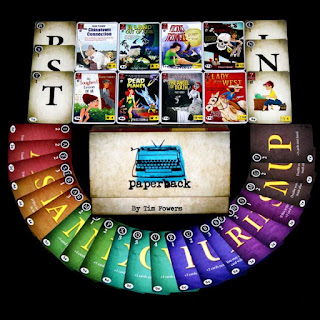


Paperback: As I'm sure I've said before, this is a fun word game.

Perfect Alibi: I'm going to be less boastful about having won this deduction game because it was simply a lucky guess at the point at which I was so bored that I just wanted it to end.

The Prodigals Club: I enjoyed this worker placement game about giving all one's money away and losing one's reputation less than the previous time I had played. possibly that's because with only three players there was less restriction on what one wished to do.

Rattus: Very good game about the plague. I'd like to play this more often.

Splendor: Perfectly passable, rather abstract, engine building game.

Stockpile: A fun stock market game with a mechanism that mimics the rise and fall of shares reasonably well.

Sushi Go!: Card drafting game that doesn't last long.

Thurn and Taxis: A classic Eurogame with the strangest of themes - designing routes for the Bavarian postal service - sitting very loosely on top of some very nice card drafting and set collecting game play.

Ticket to Ride - UK map: This was the first time I've played this map and thought it was very good. Other complained about the new technology/permit element, but I rather liked it. I didn't win, but it all reinforced just what a good game Ticket to Ride is.

Monday, 30 January 2017

Pot65pouri

“There is a point of no return, unremarked at the time, in most lives.”- Graham Greene

So, it's nearly the end of January already. Doesn't time fly when one is getting older? At the beginning of the month I met up with a couple at whose wedding some thirty years ago I was best man. The wedding was near Niagara Falls, which is where they still live, in the depths of winter, and whilst I remember it as if it was yesterday - it was very cold - it clearly wasn't; there's been a lot of water under the bridge. I see Carl from time to time - one of the few photos of me on this blog is of us standing side by side - but hadn't seen Sandra for many years. An infrequent visitor to the UK with a first degree in linguistics she was keen to see the Rosetta Stone and so we visited the Egyptian galleries at the British Museum. There's surely no better way to reflect on the passing of time and on what it means to grow old than to spend a couple of hours in the company of a civilisation obsessed with death; cheerful it wasn't. I do find it interesting however that the Rosetta Stone is the most viewed item in the museum. It has no particular intrinsic aesthetic appeal and one must assume that people are drawn to it because they understand its cultural significance and its status as a totem for the advancement of knowledge. That's quite an optimistic thought in this otherwise dumbed down world.

I've also been to see a couple of bands that I haven't mentioned yet. Paul Lamb and the King Snakes play the blues rather well, Lamb's harmonica being especially good. The man himself -  a contemporary of mine or possibly slightly older - rambled incoherently between songs, as if drunk or on drugs, but as far as one could make out he was displaying the sort of sexism that was readily accepted  when we were young, but certainly isn't now. During the interval I went to the merchandise desk to buy a CD and found him to be both charming and articulate. His stage persona would appear to be a complete act. The second band were a vocal duo called 'Waiting for Wednesday' who I mention mainly because they did a very good cover of John Prine's 'Angel from Montgomery', which is, of course, about growing older and realising that one has reached the point where life is as it is and it's never going to get any better. You may be familiar with the Bonnie Raitt version, but let's take a look at the Tedeschi Trucks Band instead, watch out for the very nice trombone solo about five minutes in:


And here's another cover of a John Prine song, also about aging:


And here's my favourite John Prine song, sung by the man himself:

Saturday, 28 January 2017

Nominative determinism

I alluded yesterday to the name which appears on my birth certificate, leading to the inevitable, though so far imaginary, question from readers as to why I chose Epictetus as my nom de réseau. Well, I like to think that the second part comes from the Scottish word, tetus, which means a delicate person; or perhaps, though less likely, it's from the French word for stubborn; or there's always the same word in Spanish meaning tide, although I go backwards and forwards on that one. What can't be in any doubt is that the first part reflects the fact that your bloggist is indeed epic.


So, if ever there was a set of rules made to measure for yours truly it must be that part of the newly released GMT expansion, EPIC Napoleonic Command & Colours (their capitalisation, but not their spelling) which caters for games on a wider board. Expansion 6 also contains rules for La Grande Battles - an interesting mix of languages there - but that's the game which requires eight players and... well, fill in your own Billy No-mates jokes at this point. As you may recall from this post we had our own try a few months ago at making C&C Napoleonics work on a larger playing surface. I would hope to give these new, and official, rules a try in due course. If I have one reservation from reading them it is that some of the new mechanics don't seem to have any thematic basis and appear to be there simply to address the problem of more units on the table requiring more actions per turn. We shall see.

Friday, 27 January 2017

Forever Forwards

And so to the theatre. I have been to see 'Dare Devil Rides to Jarama', a play which speaks not just to my love of theatre, but also to my interest in military history, socialism, walking and speedway. I accept that the last of those might not have featured too much in this blog to date. Indeed it is an interest that might accurately be described as dormant, but nevertheless it's there. Despite (or perhaps because of) mon vrai nom it's the only motor sport that I've ever had any time for and I used to go to watch the Wembley Lions during their brief reappearance in the early 1970s.


The play was put on by Townsend Productions whose 'Ragged Trousered Philanthropists' and 'We Will Be Free!' - the latter about the Tolpuddle Martyrs - I had both seen and enjoyed. With only a cast of two they recreated everything from dirt track racing, the wall of death and the mass trespass on Kinder Scout through to Franco's advance on Madrid, with the audience providing appropriate sound effects when required through the use of those rattles that one sees in old film of football matches. The one point where the audience participation fell a little flat was when we were invited to jeer at the leader of the blackshirts; I obviously can't have been the only one to find the portrayal more Spode than Mosley.


The story is that of Clem Beckett, champion rider, union organiser, rambler, and anti-fascist who, as member of the British Battalion of the International Brigades, was killed on the first day of the Battle of Jarama. Sadly the telling of it matches up neither to its inspirational subject matter nor the theatrical verve and skill with which it is presented. The play just isn't particularly well-written and despite the acting and the design - both very good - it fails to engage the emotions. Beckett himself came across as rather selfish, which for a man who gave his life for someone else's cause is a real own goal by the author.

However, I'm glad that I went and look forward to their next production, which will be about Grunwicks, something I saw at first hand.

Tuesday, 24 January 2017

I'm walking backwards for the Sultan


Culture is all very well, but there has also been a low level of wargaming related stuff going on in the background; a very low level. I have finished off the Roman casualty markers for To The Strongest!, although for some long forgotten reason I have never started the final batch of their Celtic equivalents. I have in addition painted and based a further unit of Janissaries for the Siege of Constantinople game that I've given up as a bad job while they were in progress, and I've started painting some of the fifteenth century longbowmen that I bought for no real reason and have no specific plans to use. Focus is the key.

I've never been any good at painting, but I seem to be losing such other modelling abilities as I once had. I believe that I previously mentioned an inadvertency with a Vickers machine gun and I now have to report another incident. One of the new Janissary bases turns out, upon closer inspection, to contain a figure facing in completely the opposite direction to his colleagues. Now I know at least one other wargamer who would have immediately started again and rebased everything, but I am pleased to say that I at least have my OCD under control. This base will - as will the Vickers - fight on regardless.

In one of Donald Featherstone's books he advised personalising ones troops - awarding battle honours to specific units, medals to individual figures and so on. When I read that I thought "Oh dear, he's lost the plot; it must be the paint fumes.", and until now have never given it a second thought. However I am tempted to give this particular unit the permanent ability to turn and face when attacked in the rear. Although of course if they did that, this poor sod would still be looking in the wrong direction. Altogether now:

"I've tried walking sideways,
And walking to the front,
But people just look at me,
And say it's a publicity stunt."

Sunday, 22 January 2017

Снегурочка

And so to the opera; some Rimsky-Korsakov this time. It's fairy tales for the spring season at Opera North, and what better way to start than with one that no one will be familiar with: the Snow Maiden, apparently an old Russian folk tale. If one ignores the symbolism - which one can't - then the plot bears some resemblances to 'La Vida Breve', and like their recent revival of Falla's one act piece the director has chosen to set it in a garment factory. Apart from reusing the sewing machines I'm not sure what that adds to things. The rest of the design is really impressive though, with a transparent front screen being used to display snowflakes, sunflowers and other devices to move the narrative along including at one point a Keystone Cops style charabanc. Our heroine's death (a) is also nicely handled; one minute she's there, the next minute she's not, her literal corporeal deliquescence following her culminating emotional thaw.


Returning to the symbolism, it is about as opaque as the front-of-stage screen. If one lives in a place that for half the year is bitterly cold and buried under snow then one is going to create myths about the crucial annual cycle by which the winter recedes and life returns. Grandfather Frost long predates the Soviet Union's use of him to replace that arch capitalist lackey Santa Christmas, as presumably does his drink problem. And it is with good reason that Lel, the womaniser representing the sun, prefers the warm, voluptuous and, one must assume, fecund Kupava to the Princess who, though beautiful, will not be able to either stand up to or return his ardour. The snow must be destroyed in order that the soil, suitably aided by the sun, gives forth its harvest.

It's not an opera that I was familiar with - it hasn't until now been performed professionally in the UK during my lifetime - but I must say that I found it all rather lovely.


(a) Apologies for the lack of spoiler alert, but, hey, it's an opera; it can't have been too much of a surprise


Saturday, 21 January 2017

A Curious Story, Written In Faded Ink

And so to the opera. I have been to see Benjamin Britten's 'A Turn of the Screw' performed as a genuine chamber piece, in a studio theatre in front of a few dozen people. The last time I saw it was in full scale opera house with a full set featuring a two story house; here there was a dolls house on a plinth and that was about it. The cramped space, with performers repeatedly moving through the audience, plus the very low level of lighting ideally matched the ghost story theme, as did a couple of well-judged theatrical elements. The children were, of course, sung by adults, but they were also acted by children, the performers moving around in matched pairs. I can't explain why that made it more chilling, but it did. As did the appearance of Peter Quint: who was very thin with bleached blonde hair, his face made up very pale and wearing contact lenses that hid his pupils. Things weren't helped by the fact that he kept jumping out from behind the curtains right next to where I was sitting. The first time was frankly terrifying, but even the subsequent, less surprising, occasions gave me the willies.

As it's an opera I should mention the music and singing, both of which were most impressive. I very much liked the small and intimate scale of it all; somewhat of a contrast to Aida in Verona and proving what a versatile art form it is.

Friday, 20 January 2017

Papier-maché Mephistopheles


"En politique, une absurdité n'est pas un obstacle." - Napoleon Bonaparte


"All you need in this life is ignorance and confidence and then success is sure." - Mark Twain


"Rudeness is the weak man's imitation of strength." - Eric Hoffer


"There are people in every time and every land who want to stop history in its tracks. They fear the future, mistrust the present and invoke the security of the comfortable past which, in fact, never existed." - Robert F. Kennedy


"When bad men combine, the good must associate; else they will fall one by one, an unpitied sacrifice in a contemptible struggle." 
- Edmund Burke, Thoughts on the Cause of the Present Discontents


"It is not always the same thing to be a good man and a good citizen." - Aristotle


 "It is easier to resist at the beginning than at the end." - Leonardo da Vinci


Thursday, 19 January 2017

The Copenhagen Interpretation of Galley Battles

We finished refighting Actium last night, or to be more accurate we decided that we didn't want to carry on any further. As I said when I posted about the first night's play I have a nostalgic fondness for a bit of galley action, so it's disappointing to have to report that I didn't really enjoy this game.

On the plus side, I am more convinced than ever that hexes work very effectively for a game that is basically about manoeuvre and contact. A less clear cut question is the use of two hexes per ship rather than one as in the original paper and cardboard version. On balance I think it makes sense - beyond the obvious physical constraints of the size of the models - because not only are ships longer than they are wide, but they also move forwards so during whatever time period is meant to be represented by a turn their path should be harder to cross in a perpendicular manner than it is to avoid them head on.

The command and control also worked reasonably well. I like the random nature of squadron activation including the use of jokers. It may be that further friction could be introduced by adding more tokens to the bag. We didn't really use the double activation option much, so I'll reserve judgement on that.

So what doesn't work? I'm afraid I have a bit of a list:
  • Visual differentiation between ships: This might just be me, but beyond the obvious fact that some are bigger than others I really can't tell the difference between them let alone which ones have towers and engines and which ones don't. The knock on effect of this is just to make every other aspect of the game - moving, shooting, ramming, raking, boarding - painful to calculate. Funnily enough it's very easy to identify crew quality even though crews aren't modelled at all.
  • Shooting: There is far too much of it, and it's far too complicated.
  • Burning: Seems much too easy to set ships on fire and then ships sink very quickly while on fire.
  • Grappling: This seems very difficult to do, although there was a view that I was just rolling badly. In common with everything else in this game, it's somewhat complicated.
  • Boarding: Calculation of casualties is more complex than it needs to be. I also don't understand why it isn't possible to split marines between the original ship and the captured ship, especially as one can split the fire of marines on the same ship between different targets, thereby increasing the complexity if that exercise even further.

James has already made some suggested changes with which he intends to finish off the game solo. These are intended above all to simplify shooting and reduce the number of ships sinking because of burning. Personally I'd go for a bucket of dice approach and get rid of all the tables; the game it most resembles on the table is actually X-Wing, and it works there. Interestingly he has also taken the view that a floating ship is more likely to be able to keep a sinking ship afloat than a sunk wreck is to be able to drag down a floating ship. Maybe it would, maybe it wouldn't. Perhaps what is actually needed is a quantum approach, a sort of Schrodinger's galley, whereby one doesn't know whether a fouled ramming ship has sunk until it disengages.


Wednesday, 18 January 2017

Heart of Darkness


Eyebrows have been raised about my suggestion yesterday that the UK faces a future as a colony. I assume that this is in part because, as it's a wargaming blog, my readers associate colonialism with chaps in red coats and sunhats or blue coats and képis arriving and taking over the country. What I was referring to was instead the economic effects of colonisation whereby the local population is obliged to work for low wages with no rights or political power and all profits are expatriated elsewhere; think Britain as banana republic and you're on the right track.

I would point you to Wallerstein's world-systems theory, which posits that the world tends in the long run to a relatively stable set of relations between core and peripheral states, with both the division of labour and the flow of wealth benefiting those in the core. The UK has, or so it would seem, decided to leave the core and join the periphery; a stupid decision taken by stupid people.


Tuesday, 17 January 2017

Wherefore weep you?

I have been to see the live broadcast of the RSC's latest production of The Tempest. The focus is very much on the magic and on forgiveness, of oneself as much as of others. I wasn't convinced that any real remorse was being shown by Antonio, but perhaps that's the point (1).  The magic however was paradoxically realistic. When watching these live broadcasts I am often left with the impression that the cinema goer gets a better deal than those in the live audience. On this occasion that probably isn't the case. The extensive special effects, especially Ariel's motion capture suit, were par for the course on the big screen, but I suspect would have been astonishing when seen on the stage.


 They didn't make much of the political aspects, such as the play as metaphor for colonialism. Perhaps that's a shame. At the time the play was written England (and it was then England and not Britain) was just setting out on establishing a global Empire. And as of today we seem destined to be colonised in our turn. Perhaps a production of Shakespeare's last solo composition in which Caliban represents the English white working class in all their lumpen, unintelligent monstrosity would be very interesting. Subhuman children of the witch indeed (2). For surely what angers Caliban isn't - as it should be - his oppression, but the fact that he is aware - at least subconsciously - of his inadequacies when compared to others, but feels impotent to address them. Oscar Wilde's observation in the preface to 'The Picture of Dorian Gray' has a validity just as relevant to the this century as to his: “The ... dislike of realism is the rage of Caliban seeing his own face in a glass.”


(1) "Then came Peter to him, and said, Lord, how oft shall my brother sin against me, and I forgive him? till seven times? Jesus saith unto him, I say not unto thee, Until seven times: but, Until seventy times seven." - Matthew Chapter 18 Verses 21-22

(2) I'm allowed to say this - I am, by origin and upbringing, as white working class as it is possible to be.

Monday, 16 January 2017

Who's Gonna Build Your Wall?

I have been to Hebden Bridge Trades Club to see the mighty Tom Russell. The last time I visited the town was way back before the floods, when the big bouncy woman and I took a stroll up to Hardcastle Crags one very pleasant October morning in 2015, coincidentally just a couple of weeks after I previously saw Russell in concert. I had never been to the venue before, and found it to be - and I choose my words carefully - atmospheric. It suffered very badly from water damage, being close to both canal and river, but may or may not have been extensively renovated; it was hard to tell. It also made me wonder whether the governments austerity programme has led to a reduction in inspections by the fire brigade. As for the clientele, they were somewhat of a mixed bunch. For the record I am not referring to Peter who, as a big fan of this type of music and Russell in particular, was there; making a rare interface of wargaming and my other hobbies such as music and...well  my other hobbies.  My companion for the evening was a bit disconcerted by the person - neither of us could work out whether it was a man or a woman - sitting next to her. When said person got up to have a wander during the interval he/she left behind on the chair, and in plain view, some money, a phone battery and a condom. I'm not sure what enjoyment one could hope to have without taking those three essentials with you, but perhaps that's just me. In any event the audience was obviously very knowledgeable about the man's music, indeed they appeared to sometimes be shouting out for songs that were so obscure that even he had never heard of them.


But, despite all that, the gig was great. Russell's between song talking is almost as important as his singing. He told various anecdotes about, for example, Johnny Cash and managed to be entertainingly rude about both Torquay and Tromso, showing the sort of cosmopolitan outlook so often lacking in these dark times. There has been a silver lining for him at least, as he was able to report an sizeable uptick in royalties from his song "Who's Gonna Build Your Wall", written a decade ago, but enjoying a new relevance. It was an almost universally excellent concert. One must perhaps overlook the song about Dylan Thomas that was quite clearly "Streets of London" with different words, and most of those either direct quotes from "Do Go Gentle Into That Good Night" or just the names of pubs in Swansea; even one's heroes occasionally fail to meet our expectations. Once again featuring the marvellous Max di Bernardi on guitar, the set list overlapped that of the last time I saw him - he could surely never get away without singing Tonight We Ride and one or two others - but with an extensive back catalogue and a willingness to cover people's songs - a rather fine Johnny Cash medley this time, Warren Zevon's Carmelita last time - there is plenty of variety. He is apparently returning in November and I hope to see him again then.

Sunday, 15 January 2017

Truth and roses

"Between men and women there is no friendship possible. There is passion, enmity, worship, love, but no friendship." - Oscar Wilde


Saturday, 14 January 2017

Kow bisa para Kong!

 As regular readers know it is my custom to go to all the exhibitions at the Henry Moore Institute and then come out and say how bad they are; basically I just don't like modern art. However, credit where credit is due; I should have reported earlier that I have been very much enjoying the magnificent five metre tall gorilla that has been standing outside the building for the last few weeks.


I have now been to see the exhibition of which the beast forms part and and can confirm that virtually all of it is terrible. I must be going soft however because I also quite liked this piece by Nigel Hall, although the photo (taken with the camera which I keep in my manbag for just such occasions) doesn't do it justice (you'll have to take my word for the fact that it appears to float in mid air) and nor can I remember its name.


Going back to King Kong (for it is he, sculpted back in the 1970s by Nicholas Monro), the eighth wonder of the world will be on the Headrow for another month or so; well worth a trip.

By the way, neither of those photos is in black and white, which you can verify by enlarging the first and looking at Kong's eyes; it was just a very grey day in Leeds.


Friday, 13 January 2017

The Analytical War Engine

"The public character of every public servant is legitimate subject of discussion, and his fitness or unfitness for office may be fairly canvassed by any person" - Charles Babbage

The distinguished mathematician's views are as valid now as they were well over a century ago. However that's not why we're here. I have been reading the newish set of rules published by Osprey: "The Men Who Would Be Kings". They are by Daniel Mersey, who wrote "Lion Rampant", which I rather liked despite being unable to set up a scenario that works properly. These new rules cover 19th century colonial wars, which are very low down on my list of possible periods to spend time and money on. James claims that he's going to do the Sudan at some point, but I'll be long dead by the time he gets round to it. These rules aren't really the sort of thing that I'd be looking for in any case, and can anyone imagine James putting up with only three troop types?


My real reason for taking a look was because the book contains an artificial intelligence engine allowing them to be played solo; this being given the name Mr Babbage, presumably in honour of the man who first proposed the programmable computer (1). My particular interest in this is in it's applicability to my Roman vs Celts Pony Wars rip off and, sure enough, Mersey acknowledges that what he has done was inspired by Ian Beck's original, but that he has purposefully set out to simplify the process. It certainly looks straightforward enough, although, as before, the big difference from what I want is the centrality of ranged fire. I like the dice driven concept for the introduction of new tribal units anywhere on the table rather than just at the edges or at ambush points. It shouldn't be beyond my imagination to work out a way of integrating that with the other elements activated by cards in the current approach. Indeed, it may be time to get out the Romans in Britain rules and take a look, as I now have three possible areas of revision:
  • The AI approach from these rules
  • The melee mechanism from Lion Rampant
  • Hex based movement 
I shall try to free up some time in what is, as you will appreciate, a hectic social life.

(1) I have seen it reported that Babbage wrote a letter to Tennyson complaining that the lines

Every moment dies a man
Every moment one is born

    did not reflect the world's growing population and suggesting that they be replaced with the more accurate

Every moment dies a man
And one and a sixteenth is born

    This is another of those stories the accuracy of which I have no desire to check.


Thursday, 12 January 2017

Call to me all my sad captains

The barge she sat in, like a burnished throne,
Burned on the water; the poop was beaten gold,
Purple the sails, and so perfumed, that
The winds were love-sick with them, the oars were silver,
Which to the tune of flutes kept stroke, and made
The water which they beat to follow faster,
As amorous of their strokes. For her own person,
It beggared all description; she did lie
In her pavilion,--cloth-of-gold of tissue,--
O'er-picturing that Venus where we see
The fancy outwork nature; on each side her
Stood pretty-dimpled boys, like smiling Cupids,
With divers-coloured fans, whose wind did seem
To glow the delicate cheeks which they did cool,
And what they undid did.

                      - Antony and Cleopatra Act 2 Scene 2

Thus it is that Shakespeare describes Cleopatra's favoured means of water borne transportation. Sadly despite James' renowned modelling skills all he did was take one of his galleys and stick a bit of cardboard on the back saying 'Cleopatra'; rather prosaic I felt. The bard may have been OK at the poetry ["May have?"], but he was as careless of the historical accuracy of his description of the final naval showdown between Octavian and Antony as he was about many battles. However, he was right in his judgement that Antony in becoming a "strumpet's fool" had lost the plot somewhat. It is only fitting therefore that he should be represented in the refight of Actium by moi, a man whose complete lack of spatial awareness accurately reflects - through the medium of the rules - the man's shortcomings as an admiral. Woe, woe and thrice woe.

Having said that, I am - as things stand after one evening's play - winning, entirely due to my success at setting Caesar's ships on fire (1). I have consequently warmed to the rules somewhat. It was noticeable that we had a lot less successful raking than in the previous game and I think this was simply a reversion to the mean. I suspect a similar statistical anomaly in the 'going on fire' situation and am not sure whether a rule change is particularly required. A large ship with a full complement of marines will cause a fire test approximately half the times it shoots, more if it is targeting smaller ships. Of those half will catch fire, and of those that do half will sink. So a large ship will cause a sinking by shooting - with an uncertain time delay - say one in six times. It can fire twice a turn and a game will last five or six turns, during which time smaller ships can easily out manoeuvre it to keep their distance.

I like playing galley actions for nostalgic reasons as much as anything else. In my teens Len the Ink, one of my early wargaming buddies, and I made 2D fleets from black paper and fought actions on the living room floor. Despite knowing little about the historical reality (I still don't) what we did then seems pretty similar to what we're doing now; the big improvement is the use of the hex grid. I'm not sure what prompted our interest then, although watching Ben Hur at Christmas would probably be a good guess. What we knew about Roman history often came from the television:


(1) I have discovered why I don't remember setting so many ships aflame before. Apparently our previous game was a scenario from the Punic Wars, a time in history when the idea that fire was detrimental to wooden galleys had not occurred to anyone.

Sunday, 8 January 2017

Premature and perpetual decay

That's how Gibbon described the entire millennium that the empire of the East lasted between Arcadius and Mehmet. It also describes the state of my Siege of Constantinople game which has rather fallen into desuetude.

As a recap, the game was based on the Ottoman final assault on May 29th 1453, via the approach suggested in the WHAB Siege & Conquest supplement. The scenario features the three successive attacks which the Ottomans launched on the same section of wall, the intention being that the defenders would be so worn down that they would eventually be overwhelmed (1). The problem that I have been encountering is that my chosen rules - To the Strongest! - aren't very good at slow degradation over a period of time. Their two hits and you're dead structure combined with the ability to rally back to full strength don't really fit the bill, which is a shame because everything else can be handled quite nicely within the framework of activations at differing levels of difficulty.

I tried a proxy whereby the first wave - the bashi-bazouks - made the job of subsequent attacker easier, rather than causing casualties to the defenders as such. I got the mechanics to work, but it just didn't gel thematically for me. Much pondering has failed to deliver a solution, so I think I shall pack it all away, set something else up and let the problem simmer in the background of my mind for a while.


(1) This may or may not be what happened on the day. You can take your pick from sally ports left open, artillery breaches in the walls and/or the fanaticism of Hasan the Giant.

Friday, 6 January 2017

Pot64pouri

More bread related paraphernalia has arrived at the Casa Epictetus, including a set of drug dealer's scales and a bag of ascorbic acid. It feels good to have yet another hobby that demands constant spending at a level which it would be hard to justify to someone else. Speaking of which, I have also just bought the new Strelets set of English longbowmen, for no better reason than...well actually for no real reason at all, except that it's new and I wanted it. In fact I must admit to an intense mental struggle before I ended up only buying one box. Yes it's spend and damn the consequences here, an attitude which was only heightened when I went the other day to see my financial advisor. We agreed a certain course of action and then he said that he couldn't execute it immediately because he was going to the Cayman Islands and would let me know when he got back. I cannot decide whether this comforts or alarms me.

 I have been to my first concert of the year, seeing the Ale Marys, who played the same set that they did when I'd seen them three weeks earlier, and which was just as enjoyable second time around. As we left I asked my companion for the evening - a different lady to the previous occasion - for her thoughts and she replied "I thought they were very good. I might bring the dog next time.", a statement that raised so many questions that I was lost for words until it was too late to reply at all.


I have also been to the cinema to see Vertigo, Hitchcock's masterpiece, which stars James Stewart, always watchable, and Kim Novak, after whom a company that I worked for once named a computer in their data centre. (Do people give their computers names any more?) It seems redundant of me to say that it is rather good - it was voted the best film of all time by Sight and Sound magazine - but I'm very glad to have seen it on the big screen. As everybody from Hitchcock onwards has observed, either Stewart is too old or Novak (and also Barbara Bel Geddes, appearing here as supposedly the contemporary of a man fourteen years her senior two decades before as Miss Ellie she was cast as the mother of a man only nine years her junior) is too young, but that's Hollywood for you. The film is set in San Francisco and all the famous sites appear: the Golden Gate bridge, Lombard Street, Fisherman's Wharf, the bit of road near the cathedral where I fell off the Segway - they're all here.


Thursday, 5 January 2017

So row well, and live

A little over a year ago we tried out Richard H. Berg's 'War Galley' rules; details of our lack of success can be found here and here. Osprey have recently published a set of ancient naval rules and James has managed to blag a copy. The obvious thing therefore was to get the galleys out and, well, have another crack at 'War Galley'. Last night was a bit of a much needed refresher in the rules and a chance to learn the inevitable changes that James had introduced. These fell into two main categories: command and control, where he had opted for a sort of Two Fat Lardies lite squadron activation process; and fatigue, which has been simplified enormously.

A chap with a beard is simply fatigued

 It went smoothly enough - if you allow for the fact that we kept getting the rules wrong - and we shall hopefully have a more polished proper game next week. It's a bloody affair with ships sinking very easily. There was also far more going on fire than I remember from before.


Should have rolled a 1,2 or 3

I can't say that I've changed my opinion much. I think that hexes - or at least grids - are ideal for galleys; I think that these particular rules are rather complicated with their many different categories of movement restriction - fatigued, half-speed, raked, crippled and so on; and I think too much rides on the luck of getting first strike when within ramming distance. So, it's a completely open-minded approach from me then.

Wednesday, 4 January 2017

A loaf of bread...

...and thou beside me singing in the wilderness

Omar Khayyam (a) of course. Not the chap who liked the product so much that he bought the company, although I do hope they are related. I can't help thinking that Victor has appeared in this blog previously, so apologies for any repetition. The product that I currently like very much is the breadmaker. Obviously it is immensely inconvenient to use, costs far more than going to the excellent artisan baker five minutes from my house, and has required the acquisition of lots of additional equipment - flour storage, milk thermometer etc - but the bread is really good. I am slightly disappointed that the best results so far have come from ready prepared mixes rather than from my own efforts, but perhaps that's why Waitrose is the spiritual home of the breadmaker owner. 


Last night, following the purchase of yet more expensive ingredients, I set it up so as to have freshly baked bread available first thing this morning; the smell was as every bit as good as you would expect. There has been one other bonus out of all this. Coral Laroc - a name not mentioned here for a couple of years, but still very much around - has gone on a juice fast as a new year detox regime (b) and is permanently hungry. What better entertainment then but to make sure that by email and text she is kept fully informed of just how good my bread (and cakes and biscuits and indeed the sweet potato, chilli and spring onion rosti that I made on Monday) are and how wonderful they taste.


(a) When racking my brains for a quote with which to introduce a post about bread I did briefly consider W. B. Yeast, but nothing relevant sprang to mind.

(b) One reason for not mentioning her very often is that if I posted every time she went on a faddy diet there would be no room for anything else.

Monday, 2 January 2017

December 2016 Boardgaming

Last year I played 133 boardgames a total of 250 times, a number obviously restricted by my illness. Before looking it up on Boardgamegeek I would have guessed that my most played game was Codenames, but it was actually Red7; both excellent fillers of course. The question of whether it would be better to play fewer games more times each is valid in philosophical terms, but in practical terms is moot. The people I play with are - how can I put this? - obsessive, but the thing they seem most obsessive about is buying games, and therefore the cult of the new rules OK. I have largely given up buying games myself; it just seems redundant. In fact the only game that I bought all year was Colt Express, chosen because I thought it would appeal to the younger Miss Epictetus' boyfriend; a hypothesis so far untested.

Abluxxen: It's always fun to watch the sheer bafflement on the faces of those playing for the first time as they struggle to work out a strategy.

Avenue:  A bit like Karuba with pen and paper and a neat scoring twist. It's OK.

Glory to Rome: This is very similar to Mottainai, but with a theme vaguely- very vaguely - related to the rebuilding of Rome after Nero's fire rather than that of making souvenirs in a Buddhist monastery. I'm not sure which one makes less sense.

Honshu: Nice trick-taking/auction/map building card game. It doesn't play to my strengths, but I like it.

Isle of Skye: Another map building game with auction elements and a touch of set collection. Once again I'm always happy to play this.

Kingdomino: Funnily enough this is a game about building maps with a competitive resource selection element. I've only played it once so reserve judgement. The endgame creeps up on you and if you are not careful leaves with few, or even no, options.

The Manhattan Project: I enjoy this game, not least because it always gives me a chance to trot out my weapons of mass destruction anecdotes for those who have never heard them, or even for those who have heard them several times. It is, however, broken as a game. A uranium only strategy coupled with ignoring the bomber/fighter stuff will always win.

The Manhattan Project: Chain Reaction: This is the card version of the above game. I thought it worked very well, stripping out the bits that don't - to me - add a great deal of interest, such as the attack and defence elements. I thought that as a card re-implementation it worked far better than Power Grid.

Rococco: The hybrid dressmaking/fireworks/interior deign theme may be odd - OK, it is odd - but the mechanics make for a rather good game.

Terraforming Mars: This is a game about which there has been a huge amount of buzz; so much so that even I had heard it. I played it because one of the Yanks from the not-so-secret spy base just up the road - we regularly get visitors from there and as they are all cryptographers and the like they win a lot of games - was very keen to try it out. In the event I couldn't see what all the fuss was about. It wasn't bad, but went on far too long.


Sunday, 1 January 2017

Laughing Heart

your life is your life
don't let it be clubbed into dank submission.
be on the watch.
there are ways out.
there is a light somewhere.
it may not be much light but
it beats the darkness.
be on the watch.
the gods will offer you chances.
know them.
take them.
you can't beat death but
you can beat death in life, sometimes.
and the more often you learn to do it,
the more light there will be.
your life is your life.
know it while you have it.
you are marvelous
the gods wait to delight
in you.

      - Charles Bukowski