Wednesday, 28 September 2022

Blimey O'Reilly

 "Our society is run by insane people for insane objectives" - John Lennon


It seems only a couple of months ago that I described the contenders to be leader of the Tory party, and therefore prime minister, as headbangers. It would seem that I was too kind to the winner.


Sunday, 25 September 2022

Piquet Redux

 We finished off the game of Soldiers of Napoleon about which I was complaining here. We down graded the over-powerful British skirmishers, which certainly made things better, but the game still limped to a fairly unsatisfactory conclusion. Even before the usual post-game discussion there was clearly an unspoken consensus that SoN had run its course, at least for the time being. The rules have many good features, but things don't half take a long time to get going, and just when they do the game seems to be over because one side runs out of morale. I am quite prepared to believe that we aren't playing it in the right way, but then perhaps that in itself doesn't reflect well on the rulebook as published.

In any event, this last week we stayed in the Peninsular, but returned to Piquet with the best elements of SoN (as defined by James) incorporated. The version of Piquet now in use for this period (and indeed that used for the Seven Years War) have migrated a fair distance from the original core rules and incorporate bits and pieces that we have liked in other games; the primary influences before the latest amendments being Piquet's sister ruleset Field of Battle and Black Powder. It all seemed to gel together better than it had any right to, especially since the rest of us often didn't know what the rules actually were until we tried to do something.  What it did do was produce a rather good game.

It was  a Charles Grant scenario based, I am told, on Fontenoy. Given my earlier observation about games of SoN starting slowly it was perhaps just as well that, as the attacker, I got the bulk of the early initiative and was able to move forwards. I was literally one dice roll away from having one of infantry divisions broken leading to inevitable defeat, but turned the card necessary to bolster their morale and never looked back. I eventually won because the British guns in the redoubts were unable to inflict any casualties on the French cavalry as they advanced past them and then the British cavalry commander died in slightly unfortunate circumstances as he tried to rally them.

We going to swap sides and give it another go next week. Piquet always produces a different game and both sides have the advantage of learning where not to deploy (the British infantry need to be nearer the village in the centre and the French should probably not bother trying to advance through the wood), but we shall be lucky if it is as entertaining.

Wednesday, 21 September 2022

The Howgill Fells

I have been to southern Cumbria for a couple of days, but neglected to take any photos of the Howgills themselves, features which Wainwright described as being like sleeping elephants. However, on my way up there on Monday morning I did take this one of the Ribblehead Viaduct.


An awful lot of people had obviously decided that an unexpected day off would best be spent by climbing Pen-y-ghent, Ingleborough and Whernside one after the other. Your bloggist was not among them. My companion for the trip and I took a much flatter walk for about a third of the 24 miles that the three peaks challenge requires. Then having done the aforementioned photo-free fell walking north of Sedbergh we paused on the way back to walk around Semer Water


One thing that took me north was the opportunity to stop off in Settle and see Maggie Bell and Dave Kelly perform. They have both featured here before: Dave as part of The Blues Band and Maggie as the lead singer with Stone the Crows, whose videos I have posted on several occasions. I have sometimes mentioned acts I wish I had seen forty years ago; in Maggie Bell's case it was actually fifty years ago. Bell didn't hark back to those days much, although she referenced in passing the band's support slot on Joe Cocker's 'Mad Dogs and Englishmen' tour (sadly neither they nor Freddie King feature in the film). One track she and Kelly did perform was this:


It was well worth the long wait. She may be 77, but she can still belt out the blues.

Monday, 19 September 2022

Worth remembering

 When the game is over the king and the pawn go back into the same box.

Friday, 9 September 2022

Cooling

 "Ignorance gives one a large range of probabilities." - George Eliot

I've been doing August stuff, including a trip here:


But there has been some wargaming in the background. We had a somewhat bizarre game of To the Strongest!, with some very lopsided luck, which was clearly just that - luck - and not something inherent in the rules. Soldiers of Napoleon, however is a different matter.

I am definitely cooling on this game and considering that I started off lukewarm that is not exactly a ringing endorsement. Part of the problem undoubtedly stems from the fact that it is not designed as a multi-player game, but there are four of us. We seem to have ended up playing the author's suggested approach, which is basically two games side by side. It's crap (*). We seem to be sacrificing much of the pleasure of social interaction - which is for me at least a big part of why I do this in the first place - for the sake of the purity of the rules. It all seems a bit arse about face to me.

My main problem though is with the flawed arithmetic implicit in the rules. James recently passed me a copy of WRG 6th edition so that I could look at the siege rules. The writers of these appear, to me at least, to have attempted to achieve 'realism' and bugger the playability. Thankfully authors of more modern games tend to do it the other way round, concentrating on finding mechanisms that are easy to use and which move things along smoothly. I play a lot of boardgames and in that sphere one need do no more; it's usually all abstract anyway. When wargaming though one needs/wants to add chrome to make it a reasonable facsimile of what one imagines the historical period was like. Authors don't always seem to me to be able to manage the interface between their neat, simple mechanisms and the chrome. I previously wrote about some nonsensical effects of this in Blitzkrieg Commander 4.

One example from SoN relates to skirmish fire. Now skirmish fire is hard to get right in a set of rules. We tried any number of ways with Piquet and never produced anything particularly worthwhile. The version we ended up with had the sole merit that it sometimes allowed French columns to close with British lines. In SoN units can throw out their light company which then appear as two skirmish stands . You can then fire these with a dice per stand at a longer range than volley fire. If you fire at another unit which also has its light company out then you lose a dice. So far so good. Standard units hit on 4,5,6 and save on 4,5,6, so two units skirmishing against each other would both have an expected value of damage caused of 0.25 disruptions (the term for damage caused in SoN) each time they fire. It's not very effective, but worth doing because units with no disruptions get a bonus in combat. 

Some units, for example those of the British Light Division, qualify for a third skirmish stand. This seems reasonable; specialist troops get a 50% bonus. In practice of course it means they get two dice when firing at a line unit with skirmishers, so that's actually a 100% bonus. And this is where another rule comes into play. One can only save the first hit caused, so the ability to cause two hits is very powerful. I'll let you do the arithmetic for yourself, but it turns the expected hits of these units against a standard unit to 0.625, i.e. a 150% increase. What makes it worse is that these units also tend to be elite (not the term used in the rules) and can both hit and save on 3,4,5,6. If we consider our match up of one of these units versus a standard unit, both with skirmishers out, we find the standard unit's expected hit has dropped to 0.167, while the specialists' has increased to 0.889. Were these units really five times better? It seems unlikely to me.

Add in other facets of the rules, in particular the ability to concentrate of multiple units' fire on one target, and you end up with a game that is dominated by the skirmish fire of certain formations - I'm looking at you again Light Division -  and frankly isn't that much fun. 

* And, incidentally, quite a lot worse than our own quickly cobbled together approach which we tried first.

Tuesday, 6 September 2022

It gets worse

A haunted ventriloquist's dummy has become Prime Minister of the UK.


What a time to be alive.

Saturday, 27 August 2022

Silla

 And so to the opera. In a rare crossover between the ultimate art form and wargaming I have been to see Handel's 'Silla'. The 'Infamy, Infamy' game which I played in Nottingham a couple of weeks ago took place in the Social War of 91-87 BCE, and the Lucius Cornelius Sulla who was involved in those as a military commander becomes Silla in Rossi's libretto. The setting is (sort of - it's not terribly historically accurate) the civil wars of a few years later, through winning which Sulla/Silla becomes dictator. It is, as the programme tells us, about a womanising populist leader who rises to power, but is brought down by those closest to him when he loses his appeal to the populace. It had a contemporary setting (*), presumably so that the audience could more easily read into it whatever parallels they could find.


It was all very good, although the music seemed vaguely familiar. Some subsequent research tells me that the dramma per musica was written for a specific time and place, only performed once and the music was simply used again in 'Amadigi de Gaula' which, of course, I saw last autumn. Among what is by now the traditional trouser-role same-sex relationships and gender-swapping, this production of 'Silla' did contain a couple things I'd never seen before at the opera. At one point Mars, god of war, encouraged the audience to clap along, which did nothing so much as prove that classical music audiences are as incapable of keeping rhythm as any other sort. Then, a bit later on, some members of the orchestra joined in the singing. If you live long enough then you will see most things eventually.


 * I can't help thinking they missed a trick by not setting it in 1960s Liverpool and giving a key role to the cloakroom attendant at the Cavern, all of which would undoubtably have been a lorra lorra laughs. 

Sunday, 14 August 2022

Lard Workshop

 The lack of postings here, and the fact that medieval cattle raid hasn't been played yet, are of course due to scorchio. Indeed the only reason I am writing this now, is that the cumulative effect has all been too much and I have retreated indoors. This is not to say that there has been no wargaming. We completed our second game of 'Soldiers of Napoleon', about which rules I have nothing to add to what I have said previously. We shall have a go next week with move distances tweaked to match the specific size of table and bases, and I shall report back. It was fairly sweaty in the legendary wargames room on Wednesday, but nothing to compare with the sauna that was the Old Chemistry Theatre at Nottingham Trent University on Saturday for the inaugural Lard Workshop (*).

The Workshop, which took place alongside the BHGS Britcon show, was organised by Don, my old (very old) school friend and bandmate, despite which it was a great success. I for one thoroughly enjoyed it, and had a blast. And no one could say that it wasn't excellent value for money. For £15 one got a £5 voucher to spend with the traders, a free sandwich lunch (which was rather good I thought) and to play two games; what's not to like? The one thing wrong with it was the heat, plus it was very noisy. So the only two things wrong with it were the heat, the noise and the fact that the toilets were a long walk given that middle aged men need to visit fairly often. Having said that, there were a couple of gamers involved who clearly didn't have prostates, which was the first time I've seen so many female wargamers since, well, since forever; another good thing.

I was travelling light and didn't bring a decent camera, which I regret because the eighteen games on offer were all worth photographing. There was a Far East set game of Chain of Command (possibly run by Richard Clarke himself; I wish I'd taken some notes as well as some pictures) which had more terrain crammed on to one table than I can remember ever seeing before. Very sadly I only took one photo of David Hunter's game of 'Infamy, Infamy', which I played in the afternoon, and that is very far from doing the table justice.
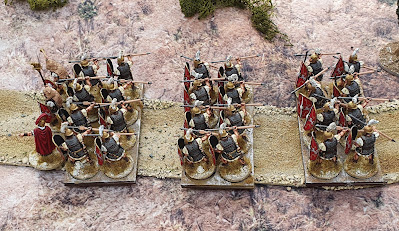

I'm playing the chap at the front left, tasked with getting my men along the road to a camp manned only by some unreliable slaves. The game was set in the civil wars of the early first century BC and, while I didn't get anywhere near the camp my Gallic ally and I had killed enough Italian rebels en route to win the game. I had played Infamy once, pre-publication and pre-pandemic, and despite reading through them again was feeling a bit lost at the start. However, as the game progressed I found it all began to make sense (**). Maybe I should get the chariots out before I forget it all again. 

You've got to love a measuring stick

I took more - and more useful - photos of the game I had played in the morning, Sidney Roundwood's 'Flashing Blades'. It wasn't hard to get a larger amount of the action into the picture because everything happened in a 2ft x 2ft square. It's not obvious from the above, but it's mounted on a Lazy Susan (£14 from Amazon according to Sidney) and players seated around the table can easily turn it to allow them to move their musketeer. Because the Mousquetaires du Roi, opposed inevitably by the Cardinal's Red Guards, are what this cracking little game is all about. The rules are not yet published (***), but they are in a pretty polished state already. The rules have quite a lot of the boardgame about them - and I mean that in a good way - and produce a result that, at least in our game, was a positively cinematic narrative arc. I loved the game, almost, but not quite, with the same passion that James has for SoN. And that was only a little bit helped by it being one of my characters, Monseigneur d'Eclair, who rescued the Comtesse de Chablis from the scaffold and spirited her away.
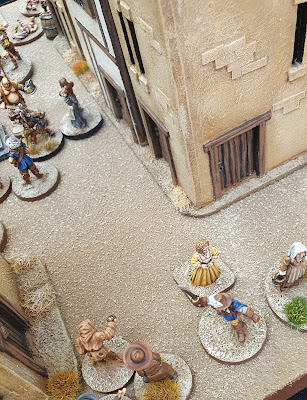

D'Eclair leads la Comtesse away through a crowd of Parisians

Interestingly, in the afternoon Sidney ran a Samurai scenario using the same mechanics. As for what I spent my £5 on: a copy of the second edition of Lion Rampant, of which more when I have read it. To conclude, thanks to David, Sidney, my various teammates and opponents, Richard Clarke and, in particular, to Don for a most enjoyable, albeit hot, day of wargaming.


* If you are going to Google that, then I would try to be precise in your search terms unless you genuinely wish to find out the best way to render lard, which is a very different thing and quite possibly smells even worse that a hot room full of wargamers.

** Except perhaps the close combat rules, which are, shall we say, convoluted.

*** Next year possibly, depending on the rest of TFL's publishing schedule.

Monday, 8 August 2022

Soldiers of Napoleon again

 “Remember, there are more people in the world than yourself. Be modest! You have not yet invented nor thought anything which others have not thought or invented before. And should you really have done so, consider it a gift of heaven which you are to share with others.” - Robert Schumann

James has given a big thumbs up to Soldiers of Napoleon, as you may already have seen. We've now played three times (i.e. one and a half games) and I still get the impression I'm the least enthusiastic of the four of us. You can't read too much into that; apart from anything else it's an inescapable fact that someone will have be in that position. The context is important as well: we're clearly still not playing them as written; it has become obvious that the text does not adequately reflect what the author and his play testers actually did in practice; and even when one has the rules correct - whatever that means - one still has to get one's head around the best way to play. Picking up on that last point, I'm fairly sure we've been playing the skirmisher rule correctly from the beginning, but it was only last week that I suddenly had an epiphany as to how one used it in practice (*).


I agree with James that the way skirmishers are handled is elegant and makes sense. We had tried something a bit similar with Piquet, but for whatever reason didn't quite arrive at the same rule. On the other hand I think the event cards could very easily get a bit samey each game, because there aren't that many different ones. If one is lucky enough to get the ones that target the other side's artillery or commanders early on, when the situation is less sensitive to what card you play, then they will always get used; later on in the game they probably won't. As for the Big Battle rules as written (**) they are even more pants than the 'How Goes The Day' mechanism. 


One of the issues we had, and which led to the sort of calm, rational, evidence-based discussion so often seen in the legendary wargames room, related to infantry attacking buildings. A lesser man than your bloggist would point out that the answer received back from Warwick Kinrade - namely that units must adopt a special 'attacking buildings formation' - was precisely what I have been saying about the same situation in Piquet. But, as I hope you all realise, I am better than that.


* Apparently you put them out at the front of units and they shoot at things.

** Or to be precise, as James says they are written; I don't own a copy and haven't read them.

Sunday, 7 August 2022

Road to Trojan

 Yesterday was the 60th anniversary of the independence of Jamaica, and I went along to a celebration. It was rather a large gathering because there a fair number of people with Jamaican heritage in Leeds, including a 96 year old who sailed on the Windrush. I was left a bit unclear as to whether he was actually present last night, it seemed to all depend on whom one spoke to. I hope he enjoyed himself, wherever he was.

First up were the Jamaica Jazz All Stars featuring Brinsley Forde as guest vocalist, very good and very tight. They reminded my of a sort of Jools Holland Big Band with reggae replacing the boogie-woogie. The headliners were Dennis Alcapone, whose birthday it also was, but who was undoubtably a fair bit older than the country, and Freddie McGregor who I had assumed was old, but worryingly turned out to be younger than me.  Anyway, they were both every bit as good as I hoped and I'm glad I've seen them.


The band backing Mr Alcapone in the above clip is the Cimarons, who have previously been mentioned in this blog.

Saturday, 6 August 2022

Let Loose The Cows Of War

 "Cow-slaughter and man-slaughter are two sides of the same coin" - Mahatma Gandhi

On the second turn the besiegers start to construct some siege equipment, mainly because the original purpose of this whole thing was to get mine out on the table. However, they were obviously too close to the walls because on their turn the defenders were able to destroy it with missile fire. On the next turn the attackers started over again with the sawing and nailing, this time a bit further away. The defenders, who are apparently a feisty bunch, decided to 'Sally Forth'. After a bit more dice rolling their target was revealed as the besiegers' food supply, more specifically their herd of cattle. If they can kill or drive off sufficient of them the besiegers' ability to sustain an extended siege will, not for the first time, be impeded.


The friendly foresters, who have made a remarkable recovery after being ridden down by their social superiors during the previous fracas, are leading a couple of parties of soldiers through secret paths in the woods known only to them. The tiles at the bottom will be turned over when the relevant group is sighted: 1 means it's the group with the leader attached (although he has rolled up as Insipid, so probably not a great deal to be expected from him), 2 will be the other group, and 0 is a blind. The target is the pen in the middle of the table. 


Unfortunately for the raiders, a few of the besiegers' leaders are having an early morning boar hunt, and their dogs, smelling something strange (perhaps the town is already running short of water for washing), have given the alarm. The boar himself seems quite unperturbed by it all. That chap who looks a bit like the messenger in the previous scenario (note to self: get some more medieval civilian horsemen) is their leader, and rolled up as a Braveheart. The hunters will have an activation penalty and be restricted to moving within the wood for the first couple of turns while they work out what's going on. There is half a unit of crossbowmen standing guard over the cattle and they will joined by others from the camp as they respond to all the noise.


Friday, 5 August 2022

Freedom Road

 I've been overdoing the wargaming blog posts recently. Let's have some music from back in the day:


Thursday, 4 August 2022

Help is sent for

 "You that way, we this way." - Shakespeare

Lion Rampant has an activation mechanism which poses a similar dilemma to, for example, To The Strongest!. Does one try to move the most useful unit if it is more difficult to do so than activating something which will be of less value? Of course one does, silly question. And so the besieger's Men-at-Arms failed to activate on the first turn, and the defenders' messenger quickly moved twice to the pursuers once.


I diced to see which way that the MAA went, but in any case I think logic says that after failing to move and with the light cavalry screening the other route then what they did was appropriate. A Rash leader attached to unit which already has the Wild Charge attribute means that they must charge at anything in reach. However, I decided that they couldn't see the foresters lying in ambush and so didn't have to.


Elsewhere the besieger's infantry had moved to block the route of the cavalry hoping to delay them until their own heavy cavalry turned up. That unit, right at the top of the next photo, was about to be fired on by the foresters.


The ambush caused no casualties, but now the MAA were aware of the bowmen  they were forced to charge them.


Unsurprisingly they caused many casualties and the foresters fell back Battered (*). They carried on falling back and getting weaker for the rest of the game. One LR rule which I rather like is that Battered units get an automatic chance to rally each turn, but if they fail they retreat further and take another casualty, which in turn makes it less likely they will rally next time.


On the other side of the stream from the watermill there were a couple of cavalry versus infantry melees. The unit with the messenger attached got thrown back, but despite the leader's Vulnerability (which made it three times more likely that he would be a casualty) he survived, as did the messenger. The infantry themselves failed their courage test and fell back Battered. The light cavalry had similarly pushed back and Battered the other infantry unit.


The same light cavalry then destroyed the Battered infantry blocking the way to the exit point allowing through the unit with the messenger. I called the game at that point because the Rash leader will be forced to charge the cavalry behind them (no facings in this game) and the messenger will get three attempts at least to move off table. 

So, the siege game is underway with a victory for the defenders which makes it more likely - but not certain - that the besiegers will have to storm the town before making as many preparations as they would wish. It took an hour or so and passed the time quite nicely. If I was going to do it again I would make the stream a more significant barrier than the basic rules suggest.

* I know that term just means the same in context as Shaken, Broken or Disordered, but it really is a ridiculous word to have chosen.

Wednesday, 3 August 2022

Send for Help!

 Having listed the flaws I'd previously come across in Lion Rampant, I have now been reminded of the good bits: they are really simple and really quick to play. Inevitably they (and we're still talking about the first edition; second edition out imminently) are a bit too simple in some ways.

Our siege starts with the defenders sending out a messenger to request reinforcements. That's him at the back of those troops in the bottom left, who are his bodyguard. If he can get off the board in the top right between the wood and the stream then the siege may possibly be shortened by the arrival of a relief force. This is where the over-simplification starts to affect things. There are no rules for light cavalry without them being missile armed, but that doesn't fit my conception of the admittedly vague period in which the game is set. So the two flanking units are Mounted Yeomen without bows, and the middle one is Mounted Sergeants, being assumed to be a mix of the leader - a knightly sort of chap presumably - and some more light cavalry. I've also given them a small unit of local foresters (Bidowers in LR terms) who, having found out by some unspecified means of the impending breakout, have gathered in the wood in the centre to assist if they can. These are the only troops on the board who have any ranged fire capability.

The besiegers, having been alerted to the messenger's mission have chased after him with a unit of Mounted Men-at-Arms. That's them in the bottom right corner of the first photo. They would appear to have used the tactic beloved by sheriffs and their posses in Hollywood westerns of trying to 'head him off at the pass' by taking a shorter route, despite in this case the messenger being the one with local knowledge. We must suspend disbelief. Their forces are rounded out by some infantry who have been foraging in the surrounding countryside. Because of this they are considered not to be fully armed and armoured and are rated as Foot Yeomen.

The defender's leader has rolled up as Vulnerable, and the besieger's as Rash. This latter attribute will prove to be decisive in the skirmish.

Monday, 1 August 2022

Roar!

 There's an article in this week's Economist about the big cats which roam Britain killing sheep while at the same time evading capture either physically or in an irrefutable photograph. Apparently these sightings first started to be reported during the Industrial Revolution, a phenomenon ascribed to new city dwellers yearning for the rural lifestyle they had left behind. After finishing the article I still wasn't entirely sure why this nostalgia took the form of imagining animals which had been extinct in this country since the last ice age and which none of those involved would ever have seen. Even the Eurasian lynx had disappeared over a thousand years before that. Not, of course, that a lynx is a big cat, the difference being that big cats roar while the others merely purr. Here's a picture of a lion on a rampart, as out of focus as it should be:


Sunday, 31 July 2022

Rampant, but not relevant

I shall be using Lion Rampant rules for the siege game on the table for no better reason than they're what the article in MW is written around. I have forgotten pretty much everything I ever knew about LR, so thought it worth listing what I think I remember before reading them again. Apart from anything else it's an entry for the most pointless rules review ever. What I am describing is the first edition and the second edition is being published literally next Thursday. So, please ignore what follows.


Haven't got it

I don't think I bought the first edition, I'm pretty sure James passed them onto me having received them from Osprey in return for doing something or other. We had a couple of games and my memory tells me that most of the problems were self inflicted. There was no particular issue with using figures grouped on stands rather than single bases, or with the bookkeeping side of the game. I vaguely recall quite liking the combat resolution element, but I seem to remember being dissatisfied overall because:

  • The playing area was too big. The book suggest 6ft x 4ft, but says smaller would work. My table is 2.5m x 1.5m, we used essentially the whole thing, but everything was too far apart and it took far too long for anything to happen. There's an activation mechanism which provides a nice fog of war, but also slows things down on its own without adding in an oversize table as well. For this game I shall use 120cm x 90cm.
  • There wasn't enough terrain on the table. As I digression I've always found it a bit of a paradox that the larger the scale of the combat being modelled the more the terrain is abstracted away and the table bare, while for smaller scales the opposite is true. Basically, I ignored my own rule of thumb, left big open spaces and it was all very uninteresting. So, put more stuff out this time.
  • The 3" rule. There is a strict prohibition on units coming with 3" of each other, which we followed to the letter and which was a monumental pain in the arse without seeming to have any upside to compensate. Subsequently I saw a group playing the rules at a show and they ignored this rule totally, and, who'd have guessed, nothing bad happened. This rule is in the bin.
There you go, a list of the things I probably did wrong, but possibly may not have, quite a few years ago with a set of rules that have been updated since anyway. This blog remains at the cutting edge. 


Saturday, 30 July 2022

More Rampant Ramparts

 Having bigged up the 'Lion Rampart' article in the July Miniature Wargames I do have a slight complaint: it was a tad vague on one detail. "Surely not," I hear you cry "wargames rules that are ambiguous? Say it ain't so!". The issue relates to what I see as the key difficulty with gaming a siege on the tabletop, namely that sieges are clearly campaigns. They go on for a long period, with happenings in slow time punctuated by happenings in quick time. If one wishes to get all one's toys out on display - and what else are they for? - then one ends up with the table being the map and the map being the table. 


This typically means that the slow-time stuff works fine, but there is a problem when we need to move to the quick-time stuff, typically assaults and sallies. The 'Vauban's War' answer to this is to pretend there isn't a difference and that one can just switch to a tactical ruleset and carry on. This was so obviously bollocks that we didn't even try it. Instead I quickly knocked up an abstract high-level set using C&C dice, but they haven't been used to date because in our playtests everyone seemed to prefer the grind of bombardment and starvation. I think that the answer to this dilemma which has been decided on by the author of 'Lion Rampart' is to admit defeat and put the toys back in the cupboard. A lot of action will be pen and paper until there's a need to set terrain up, get the little men out and play a scenario. I say that's what I think because it would seem implicit, but he never actually comes out and says it. 


It all makes sense, but I rather like the look of how my home made town and castle all looks and want to leave it set up to be admired, although admittedly only by me and the window cleaner. So, I've chosen to go for two 'tables' side-by-side. The first is the town and is the one on which the final assault (*) will be fought; the other is a space on which scenery will be set up and taken down to fight out the smaller actions along the way. I think this is not only aesthetically pleasing, but actually beneficial based on what I remember of how 'Lion Rampant' plays in practice. More of this in due course.

* And one thing I really like about these siege rules is that there will definitely be a final assault come what may.

Friday, 29 July 2022

Lion Rampart

 Last year we played some horse and musket siege games in the annexe using 'Vauban's Wars'. It was the publication of those which had led me to laser cut a fortress and take up resin casting in order to make some saps. That was all a bit of a digression from what I was previously doing, which was using the laser cutter to make myself a modular castle and some town walls. That in turn had been driven to some extent by having owned models of medieval siege equipment for years and never really having got them on to the table.


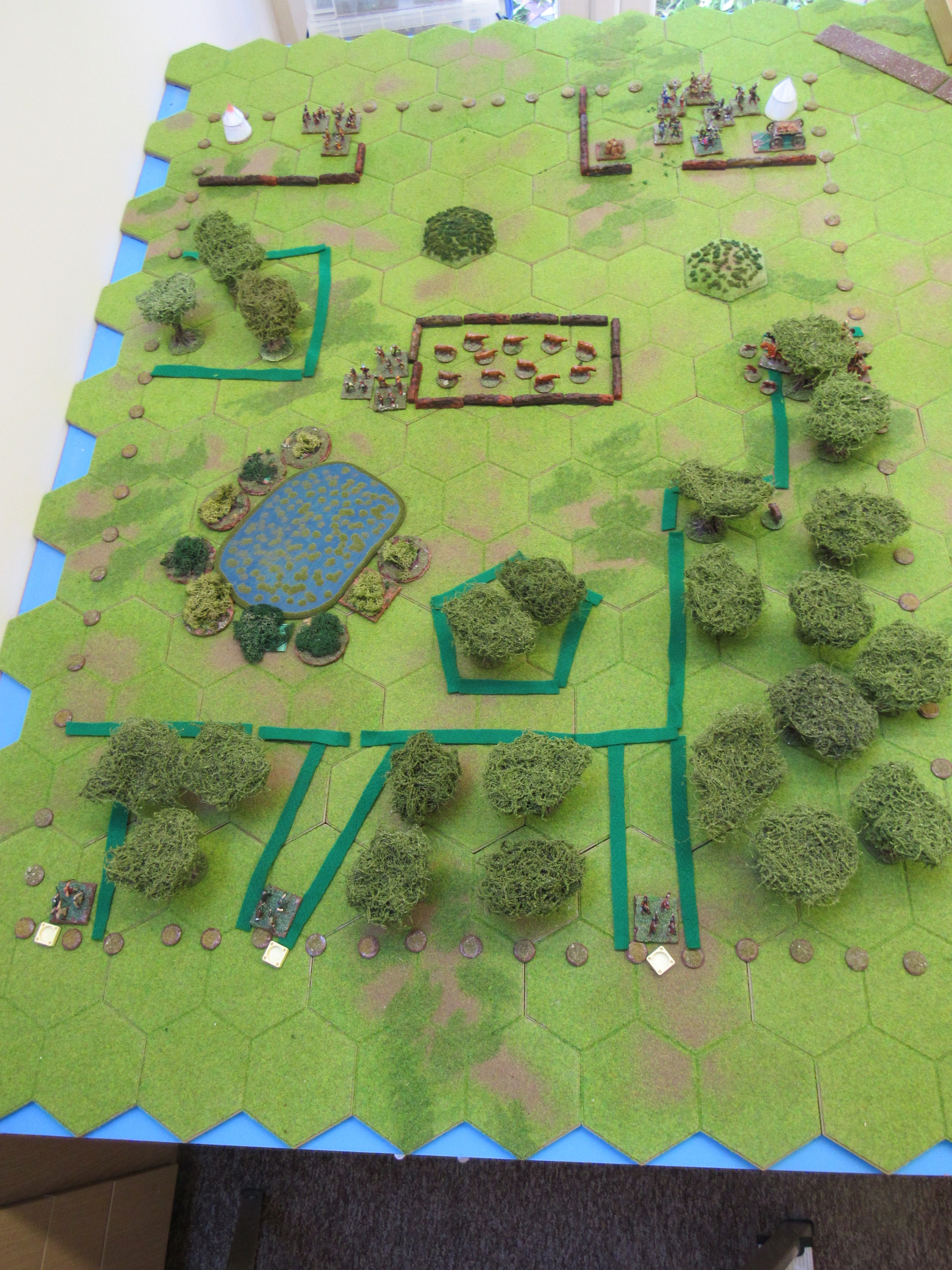
My attention was therefore caught by an article by David Hiscocks in the July issue of Miniature Wargames entitled Lion Rampart, described as a siege campaign for Osprey's 'Lion Rampant' rules. I had briefly thought about trying to rejig VW for an earlier period, but had abandoned the idea as those rules are definitely written for the age of a structured and scientific approach to siege warfare. However, having read and played them was good background to reading this article because I could see how he was attacking the same challenge, but had come up with a very different approach. I was sufficiently impressed to think about trying it out. I've had a bit of a play around and have come up with the following:


I'll do another post as to how I ended up with that layout and what the marked off area is all about. Note that the sun is still shining in West Yorkshire despite it being late July.


Don't enquire too closely into the period or the place; let's just say late medieval, somewhere in Western Europe.

Thursday, 28 July 2022

The Second SoN

 We played the second half of our initial Soldiers of Napoleon game last night. I don't own a copy of the rules, but both James and Mark do. When I arrived they were both observing that they had re-read them since the previous Wednesday and were engaging in mutual congratulations as to how we had got absolutely everything correct despite it being the first game. Now, one doesn't have to be as big a cynic as me to realise that this was all a bit of a hostage to fortune. Inevitably enough, a series of errors became steadily apparent throughout the evening: saving throws against artillery (there aren't any), what happens when you fail to pass a morale test to charge home (you fire instead, which I rather liked without being able to justify it thematically), the way reserves arrive (not intuitive at all, but makes sense once we'd bothered to read it), and too many others to mention. In the end we called it a draw and decided to start again next week. Mark and I had nearly won by then by throwing everything into a cheesy attempt to achieve one of our hidden objective cards and accept that quite a few units would evaporate in the process. It came down to the need to throw a 4,5 or 6. I threw a 2.


James wondered whether the rules had been written around how the playtesting group played the game rather than it being fully thought through as to how anyone picking them up cold would do it, which I thought was quite astute. But, having said that, we all changed our approach over the two evenings and no doubt will do so even more next week. We're going to try the big battle rules - main difference apparently being that each player has their own hand of cards - and use a larger playing area. I hope we drop the 'How Goes the Day?' bit, because it's pants; not the idea as such, just the manifestation of it.

Sunday, 24 July 2022

Ooh, Mr Grimsdale

 I have stayed away from commenting on the current Tory leadership contest because it's obvious they're all headbangers without me having to point it out. However I do need to draw your attention to a letter in the Yorkshire Post earlier this week which declared: "Rishi Sunak should not be allowed to stand for Conservative Party leader because he wears Norman Wisdom suits".

"The public rightly expect government to be conducted properly, competently and seriously."

I get free access online to the Yorkshire Post through membership of The Leeds Library. Perhaps more surprisingly membership also allows me to read Miniature Wargames for nothing. An article in the July edition has unexpectedly led to a burst of activity in the wargames annexe. I hope to post about it here soon.

Thursday, 21 July 2022

Lukewarm

 And I'm not talking about the weather which, at nineteen degrees and raining, is about par for high summer in a normal year in the lower Wharfe valley. Last night there was a full turnout in the legendary wargames room: Peter (*), James (**), Mark (***) and me. We had a first game of 'Soldiers of Napoleon', a new set of rules which are creating a bit of a buzz.


And the verdict: they were all right. I got the impression that the others were more enthusiastic than I was, but it all has to be interpreted in the context of us almost certainly not playing them correctly on this first occasion. I like a card driven game, so that aspect was good. It uses a system whereby each card can be used in a variety of ways, but only one can be chosen each time you play it. It's a very common mechanism in boardgaming, but I'm not sure whether I've ever come across it in wargaming before. I also quite liked the relatively simple idea it uses to encourage one to switch successive activations from one command to another. Combat resolution seemed very bland and I was bemused by artillery being so underpowered and vulnerable on a Naploeonic battlefield. The biggest disappointment was the much vaunted 'How goes the day?' concept of one playing a small section of a larger battle with what happens elsewhere affecting what's happening in your sector. All it actually amounts to is rolling dice every turn and the winner getting some victory points.


We shall carry on next week, with the biggest challenge being to stop James introducing house rules before we've even finished the first game.


* Who I'm very pleased to say looked well after an unavoidable absence.

** Who seemed a bit out of sorts; perhaps it was the heat.

*** Who was wearing shorts. I know one can't expect everyone to live up to my standards - I always wargame in a tie and sleeveless sweater - but really!

Tuesday, 19 July 2022

How rude so'er the hand

 I like getting questions about blog postings, despite them usually being along the lines of "Why do you bother?" or "I suppose you think you're funny?". I am glad to say that I have received one which is marginally more constructive, an observant reader asking why I spelled 'gaily' as 'gayly' in the title of the previous post. Don't blame me, blame Sir Walter Scott. The quote comes from his narrative poem 'The Lady of the Lake'. I haven't read it - Scott is one of those authors who I firmly intend to read when the time is right, but as to when that time might be I can't say - but I have just been to a performance of Rossini's 'La donna del lago'.

The lady and, believe it or not, the lake

I'd never seen it before, and have read various theories as to why it isn't put on more often: either the staging and set requirements are too demanding or it's difficult to assemble the combination of voices needed seem to be the favourites. This production was a bit odd, but the music and singing was excellent and I enjoyed it thoroughly. 

The oddities included archaeologists and museums, neither of which appear to feature in Scott's original and no kilts or tartan, both of which certainly (*) did. The driver of the plot is the apparent real-life tendency of James V to wander around in disguise. He was, of course, the father of Mary Queen of Scots, but if you can guess 16th century from the pictures then you're doing better than me. The chap on the chair is the baddie, who bears the fine Scottish name of Rodrigo, and as whom John Irvin stole the show, brilliantly portraying the character's MacHeath-like psychopathic tendencies. The eponymous lady was wonderfully sung by Máire Flavin, whose Violetta for Opera North this autumn I am very much looking forward to.


* For 'certainly' read 'probably'; hard to know for sure without putting in the effort of actually reading it.

Saturday, 16 July 2022

Gayly to Burgeon

 I've been away again, this time to here amongst other places:


I may write about my experiences if the next few days are as doubleplus scorchio as we are being promised, meaning that I have to skulk indoors to keep cool.

In the meantime, here is my old mate Robb Johnson with his view of recent events:


Monday, 4 July 2022

Advance Guard Action Action Report

I am motivated to put finger to keyboard by James having done the same. His report on last week's game is here. He draws attention to the luck inherent in the scenario having rather swamped the luck inherent in the game. However, he was also spot on in saying that it was a good and entertaining evening. Fortune swung backwards and forwards and I wasn't that far off winning before anybody's reserves had turned up.

In fairness though, that last bit is actually a negative. Having broken the British cavalry division with my own cavalry charge (basically by dint of good dice rolls), I only had to break one more division to win. One of the infantry divisions attacking the town hadn't started with much morale and so, once it was clear I was going to lose the town anyway, I made an assault which, had it succeeded, would have won me the game. My estimate was that I only had about a twenty five percent chance of success, but as I know that I have mentioned before, the morale rules currently being used in the Peninsular games do very much encourage cheesy play.

Anyway, I probably deserved to lose because I tried to - and indeed did - capture both objectives, but in doing so left myself so stretched that I couldn't realistically have hoped to hold either for the remainder of the eight turns required. We're having another crack this week with a revised scenario and slightly altered terrain. I've been offered my choice of sides. I think I might stick with the French and try a more measured strategy; or will I?


Tuesday, 28 June 2022

Return (slight happy returns)

 I've been away on a bit of a road trip, including to this place:


I haven't got anything much to report, I'm just trying to get back in the habit of posting. There's a game tomorrow; details over at James's blog.

I have had a little play around with the Peter Pig Mexican Revolution figures that I bought recently. Were I to buy any more - which of course I won't - I am leaning towards basing them singly and using sabot bases to allow the playing of different sets of rules (*). I bought 15mm figures because PP do a complete range, but wonder if they are a bit small to be based in that way. Here's where I am at the moment:


* And I do have rather a few sets which could be tried out, hypothetically.


Monday, 27 June 2022

Return

Return often and take me,

beloved sensation, return and take me -
when the memory of the body awakens,
and old desire runs again through the blood;
when the lips and the skin remember,
and the hands feel as if they touch again.

​Return often and take me at night,
when the lips and the skin remember...

                    - C. P Cavafy


Saturday, 18 June 2022

Some Napoleonics - mainly

 It's been a while since wargaming featured here, but there has been a bit going on in the background. Mark and I had a run through of Friedland in the annexe using C&C, but came nowhere near finishing, which was a bit disconcerting as the ability to play a game in an evening has always been a big attraction to me. I don't think we were playing particularly slowly; just an effect of having lots of troops on the table perhaps. Before setting the game up I had a vague idea of the strategic significance of the battle, but couldn't have told you any of the tactical detail. Having read some background it reminded my why I started tweaking the victory conditions on official C&C scenarios. Historically the Russians were trying to evacuate across a river, but don't get any victory points for doing so, only for destroying enemy units.


Speaking of rivers, the next game I played in was a couple of weeks later in the legendary wargames room of James 'Olicanalad' Roach was set in the Peninsula and featured a British attempt to deny a bridge to an advancing French force. You can just see the bridge at the top of the photo. The French collapsed rather quickly, and in the after game debrief there some tentative suggestions that the scenario would have been better if they had a bit more morale. When we met again the following week for another peninsula game James admitted that he'd cocked the calculation up and the French should have had twice as much morale; proving I suppose that sometimes one's instincts are correct.

The new game, which took place over the last couple of weeks, proved to be the best of the three, despite me as the French losing to a tag team of British commanders in Peter the first week and Mark the second. If I could summarise James's intention in developing a Piquet variant specific to the Peninsula, it isn't especially to recreate history. You will recall that, by and large, British lines always beat French columns. Instead it is to make an enjoyable game in which the French, using columns, can sometimes close with and overwhelm British lines, but will sometimes be repelled by firepower. The rules have a lot of moving parts which all need to gel together, but if I was going to pick one change which occurred over the time we have been working on them, and which appears to have helped, it would be the handling of skirmishers. When we started we kept trying to make skirmishers do what they did - or what we thought they did - historically. Where we have ended up is using them in an essentially abstract way to make it easier for troops that have them to move up to charge range. It all comes back to whether one is striving for a historical simulation or an enjoyable game.

Lastly, you are all no doubt wondering how I am getting on painting the packs of Peter Pig Mexican Revolution figures I bought some weeks ago. Well, in the way these things always work out, such limited painting as I have been doing has been of some Kennington Grenadiers à Cheval.

Monday, 13 June 2022

Medieval Military Combat (slight return)

 Just over a year ago I reviewed Dr Tom Lewis's 'Medieval Military Combat' and so too, albeit in a more dismissive fashion, did Graham Evans over at 'Wargaming for Grown-ups'. In Volume XXXII of The Ricardian, journal of the Richard III Society and hot off the presses, is another review. This one is by Peter Hammond, Research Officer of the society, and author of many books on the period himself. 

He is of much the same mind as me on Lewis's tome. His concluding paragraph reads:

"This book is an interesting mixture. As described it contains some interesting practical points which are not usually discussed. It is not well written, being badly organized but it is worth reading for the discussion of battle aspects not often covered. Unfortunately there are very few illustrations, all in black and white and very badly reproduced and the index is poor."

So, worth a read, but borrow don't buy.

Saturday, 11 June 2022

Time Becomes Space

 And so to the opera. For some reason this blog has been neglecting its self-ordained role of bringing reviews of the most life-affirming of the arts to wargamers who don't give a toss. Half a dozen operas have passed without comment this year (plus this one which snuck in somehow), but Parsifal is going to get the treatment, not least because it lasted five hours.

Musically, it was wonderful. Five hours seems a long time (*), but as with other Wagner operas that I have seen it actually goes very quickly, especially if one takes the sensible option of just surrendering to it without constantly trying to estimate when the the next interval is. Plus of course, taking the other sensible option of going to the toilet first. As with Ian McKellen's 'King Lear' I think one should say to oneself that if those on the stage can stick it out then so can I.


The semi-staged concert production was striking, with the orchestra - on top form - present on stage, but not able to be seen clearly because of a slightly opaque curtain between them and the singers and bright lights shining from the back. The singers were uniformly excellent, although I would pick out Katerina Karnéus as Kundry for special mention. Kundry, incidentally, undergoes almost as big a change between acts as Puccini's Mimi. 


But what is it all about? Good question; buggered if I know. Superficially, it's about the Grail legend Parsifal being the German version of Percival. 
I have seen it suggested that Wagner had convinced himself that the word was related to the Parsees of India, which seems odd because they are Zoroastrians, and this is overtly Christian, albeit layered with even more mumbo-jumbo than normal. It could be about compassion, but the characters spend more time placing curses on each other than one would expect from truly compassionate people (**). It's possible that there is some connection being drawn between castration and celibacy - this is before Freud of course - or perhaps it's a commentary on the risks men run from women who may emasculate them, Kundry again; she really is the most interesting character involved.

The programme went to great lengths to say that if one didn't know that Wagner was anti-semitic then one couldn't deuce it from the libretto. Maybe not, but equally one can see why in later decades sinister types would seize on operas about groups of uniformed Aryans with unresolved homoerotic tensions whose destiny can only be fulfilled on the arrival of a charismatic leader. 


* Probably because it is

** In particular the question of who had originally placed the curse on Kundry confused me enormously. If anyone knows, please leave it in the comments.


Sunday, 5 June 2022

Three Strong Women

 "A strong woman is a woman determined to do something others are determined not be done" 

- Marge Piercy


Yesterday's post ended with a reference to Catherine of Aragon and - is it planned? is it coincidence? - it was that queen, as portrayed by Bea Segura, who stole the show in 'Henry VIII' at the Globe a couple of weeks ago. In fact the Spanish actress was the only good thing about it, it being all too clear why no one ever puts on this collaboration between Shakespeare and John Fletcher. I'd certainly never seen it before and couldn't have told you anything about it beyond the fact that it was an accident with a cannon on the opening night that led to the burning down of the original Globe. This production gave a co-writing credit to Hannah Khalil who had been tasked with making it focussed more on the female characters. She did this by importing lines from other plays and poetry by Shakespeare and giving them to Catherine, Princess Mary and Ann Bullen (sic). I'm not entirely sure it worked, because hearing Mary speak lines which one knew really belonged to Lear just made me wish I was watching that play instead. Anyway, Segura was great as a woman determined not to be pushed aside for the convenience of others and it was good to be back in the Globe again after it had been forced to close by the plague.


Much better was 'The Corn Is Green' at the National Theatre, although as it cost literally a dozen times as much to watch then so it should have been. This semi-autobiographical piece by Emlyn Williams about a poor child from a Welsh-speaking mining community being mentored by an inspirational teacher and eventually winning a scholarship to Oxford, was heart-warming without being sickly sweet. Even a stage full of miners, faces blacked with coal dust and singing hymns, seemed to work in context. Nicola Walker as Miss Moffat, overcoming the class and gender prejudices ranged against her, was excellent. The evening also provided something I'd never seen before when the backstage machinery to bring the set on for the second half malfunctioned, and so the actors simply performed with a third of the stage bare. The show must go on. 


The third really good performance of a strong woman that I have seen recently was that of Bettrys Jones, as Ellen Wilkinson, in Caroline Bird's 'Red Ellen'. Wilkinson was the only female Labour MP elected in the October 1924 election, served in the wartime coalition government and was the second ever female cabinet member as Minister for Education under Attlee, before her untimely death in 1947. There's a lot to fit in, from the Jarrow March to the Spanish Civil War, and the staging if pacey, with lots of set and costume changes occurring before our eyes. A host of supporting characters are played by the small cast - including Einstein, Hemingway, Churchill and Herbert Morrison - but the focus is always on Ellen herself, who is never offstage. 


As the programme says: forever on the right side of history, forever on the wrong side of life.

Saturday, 4 June 2022

The Alteration

 I find that I didn't say everything I wanted to yesterday. I think I was distracted by listening to Test Match Special and wondering if there was an alternative timeline in which England were any good. Jonathan Agnew reported that after the first day's play he had been asked by the ICC's anti-corruption team whether he thought there was anything suspicious about the loss of so many England wickets in such a short time. He had given the only possible answer: "Haven't you been watching for the last two years?".

Anyway, what I wanted to mention was that I don't mind alternative history fiction, because it's, you know, fiction. I'm not talking about about time-travelling fantasy where someone goes back to the middle ages with a machine gun, but simply a novel set somewhere sometime where things have turned out differently. Robert Harris's 'Fatherland' would an example probably known to many readers (*), and a Nazi victory in the Second World War has spawned many others. The only one of these currently on my to-read list is Philip K. Dick's 'The Man In The High Castle'. However, this blog's recommendation in the genre is 'The Alteration' by Kingsley Amis.


The two main alternative path taken in the book is no Protestant Reformation, and therefore no Enlightenment and so scientific progress has been slowed and restricted. The Roman Catholic church now dominates a totalitarian Europe through what is a cross between the Inquisition and the Gestapo. The novel is set in the 1970s and a number of people prominent in that decade pop up in different guises, as do many historical figures. There are many allusions to familiar cultural artefacts in this different context, but perhaps the one to highlight is an alternative history book within a book: 'The Man In The High Castle' by Philip K. Dick in which Henry VIII has had a son by Catherine of Aragon.


* If, of course, the blog had many readers in the first place.

Friday, 3 June 2022

The Armchair General

 I am not particularly a fan of counterfactual history, but have been reading 'The Armchair General' by John Buckley.

The premise of the book is not so much what if things had happened differently, but more specifically what if allied commanders had made different decisions at various stages during the Second World War. The structure is that for each of eight scenarios the reader is presented with binary options, then for each of those routes there is another binary option and so on, leading to a small number of alternative situations. The author claims these to be 'plausible rather than fantastical' and that seems a reasonable description to me.

The reality is that readers will go back and take all the alternative paths anyway, so it ends up being not so much one counterfactual history as a group of possible outcomes collectively illustrating why and how choices were made. The areas covered are all of a strategic nature with Market Garden being the most operational.

I don't think there are any huge surprises in it, especially for the sort of person who reads wargaming blogs, but it's well put together and I found it an enjoyable read.