Tuesday, 15 December 2020

post eventum sapientibus

 Wargames blogs have been around for years now, and certain customs and practices have arisen. One of these is promising to do things that are not only never done, but which the both the bloggist and his or her readers know that there is little or no intention of doing in the first place. A small example of this is my claim yesterday that I was going to produce a model of the sap as illustrated by Vauban and Duffy. Clearly, I was never going to model the trench part - that would be silly - and I always knew that I would skip the fascines on the top given that they would probably be mostly covered in earth. I possibly half thought that I might add the sandbags, but in the end I didn't; partly CBA and partly because I think they would make the subsequent steps in my plan more difficult. So, what I have actually made is a row of gabions in front of an earth bank. It's pleasant enough, but falls woefully short of what was shown in the plans.


What it did do is give me a chance to get out the hot glue gun, which is far and away my favourite modelling tool. There is possibly some deep Freudian reason for that, but fortunately I have given up introspection for advent.


The gabions are from the Italeri Battlefield Accessory Set, in part because that's what I had to hand, but mainly because they come in half sections. 


You will note that we are back on the really, really crud covered cutting mat today.

Monday, 14 December 2020

Quelle saprise

 The 'Vauban's Wars' rulebook contains the following picture, apparently from a publication by Vauban himself. (My scanner won't work - no doubt a Windows 10 update problem - so photos only.)


It reminded me of something, but, as seems to happen increasingly frequently as I get older, I couldn't remember what. It has now come back to me: it's this from Chapter 6 of Duffy's 'Fire and Stone', which also appears to be from a publication by Vauban, but is slightly different.


Duffy also includes this illustration, which is more obviously a redrawn version.


On the printed page the figure standing guard in the trench is exactly 25mm tall, which is probably not coincidental; the book does after all contain some rudimentary rules for wargaming sieges. I think I shall try to make a model of, loosely, the sap shown in those plans.

No doubt you are all asking yourselves the same question as me: given that saps zigzag forwards towards the enemy, what does the man at the front do when he wants to turn the corner from zig to zag? Perhaps making a model will reveal all.

Sunday, 13 December 2020

A Nocturnal Upon St Lucy's Day

It is the Feast of Santa Lucia, a much bigger deal in Scandinavia (not to mention the eponymous Caribbean island, where it's the national day) than it is in the UK. As was explained to me by my Swedish colleagues over glögg and lussekatt when I worked in Gothenburg, that's because December 13th was the winter solstice under the Julian calendar and therefore a festival of light was just what they needed. 


Regular readers will know that nothing pleases me more than a debate about the Earth's orbit around the sun, but they are a non-confrontational race of people so I didn't bother to point out the obvious flaw in the Julian calendar theory. Still, it does explain why John Donne started his poem in the way that he did:


 'Tis the year's midnight, and it is the day's,

Lucy's, who scarce seven hours herself unmasks;
         The sun is spent, and now his flasks
         Send forth light squibs, no constant rays;
                The world's whole sap is sunk;
The general balm th' hydroptic earth hath drunk,
Whither, as to the bed's feet, life is shrunk,
Dead and interr'd; yet all these seem to laugh,
Compar'd with me, who am their epitaph.

Study me then, you who shall lovers be
At the next world, that is, at the next spring;
         For I am every dead thing,
         In whom Love wrought new alchemy.
                For his art did express
A quintessence even from nothingness,
From dull privations, and lean emptiness;
He ruin'd me, and I am re-begot
Of absence, darkness, death: things which are not.

All others, from all things, draw all that's good,
Life, soul, form, spirit, whence they being have;
         I, by Love's limbec, am the grave
         Of all that's nothing. Oft a flood
                Have we two wept, and so
Drown'd the whole world, us two; oft did we grow
To be two chaoses, when we did show
Care to aught else; and often absences
Withdrew our souls, and made us carcasses.

But I am by her death (which word wrongs her)
Of the first nothing the elixir grown;
         Were I a man, that I were one
         I needs must know; I should prefer,
                If I were any beast,
Some ends, some means; yea plants, yea stones detest,
And love; all, all some properties invest;
If I an ordinary nothing were,
As shadow, a light and body must be here.

But I am none; nor will my sun renew.
You lovers, for whose sake the lesser sun
         At this time to the Goat is run
         To fetch new lust, and give it you,
                Enjoy your summer all;
Since she enjoys her long night's festival,
Let me prepare towards her, and let me call
This hour her vigil, and her eve, since this
Both the year's, and the day's deep midnight is.

                                       - John Donne

Wednesday, 9 December 2020

Mortars - various

 Thanks to everyone for their kind words regarding my latest efforts at CAD design, laser cutting and Polyfilla gap closing. Unusually for these strange times I have some progress to report for a second consecutive day.

I was going to try my hand at scratch building some Gribeauval style siege mortars, in a similar manner to this. But then I came across Speira Miniatures and decided to take the easy option and order some from them instead. They duly arrived from Helsingborg this morning.


They are 3D printed and they can therefore supply them in whatever scale one wants. I obviously went for 1/72 and can confirm that the dimensions are spot on for a 12" Gribeauval mortar, at least according to the Osprey book on the subject. In other words substantially more accurate than I could have made them.


While I was at it I bought some Coehorn style light mortars. These are actually from their ACW range, but van Coehoorn's orginal design wasn't changed overmuch from its first use in 1702 until its final outing in 1915. On top of which, those are 1cm squares that they are sitting on, so one would have to be a pretty enthusiastic rivet counter to spot any difference.

So, a thumbs up from me for Speira Miniatures, excellent products and good service.

One last point: you may, like me, be wondering why my cutting mat appears to be covered in crud in those photographs. I have been to take a look and can confirm that it is, in fact, covered in crud. 

Tuesday, 8 December 2020

Never Mind The Bulwarks

 Bastions are Go! 


It's the usual story about the spraying, and there's a design fault that means they can't currently be used in straight wall sections, but I think they achieve the objective of vaguely suggesting what they're meant to be.


I shall have to get round the straight wall problem by making some spacer sections to flank them; as if I didn't have enough different bits already.


The cannon are what I propose to use as fortress guns. Those above are from Hat 8311 Napoleonic Naval Cannon and Crew, and the others are from Orion 72001 English Pirates. The Hat ones are a lot better, but waste not want not. I was trying out the 2p pieces as bases, but they are a bit too big. Crew will be individually based so that the guns will serve whoever is defending.

Saturday, 5 December 2020

Sappeurs

 Apart from bastions and artillery, on which subjects much has been written and very little actually done, a horse and musket period siege required sappers, engineers etc. When, at the start of the first lockdown, I photographed those elements of my collection never to have seen the table top I ran out of enthusiasm before reaching the French Napoleonic engineers in siege dress.


I have rather a lot of these, which I think is going to come in handy. The opposition to the French will either be Russian or Prussian and I have no idea what the equivalent troops for those armies looked like, or where on earth I'd get some even if I did. The assumption will therefore be that they took their lead from the French and looked pretty much the same.


Three chaps with very unconvincing beards

To stop them from being truly indistinguishable, the French engineer units will each be accompanied by a line infantry sappeur, somewhat incongruously wearing full dress uniform. This is, of course, because I have a number of those and they have never to date seen any action. 

Monday, 30 November 2020

Bastion failure #1

 I keep saying that I intend to make some bastions to turn my town walls into a Vauban fortress. 


What I really mean is that I want to make something that gives a least some of the look and feel of a Vauban(ish) fortress whilst having the footprint appropriate for 20mm figures on a 1.5m x 2.5m table. This is a task that is so far proving beyond my design skills. 

On a more positive note, I have produced some wall segments that connect at other than 90 degrees.


I've also finished painting the forty or so Ancient Britons that I started several months ago. Hooray.

Wednesday, 25 November 2020

Napoleonic Siege Artillery, a modest recrudescence

 "We judge ourselves by what we feel capable of doing, while others judge us by what we have already done."

 - Henry Wadsworth Longfellow


It's a good job that there is no form of audit for wargaming blogs, because the overall ratio of things promised to things delivered would probably shame even the current prime minister. I thought that I had avoided this trap in a recent post when I blithely said that nobody made any 20mm Napoleonic siege artillery and therefore I wasn't going to do anything further on the subject. No sooner had I written it than something began to bug me. Somewhere in my subconscious a distant memory was trying to rise to the surface. It has eventually done so and has led me to to Rod's Wargaming Website. Firstly, if anyone is unfamiliar with that blog you need to start by reading the 'About' page; quite a story. Anyway, the specific post that I had remembered reading was this one. So, a reverse ferret it is, and I think I shall take a look at what can be done after all.

The first step is to consult this book:


And this book:


Tuesday, 17 November 2020

PotCIpouri

"Whatever they do, I won't deplore, or even preach a lesson" - Charles Perrault, Sleeping Beauty


There is still nothing much happening here, except for mince pies and lots of them. Some progress, though slow, is being made on painting the castle. 


It must be nearly finished, as Rapunzle has taken up residence.


Or perhaps it's Sleeping Beauty, who has woken up already because it's all taking so very, very long. 

I've been asked why the towers are modular. It's because I didn't trust the birch ply not to warp if used in sections that long.

Thursday, 12 November 2020

The Anniversary Walls

 It's exactly a year ago today that I produced the first prototype piece for my castle, which is nearly - but not quite - finished. So, a fairly quick timescale by the standards of most wargaming projects I would say. I have enough basic pieces now, although I shall be making some more damaged and breached walls. I will also make some bastions if I can come up with a design that looks the part without being overly complicated to cut out and assemble.


The lecturers who attempted to teach me operations management at business school wouldn't be very impressed, because far from getting a smooth production flow set up, I rather concentrated on the laser cutting and the spray painting. The detailed work all got put to one side and I have recently been faced with painting endless lines of white mortar (*), which has all been very dull. There are a dozen or so pieces still being sprayed, as and when climatic conditions allow. I have discovered that it's a waste of time trying to cover them in one coat - I don't really know why; perhaps because the paint is textured - and that it is better to give them half a dozen or so quick sprays, which adds to the elapsed time. When it is 'finished' I shall set up a proper picture.

* For the record the colour actually used is tapioca. 

Sunday, 8 November 2020

Life imitates art

 "Life imitates art far more than art imitates life" - Oscar Wilde

Lockdown has so far consisted of nothing much more than sitting around eating Heston Blumenthal's Spiced Mince Pies with a Lemon Twist, perfectly pleasant without being remotely worth the money, and chuntering about Windows 10, the October update of which has disabled a number of features on my laptop. You would not believe how many tickets I had booked for events in November: ranging from Beethoven to Buster Keaton via Alan Bennett. I was even going to see 'Citizen Kane' on the big screen to mark the 75th anniversary of its release. Coincidentally, the following clip has been forwarded to me more than once over the last couple of days; people seem to think it captures the zeitgeist.


Saturday, 31 October 2020

Vauban's Wars - the unboxing

I mentioned a couple of months ago the publication of 'Vauban's Wars', a set of horse and musket siege rules which had been long in the gestation. It had been my intention to take a look at James' copy - he's in the Piquet Inc inner circle and will undoubtedly get one - but given that I'd been waiting to see them for some seven years already, plus the likelihood that the way things are being managed in the UK at the moment it will probably be another seven years before the inhabitants of the Wharfe Valley are allowed to visit each other's wargames rooms, made me splash out and buy my own copy.

The man himself

So, these are my first thoughts:

  • The production values are good. It's a 98 page ring bound book in colour plus quick play sheets. 
  • Sheets containing the cards, which need to be cut out, are provided. Alternatively you can, as I did, pay extra for a playing card quality version. Either will fit the standard 63.5mm x 88mm sleeve.
  • There is a thorough list of contents, background information including a glossary, designer notes and game markers for photocopying.
  • The colour photographs are not, as is so often, merely to look good and inflate the price, but actually give a pretty good indication of what is going on, which is particularly useful given the differences with a normal tabletop battle. 
  • The game is a Piquet derivative - hence the cards - or to be more specific it's based on Field of Battle, the faster flowing and less swingy updated version of Piquet.
  • These rules cover the aspects of sieges such as sapping, mining and bombarding at the level of one turn representing three or four days. As and when assaults and sorties are indicated these will need to be resolved using a separate set of tactical rules, before returning to siege game. Rules to manage the transitions are included
  • Events such as weather, supply, espionage, disease, relieving armies etc. are covered, but all at a fairly abstract level.
  • There are no army lists as such, but some reasonably prescriptive constraints as to the minimum and maximums of each unit type. National characteristics exist - especially for the Ottomans for some reason - but don't appear to be that significant.
  • Everything seems straightforward to me from my first read through, although it must be remembered that I have played a lot of Piquet. 
  • Overall, I'm very impressed, but the proof of the pudding is of course in the eating. It will be a while before I can try them - and they have to take their place in the queue of new rules anyway - but there is a report of a playtest game here for those interested.
A couple of relatively unimportant points require mentioning. Firstly, the rules are printed on US size paper, which is unsurprising but irritating for those of us in the rest of the world. It makes it much harder to put the quick play sheets in protective coverings. For C&C, for example, I retyped them all on to A4 before laminating them. Secondly, and on a more positive note the rules contain an absolutely explicit definition of what constitutes a flank, which happens to be the definition with which I agree and have been pushing for some years, and the author supports this with no less than a full page colour diagram. It's all a bit superfluous because, by and large, units are behind cover in trenches and fortifications and impossible to flank, but it's the thought that counts.

I have a twofold interest in the rules. I would like to play them as written, although that would probably require James to acquire the necessary siege and fortress guns, which I don't expect come cheap in 28mm. As far as I know nobody makes them for 20mm Napoleonics, so any game in the annexe is going to see some substitution taking place. I am tempted to make some bastions to match my town walls in any event. One question would be how to interface the siege rules to the hex grid if using, as I probably would, C&C for the assaults and sorties. Which also reads across to my other area of interest. It seems at first review that there would be scope to straightforwardly amend these for the late medieval period, and in that case the same question of matching to a grid would come into play if I wanted to use them in conjunction with To the Strongest!. 

Monday, 26 October 2020

Crack Dens and Brothels


"Of all the preposterous assumptions of humanity over humanity, nothing exceeds most of the criticisms made on the habits of the poor by the well-housed, well-warmed, and well-fed." - Herman Melville

Sunday, 18 October 2020

ON play ELP

 "No wise man ever wished to be younger." - Jonathan Swift


My incapacities have been fairly selective: I can't drive or do anything that requires close up focussing plus I fall over if I'm not careful, but other than that I can get about OK. And so I have been able to partake of some of the cultural activities opening up, albeit to be immediately closed back down again. Firstly, there was a recital by a baroque violinist. In fact, now I think about it, that was the day I got carted off to hospital, although it would be most unfair to blame her.

Once I had got myself together again it was the turn of what is now known as the Leeds Playhouse, which has been having a festival of performances for works with not many performers. First up was Poulenc's short opera for single soprano, 'La Voix Humaine'. I've seen this a couple of times before and I still wonder a bit what it's meant to represent. Is she really living through what we see or is it the condensed reminiscences of an unhappy period in her life on which she is looking back? I believe that Cocteau's play, on which this based, was more explicit, especially about the ending, but I've never seen it so that doesn't really help.

I'm also a bit ambivalent about the second piece, Beckett's 'Krapp's Last Tape', which likewise dates from the end of the 1950s. Krapp is a sad, shabby, bald man in his sixties who sits all alone at home on his birthday looking back on his life and wondering how it had ended in loneliness and failure. So, no parallels with your bloggist there then, except perhaps for needing to cut down on the bananas. I think it was about getting old and realising that being young was better, but frankly am open to alternative suggestions if you have them. 

Lastly, but not least, I saw the brass and percussion sections of the Orchestra of Opera North perform a programme of works which might have been - but wasn't - labelled as a tribute to Emerson, Lake and Palmer. They opened with Copeland's 'Fanfare for the Common Man' and closed with a selection from Mussorgsky's 'Pictures from an Exhibition'. It was like reliving my youth, except without all the aggravation of health, ambition and hair. I enjoyed it immensely, but shall not be rushing off to buy a copy of 'Brain Salad Surgery'.


Thursday, 15 October 2020

PotCpouri


Indeed it has, Dame Helen. Still, we have to keep on keeping on. This week's Royal Armouries lecture was a bit of a curate's egg; I learned more from the Q&A than from the presentation bit. The presenter didn't help himself by taking the time to debunk various myths about plug bayonets that can't have occurred to many people in the first place. He did, however, address one issue that had puzzled me, namely how one removed a plug bayonet from the musket without cutting one's hand. Apparently the answer is that you rarely can. Interesting fact of the week was that the plug bayonet wasn't developed so much in imitation of the pike as it was as a convenient way of sticking wild boar; and the name does indeed come from Bayonne.

While I'm talking about online talks, let me draw your attention to this one, in which the 12th Duke of Northumberland is going to speak about 1,000 years of the Percy family at Alnwick Castle, a period which ought to contain something of interest. The picture below reflects slightly less than a millennium of the Epictetus family at Alnwick Castle. The one in the middle is the elder Miss Epictetus; I don't know who the other two are.


And finally, this is rather nice, and it's in a good cause:


Tuesday, 13 October 2020

Britannia AD 43

 So, the fact that the world won't stand still is restricting my ability to indulge in those few things that remain legal in Leeds, sitting all alone at home painting figures for example, but oddly enough I can read books without any problem (computer screens are more difficult) and I have been looking through a recently published book in the Osprey Campaign series: 'Britannia AD 43: The Claudian Invasion' by Nic Fields.


I hope I'm not damning with faint praise when I say it's OK. Two obvious problems that the author has are a lack of sources plus the significant changes in the geography of both the Kent coast and the course of the rivers Medway and Thames during the intervening two millennia. He copes with both as well as could be expected, although he does tend to repeat himself a tad. It's copiously illustrated with both paintings (by Steve Noon) and photographs of subjects ranging across museum exhibits, re-enactors, Roman remains from well after the invasion, much later buildings which happen to be where something may or may not have happened at the time etc. One of the photo credits is given to Neddy Seagoon, so one can't complain that the publishers have not looked in every possible place that they could think of.


Everyone will come to the book with a different level of prior knowledge, and most will be greater than mine. When Fields says that many people's impression of Claudius himself comes from Robert Graves via Derek Jacobi, he might have been describing me. Personally, I found the description of the difference between the alae and the cohortes equitatae to be very helpful, although I can't imagine it will make any difference to how I classify my Roman cavalry in 'To the Stongest!'. Also interesting was the contrast between the tribesman using local knowledge to finding their way through estuary marshes and the Batavian auxiliaries' ability to swim across rivers and move directly into combat. The text further prodded me towards thinking that the way chariot rules work in 'Infamy, Infamy' is more likely to reflect how they were used than those in TtS!; still, the latter shouldn't be hard to change. Lastly, but by no means least, I am very tempted to model (when vestibular stability has been restored) the illustration of Claudius parading towards Colchester on an elephant. And why not?


Still remembered


Monday, 12 October 2020

Two Poets

Two poets have been in the news. Firstly, Louise Glück won the Nobel Prize for Literature. I rather like the following lines from her poem 'Vespers', which say it like it is, for me at least.

"In your extended absence, you permit me
use of earth, anticipating
some return on investment. I must report
failure in my assignment, principally
regarding the tomato plants."


And Derek Mahon, Irish poet and 'aesthete with a penchant for left-wingery', died at the beginning of the month. He also tells it like it is, this time with perhaps a wider pertinence. These lines are from 'Afterlives':

"What middle-class shits we are
To imagine for one second
That our privileged ideals
Are divine wisdom..."

Friday, 9 October 2020

Milan 1630

I bet you all looked at that title and thought I was going to write about military history, or perhaps I was about to start wargaming a new period. However, and temptingly obscure though the War of the Mantuan Succession would be, neither of those is the case; you know me better than that.


I have been reading Manzoni's 'I Promessi Sposi', the classic of Italian literature which, on the off chance that you don't know it, is a bit Walter Scott, a bit Dickens or Thackeray, but perhaps mostly like Tolstoy. The author dedicates the whole of Chapter 31 to the arrival of the plague in Milan in 1630, and much of what he writes seems worryingly familiar. For example:

"The infection entered through the inadequacies of the edicts, negligence in carrying them out, and adroitness in eluding them."

Plus ca change.


Thursday, 8 October 2020

A Question of Balance

 The lack of posts on the blog has been to a great extent driven by a lack of balance in your bloggist. By coincidence the cover story of this week's edition of the New Scientist is about the fact that the population as a whole is falling over more often and that the problem is occurring at a younger age than ever before. They point the finger at less and less physical movement being undertaken by the bone idle denizens of the modern world, or at least that's what I think it said, but the magazine is on the other side of the room and I can't be bothered to go and get it. I have been placed on a regime of Balance Retraining exercises, about which I shall simply say that it is a good job that I live alone. Yoga has been mentioned, as it frequently is, especially by those who don't do it themselves. However, as I can't currently walk in a straight line, the Revolved Bird of Paradise may be some way off.

Anyway, here's some Sam & Dave, dedicated to the fond memory of those who perform the Downward Dog.


Friday, 2 October 2020

Royal Armouries Lectures

 During the last few months I have found that many of the things I enjoyed doing pre-plague aren't anything like as good when one tries to do them online. I appreciate that comment will be misinterpreted in some quarters, so let me be clear that I am talking about opera, theatre, live music etc. However, one thing that seems to work rather well is the giving of talks, and I have watched quite a few now, on subjects such as how the myth of Prometheus has influenced culture, The Beatles and the Sixties Art Scene, and Crusader Arms and Armour from Africa and Asia; and very good they have all been.


The last item on that list was the first of the winter series of lectures from the Royal Armouries, a series which under other circumstances I would have attended many of in person. That's obviously an option for me because I live in Leeds, but their new practice of streaming them means not only that I don't have to get off my arse any more, but that others who are not based in West Yorkshire can see them as easily as me, either live or after the event. A recording of the recent one about 'genuine' Crusader armour and weapons sold to the unwary by Victorian dealers (and they may be fakes, but it's a very interesting story) can already be found here on their YouTube channel. The next two are on the subjects of 'Plug Bayonets' and ' The Development of Gunpowder Weapons in Medieval England', either or both of which may be of interest to either or both of my readers. The lectures are given by staff at the Royal Armouries, so they know their stuff, and are free, which now I think about it was what attracted me in the first place.

Details and a link via which to book can be found on the Royal Armouries website. Presumably future recorded lectures will appear on the YouTube channel, which anyway contains all sorts of fascinating stuff.

Thursday, 1 October 2020

Sonnet 113

Since I left you, mine eye is in my mind;
And that which governs me to go about
Doth part his function and is partly blind,
Seems seeing, but effectually is out;
For it no form delivers to the heart
Of bird, of flower, or shape which it doth latch:
Of his quick objects hath the mind no part,
Nor his own vision holds what it doth catch;
For if it see the rud'st or gentlest sight,
The most sweet favour or deformed'st creature,
The mountain or the sea, the day or night,
The crow, or dove, it shapes them to your feature.
Incapable of more, replete with you,
My most true mind thus maketh mine eye untrue.

                                   - Shakespeare

Wednesday, 23 September 2020

Bloody Barons II

 I like to keep an occasional eye on  the most common search terms that have brought people to the blog. Sadly 'gay porn' has disappeared from the list, but thankfully 'beardy Branson is a twat' is hanging in there. Recently, the term 'Bloody Barons II' has appeared. Upon investigation I discovered that I had somehow overlooked the fact that Peter Pig had updated the rules first issued in 2005 and of which I own a copy. Even more investigation revealed that they are in fact a completely new set of rules, but have been given the same name.


My initial reaction was that it was some sort of con; in my defence I'm a bit of a cynic and that is my reaction to most things. However, logic says that it's the opposite that would be a con: the same set of rules with a new name. I don't know why I mention it. In any event I bought a copy.

As a slight digression, I am in the market for a fitness tracker or smartwatch and have been watching a number of YouTube reviews of various options. These influencer chaps - none of whom seem to be at all physically fit despite their interest in health tracking apps - have hit upon a useful trick for stretching out content. They do an 'unboxing' post followed, if one is lucky, by a full review in due course. That doesn't seem a million miles from what I have done (i.e. started to do) with 'Infamy, Infamy', and so this is an unboxing of 'Bloody Barons II':

  • They are genuinely a completely different set of rules with, as far as I can see, no mechanisms in common.
  • They are recognisably a Peter Pig/Rules for the Common Man ruleset:
    • Four base units with casualties removed in half bases
    • a pre-battle sequence, this one much simplified compared to others
    • random game length
    • Very useful playsheets; completely impenetrable main rulebook that seems deliberately written to confuse
  • They are gridded with some obvious similarities to 'Square Bashing' e.g. in the morale phase
  • There a couple of what look like innovative rules - albeit that for all I know they appear elsewhere in the RFCM canon - such as a phase where movement is by square followed by one where movement is, well, by square, but in a different way. Cavalry also seem to spend all their time off-table until they charge on to the field, melee and then retreat off-table again.
  • Includes scenarios for all the battles from the WotR.
One of the things that I didn't like about the original rules was the way that they dealt with mixed bow and bill units, which was far too fiddly for me. These new rules seem to just assume that all units are mixed and abstract it from there, which is rather more to my taste. So, I shall add them to the pile of rules to try, and you can add them to the pile of rules awaiting a full review. Don't hold your breath.

Monday, 21 September 2020

New walls for old

 "Scenery is fine, but human nature is finer" - Keats

What Keats was undoubtedly saying with those words is that whilst most wargamers may desire in principle to have beautiful, lifelike terrain on their tabletops, by and large they are too idle by nature to actually bother much about it. Obviously there are exceptions, all of James' scratchbuilt stuff for example, but I'm not one of them. It is in that context that we must look at my ever growing castle and town wall collection.


Many years ago I made a version in card and the learning from that process has influenced the design this time, including the decision to make it from laser cut wood in the first place, which I may return to another time. The main mistake of my previous attempt was that I used whatever card came to hand and ended up with no standardisation in length. This time everything, more or less, is10cm in length, or possibly 5cm or occasionally 2.5cm. They all fit together anyway. One positive feature was making the width of the wall sufficient for a 40cm deep base, and I have retained that. Before, I had gone for a thin wall with overhang; this time, after reviewing early prototypes, I switched to wider walls. I left the height the same, not least because that's the height of the ladders and assault tower that my armies are equipped with.


One other observation from my first attempt relates to the size of the blocks making up the wall. I quickly found that if one painted them to scale then the relatively small size and regularity that resulted - let's not forgot that the masons who built them really knew what they were doing - made it look like brickwork rather than stonework. So I painted the mortar lines freehand to represent quite large blocks, which looked better to me, although by any objective measure it is a lot less accurate. I have kept to essentially the same principle this time, but after fifteen or so years looking at the old ones, have put in an extra row on the new ones; finetuning if you like.

Friday, 18 September 2020

Oh Oh Domino

 "You may get disgusted, start thinking that I'm strange" - Van Morrison, Domino


I have always believed in the power of music - and envied the ability of composers, musicians and singers - to convey emotions such as love, desire, lust...["OK, calm down, there are plenty of other emotions, you know." (*) ] ... but have never seen its strength as being the explanation of the principles of infection control. So, despite being a huge fan of Van Morrison, I have let his recent rantings about face masks rather pass me by.


"Take off your mask and drink your milk"

I am still, other than in medical situations, rocking a bandana, and have been a bit surprised not to see more of them about. At first, when people commented, I would reply "If it's good enough for John Wayne, then it's good enough for me.", but when it became apparent just how old people had to be before they had even heard of Wayne I quickly stopped.


Should I ever adopt a more straightforward facemask then I shall be sorely tempted by those available from the Royal Armouries. The tosei gusoku has a certain something about it.


* Actually I didn't

Saturday, 12 September 2020

Nothing ever goes away until it teaches you what you need to know

 “If you desire healing, let yourself fall ill, let yourself fall ill.” - Rumi


A couple of days ago I mentioned that I had been ill, and did so in a somewhat flippant context. Regular readers, especially those who have remember the events of almost exactly four years ago, will know what happened next. On Thursday evening a blue-light ambulance duly arrived and carted me off to A&E. It was, as you might expect, pretty deserted - although there was the usual quota of drunks accompanied by police officers - and was a somewhat more pleasant experience than on the previous occasion. Except, that is, for the most painful injection that I can ever remember having. I also had a brain scan; they didn't find anything.


Boom Boom


I have been given some medication whose side effect is to leave me lethargic and drowsy, although you'll have to take my word for it that things are worse than usual. In any event, no painting is likely in the immediate future. There has been one unexpected benefit in the form of the reappearance of the wise woman of Thornton, the estimable Coral Laroc. Coral last featured on here when I recounted the story of the cat, and has understandably been keeping her distance ever since. However, she has used her mystic powers (*) to get in touch and say that she is 'sending some healing'. I think we can safely assume that this will set back my recovery by some time, but I'm sure that she means well.

For reasons that I don't really understand, mentions of Coral in this blog get more reaction from readers than those about any other woman except those actually wearing male military uniform. I think therefore it is time to pass on how you can follow her adventures directly. Firstly, for cat lovers, I must sadly report that the cat is no longer with her. She had to pass it on because - as the episode in my kitchen proved - it doesn't fit with her lifestyle. "What is this lifestyle?", I hear you ask. Well, I would describe it as a odd mix of superannuated YouTube influencer, peripatetic D-i-Y woman, and 'Carry On' film tribute act. For those with nothing better to do, she can be found here. Please don't give her money or encourage her in any other way.


* WhatsApp

Thursday, 10 September 2020

Advice to the Officers of the British Army

 Speaking of drumming yesterday reminded me that the book 'Advice to the Officers of the British Army', which I believe that I quoted from at the beginning of the recent troubles, is subtitled 'with the addition of some hints to the drummer and private soldier'. I'm not sure how well known the book is, and I'm pretty sure that it's currently out of print. My own copy is dated 1946 and that may well be the last time it was issued.


The book was originally published anonymously, but is generally accepted to have been by Francis Grose, a noted eighteenth century antiquarian. He may have decided to withhold his identity because whilst a militia officer (he had previously served as a regular in both the 19th foot and the 10th dragoons) he was entrusted with the funds from the officers mess and apparently managed to mislay much of it. The book is a satire ('1066 And All That' is as good a reference point as I can think of, although Grose's book isn't as funny as Yeatman and Sellar's) and may have been written in response to the debacle (from a British perspective) of the American Revolution.

The shortish book isn't relevant solely to the British army of that period, or even just to the military. A great deal of it has a sort of universal applicability.  Indeed, while we are speaking of shambles being carried on by the British government, this is included in his chapter addressed to the commanding officer:

"As you probably did not rise to your present distinguished rank by your own merit, it cannot reasonably be expected that you should promote others on that score. Above all, be careful never to promote an intelligent officer; a brave, chuckle-headed fellow will do full as well to execute your orders. An officer that has an iota of knowledge above the common run, you must consider as your personal enemy; for you may be sure he laughs at you and your manoeuvres.

A principal part of your duty is to see justice distributed amongst your troops. Military law being so summary and concise, you will not find this a difficult matter: but if, simple as it is, you should be entirely unacquainted with it, you may substitute your own goodwill and pleasure - and that, in fact, must be justice."


Wednesday, 9 September 2020

Pot99pouri

"If a man does not keep pace with his companions, perhaps it is because he hears a different drummer. Let him step to the music which he hears, however measured or far away."
 - Henry David Thoreau


I have been laid low with a virus - thankfully a different one to the one everyone else has - and, to preempt your question, I have no idea how I could have picked it up given the current restrictions on doing anything that makes life worthwhile. Laid low is the precise medical term as my balance has been all to pot; it was all rather unpleasant, as was the treatment, which involved drugs being blown forcefully up my nose. Anyway, mustn't grumble.

I'm not sure if it was the illness or just the general lying around, but I have been experiencing vivid dreams. After the latest I woke up with the thought in my mind that it was odd how many of those that I had played wargames with I had also seen perform on Top of the Pops, added to which notion was a mental image of Tim Tennant playing the drums. I did wonder if the rock music element of the dream was in any way related to the drugs up the nose situation, but that's just speculation. Anyway, getting back to Tim, I appreciate that very few of you will have met him, but as far as I am aware he has never actually been a member of a popular beat combo. However, were he so to have been, I think it highly plausible that he would have been found in the rhythm section. I am therefore going to count this episode as a demonstration of the mysterious truths that we would find in our dreams if we only knew how to look. 


Tim displays his brushes to good effect

Perhaps it's time I got round to re-interpreting the one with the harem and the raincoat.

Sunday, 30 August 2020

Don't Call Me Ludwig

“Alas, he is so handsome and wise, soulful and lovely, that I fear that his life must melt away in this vulgar world like a fleeting dream of the gods.” - Richard Wagner about King Ludwig II of Bavaria

Ludwig was a big fan of opera, liked building grandiose castles, and was, or at least was considered to be, mad. Be that as it may, opera having been welcomed back to the blog yesterday, it's now time for the return of something vaguely related to wargaming, namely another progress update on the castle.


As previously the pieces are at various stages of painting. It hasn't been good spraying weather recently. I have also changed the undercoat colour, and not entirely because I ran out of the other one. I think black will help to cover the joins.  


I had decided to wait until I had finished making all the pieces before painting on the mortar lines to show the individual stone blocks. However, 'finished' doesn't appear that easy to define. One element of a modular system is that one never uses all the pieces at the same time anyway. So, perhaps it's time to get on with some of the finer detailing.

Saturday, 29 August 2020

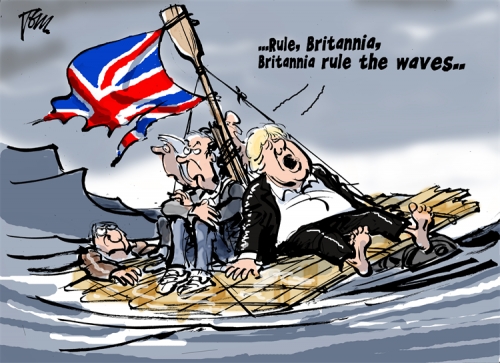
Rue, Britannia

 I mentioned recently that I had been to an outdoor, socially distanced opera. Well, now I've been to another, so I'd better write about them.

First up was the dress rehearsal of a short, family friendly version of Humperdinck's 'Hansel and Gretel' that Opera North are touring as 'Whistle Stop Opera', with four singers and an accordion . It was excellent in every way: musically of course, it didn't rain, it was free, and, probably most important to me anyway, it was a small, small step towards some sort of a hint of a return to normality. It took place in the car park of the UK's oldest surviving working men's club, which is in an inner city area a kilometre or so south of central Leeds. The entire audience was made up of middle class visitors whilst the locals ignored events completely.

Also excellent - and free - was Northern Opera Group's performance of Thomas Arne's 'Thomas & Sally', which was one of the few elements of this year's Leeds Opera Festival not to be online. Taking place in a small park between a multi-story car park and a shopping centre (and which for the first time that I can ever recall contained no winos) it was billed as a one-act comic opera. I didn't laugh once, and it had two acts, but nevertheless it was very good. Perhaps the comic part is simply that the soprano not only doesn't die, but even gets to marry her sweetheart in the end. 

Now you'e all thinking to yourselves, "Thomas Arne, where do I know that name from?". Well, I suspect that you are bringing to mind the rousing choral finale to his opera 'Alfred' (as in 'the Great'), a song beloved of racist simpletons and rabble-rousing demagogues alike.


As a different song puts it:

"Land of hopeless Tories, 

Mother of the Sleaze" 


N.B. Credit for both cartoon and lyrics to Martin Rowson

Wednesday, 26 August 2020

On dit que le destin se moque bien de nous

 I'm back. I'm tempted to pretend that I've been on a week long mescalin trip, but I think we all know that actually I have been doing sudoku and listening to the cricket. I have been to see an outdoor, socially-distanced opera production, but I'll come back to that later.

In the meantime, here's the former first lady of France singing a poem by W.B. Yeats.


Thursday, 20 August 2020

Pot98bpouri

 Some questions have arrived at the Casa Epictetus, and I am inclined to answer them:

Q1: Can you tell us how you hurt your neck? No, mind your own business, although I will confirm that no horses were involved

Q2: There is previous evidence that you are a Brentford supporter. Can you explain how they went overnight from being the form team not just in the division, or even in the country, but on the planet, to coming fourth in a two horse race? I have absolutely no comment to make on this subject.

Q3: Has any light been thrown on why someone thought it would be a good idea to donate a hand grenade to charity? No.

Q4: Is it the case that you set off the smoke alarm while using the laser cutter and a fire engine turned up? There may possibly be some truth in this. In my defence, setting fire to pieces of wood is an intrinsic part of the activity, and I was wearing a mask and therefore unable to smell anything.

Q5: How can you justify your assertion in the comments section a couple of days ago that there is a mathematical joke to suit all occasions? At last, a sensible question:


A mathematician is tired of maths and decides to become a fireman. At the fire station they give him a test to check his suitability. He is told to imagine a skip full of combustible material, a hose and a tap and asked what he would do if the skip were on fire. 

The mathematician replies, "Well, I put the hose on the tap, turn the water on, and put out the fire." Obviously that is the correct answer so they move on to the second question. The mathematician is asked what he would do if, on a fire inspection, he came across the same skip full of combustible material. "That's straightforward," he says " I would set fire to it."

This causes a certain amount of bewilderment so they ask him why. "Well," the mathematician replies, "that way I reduce the problem to one that I've already solved."