She really did used to dance like that on stage. Happy days.

Epictetus - Discourses on Wargaming
Saturday, 28 March 2015
Milton Keynes ain't much of a town
And it hasn't been much of a week here at the Casa Epictetus, with no wargaming and no boardgaming. I have been both to Milton Keynes and to Birmingham Airport, but can think of nothing interesting to say about either. So instead, let's take a look at Janita's belly button.
She really did used to dance like that on stage. Happy days.
She really did used to dance like that on stage. Happy days.
Saturday, 21 March 2015
Pass it on
And so to the theatre. I have been to a very fine performance of 'The History Boys', written of course by the thankfully-still-with-us Alan Bennett. I've seen the play in the theatre before, as well as having watched the film, and admire it for many reasons. Its ability to transcend being set in the 1980s without any references to that decade - indeed with all the detail about Oxbridge entrance being well out of date even at that time - and still not annoy even the most pedantic members of the audience (i.e. me) shows how dramatically strong it is. Plus it addresses the value or otherwise of the various ways of engaging with culture. Does one allow it inside oneself, to change one as an individual slowly over time, or does one simply acquire 'gobbets' to be regurgitated to impress?
Salvador Dali disparaged the performing arts because of their ephemeral nature. It has been suggested that Bennett was in this play drawing a parallel between history and theatre; both existing only for a moment and then living on solely in the memories of those who witnessed it and what they pass on to others. I think that, in its own small way, wargaming is also like that. I shall in future classify my opponents into the Lintott-like sticklers for fact, the Irwin-like cynical win-at-all-cost types and, my own clear preference, the poetic Hectors (minus the ball-cradling obviously).
There has been some comment on your bloggist's tendency to include passages and quotations in foreign languages, and his possible motivations for so doing (*). The History Boys contains a longish scene early in the first act which is entirely in French. Bennett clearly sees no need to translate or explain and it didn't seem to affect the enjoyment of the audience last night. Discuss.

 |
| Not dead yet |
Salvador Dali disparaged the performing arts because of their ephemeral nature. It has been suggested that Bennett was in this play drawing a parallel between history and theatre; both existing only for a moment and then living on solely in the memories of those who witnessed it and what they pass on to others. I think that, in its own small way, wargaming is also like that. I shall in future classify my opponents into the Lintott-like sticklers for fact, the Irwin-like cynical win-at-all-cost types and, my own clear preference, the poetic Hectors (minus the ball-cradling obviously).
 |
| A dog in a hat |
There has been some comment on your bloggist's tendency to include passages and quotations in foreign languages, and his possible motivations for so doing (*). The History Boys contains a longish scene early in the first act which is entirely in French. Bennett clearly sees no need to translate or explain and it didn't seem to affect the enjoyment of the audience last night. Discuss.

(*) For once Monsieur Fwa is incorrect; I don't do it to annoy. I do it because I am a superficial pseudo-intellectual regurgitating my gobbets.
Friday, 20 March 2015
Großbeeren
"Ein Optimist ist ein Mensch, der ein Dutzend Austern bestellt, in der Hoffnung, sie mit der Perle, die er darin findet, bezahlen zu können." - Theodore Fontane


But that's enough about the budget. And the solar eclipse was just as bad. It's tough being a blogger sometimes. I have just received a very nice compliment from this blog's faithful though irregular reader in Luxembourg. If only he knew the struggle I go through. Within the last few weeks there was a period where so little happened that I had to resort to writing about the wok that I bought for £1.50. And as a digression I have to say that the non-stick coating on that wok has turned out to be not of the highest quality. But today I am so replete with things to write about I don't even have to mention the disaster that I just had with a jar of pickled onions.

Tuesday, 17 March 2015
Tales of old Dartmoor
That's an obscure title for a blog posting even by my standards. Hercules Grytpype-Thynne would understand. In any event I feel the urge for a boardgame round-up.
Cuthulhu Fluxx: Fluxx is a game that's fascinating the first couple of times that you play it and then gets dreary. I don't understand fantasy in general or H.P. Lovecraft in particular. Enough said.
Trains: This is a bit like Dominion with a board and with, well, trains. I'm not a particular fan of deck-builders, but this was as good as any I've played.
Eight Minute Empire: It actually lasted about twenty minutes, but it provided a good game for five of us. I'd play it again.
One Minute Unltimate Werewolf Daybreak: Which is the same old stuff, but with extra chrome (Alpha Wolf, Paranormal Investigator). Someone had brought in a loudspeaker to play their smartphone through. Strangely this didn't make it any better.
6 nimmt!: I like this, and don't understand why people think it's random; they're just not playing it properly.
Rococo: A nice game with all sorts of mechanics that mesh together well. My only quibble is that it is very difficult to work out who's winning whilst playing. It's about dressmaking and - please remember that logic doesn't always apply in these circumstances - I won essentially by making the most dresses.
Skull: Another game that I like. My logic was impeccable on every turn and yet somehow I failed to call people's bluff correctly. I'm not sure how that works.
R-Eco: We played this with the same rules (the correct rules?) for the second time running and it's growing on me. If you do try it then bear in mind that it's a very low scoring game when making decisions.
The Secret of Monte Cristo: Firstly this game has some lovely components - the marbles and the jewel value markers - and some really tatty ones - especially the jewel placement markers. Any heaviness in this game comes from placing one's marble after the end of one's turn, but my impression was that the number of possible outcomes makes it all so complex as to actually be far more luck than skill. It does however have my new favourite feature: in-game scoring on a track with a clear victory target. By the way, the game has nothing whatever to do with the story in the book.
It is also some time since I posted a photo of me on top of Haw Pike surrounded by women of a certain age. So here goes.
Cuthulhu Fluxx: Fluxx is a game that's fascinating the first couple of times that you play it and then gets dreary. I don't understand fantasy in general or H.P. Lovecraft in particular. Enough said.
Trains: This is a bit like Dominion with a board and with, well, trains. I'm not a particular fan of deck-builders, but this was as good as any I've played.
Eight Minute Empire: It actually lasted about twenty minutes, but it provided a good game for five of us. I'd play it again.
One Minute Unltimate Werewolf Daybreak: Which is the same old stuff, but with extra chrome (Alpha Wolf, Paranormal Investigator). Someone had brought in a loudspeaker to play their smartphone through. Strangely this didn't make it any better.
6 nimmt!: I like this, and don't understand why people think it's random; they're just not playing it properly.
Rococo: A nice game with all sorts of mechanics that mesh together well. My only quibble is that it is very difficult to work out who's winning whilst playing. It's about dressmaking and - please remember that logic doesn't always apply in these circumstances - I won essentially by making the most dresses.
Skull: Another game that I like. My logic was impeccable on every turn and yet somehow I failed to call people's bluff correctly. I'm not sure how that works.
R-Eco: We played this with the same rules (the correct rules?) for the second time running and it's growing on me. If you do try it then bear in mind that it's a very low scoring game when making decisions.
The Secret of Monte Cristo: Firstly this game has some lovely components - the marbles and the jewel value markers - and some really tatty ones - especially the jewel placement markers. Any heaviness in this game comes from placing one's marble after the end of one's turn, but my impression was that the number of possible outcomes makes it all so complex as to actually be far more luck than skill. It does however have my new favourite feature: in-game scoring on a track with a clear victory target. By the way, the game has nothing whatever to do with the story in the book.
It is also some time since I posted a photo of me on top of Haw Pike surrounded by women of a certain age. So here goes.
 |
| I'm a little teapot |
Sunday, 15 March 2015
He got a real pretty mouth ain't he?
I have been too busy behaving badly to give this blog the attention it deserves. ["Tell me," asks the Rhetorical Pedant, missing the point as usual "does that mean you only write it when you're bored?"; to which the only reply necessary is a snort of haughty derision] However, I find myself on a Sunday evening with time weighing heavily on my hands and nothing better to do and so here's a catch-up post.
James has still been in wargaming limbo - although he is in regions even more remote this weekend having gone off to Scotland to mingle with the great and good of wargaming - and so Peter and I had a few games of X-Wing. I was rather taken with it, being by and large a fan of simple mechanics. I have never seen any of the Star Wars films so can't really comment on the theme and my lack of engagement with popular culture caused me some problems with interpreting what was written on the cards. It was a very pleasant evening, although I do think that the Target Lock action is a bit over-powerful. Normal service should be resumed next week with a look at the fourth expansion of C&C Napoleonics, the Prussians.
Culturally, I belatedly caught up with 'The Lunchbox' which, while finding a tad close to home, I really enjoyed. And then it was on to see Gren Bartley and his band. Fortunately the heated argument I had with Mr Bartley during the interval, and which continued after the gig finished, didn't in any way diminish my enjoyment of the performance. The subject under contention was the attractiveness - or otherwise - of the music of the banjo. For the record, I side with Mark Twain who of course defined a gentleman as someone who knew how to play the banjo, but didn't. Don't let any of that put you off, the banjo only features on one song and the band - who showcase more palatable instruments such as cello, guitar, violin, piano and percussion as well as terrific vocal harmonies - are excellent.
 |
| Nimrat Kaur |
James has still been in wargaming limbo - although he is in regions even more remote this weekend having gone off to Scotland to mingle with the great and good of wargaming - and so Peter and I had a few games of X-Wing. I was rather taken with it, being by and large a fan of simple mechanics. I have never seen any of the Star Wars films so can't really comment on the theme and my lack of engagement with popular culture caused me some problems with interpreting what was written on the cards. It was a very pleasant evening, although I do think that the Target Lock action is a bit over-powerful. Normal service should be resumed next week with a look at the fourth expansion of C&C Napoleonics, the Prussians.
 |
| Green Bartley |
Culturally, I belatedly caught up with 'The Lunchbox' which, while finding a tad close to home, I really enjoyed. And then it was on to see Gren Bartley and his band. Fortunately the heated argument I had with Mr Bartley during the interval, and which continued after the gig finished, didn't in any way diminish my enjoyment of the performance. The subject under contention was the attractiveness - or otherwise - of the music of the banjo. For the record, I side with Mark Twain who of course defined a gentleman as someone who knew how to play the banjo, but didn't. Don't let any of that put you off, the banjo only features on one song and the band - who showcase more palatable instruments such as cello, guitar, violin, piano and percussion as well as terrific vocal harmonies - are excellent.
Tuesday, 10 March 2015
Pot38pouri
My mug - see postings passim - has arrived. It is too good to actually use and now resides in my trophy cabinet next to my award for being Yorkshire Interim Finance Director of the Year, 2011; and very little else. A small wargaming context is provided by the adjacent Mambise flagbearer that I bought in Havana's only model soldier shop. Given the concern expressed by General Fwa over the likelihood of the mug being transported without damage it is ironic to note that it is in pristine condition while both award and figure are much knocked about.

Peter and I returned to Richard III last week having familiarised ourselves with the rules the previous week. I was once again much impressed by the game, despite receiving a fairly sound thrashing. It deserves a proper review; but it's not going to get one. Suffice it to say that Peter recognised the importance of persuading nobles in the other faction to switch sides earlier than I did. The Yorkists took two campaigns as invading pretenders to seize the throne, but after that they were never going to be removed. Henry VI was reduced to making vain, and historically implausible, heroic battlefield charges.
Other boardgames played recently include:

Peter and I returned to Richard III last week having familiarised ourselves with the rules the previous week. I was once again much impressed by the game, despite receiving a fairly sound thrashing. It deserves a proper review; but it's not going to get one. Suffice it to say that Peter recognised the importance of persuading nobles in the other faction to switch sides earlier than I did. The Yorkists took two campaigns as invading pretenders to seize the throne, but after that they were never going to be removed. Henry VI was reduced to making vain, and historically implausible, heroic battlefield charges.
Other boardgames played recently include:
- Abluxxen: Enjoyed it, but have no idea what strategy to follow
- Archipelago: A fairly heavy game. In theory, although not practice, it's semi-cooperative. I think I'd get more out of it on a second run through, especially the range of possible victory criteria.
- Red7: I really like this.
- One Night Ultimate Werewolf: I don't really like this. I feel even more stupid than usual sitting in the pub with my eyes closed listening to an American voice on someone's smartphone pretentiously intoning drivel - including the truly ridiculous "Insomniac, wake up".
Saturday, 7 March 2015
The best words in the best order...
...was Coleridge's definition of poetry. T.S. Eliot said that poetry wasn't a career, but rather it was a mug's game. In my own small way I have provided some evidence for the latter aphorism. I have been awarded a mug in a competition over at MS Fwa's blog for composing some doggerel.
I have now won two prizes in wargaming competitions in my time and in neither case have I had to demonstrate any knowledge of, or proficiency in, wargaming. Which is just as well really.
 |
| A chap with a beard |
I have now won two prizes in wargaming competitions in my time and in neither case have I had to demonstrate any knowledge of, or proficiency in, wargaming. Which is just as well really.
Wednesday, 4 March 2015
Мы отдохнем, мы отдохнем
And so to the theatre. The West Yorkshire Playhouse has a new production of an old play, Chekhov's 'Uncle Vanya'. I'd never seen it before and came away somewhat baffled. On the surface it appears to be about a group of Russian bourgeoisie getting bored, drinking and carrying on frustrated, unconsummated love affairs while the peasants do all the work. On closer inspection that's pretty much all it seems to be about underneath as well.

It's possible that Chekhov is expounding the sort of existentialist argument being made elsewhere at the time, or possibly he is drawing a moral about the dignity of work. More likely I suspect he was just painting a mood; what the Russians call настроение. Does anyone remember listening to 'tone poems' which to a philistine like me simply meant a piece of music with no tune? This is a play with no narrative arc - despite quite extravagant and theatrical things happening. The Reduced Shakespeare Company apparently did a three-line version of the play - it can be found in its entirety on the play's Wikipedia page - which I think falls into the category 'cruel, but fair'.

I went to a preview and afterwards my friend the theatre critic of the Morning Star tweeted me to ask what she could expect on press night. Given the likely political views of her readers - they'd have to be pretty hard core tankies to still be hanging in there - I would imagine that seeing it for themselves they'd just see it as confirmation that the 1917 revolution was both necessary and overdue. And on this issue at least I would agree with them.

It's possible that Chekhov is expounding the sort of existentialist argument being made elsewhere at the time, or possibly he is drawing a moral about the dignity of work. More likely I suspect he was just painting a mood; what the Russians call настроение. Does anyone remember listening to 'tone poems' which to a philistine like me simply meant a piece of music with no tune? This is a play with no narrative arc - despite quite extravagant and theatrical things happening. The Reduced Shakespeare Company apparently did a three-line version of the play - it can be found in its entirety on the play's Wikipedia page - which I think falls into the category 'cruel, but fair'.

I went to a preview and afterwards my friend the theatre critic of the Morning Star tweeted me to ask what she could expect on press night. Given the likely political views of her readers - they'd have to be pretty hard core tankies to still be hanging in there - I would imagine that seeing it for themselves they'd just see it as confirmation that the 1917 revolution was both necessary and overdue. And on this issue at least I would agree with them.
Tuesday, 3 March 2015
Mi piace, è bello, bello
And so to the opera. Opera North have laid on a fine double dose of verismo with two short pieces by Falla and Puccini.

I'd seen this production of 'La vida breve' about ten years ago and it remains, I think, the only opera sung in Spanish that I have ever been to. It's staged in a garment factory rather than a metalworks, but is still a cautionary tale based on the age old truism: it's the rich wot gets the pleasure, it's the poor wot gets the pain. Obviously feeling that the libretto doesn't sufficiently cover discrimination against Gyspies there is another such sub-plot acted out in mime. It's all very gory and rather excellent with the moral clearly being that one woman at a time is sufficient. Let us all take note.

After the interval we heard 'Gianni Schicchi', Puccini's only comedy and despite knowing that fact I found myself surprised that it was rather funny. Based on a throwaway incident in 'The Divine Comedy' it deals with greed rather than the lust at the heart of Falla's work. I've actually seen the trickery employed by the eponymous lawyer used in action myself on more than one occasion, so as opera plots go, it's not that far fetched.

I'd seen this production of 'La vida breve' about ten years ago and it remains, I think, the only opera sung in Spanish that I have ever been to. It's staged in a garment factory rather than a metalworks, but is still a cautionary tale based on the age old truism: it's the rich wot gets the pleasure, it's the poor wot gets the pain. Obviously feeling that the libretto doesn't sufficiently cover discrimination against Gyspies there is another such sub-plot acted out in mime. It's all very gory and rather excellent with the moral clearly being that one woman at a time is sufficient. Let us all take note.

After the interval we heard 'Gianni Schicchi', Puccini's only comedy and despite knowing that fact I found myself surprised that it was rather funny. Based on a throwaway incident in 'The Divine Comedy' it deals with greed rather than the lust at the heart of Falla's work. I've actually seen the trickery employed by the eponymous lawyer used in action myself on more than one occasion, so as opera plots go, it's not that far fetched.
Sunday, 1 March 2015
Awopbopaloobop Alopbamboom
I went to the Flying Duck last night to see the rather fine Alex Graham and the Concords. They are a piano trio plus vocalist playing rock and roll (the expected Little Richard and Jerry Lee Lewis plus Chuck Berry, Elvis, Carl Perkins etc) with a smattering of more modern stuff from Queen, T. Rex and so on (I said more modern, I didn't say modern per se), all in a boogie woogie stylie. Highly recommended.
.jpg)
After the gig one of the yummy mummies of Ilkley told me that the band were all students at Leeds College of Music. In one of those coincidences beloved of this blog I had the previous day been to that very institution and whilst I can't confirm that either Alex or the Concords are students there, I can advise that they look as if they might be - four very young men in skinny trousers with hipster beards. I'm glad to say that they eschewed the ponytails though. The college shares a building with BBC Leeds and, more importantly, the Aagrah restaurant. Strangely I haven't yet been summoned in to the former to share my worldview with the good people of West Yorkshire and so apart from numerous visits to the latter - which don't really count - this was my first time inside since it was a construction site. On that occasion I was showing our new audit partner a 'typical' project. Apart from its central location the reason for choosing the College/BBC building as a showcase was that of the two managing engineers (electrical and mechanical) one was a woman and one was black. Possibly you won't be surprised that they were the only ones of either type that we employed across dozens of jobs.

Anyway, my reason for visiting on this occasion was to hear Ed Miliband and Ed Balls speak. [Oh no, it's politics - there go the readers again] on the subject of university tuition fees and, although not much reported in the media, improving opportunities for all young people. I will limit myself to saying that ensuring that everyone in society gets a fair crack of the whip is the primary issue on which I will base my vote in two months time (taking as a prerequisite an aversion to invading other countries on the basis of dodgy dossiers), because I would prefer a society in which there is genuine meritocratic diversity rather than the need to pretend that it exists by a bit of window dressing.
.jpg)
After the gig one of the yummy mummies of Ilkley told me that the band were all students at Leeds College of Music. In one of those coincidences beloved of this blog I had the previous day been to that very institution and whilst I can't confirm that either Alex or the Concords are students there, I can advise that they look as if they might be - four very young men in skinny trousers with hipster beards. I'm glad to say that they eschewed the ponytails though. The college shares a building with BBC Leeds and, more importantly, the Aagrah restaurant. Strangely I haven't yet been summoned in to the former to share my worldview with the good people of West Yorkshire and so apart from numerous visits to the latter - which don't really count - this was my first time inside since it was a construction site. On that occasion I was showing our new audit partner a 'typical' project. Apart from its central location the reason for choosing the College/BBC building as a showcase was that of the two managing engineers (electrical and mechanical) one was a woman and one was black. Possibly you won't be surprised that they were the only ones of either type that we employed across dozens of jobs.

Anyway, my reason for visiting on this occasion was to hear Ed Miliband and Ed Balls speak. [Oh no, it's politics - there go the readers again] on the subject of university tuition fees and, although not much reported in the media, improving opportunities for all young people. I will limit myself to saying that ensuring that everyone in society gets a fair crack of the whip is the primary issue on which I will base my vote in two months time (taking as a prerequisite an aversion to invading other countries on the basis of dodgy dossiers), because I would prefer a society in which there is genuine meritocratic diversity rather than the need to pretend that it exists by a bit of window dressing.
Friday, 27 February 2015
As long as there are games to play...
"As long as there are games to play it's not over" - Sir Alex Ferguson
I have been fortunate enough to be able to play some board games over the last couple of weeks. (And I am still intending to devote a post to the broader subject; as soon as real life becomes a little less complex.)
Lewis & Clark: Everything that I know about the Lewis & Clark expedition comes from the notes on the box of the Imex set so I can't really comment on the theme. It's a worker placement game, but with the benefit of very simple victory conditions; reach the objective first and you win. If this was an Olympic sport it would be the 3,000 metre steeplechase and Keyflower would be dressage. I enjoyed it. For the record, most of my Imex Lewis & Clark set is still unused, but various components are spread between a Celt village, the crew of The Crow (not yet featured in this blog as it hasn't yet appeared on the table in the wargaming annexe) and a unit of Opolchenie.
6 Nimmt: Still completely random, but rather good fun.
Guillotine: Who wouldn't enjoy executing the parasitic nobility of France, not to mention the Piss Boy? We certainly did.
Hanabi: Still a good game, but this run through was a disaster with all the 2 cards being bunched at the end.
Harbour: Apparently this is Le Havre light, but I wouldn't know about that. It was quite enjoyable, and being essentially an accounting game, I wasn't surprised when I won.
K2: I really enjoyed this despite coming last by virtue of being the only one to lose a climber to oxygen deprivation. I was much reminded of the ill fated 1986 expedition to the mountain. The board is very similar to the progress wallcharts that Fullers, Smith & Turner put up in all their pubs so drinkers could monitor the progress of the mountaineers that the brewery had sponsored, while toasting them in the specially created K2 lager. The untimely deaths of so many people rather limited the success of this as a marketing campaign.
R-Eco: I enjoyed a second run through of this although we seemed to be playing completely different rules to last time. The theme is still rather obscure though.
Sail to India: I continue to rate this elegant and minimalist game. I tried a different strategy to my usual and managed to narrowly win.

Richard III: James has gone walkabout so Peter and I decided to dig out this two-player block wargame. I hadn't played it for years and we struggled to get the rules straight at first. It's a fine game, effectively reproducing of the swings of fortune found during the Wars of the Roses, full of decision making and prioritisation and very bloody - especially on the heirs to the throne. Having sussed how it works we shall have another crack next week.
I have been fortunate enough to be able to play some board games over the last couple of weeks. (And I am still intending to devote a post to the broader subject; as soon as real life becomes a little less complex.)
Lewis & Clark: Everything that I know about the Lewis & Clark expedition comes from the notes on the box of the Imex set so I can't really comment on the theme. It's a worker placement game, but with the benefit of very simple victory conditions; reach the objective first and you win. If this was an Olympic sport it would be the 3,000 metre steeplechase and Keyflower would be dressage. I enjoyed it. For the record, most of my Imex Lewis & Clark set is still unused, but various components are spread between a Celt village, the crew of The Crow (not yet featured in this blog as it hasn't yet appeared on the table in the wargaming annexe) and a unit of Opolchenie.
6 Nimmt: Still completely random, but rather good fun.
Guillotine: Who wouldn't enjoy executing the parasitic nobility of France, not to mention the Piss Boy? We certainly did.
Hanabi: Still a good game, but this run through was a disaster with all the 2 cards being bunched at the end.
Harbour: Apparently this is Le Havre light, but I wouldn't know about that. It was quite enjoyable, and being essentially an accounting game, I wasn't surprised when I won.
K2: I really enjoyed this despite coming last by virtue of being the only one to lose a climber to oxygen deprivation. I was much reminded of the ill fated 1986 expedition to the mountain. The board is very similar to the progress wallcharts that Fullers, Smith & Turner put up in all their pubs so drinkers could monitor the progress of the mountaineers that the brewery had sponsored, while toasting them in the specially created K2 lager. The untimely deaths of so many people rather limited the success of this as a marketing campaign.
R-Eco: I enjoyed a second run through of this although we seemed to be playing completely different rules to last time. The theme is still rather obscure though.
Sail to India: I continue to rate this elegant and minimalist game. I tried a different strategy to my usual and managed to narrowly win.

Richard III: James has gone walkabout so Peter and I decided to dig out this two-player block wargame. I hadn't played it for years and we struggled to get the rules straight at first. It's a fine game, effectively reproducing of the swings of fortune found during the Wars of the Roses, full of decision making and prioritisation and very bloody - especially on the heirs to the throne. Having sussed how it works we shall have another crack next week.
Thursday, 26 February 2015
Do trousers matter?
And so to the theatre. "Perfect Nonsense: Jeeves and Wooster" is on tour at the moment and I went to see it in Harrogate, accompanied by my elder daughter who claimed never to have seen the Fry and Laurie version, nor to be familiar with any of Wodehouse's work whatsoever. I blame the parents.
The conceit of the play is that Bertie, having seen a couple of shows, decides that acting is easy and that he will therefore recount his latest adventures in this way, assisted only by Jeeves, his gentleman's gentleman, and Stebbings, his Aunt Dahlia's butler. The latter two are called upon to play a host of characters, wherein lies much of the humour. Because interestingly, while the dialogue of the play within the play is lifted directly from the source material (The Code of the Woosters to be precise) the laughs mainly come from the physical theatre.

The small, multi-tasking cast and the creative design of the staging immediately reminded me of the Peepolykus version of "The Hound of the Baskervilles" and, unusually for me, I was right because one third of the cast - playing Jeeves, Gussie Fink-Nottle, Sir Watkin Basset, his daughter Madeleine and his niece Stiffy Byng - was Jason Thorpe who starred in that production. Robert Webb had the somewhat easier role of Wooster. He was good, but perhaps his television experience was the cause of not speaking quite loud enough for the theatre.
The third member of the cast - playing Stebbings, Aunt Dahlia, Constable Oates and most memorably Sir Roderick Spode - illustrates once again that this blog is not just thrown together, but follows a carefully plotted narrative arc. Having been steered in the direction of Robert Morley by well-known Scottish mug designer MS Foy, we have travelled via that actor's portrayal of Hamilton Black to 'The Young Ones' film. We now arrive at Christopher Ryan, here giving us a would-be fascist dictator in black footer bags, but perhaps best known as Mike in 'The Young Ones' television programme. No applause is necessary.
 |
| A pig who takes things as they come |
The conceit of the play is that Bertie, having seen a couple of shows, decides that acting is easy and that he will therefore recount his latest adventures in this way, assisted only by Jeeves, his gentleman's gentleman, and Stebbings, his Aunt Dahlia's butler. The latter two are called upon to play a host of characters, wherein lies much of the humour. Because interestingly, while the dialogue of the play within the play is lifted directly from the source material (The Code of the Woosters to be precise) the laughs mainly come from the physical theatre.

The small, multi-tasking cast and the creative design of the staging immediately reminded me of the Peepolykus version of "The Hound of the Baskervilles" and, unusually for me, I was right because one third of the cast - playing Jeeves, Gussie Fink-Nottle, Sir Watkin Basset, his daughter Madeleine and his niece Stiffy Byng - was Jason Thorpe who starred in that production. Robert Webb had the somewhat easier role of Wooster. He was good, but perhaps his television experience was the cause of not speaking quite loud enough for the theatre.
 |
| The Cool Person |
The third member of the cast - playing Stebbings, Aunt Dahlia, Constable Oates and most memorably Sir Roderick Spode - illustrates once again that this blog is not just thrown together, but follows a carefully plotted narrative arc. Having been steered in the direction of Robert Morley by well-known Scottish mug designer MS Foy, we have travelled via that actor's portrayal of Hamilton Black to 'The Young Ones' film. We now arrive at Christopher Ryan, here giving us a would-be fascist dictator in black footer bags, but perhaps best known as Mike in 'The Young Ones' television programme. No applause is necessary.
Friday, 20 February 2015
Oh, I would, I would, if welcome I were
"Oh, well I like your feather bed
And well I like your sheets
But better I like your lady wife
Who lies in my arms asleep"
And well I like your sheets
But better I like your lady wife
Who lies in my arms asleep"
Thursday, 19 February 2015
Nobody gets justice
"Nobody gets justice. People only get good luck or bad luck." - Orson Welles
So, wargaming has taken place. Peter and I played a Seven Years War scenario developed by James, which can be seen on his blog. I drew the Prussians and had to hold two hills and/or capture the road exit on the Russian side of the table. I was keen not to over-think my initial deployments, resulting in a massive under-think, with my units spread rather thinly on the hills and rather too many of them in the central village. The theory there was that they could be switched to either hill as appropriate. I chose the option for extra forces which included the most infantry. Having drawn an additional musket reload card my logic was that I would be more likely to be able to fire when I wanted, plus of course it gave me units with which to hold the ground. I never really had any intention of trying to capture the road exit.
Peter massed the Russians on either flank and attacked through the terrain. On my left I had a small initial success when my Hussars routed the leading unit of infantry in the woods, but they pursued and were destroyed, and that turned out to be the only melee that I won in the entire game. On my right the Russian cavalry quickly crossed the stream and marsh and eventually outflanked and destroyed my cavalry. There was a moment where I had the opportunity to advance my infantry from that hill and, bringing my extra fire power into play, shoot down his cavalry. But I didn't. Nor did I move my infantry in the village to either flank at any sort of early opportunity. In fact I left it until they could only manoeuvre across the face of his guns or backstep slowly.
So, my set-up was dreadful, my play was appalling, I lost all the melees and on every morale challenge that I issued I rolled a one. How then, I hear you ask, did I win? Luck, comes the answer. I simply won all the initiative, especially on the second night. The Russian progress was slow and made them vulnerable to my artillery, and I drew the necessary combination of cards to speedily retire my best unit (some superior Grenadiers) from one field in front of the village when they came under artillery fire and then miraculously advance them forward on the other side of the road at exactly the right time. We both failed Major Morale twice (a cumulative probability of somewhat less than 0.1% given how few units we had lost) and Peter ran out of morale chips the second time it happened to him while I had only one left myself.
It was a good scenario - although the turn limit was far too small and we abandoned it almost immediately - and deserves replaying sometime, preferably with someone who knows what they are doing in command of each side. Hopefully more photos will appear on James' blog sometime.
So, wargaming has taken place. Peter and I played a Seven Years War scenario developed by James, which can be seen on his blog. I drew the Prussians and had to hold two hills and/or capture the road exit on the Russian side of the table. I was keen not to over-think my initial deployments, resulting in a massive under-think, with my units spread rather thinly on the hills and rather too many of them in the central village. The theory there was that they could be switched to either hill as appropriate. I chose the option for extra forces which included the most infantry. Having drawn an additional musket reload card my logic was that I would be more likely to be able to fire when I wanted, plus of course it gave me units with which to hold the ground. I never really had any intention of trying to capture the road exit.
Peter massed the Russians on either flank and attacked through the terrain. On my left I had a small initial success when my Hussars routed the leading unit of infantry in the woods, but they pursued and were destroyed, and that turned out to be the only melee that I won in the entire game. On my right the Russian cavalry quickly crossed the stream and marsh and eventually outflanked and destroyed my cavalry. There was a moment where I had the opportunity to advance my infantry from that hill and, bringing my extra fire power into play, shoot down his cavalry. But I didn't. Nor did I move my infantry in the village to either flank at any sort of early opportunity. In fact I left it until they could only manoeuvre across the face of his guns or backstep slowly.
So, my set-up was dreadful, my play was appalling, I lost all the melees and on every morale challenge that I issued I rolled a one. How then, I hear you ask, did I win? Luck, comes the answer. I simply won all the initiative, especially on the second night. The Russian progress was slow and made them vulnerable to my artillery, and I drew the necessary combination of cards to speedily retire my best unit (some superior Grenadiers) from one field in front of the village when they came under artillery fire and then miraculously advance them forward on the other side of the road at exactly the right time. We both failed Major Morale twice (a cumulative probability of somewhat less than 0.1% given how few units we had lost) and Peter ran out of morale chips the second time it happened to him while I had only one left myself.
It was a good scenario - although the turn limit was far too small and we abandoned it almost immediately - and deserves replaying sometime, preferably with someone who knows what they are doing in command of each side. Hopefully more photos will appear on James' blog sometime.
Wednesday, 18 February 2015
That's no way to run a railroad
"It is not from the benevolence of the butcher, the brewer or the baker that we expect our dinner, but from their regard to their own interest." - Adam Smith
Having pointed out in my last post that I was temporarily relying on a tablet to access Blogger, the aforementioned tablet promptly stopped working. Having eventually figured out how to discuss the subject with Amazon - and given that their customer service is actually rather good, why do they make it so difficult to access it? - I was a bit baffled by their response. They declined to replace the item, which is what I wanted, but instead offered me a refund and asked me to re-order separately. The price has dropped in the six weeks since I bought it, so in effect Amazon have replaced my faulty kit and refunded me £40.
All of which put me in mind of a visit that I made to Sainsbury's last weekend. I bought £20.20 worth of groceries, but had so many money-off vouchers that I only had to pay £1.70. The supermarket is currently running a promotion whereby when one's Nectar card is scanned one can win bonus points. I duly won £5. So, I walked away with stuff to the value of more than £20 and in effect they gave me £3.30 for my trouble.
Seeing as these two large organisations seem intent on giving me things, I shall offer them some free professional advice in return. Speaking as an accountant, the only way to make a profit is to take more money from the customer than you give him or her. That is all.
Having pointed out in my last post that I was temporarily relying on a tablet to access Blogger, the aforementioned tablet promptly stopped working. Having eventually figured out how to discuss the subject with Amazon - and given that their customer service is actually rather good, why do they make it so difficult to access it? - I was a bit baffled by their response. They declined to replace the item, which is what I wanted, but instead offered me a refund and asked me to re-order separately. The price has dropped in the six weeks since I bought it, so in effect Amazon have replaced my faulty kit and refunded me £40.
All of which put me in mind of a visit that I made to Sainsbury's last weekend. I bought £20.20 worth of groceries, but had so many money-off vouchers that I only had to pay £1.70. The supermarket is currently running a promotion whereby when one's Nectar card is scanned one can win bonus points. I duly won £5. So, I walked away with stuff to the value of more than £20 and in effect they gave me £3.30 for my trouble.
Seeing as these two large organisations seem intent on giving me things, I shall offer them some free professional advice in return. Speaking as an accountant, the only way to make a profit is to take more money from the customer than you give him or her. That is all.
Monday, 16 February 2015
Nothing's impossible
I am currently restricted to accessing Blogger from a tablet rather than a proper computer. This is only a problem because of my technical incompetence which among other things is preventing me from replying to comments.
In which context, can I say two things. Firstly that Yuri Gagarin must surely have been among the most famous people in the world in 1961. Secondly that I met Ronnie Cash - author of the rhyme about the first man in space referred to above - about a dozen or so years after 'The Young Ones' came out. Our school was very close to, and had links with, the studios in which the film was made. As a result we did a stage version as our school play with support and input from Mr Cass. Sadly I was too callow to ask him for the secret of his inspiration for songs about cosmonauts.

So impressed was he that we went on to try out a musical version of 'Midsummer Nights Dream' which he had just written and of which he had high hopes of a West End production. Unfortunately for him the new work didn't prove as robust to being mangled by a bunch of sixth formers as a plot about a youth club putting on a show. And that was despite your bloggist giving the world his Flute the Bellows Mender, in what remains his last stage performance to date.
Friday, 13 February 2015
When the years have flown
Not time for much today, so here is a little clip featuring Robert Morley as Hamilton Black.
Apart from the always excellent Morley (not to mention Cliff, Hank and the boys), look out for the strapline that appears at one minute twenty seven seconds. O tempora o mores!
Apart from the always excellent Morley (not to mention Cliff, Hank and the boys), look out for the strapline that appears at one minute twenty seven seconds. O tempora o mores!
Tuesday, 10 February 2015
The right time is any time
"Do you know what my favourite part of the game is? The opportunity to play." - Mike Singletary
The amount of gaming rises and falls to its own rhythm and seems to be on the up again. I have just finished marking up my opening dispositions for James' latest Seven Years War scenario, which kicks off tomorrow. Full details are naturally enough available on his blog although you'll have to dig back past the terrain porn. I have also written up a draft set of amendments to 'For, Lords, Tomorrow is a Busy Day', although I imagine that it will be some time before we go back to it. I wish that I had done the same when we had finished playing 'Romans in Britain' as all I have in that case is a set of unintelligible scribbles in the margins of the first draft. Painting has been suspended due to the table being needed for other purposes, but I had completed six stands of 15th century light horse, nine Roman auxiliaries and yet more Roman civilians.
And then there is boardgaming, with yet another new venue making its debut. Games played were:
- Princes of Florence - a first play for me although it's about fifteen years old. It has many features in common with the much newer 'Castles of Mad King Ludwig'. I thought it was good and I'd play it again.
- Euphoria - which struck me as being very similar in mechanics to 'Alien Frontiers' although I preferred the latter. The theme - exploitation of workers in a dystopian future - is completely irrelevant and superfluous.
- R-Eco - another neat card filler, apparently about recycling although one would never guess.
- Evolution - I enjoyed this yet again, although I really cocked up the last round and suffered my own personal mass extinction.
- Condottiere - this is a good game that doesn't get played enough and is another with a war theme that go down well with the wider boardgaming community. Oh, and I won.
- Red7 - we played this a bit more extensively this time round, moving on to the second level of rules which I think made it even better. Oh, and I won.
Saturday, 7 February 2015
A thing long expected
"A thing long expected takes the form of the unexpected when at last it comes.” - Mark Twain
The bad weather abated sufficiently for us to get in not one but two games of "For, Lords, Tomorrow is a Busy Day". We managed the second because these rules don't mess about. Combat is swift and bloody and the morale rules mean that when one's army starts to go, it won't be long be it disappears completely. For the record the Lancastrians under Somerset won once and the Yorkists under Edward IV won once. In both cases there was a bloodbath of leaders following terrible dice rolling. Indeed in the second game Richard of Gloucester was captured in melee and the the subject of an heroic rescue.

I think that there was a general feeling that the combat resolution rules were nice and simple and contained some interesting ideas. There was also a consensus that while the morale and pursuit rules may reflect reality, their brutality rather detracts from the game experience. We also felt that perhaps a complete absence of command, control and movement rules wasn't exactly to our taste.

So I shall take two actions. Firstly to add some simple motivation rules and secondly to modify the routing and pursuit rules so that they are based around a single modified D10 roll rather like the combat rules. Other than that and I think the addition of a Levy class ( -1 dice modifier) and then they will get another run out. In the meantime it's back to James' and the Seven Years War, where a dice roll on Wednesday means that I shall be commanding the Prussians.
The bad weather abated sufficiently for us to get in not one but two games of "For, Lords, Tomorrow is a Busy Day". We managed the second because these rules don't mess about. Combat is swift and bloody and the morale rules mean that when one's army starts to go, it won't be long be it disappears completely. For the record the Lancastrians under Somerset won once and the Yorkists under Edward IV won once. In both cases there was a bloodbath of leaders following terrible dice rolling. Indeed in the second game Richard of Gloucester was captured in melee and the the subject of an heroic rescue.

I think that there was a general feeling that the combat resolution rules were nice and simple and contained some interesting ideas. There was also a consensus that while the morale and pursuit rules may reflect reality, their brutality rather detracts from the game experience. We also felt that perhaps a complete absence of command, control and movement rules wasn't exactly to our taste.

So I shall take two actions. Firstly to add some simple motivation rules and secondly to modify the routing and pursuit rules so that they are based around a single modified D10 roll rather like the combat rules. Other than that and I think the addition of a Levy class ( -1 dice modifier) and then they will get another run out. In the meantime it's back to James' and the Seven Years War, where a dice roll on Wednesday means that I shall be commanding the Prussians.
Tuesday, 3 February 2015
The vasty fields of France?
Boardgaming has returned to l'Arbre d'If (although the venue is still suffering from the hasty departure of the previous landlord - unspeakable things in the kitchen were was what was being, er, spoken about this week) and I played some enjoyable games that I had not come across before.


6 Nimmt was roundly and loudly denounced by one of the attendees who refused to have anything to do with it, but I rather liked it. I had absolutely no idea of how to approach it though, despite having both the 102 and 104 cards in my hand.


Ice Flow was as usual a hit with those who played it for the first time, with it's deceptively deep strategic play catching them out. I am pleased to report a return to winning form for your bloggist, with December's sound thrashing by some random young person being exposed as the aberration it undoubtedly was.


Archaeology was a rather fine card game filler, one of many that I have come across in recent weeks. I came a fine last, having suffered heavily from sandstorms and thieves and managing only to sell two pieces of broken pot to the museum. Poor stuff.


New game of the night for me was Lancaster. Now this is a medium complexity Euro game with elements of both worker placement and area control, and I wouldn't want to mislead anyone by suggesting that it is anything else. However, within the context of a straightforward mechanic-driven game, the theme manages to come across quite strongly, giving plenty of opportunity to intimidate one's rival barons in early 15th century England by displays of martial strength as well as racing across the channel to fight the French. The fighting was of course very high-level, although it was carried out by pieces reminiscent of a block wargame, but it also allowed stitching-up of the other English barons while one was at it. Indeed I won right at the death when one of my main rival's knights got captured and he couldn't afford the ransom. Shame.
Monday, 2 February 2015
Uh-oh
MS Foy has gone all cryptic in his comment on yesterday's posting, but I have decided to interpret it as a request for me to post a link to Talking Heads' "Uh-Oh, Love Comes to Town", a song that I'm always happy to sing along to as it contains the line "I'm a know-it-all, I'm the smartest man in town".
Monsieur Foy's own notionally-about-wargaming blog is in particularly fine form at the moment having recently featured the birds in his garden, the etiquette of selfies and motor racing at Aintree. Really wild general.
Sunday, 1 February 2015
In silence and tears
When we two parted
In silence and tears,
Half broken-hearted
To sever for years,
Pale grew thy cheek and cold,
Colder thy kiss;
Truly that hour foretold
Sorrow to this.
The dew of the morning
Sank chill on my brow--
It felt like the warning
Of what I feel now.
Thy vows are all broken,
And light is thy fame;
I hear thy name spoken,
And share in its shame.
They name thee before me,
A knell in mine ear;
A shudder come o'er me--
Why wert thou so dear?
They know not I knew thee,
Who knew thee too well--
Long, long shall I rue thee,
Too deeply to tell.
In secret we met--
In silence I grieve,
That thy heart could forget,
Thy spirit deceive.
If I should meet thee
After long years,
How should I greet thee?--
With silence and tears.
- Byron
In silence and tears,
Half broken-hearted
To sever for years,
Pale grew thy cheek and cold,
Colder thy kiss;
Truly that hour foretold
Sorrow to this.
The dew of the morning
Sank chill on my brow--
It felt like the warning
Of what I feel now.
Thy vows are all broken,
And light is thy fame;
I hear thy name spoken,
And share in its shame.
They name thee before me,
A knell in mine ear;
A shudder come o'er me--
Why wert thou so dear?
They know not I knew thee,
Who knew thee too well--
Long, long shall I rue thee,
Too deeply to tell.
In secret we met--
In silence I grieve,
That thy heart could forget,
Thy spirit deceive.
If I should meet thee
After long years,
How should I greet thee?--
With silence and tears.
- Byron
Saturday, 31 January 2015
We will, we will....
Well, it's a been a disappointing week all round; indeed on first reflection the most exciting thing I could think of was that I had bought a wok for £1.50. However, further thought reminded me that there was the sweet soul music of the Solicitors (the capital letter being rather important in this case) plus some boardgaming at la Toison.

First up was 7 Wonders which I played for the first time with the full complement of seven people. It is a cleverly designed game in the sense that it doesn't really take much longer however many players one adds. That's all I have to say about it and I couldn't see why everyone says that the Tower of Babel expansion improves things so much. Mush!Mush! was as much fun as usual; we played for the first time with the buildings and they seemed to work well. Then I finished with a couple of card games: Family Business and Hanabi, in the latter of which we once again failed to organise the firework display.
The game chez moi was once again cancelled due to bad weather which gave me the usual chance to work out that I was short of the necessary figures. I don't actually have any Wars of the Roses cavalry and needing some for the scenario laid out for a run through of 'For, Lords, Tomorrow is a Busy Day' I have substituted some Imperial forces (as in Sigismund's crusade against the Hussites). However, their light cavalry are of the Cuman horse archer variety and don't work at all. I have therefore invested in three sets of RedBox Scurrers. I'm not so keen on the axe wielding figures as light cavalry, but the others will do nicely.

First up was 7 Wonders which I played for the first time with the full complement of seven people. It is a cleverly designed game in the sense that it doesn't really take much longer however many players one adds. That's all I have to say about it and I couldn't see why everyone says that the Tower of Babel expansion improves things so much. Mush!Mush! was as much fun as usual; we played for the first time with the buildings and they seemed to work well. Then I finished with a couple of card games: Family Business and Hanabi, in the latter of which we once again failed to organise the firework display.
 |
| Otley in the snow |
The game chez moi was once again cancelled due to bad weather which gave me the usual chance to work out that I was short of the necessary figures. I don't actually have any Wars of the Roses cavalry and needing some for the scenario laid out for a run through of 'For, Lords, Tomorrow is a Busy Day' I have substituted some Imperial forces (as in Sigismund's crusade against the Hussites). However, their light cavalry are of the Cuman horse archer variety and don't work at all. I have therefore invested in three sets of RedBox Scurrers. I'm not so keen on the axe wielding figures as light cavalry, but the others will do nicely.
Sunday, 25 January 2015
Dove sono i bei momenti
And so to the opera. 'The Marriage of Figaro', described by Stendahl as 'a sublime mixture of wit and melancholy which has no equal' was, inevitably perhaps, superb; although I felt as I always do with this work that it went on a bit. Mozart may have been a genius ["May?" enquires the Rhetorical Pedant, er, rhetorically "Mozart may have been a genius?"], but he needed someone to take him and Da Ponte aside and tell them to drop the fourth act. It was his previous opera that provoked Emperor Joseph II to make his famous comment about there being too many notes, but something similar could be said about this one. As it's an opera it's not supposed to make any sense, but surely the goings on in the garden just detract from what has gone before. I don't believe - plot spoiler alert by the way - that either Figaro would doubt Susannah or the Count and Countess would be reconciled and the wedding (it's really about the 'wedding' of Figaro rather than his 'marriage') has already taken place. And of course an earlier finish wouldn't have caused me to miss my bus.

The set design and staging fully recognise that this is a farce, with plenty of doors and the cast popping in and out of all of them during the overture. The musical highlight for me - and what would have been the winner of the new award that I haven't decided to give out - was Figaro's aria 'Non più andrai' towards the end of the first act, and which has at least some tenuous relevance to wargaming. It's a great tune of course, but maybe it's also the words touching a nerve with this listener:
Non più andrai, farfallone amoroso,
notte e giorno d'intorno girando;
delle belle turbando il riposo
Narcisetto, Adoncino d'amor.

The set design and staging fully recognise that this is a farce, with plenty of doors and the cast popping in and out of all of them during the overture. The musical highlight for me - and what would have been the winner of the new award that I haven't decided to give out - was Figaro's aria 'Non più andrai' towards the end of the first act, and which has at least some tenuous relevance to wargaming. It's a great tune of course, but maybe it's also the words touching a nerve with this listener:
Non più andrai, farfallone amoroso,
notte e giorno d'intorno girando;
delle belle turbando il riposo
Narcisetto, Adoncino d'amor.
The Manchester Rambler
One hundred years ago today Ewan MacColl (né Jimmie Miller), the Grammy-winning social activist, was born in Salford. A complex man, with plenty of negatives, one must nevertheless stand back and admire the achievements. As a keen walker I've always enjoyed his song about the mass trespass at Kinder Scout:
And who could resist a song called 'Ballad of Accounting'?
And who could resist a song called 'Ballad of Accounting'?
Farewell to you, my love, my time is almost done
Lie in my arms once more until the darkness comes
You filled all my days, held the night at bay, dearest companion
Years pass by and they're gone with the speed of birds in flight
Our lives like the verse of a song heard in the mountains
Give me your hand and love and join your voice with mine
And we'll sing of the hurt and the pain and the joy of living
Lie in my arms once more until the darkness comes
You filled all my days, held the night at bay, dearest companion
Years pass by and they're gone with the speed of birds in flight
Our lives like the verse of a song heard in the mountains
Give me your hand and love and join your voice with mine
And we'll sing of the hurt and the pain and the joy of living
- from 'The Joy of Living'
Saturday, 24 January 2015
Ain't that mud in your eye
There seems to be a brief hiatus in the sequence of tours by bands whom I haven't seen play for forty years. I have therefore embarked on a brief diversion into watching acts whom I wished that I had seen forty years ago, but for some reason didn't. First up was Nils Lofgren, who on his last visit to Leeds played alongside Bruce Springsteen in front of twenty thousand people at the opening of the arena. On this occasion he had to make do with a capacity crowd of seven hundred and fifty at the City Varieties, but it didn't seem to affect his enthusiasm or energy.
It was an excellent gig, indeed an early contender for the hotly contested and prestigious 'Discourses on Wargaming' concert of the year title. Lofgren of course has not just been a member of the E-Street Band, but also of Crazy Horse and the highlight for me, being as you know somewhat of a pseud, was his explanation of how he had come up with the piano part on 'Southern Man' whilst playing on the sessions for 'After the Goldrush'. The speeding up of the piano during Neil Young's guitar solos apparently owes a debt to the accordion lessons that his parents made him take as a child in Chicago.
Lofgren is as good a guitarist as I have ever seen. Certainly he knocked spots off Clapton's concert last year (and was immensely more personable), and I'd put him up there with Catfish Keith; high praise indeed. He also played keyboards, a harp (I don't mean a harmonica, I mean a real harp) and tapdanced. Sadly a double hip replacement meant that the trampoline has been retired.
Song of the set - not yet a blog award, but I'm considering it - was final encore 'Shine Silently', but he naturally also performed favourites such as 'Keith Don't Go', 'I Came to Dance', etc.
The last song is also by way of a lead in to tomorrow's post.
It was an excellent gig, indeed an early contender for the hotly contested and prestigious 'Discourses on Wargaming' concert of the year title. Lofgren of course has not just been a member of the E-Street Band, but also of Crazy Horse and the highlight for me, being as you know somewhat of a pseud, was his explanation of how he had come up with the piano part on 'Southern Man' whilst playing on the sessions for 'After the Goldrush'. The speeding up of the piano during Neil Young's guitar solos apparently owes a debt to the accordion lessons that his parents made him take as a child in Chicago.
Lofgren is as good a guitarist as I have ever seen. Certainly he knocked spots off Clapton's concert last year (and was immensely more personable), and I'd put him up there with Catfish Keith; high praise indeed. He also played keyboards, a harp (I don't mean a harmonica, I mean a real harp) and tapdanced. Sadly a double hip replacement meant that the trampoline has been retired.
Song of the set - not yet a blog award, but I'm considering it - was final encore 'Shine Silently', but he naturally also performed favourites such as 'Keith Don't Go', 'I Came to Dance', etc.
The last song is also by way of a lead in to tomorrow's post.
Friday, 23 January 2015
Bad Boy Modernist
I have been to another remarkably well attended lecture, this time at Leeds Art Gallery, where Sue Malvern spoke about C.R.W. Nevinson.

I have written here before about my admiration for Nevinson's futurist work prior to and in the early part of the First World War. I have also mentioned his switch to a more realistic stance when he became an official war artist and his rather bold decision to display 'Paths of Glory' with a paper sticker bearing the word 'Censored' across the two dead bodies when these were deemed inappropriate by the authorities. However I wasn't at all aware of his later work and so was pleased that this was a focus of Dr Malvern's talk. I was somewhat disappointed however to learn that there was a good reason for my lack of knowledge; namely that his later work wasn't actually very good. The speaker was dismissive of its artistic value and I didn't need her to tell me that what she illustrated with slides was aesthetically unpleasing; much of it hasn't survived, possibly indicating that it didn't sell.

She stressed that at the time Nevinson would have been considered the leading British war artist; as opposed to, say, Nash who might be so considered in retrospect. What then seems to have happened is that he maintained a high public profile - often appearing in the newspapers and socially very active - at the expense of any artistic development. I came away thinking that his ambivalent attitude to the growth of fascism in the 1930s was simply because he couldn't work out which side provided the best opportunity for advancement. Unlike most other first war artists he wasn't remobilised for the second, although he suffered a stroke in 1942 in any event.

So, there you have it, stick to the early stuff.

I have written here before about my admiration for Nevinson's futurist work prior to and in the early part of the First World War. I have also mentioned his switch to a more realistic stance when he became an official war artist and his rather bold decision to display 'Paths of Glory' with a paper sticker bearing the word 'Censored' across the two dead bodies when these were deemed inappropriate by the authorities. However I wasn't at all aware of his later work and so was pleased that this was a focus of Dr Malvern's talk. I was somewhat disappointed however to learn that there was a good reason for my lack of knowledge; namely that his later work wasn't actually very good. The speaker was dismissive of its artistic value and I didn't need her to tell me that what she illustrated with slides was aesthetically unpleasing; much of it hasn't survived, possibly indicating that it didn't sell.

She stressed that at the time Nevinson would have been considered the leading British war artist; as opposed to, say, Nash who might be so considered in retrospect. What then seems to have happened is that he maintained a high public profile - often appearing in the newspapers and socially very active - at the expense of any artistic development. I came away thinking that his ambivalent attitude to the growth of fascism in the 1930s was simply because he couldn't work out which side provided the best opportunity for advancement. Unlike most other first war artists he wasn't remobilised for the second, although he suffered a stroke in 1942 in any event.

So, there you have it, stick to the early stuff.
Thursday, 22 January 2015
Can we outrun the heavens?
Last night's game was snowed off, so by way of a substitute for a report on the action here is a photograph of the starting positions:
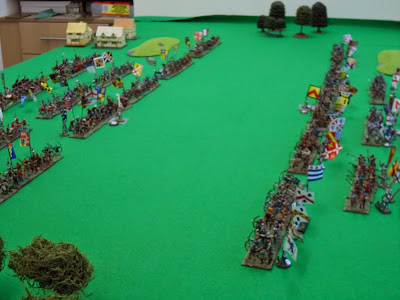
The command and control rules in "For, Lords, Tomorrow is a Busy Day" seem to be the antithesis of those in Bloody Barons, or indeed Piquet, and I'm looking forward to seeing how we adapt to them. The combat and morale rules also appear to contain some interesting ideas; the key test as usual will be whether the combination of the writing and the reading has communicated the author's intentions accurately.

In the meantime Henry VI prefers prayer. to battle, while Margaret of Anjou looks the other way in disgust. The cleric in the foreground appears to have been somewhat startled by the flash.


The command and control rules in "For, Lords, Tomorrow is a Busy Day" seem to be the antithesis of those in Bloody Barons, or indeed Piquet, and I'm looking forward to seeing how we adapt to them. The combat and morale rules also appear to contain some interesting ideas; the key test as usual will be whether the combination of the writing and the reading has communicated the author's intentions accurately.

In the meantime Henry VI prefers prayer. to battle, while Margaret of Anjou looks the other way in disgust. The cleric in the foreground appears to have been somewhat startled by the flash.


Tuesday, 20 January 2015
Pot37pouri
Boardgaming has broken out again, slightly delayed in one of the pubs which hosted us by the barmaid's breathless description of the events leading up to the landlord doing a runner immediately after New Year. These seem to have involved a mass brawl in the car park, alleged extra-marital sex in the saloon bar, an interfering mother-in-law, the landlady clearing an after hours lock-in by throwing glasses at drinkers, the police arresting the victim of domestic abuse instead of the perpetrator and much else. You will understand why most of us paused mid card play in order to get full value from the story. One result was that for the second time in just a few months I found myself in a pub with no beer and a second is that we have to find somewhere else to play next week.
 |
| Nothing distracts a truly dedicated gamer |
Anyway, you lot aren't interested in that sort of gossip, you want the games; which were:
Quartermaster General: A second play of this confirmed my high opinion of it. I took the Italians this time and we in the Axis were able to make the world safe for timely trains, although not as easily as the Allies had won the previous week. It did indeed turn out completely differently from the earlier game and, as most of us had now played before, the tactics (strategies?) were somewhat more subtle. I had wondered what the Italians brought to the party, but they have a lot of cards which add value in and around the Mediterranean; all of which makes sense.
Small World: I don't mind this every now and then although its fantasy theme is a little outside my normal comfort zone. I won quite easily by deploying Underworld Trolls, as you do.
Apples to Apples: Which never gets any better
Hanabi: I do like this, but it might suffer from diminishing returns if played too often.
Toc Toc Woodman: Or as it's known in the English version apparently 'Click Clack Lumberjack'. This is a preposterous game in which one chops down a plastic tree with a plastic axe. Jenga is probably the closest game I can think of to illustrate it. I was useless at it, thoroughly enjoyed it, played it four times in a row and must buy it immediately.
London: A bit ho hum. The aim is to redevelop London after the Great Fire, although it involves building underground railways, which I'm pretty sure weren't available to Wren and Hawksmoor. It passed the time, but I won't be seeking it out again.
Red7: A nice, short card game filler. Recommended.
Mysterium: Dixit meets Cluedo; not my cup of tea.
I also discovered that the game whose name that I couldn't remember was a Doomtown themed version of Seventh Hero which came as part of the AEG Black Box. No, I am none the wiser either.
Quartermaster General: A second play of this confirmed my high opinion of it. I took the Italians this time and we in the Axis were able to make the world safe for timely trains, although not as easily as the Allies had won the previous week. It did indeed turn out completely differently from the earlier game and, as most of us had now played before, the tactics (strategies?) were somewhat more subtle. I had wondered what the Italians brought to the party, but they have a lot of cards which add value in and around the Mediterranean; all of which makes sense.
Small World: I don't mind this every now and then although its fantasy theme is a little outside my normal comfort zone. I won quite easily by deploying Underworld Trolls, as you do.
Apples to Apples: Which never gets any better
Hanabi: I do like this, but it might suffer from diminishing returns if played too often.
Toc Toc Woodman: Or as it's known in the English version apparently 'Click Clack Lumberjack'. This is a preposterous game in which one chops down a plastic tree with a plastic axe. Jenga is probably the closest game I can think of to illustrate it. I was useless at it, thoroughly enjoyed it, played it four times in a row and must buy it immediately.
London: A bit ho hum. The aim is to redevelop London after the Great Fire, although it involves building underground railways, which I'm pretty sure weren't available to Wren and Hawksmoor. It passed the time, but I won't be seeking it out again.
Red7: A nice, short card game filler. Recommended.
Mysterium: Dixit meets Cluedo; not my cup of tea.
I also discovered that the game whose name that I couldn't remember was a Doomtown themed version of Seventh Hero which came as part of the AEG Black Box. No, I am none the wiser either.
 |
| Your bloggist ponders the big problems of the 21st century |
I am hosting the Wednesday night game again this week. I have again been busy - another impromptu and last minute trip to London - and so am sticking with the Wars of the Roses. Delving even deeper into my pile of rules for the period I find "For, Lords, Tomorrow is a Busy Day" by Real Time Wargames and so we shall give those a go.
Monday, 19 January 2015
CSI: Bosworth
I have been to a talk entitled "Killed the boar, shaved his head - the violent death of King Richard III" by Bob Woosnam-Savage, Curator of European Edged Weapons at the Royal Armouries. The lecture, lavishly illustrated by Graham Turner paintings as well as photographs, was by way of a fund raiser for Otley Courthouse (Savage is a local resident), but even so I was astonished to see around two hundred people turn out on a very cold and snowy evening. Less surprisingly I was easily in the lower quartile of the age range.
Savage didn't present any new theories (although I was intrigued by his suggestion that it was the dog that killed the princes in the tower), but did give a clear - and very graphic - account of Richard's wounds. He then outlined what he described as the team suggestion as to how events unfolded; having himself became involved after the discovery of the body with the specific task of interpreting the wounds with regard to type of weapon, direction of attack, sequence of events etc. He was particularly keen to stress the sheer unlikeliness of the whole thing. The survival of the grave, the synchronicity of both its discovery and that of the true site of the battlefield, the discovery of DNA and development of techniques for matching it, the identifying of descendants of Richard's sister through the female line before the line died out: any of these on their own were improbable - all together and one is getting close to being able to power the infinite improbability drive.
The gist of the team theory is that Richard charged with his household of around 300 well armoured men in a planned charge, got caught up in boggy ground and unhorsed (no French mercenary pikemen involved) where he was surrounded and beaten down to his knees, his helmet torn off and then he was finished off by the halberd of a Welsh foot soldier. There is naturally a book coming out in a couple of months - just after the re-internment, to which I have unaccountably not yet been invited - and so you can all check my version against the official line at your leisure.

One point of particular interest to me as a wargamer was when he discussed his involvement in the Channel 4 documentary featuring Dominic Smee. Smee has the same type and degree of scoliosis as Richard and was trained to ride and fight in armour to see how the condition might have affected the king. The documentary is well worth watching and is available online so I won't repeat any of it. However, Savage covered some aspects that didn't make the final cut, or at least if they did I've forgotten them. In particular he said that based on measurements of the newly discovered battlefield and on the team view of what happened when Richard was unhorsed, that the charge would have taken four minutes and from the point it was halted to Richard's death would have been a further two minutes. I find that a fascinatingly and poignantly short time.
The audience asked a number of questions afterwards, most of them complete nonsense. Just to give a flavour, the first asked about the size of the penis on Richard's heraldic emblem of the boar. [As an aside, if anyone can identify the relevance the above - somewhat obscure - picture then there is absolutely no prize whatsoever, but you will be have the pleasure of knowing that you are as pretentious as me.] The whole thing deteriorated to such an extent that the organiser stepped in and stopped it when Savage himself, having squeezed the last bit of fun out of talking about bollock daggers, launched into a bit of a rant about the historian Mary Beard.
 |
Savage didn't present any new theories (although I was intrigued by his suggestion that it was the dog that killed the princes in the tower), but did give a clear - and very graphic - account of Richard's wounds. He then outlined what he described as the team suggestion as to how events unfolded; having himself became involved after the discovery of the body with the specific task of interpreting the wounds with regard to type of weapon, direction of attack, sequence of events etc. He was particularly keen to stress the sheer unlikeliness of the whole thing. The survival of the grave, the synchronicity of both its discovery and that of the true site of the battlefield, the discovery of DNA and development of techniques for matching it, the identifying of descendants of Richard's sister through the female line before the line died out: any of these on their own were improbable - all together and one is getting close to being able to power the infinite improbability drive.
 |
| Zaphod Beeblebrox - long time Ricardian |
The gist of the team theory is that Richard charged with his household of around 300 well armoured men in a planned charge, got caught up in boggy ground and unhorsed (no French mercenary pikemen involved) where he was surrounded and beaten down to his knees, his helmet torn off and then he was finished off by the halberd of a Welsh foot soldier. There is naturally a book coming out in a couple of months - just after the re-internment, to which I have unaccountably not yet been invited - and so you can all check my version against the official line at your leisure.

One point of particular interest to me as a wargamer was when he discussed his involvement in the Channel 4 documentary featuring Dominic Smee. Smee has the same type and degree of scoliosis as Richard and was trained to ride and fight in armour to see how the condition might have affected the king. The documentary is well worth watching and is available online so I won't repeat any of it. However, Savage covered some aspects that didn't make the final cut, or at least if they did I've forgotten them. In particular he said that based on measurements of the newly discovered battlefield and on the team view of what happened when Richard was unhorsed, that the charge would have taken four minutes and from the point it was halted to Richard's death would have been a further two minutes. I find that a fascinatingly and poignantly short time.
 |
| The Simpletons |
The audience asked a number of questions afterwards, most of them complete nonsense. Just to give a flavour, the first asked about the size of the penis on Richard's heraldic emblem of the boar. [As an aside, if anyone can identify the relevance the above - somewhat obscure - picture then there is absolutely no prize whatsoever, but you will be have the pleasure of knowing that you are as pretentious as me.] The whole thing deteriorated to such an extent that the organiser stepped in and stopped it when Savage himself, having squeezed the last bit of fun out of talking about bollock daggers, launched into a bit of a rant about the historian Mary Beard.
Thursday, 15 January 2015
Bloody Barons
Weeks ago now I set up Tewkesbury in the wargaming annexe based on the scenario in the Bloody Barons rule book with the intention of running through it solo. I then discovered that I didn't have enough figures and painted up quite a lot more. I then discovered that I had miscounted and still didn't have enough figures and painted some more. By then it was fast approaching Christmas and we had finished the run through of Marignano so it was decided to play it through as our first game of the New Year. And that, as a result of my second short notice trip to the South Coast, was yesterday; or possibly the day before depending on when I get round to posting this.

Probably the most notable feature of the night was the sheer incompetence of the umpire. I spent so much time getting to grips with the command and control aspects that, as became painfully apparent, I had only the sketchiest grasp of the combat rules, let alone those for morale. We gradually noticed elements on the Quick Play Sheet that we didn't seem to be using and so the complexity level deepened as the battle unfolded. On balance I would not recommend this as an approach.

Any review of the rules by me would therefore be of even less use than usual. What I would say is that that there seems to be an awful lot of dice rolling involved. However, another game - playing properly from the beginning - would be needed before any even vaguely sensible conclusions could be formed.

Probably the most notable feature of the night was the sheer incompetence of the umpire. I spent so much time getting to grips with the command and control aspects that, as became painfully apparent, I had only the sketchiest grasp of the combat rules, let alone those for morale. We gradually noticed elements on the Quick Play Sheet that we didn't seem to be using and so the complexity level deepened as the battle unfolded. On balance I would not recommend this as an approach.

Any review of the rules by me would therefore be of even less use than usual. What I would say is that that there seems to be an awful lot of dice rolling involved. However, another game - playing properly from the beginning - would be needed before any even vaguely sensible conclusions could be formed.
Quartermaster General
My mention of having played and enjoyed Quartermaster General prompted some interest so I thought that I would expand on it a bit. Demonstrating the degree to which I have my finger on the pulse, I had never heard of the game before arriving in the pub on Monday evening (le Bois d'If, same as every Monday) when a fellow gamer mentioned it. Entirely by chance we found ourselves with exactly six players at a suitable time in the evening and so it hit the table. That encapsulates my main reservation with the game and why I probably won't buy it myself; to play it properly one needs exactly six people.

In order to get everyone to play it we had to overcome the reservations of one of the two women present, who expressed a disdain for wargames. I reminded her of the time we had played Manhattan Project and she had to admit to happily launching bombing raids on her competitors as part of that game (as an aside, on that occasion I won by eschewing the conflict part and sticking to the accountancy); she was also, I think, swayed by QG's co-operative aspects. It's a team game rather than strictly co-operative, with players representing the UK, US and Soviet Union facing off against those taking the part of Germany, Italy and Japan. Turn order is fixed with the Germans starting it and the US being last to join in; so far so realistic. My own dislike of co-operative games is really of those where everyone has the same information, because I find that most players simply end up as being the stooges of the most forceful personality. In this game teams can discuss things, but don't know what is in each other's hands and in any event anything they say can obviously be overheard by the other team, so such conversation tends to be limited.

I have now gone back and read a few reviews of Quartermaster General and most complaints seem to be that one's actions are restricted by the cards currently in one's hand - in particular that one often can't attack when one feels like it - and that on occasions one's turn simply consists of playing a card that will come in handy later on. Now there is no doubt that conflict resolution is perfunctory, not even reaching the levels of complexity seen in Diplomacy, but I found this constraint worked well. The Allies would like to have opened a second front in 1943, but weren't ready so they couldn't; once again so far so realistic. As the name might suggest the game is in large part about supply and about economic warfare. The US have the material, the USSR has the men and the UK has geographic reach through its empire; the Germans and Japanese have the early initiative and the Italians have, well I never actually discovered what they have.

Anyway, caveated by the fact that I only played it once, I only played one side and I only played about half of the deck (because we had saved the world for democracy by then), I enjoyed it. It's clearly a game about war - with lots of historical reference points - but it's also a game about marshalling resources and prioritising decisions. According to the person who brought it along it has great replayability. I'm not really surprised that the game gets a much higher rating on boardgamegeek than reading the reviews would suggest. But, and it's a big but, you need six people.

In order to get everyone to play it we had to overcome the reservations of one of the two women present, who expressed a disdain for wargames. I reminded her of the time we had played Manhattan Project and she had to admit to happily launching bombing raids on her competitors as part of that game (as an aside, on that occasion I won by eschewing the conflict part and sticking to the accountancy); she was also, I think, swayed by QG's co-operative aspects. It's a team game rather than strictly co-operative, with players representing the UK, US and Soviet Union facing off against those taking the part of Germany, Italy and Japan. Turn order is fixed with the Germans starting it and the US being last to join in; so far so realistic. My own dislike of co-operative games is really of those where everyone has the same information, because I find that most players simply end up as being the stooges of the most forceful personality. In this game teams can discuss things, but don't know what is in each other's hands and in any event anything they say can obviously be overheard by the other team, so such conversation tends to be limited.

I have now gone back and read a few reviews of Quartermaster General and most complaints seem to be that one's actions are restricted by the cards currently in one's hand - in particular that one often can't attack when one feels like it - and that on occasions one's turn simply consists of playing a card that will come in handy later on. Now there is no doubt that conflict resolution is perfunctory, not even reaching the levels of complexity seen in Diplomacy, but I found this constraint worked well. The Allies would like to have opened a second front in 1943, but weren't ready so they couldn't; once again so far so realistic. As the name might suggest the game is in large part about supply and about economic warfare. The US have the material, the USSR has the men and the UK has geographic reach through its empire; the Germans and Japanese have the early initiative and the Italians have, well I never actually discovered what they have.

Anyway, caveated by the fact that I only played it once, I only played one side and I only played about half of the deck (because we had saved the world for democracy by then), I enjoyed it. It's clearly a game about war - with lots of historical reference points - but it's also a game about marshalling resources and prioritising decisions. According to the person who brought it along it has great replayability. I'm not really surprised that the game gets a much higher rating on boardgamegeek than reading the reviews would suggest. But, and it's a big but, you need six people.
Subscribe to:
Posts (Atom)