Saturday, 28 November 2015

Baby, it's a Knit Mitt


For those of you jaded with wargaming I offer you an alternative vaguely military related craft based hobby. Check it out here. I have seen the future.


“Those who restrain desire do so because theirs is weak enough to be restrained.” - William Blake


Friday, 27 November 2015

Exit pursued by another bear

It's a sad fact that some readers of this blog have disagreed with some of my comments on here, the most notable when being when I pointed out that that 'Chinese' Gordon of Khartoum was a religious nutcase; a statement of the bleeding obvious that nevertheless prompted more than one god-botherer to take their bat home. It's also a fact that the writer of this blog often disagrees with what he writes himself; it not all being meant to be taken entirely seriously. However, today I can say with some certainty that even should this blog last another twenty years I shall never post a less controversial opinion than the one that follows: Judi Dench can act a bit.


I have been to see the live broadcast of Kenneth Branagh's production of The Winters Tale; a play incidentally that I had quite happily lived for almost sixty years without seeing, but which I have now seen twice in a couple of months. It was an excellent production - the play itself is a touch ho hum if truth be told - but as good as Sir Ken himself was as Leontes and as fine as the rest of the cast performed, it was Dame Judi as Paulina who stole the show. She was simply wonderful.

It was the first time that I had been to a live theatre transmission to a cinema and I was most impressed by the technical aspects: the sound was clear, the stage effects (including the bear) and lighting came across perfectly and the camera angles and close ups were very well chosen. There will be a live showing of  Branagh's company performing Romeo and Juliet next summer and I recommend it. If you needed any further incentive the elder Miss Epictetus - an increasingly fervent Shakespeare enthusiast and my accompanist for the evening -  tells me that it will be starring 'the really fit bloke from Game of Thrones'.

Thursday, 26 November 2015

Pot47pouri

“I do feel it gone,
But know not how it went” 
- William Shakespeare, The Winter's Tale

Life has ticked along nicely during my brief absence from blogging here. I went to an very entertaining talk on pseudoscience by Michael Marshall of the Good Thinking Society. There was nothing new, but it's always good to hear someone stick the boot into psychics, homeopathy etc. There was the usual round of boardgaming - which will be covered in due course, although I can reveal that I have played another cooperative game that I quite like - and even some wargaming.

First up in terms of wargaming was the little project to redo all my number markers. I set up a production line and with with a bit of focus have managed to pretty much finish, despite the fact that it quite possibly wasn't worth doing in the first place. Is that better than half-finishing something that is worth doing? What am I, a philosopher?

Which leaves the climax of the latest Seven Years War scenario at James'. I rather thought it was all over before we started, a feeling reinforced when Peter got an early run of initiative and I sank to zero morale. However, the dominoes suddenly shifted in my favour, Peter's dice rolling reverted to its usual poor state and the Prussians found themselves without any morale either. Sadly that proved to be the high water mark for the Russians and for me the tipping point was when I was one initiative pip short of being able to heroically remove a unit of horse grenadiers from the firing line. In the end the major morale rules did their job and the Russian left flank disappeared leaving the game effectively over.

I'm still not sure about the scenario; it certainly needs more physical space behind the Russian defences. Probably, the top reason for the Prussian's success was their ability to effectively fire their muskets twice as often as the Russians. The latter would have been better in melee, but never got the chance. Most of the wrap-up discussion centred on possible rule changes for morale and Cossacks. A consensus was achieved: give a try to my suggestions on morale challenges, yet another version of major morale, and moving back a bit on the previously proposed amendments to Cossacks. The current plan is to try these out next week.


Saturday, 21 November 2015

The whole vibe of everything

I'm going to try to avoid abuse for not being sufficiently appreciative of Elkie Brooks by sneaking mention of it in with a load of other stuff. In fact I seem to have also overlooked having seen Gilmore and Roberts recently. I rather liked them, make your own mind up:


The wargaming annexe was unaffected by the floods in Otley. The houses that ended up underwater were those that have a view of the river rather than of the A659 as the Casa Epictetus offers. The weather did disrupt travel somewhat, but nevertheless I made it to Leeds Art Gallery for British Art Show 8, a touring exhibition that takes place once every five years and which hasn't been to Leeds for twenty five years, or a generation as the publicity rather portentously says. Featuring forty two up-and-coming British Artists, it was mostly a load of old pony, with the only piece to which I would have given house room being 'On Nom Ore', a large hand-tufted wool wall hanging by Caroline Achaintre, that was so big that in fact I don't have enough room in my house after all. I chose the particular day that I went partly because it was when certain works were being interpreted in the galleries through the medium of music and dance by local students. This did not make things any better.


An unlikely and serendipitous result from the trip was that one exhibit, Linder's 'Diagram of Love: Marriage of Eyes' (literally a piece of old carpet that the artist found somewhere), made me realise what the device on Hastings' flag was meant to represent. That would be the first Baron Hastings, who has featured in all of my many refights of Tewkesbury and who has caused me every time to think "What on earth is that meant to be?". No doubt you already knew and are mocking me now; so be it.

Which brings us to Elkie Brooks. She was excellent. I can say no more.


Friday, 20 November 2015

Bad Penny Blues


I have, I'm sure, remarked here before that I have never understood why some wargamers are constantly rebasing their figures. It is therefore with some embarrassment that I have undertaken something even more pointless, I am reworking some of the markers that I use for indicating, for example, unit type and strength. I have two sorts, letters and numbers, both home made from adhesive craft stickers mounted on pennies in a base of filler. I had insufficient of some letters, but have now tracked down some more stickers of the same typeface to extend the collection. At the same time I managed to find some numbers in the same font, which I have decided to use to replace my existing numbers, which are perfectly adequate in both quantity and appearance. The exercise will take quite some time and will leave me pretty much where I was when I started. Perhaps I am a proper wargamer after all .

Speaking of which, last night I was half watching a documentary about WWII tanks when my ears caught the words Sidi Rezegh. What followed was a very interesting few minutes on Operation Crusader which was memorably described by an officer of 5th RTR as 'a gigantic cock-up'. The comparison of the relative sizes of shells from the British 37mm gun found on the Honey with that from a German 88mm was frightening. I'm not suggesting we fight the scenario again though.

Here's some Humph:


Thursday, 19 November 2015

Fool if you think it's over

The observant among you will have spotted the song reference above, and indeed a review of an Elkie Brooks concert will follow in due course; as soon as I can steel myself for the subsequent, and inevitable, flood of comments from Elaine's biggest fan. Instead the title alludes to the current game ongoing at James', which appeared to have ended in a resounding defeat for the badly generalled Russians - that would be me - but then leaped from its deathbed to continue into the third act just like an operatic soprano.

James has chronicled the first week here, and as he was taking loads of photographs will no doubt write up last night's second week, so I will only make a few general observations. (By the way, any readers with OCD prepare yourselves for some pain and discomfort because experience tells us that he won't write up the concluding evening at all.) So, it was the usual good fun, full of the normal swings that Piquet gives. I rolled the worst set of officers I can remember so haven't tried to rally very much, and at one point rolled about ten threes in a row on a variety of size of dice, but overall it flowed along reasonably evenly.

On the downside - and I know James won't mind a little criticism; despite apparently having been promoted recently from wargaming aristocracy to wargaming demigod - I'm not sure about the scenario. It rather relies on the Russians switching their forces around and/or counterattacking with their left flank, and they don't have enough Infantry Move cards to make it work in practice, or enough space behind their barricades to move around in even if they did.

There was much debate about Cossacks, and I agree they still seem to be too powerful. They can be rather good at shooting down flanks, although I suppose the moral there is don't let them get on one's flank. James made one of his trademark mid-game rule changes regarding their ability to close with enemy units; indeed he actually made the alteration mid-charge, which seemed a bit harsh to me. If I understand the new rules - and I'm frankly not confident that James is very clear on them, so I'm not sure what chance Peter and I have - things have now gone too far the other way. If we started over again with the current rules then at the earliest opportunity I would move all the Cossack units off the table and save myself the morale chips for losing them; and whatever one thinks of their fighting abilities I suspect that wasn't what he had in mind when he painted them. My own preference would be for their chances of closing to be dependent on the state of the enemy unit and the direction from which it's approached. I'd also make the penalty for failure becoming disordered rather than becoming shaken.

Which brings me nicely to the morale rules in Piquet, or, to be more precise, the morale rules in the version of Piquet currently being played (provisionally entitled "When life gives you lemons, squirt someone in the eye"). I don't like them. The original rules seem to have been designed so that a small game would come to a definite conclusion one way or another in an evening, which is fair enough. But they've been bastardised to such a point that they now lack - in my opinion - any real internal consistency or validity as a game mechanic. There, I've said it.

Friday, 13 November 2015

Psalm 116 Verse 3


"The sorrows of death compassed me, and the pains of hell gat hold upon me: I found trouble and sorrow."

Wednesday, 11 November 2015

It's a New Orleans thing

“There are only two things: love, all sorts of love, with pretty girls, and the music of New Orleans. Everything else ought to go, because everything else is ugly. ”  - Boris Vian

Indeed it is. Farewell, Allen Toussaint.


And you might recognise this one:


Tuesday, 10 November 2015

Hamians

I very much admire those blogs where regular progress reports are provided of what has been painted. No similar update is provided here simply because nothing much ever seems to get painted. However, I am happy to report that the dozen Hamian archers and the Celtic chariot have finally been based - the painting was largely finished some time ago - and their place has been taken in the cupboard by another dozen Hamian archers. The cupboard in question is the one in which the painting tray spends the vast majority of its life; it's actually beneath the boiler so I pretend to myself that it is in some way a sort of extended drying process.


The archers in question are a mish-mash of Roman bowmen from various manufacturers. Many of their colleagues have been converted to Ottoman forces to serve at the siege of Constantinople, but those remaining have been dragged from the plastic mountain to give some variety to To the Strongest! battles. They are Hamians mainly because that's what's pictured on Plate A of Osprey Men-at-Arms 93 'The Roman Army from Hadrian to Constantine' (not the picture above by the way which was lifted from here). Extremely rudimentary research on my part (although not Wikipedia on this occasion) indicates that one theory has them in Britain as hunters, whose main role was to provide meat and game to other troops. That suggest a possible use for them in the Romans in Britain rip-off of Pony Wars, for which I am keen to develop a hex based variant. And finally, on the subject of Hexon, I have bought some more.

Sunday, 8 November 2015

So I wait for you like a lonely house

Till you will see me again and live in me
Till then my windows ache

....................................................


                                But
                                 if each day,
                                 each hour,
                                 you feel that you are destined for me
                                 with implacable sweetness,
                                 if each day a flower
                                 climbs up to your lips to seek me,
                                 ah my love, ah my own,
                                 in me all that fire is repeated,
                                 in me nothing is extinguished or forgotten,
                                 my love feeds on your love, beloved,
                                 and as long as you live it will be in your arms
                                 without leaving mine.

                                           - Pablo Neruda

Friday, 6 November 2015

It's not cricket

 "Apart from the known and the unknown, what else is there?" - Harold Pinter
Apart from the known and the unknown, what else is there?
Read more at: http://www.azquotes.com/author/11692-Harold_Pinter
Apart from the known and the unknown, what else is there?
Read more at: http://www.azquotes.com/author/11692-Harold_Pinter
Apart from the known and the unknown, what else is there?
Read more at: http://www.azquotes.com/author/11692-Harold_Pinter

And so to the theatre. Sometimes there is a serendipitous juxtaposition of plays that one sees and so it is that shortly after 'Godot' comes 'The Birthday Party'. Pinter was clearly influenced by his fellow Nobel Laureate despite somewhat more happening in this, his second play, than in Beckett's. Having said that, one is left slightly unclear exactly what it was that occurred, the audience ending up in the kind of mental fog that engulfs Meg Boles throughout. Pinter reputedly told one director that it was all about cricket and was also supposed to have told an actor who asked why his character behaved as he did to mind his own business.


The director and actors involved here had made their own decisions and the piece was finely acted. Comedy - even 'comedy of menace' - isn't easy, and the play's descent from banality to absurdity makes it even more difficult, but their timing was excellent. One quibble might be that McCann is surely meant to be an Irish Catholic, whereas James Bell's accent was absolutely spot-on Ulster Protestant, to the extent that one wondered where the bowler hat was. Making things even more disconcerting for this member of the audience at least was that the actor playing the deck chair attendant chose to make the character spookily reminiscent of a wargaming art-shop proprietor of my acquaintance.


Anyway, to me the interesting thing about art isn't so much that it teaches you anything about how one should live life, but that every now and then there is a flash of insight into how one actually does conduct oneself day to day. For me - and I accept that this may not resonate with others quite as much - Pinter achieves just that here: "You're a big, bouncy woman." says Goldberg to Lulu upon meeting her "Come and sit on my lap.".

Thursday, 5 November 2015

Napoleon's last victory isn't

I had set up the C&C Ligny scenario mainly to see how it looked, but we ended up playing it last night.
The emperor ponders how best to waste the Old Guard
The terrain is very robust despite not being clipped together as thoroughly as recommended by the manufacturer. The video on their website makes it look so easy, but it's really not; I gave up after pinging the clips around the annexe on several occasions. The fact that the hexes were smaller than the previous squexes not only made it look more cramped, but also made the players imagine there was less room for manouevre as well. I suppose we'll get used to it.


For the record, James' peculiar aversion to combined arms attacks resulted in a straightforward Prussian victory.

Wednesday, 4 November 2015

Pot46pouri

Did I mention that I have seen Spectre? What a terrible film; if you haven't yet had the misfortune to see it, then don't bother. I'll grant you that the five minutes before the credits are rather good, but after that it's just rubbish. How they can drag the thing out for so interminably long and still leave countless plot elements completely unexplained is beyond me. The script takes itself very seriously (except for the joke about the allocation of the car, which did make me laugh), raising all sorts of political, ethical and psychological issues and the treating them all in a trivial, superficial, intelligence-insulting manner. I feel somewhat conned by all the glowing reviews in the media, but I think thay can be explained by the repeated, self-referential allusions to other films, mainly Bond although others such as Indiana Jones get a look in; critics love to display their esoteric knowledge (yes I know, I know!). And why is the state of the art global surveillance system accessed via a VDU of the type that no one has used for thirty years or more, displaying big coloured typeface on a black background?

MI6 fights cyber-crime

On a more positive note I have been to see the Jon Palmer Acoustic Band, who are very famous if you happen to live in Otley. Despite that they are very good, in a Waterboys, Pogues, Billy Bragg sort of stylie and well worth checking out. Here's one of their songs, in honour of today's Prime Minister's Questions:


Posh boys talking bollocks indeed. They did a very fine version of Steve Earle's Copperhead Road, but I'm actually going to leave you with another JP written song and then some Waterboys, both just for Crumb:


Tuesday, 3 November 2015

Les contes d'Hoffmann

And so to the opera. Offenbach's Tales of Hoffman was English Touring Opera's third offering last week and very much lived up to its five star reviews. I've no idea whether the original stories by the doomed German Romantic author E.T.A. Hoffman made any sense - it possibly depends how far advanced the syphilis was when he wrote each of them - but they make no sense whatsoever linked together here. That of course does nothing but enhance their suitability for being turned into an opera and also means that the fact that the 1920s Hollywood setting for the framing first and final acts is inconsistent with that for the three tales sandwiched in between is of no importance either. (N.B. for a completely different perspective try the Guardian review.)


What really makes this production buzz is the highly amusing acting of  Warwick Fye as the various bad guys. And the singing is good as well: from him, from Sam Furness as Hoffman - who really gives it some welly, as a good tenor should - and from Ilona Domnich, as easy on the eye as on the ears. Also excellent is Louise Mott in a number of roles, but it's a mystery as to why, while playing Nicklausse, she is dressed as Billy Bunter. I think I neglected to mention when reviewing Pelléas and Mélisande that Yniold appeared to be dressed as Wee Jimmy Krankie. Someone in ETO's design team seems to have a thing for women in boys' school uniform.


Monday, 2 November 2015

Hexon II for C&C

With all due apologies to Crumb it's time for some more wargaming. As previously mentioned I bought some of Kallistra's Hexon II at Fiasco. I suppose my main intention is to use it to build terrain flexibly for all rule sets rather than use it specifically for hex based rules. However, I haven't bought a lot so far, partly because I don't have a terribly good visual imagination and wanted to experiment before I commit to what elements to buy, and partly because I had travelled into Leeds on the bus and couldn't actually carry very much. In fact the box I bought was somewhat trickier to carry than I had anticipated and I ended up walking through Leeds a bit like George Lazenby in the old Fry's chocolate adverts.


Anyway, notwithstanding my ultimate intentions I have set up the boards that I currently have for C&C Napoleonics; it's the Ligny scenario. It all looks a bit lost in the middle of the table, although there will be plenty of room to put the rules and fizzy drinks, and to roll the dice. The whole thing has now clearly abandoned any pretence to be a wargame and stands proud as a more aesthetically pleasing boardgame.


Observations are:
  • The sabot bases and unit identifiers fit well in the clear hexes, but it gets a bit snug when a commander is added. As a reminder these are 20mm figures with units of 9 for infantry, 4 for cavalry with guns based singly.
  • The individual hex hills are too steep for the sabot bases to sit comfortably, but the flexible slopes won't fit into the standard C&C scenarios. I never had this problem with the upside down paper plates.
  • My existing river sections, paper bridges and (some of) my charity shop sourced knick knack buildings work OK. I need more small trees. Town and forest hexes need to be marked with coloured felt because the buildings and trees will have to be taken off if one wants to get any troops in the same hex.
  • Line of sight is line of sight; neither complex mathematics nor constantly referring back to the map are any longer required.

Sunday, 1 November 2015

Pelléas and Mélisande

And so to the opera. English Touring Opera are presenting three works in Harrogate. I passed on Massenet's Werther, mainly because the eponymous protagonist is so insufferable, but also partly because I made the mistake of going to see the very disappointing Spectre instead. But I did catch Debussy's version of Maeterlinck's 1893 play. I always welcome the chance to see opera in a smaller theatre and musically and vocally it was very good. The stage designs are necessarily built around transportability, but I felt they worked less well. The window in the castle tower wasn't really high enough or big enough for the Rapunzel style hair letting down and then there was the filing cabinet which lay on its side centre stage throughout. The opening and closing of various drawers to represent wells, caves, gardens etc sort of worked until late in the second half, when the top drawer was opened for the first time and a pile of papers spilled out. It was impossible to tell whether they represented anything in particular or whether someone had just forgotten to take them out. 


And what things represent is rather important here. The original play was 'symbolist'; in other words everything has a deeper meaning than that being acted out in front of us. I think - and don't quote me on this - that this one's about some things ending and other things beginning, whether we want that to happen or not. I saw echoes of Tennyson's views on the death of Arthur and the end of Camelot ("The old order changeth, yielding place to new"). Maybe that's all tied up with the mock medieval setting; maybe I'm just talking drivel. From our modern perspective it's always tempting to assume that fin de siècle (both temporally and artistically) implied some sort of intuitive awareness of the onrushing global conflict.


Whatever, I actually prefer to draw my lessons from the story as told on stage rather than looking behind it. The recital of infidelity and jealousy provides an interesting juxtaposition with both The Winter's Tale, seen on the same stage recently, and, once again against a background of impending and inevitable social change, the contemporaneous Uncle Vanya. For me, there are two pivotal moments: when the adulterous lovers first acknowledge how deep their feelings for each other are and understand that they are reciprocated; and then, when perhaps inevitably they are discovered and await whatever fate will bring, Pelléas cries "All is lost, all is won".

Saturday, 31 October 2015

Ferrybridge, the morning after (sort of)

Some weeks ago I set up a scenario loosely based on the action at Ferrybridge on March 28th 1461. The drivers for choosing this particular scenario were variously: having given up trying to make decent scenarios from the larger Wars of the Roses battles; wanting to try out To the Strongest! on something other than a straight two lines facing each other type of engagement; and because I have enjoyed a couple of Seven Years War scenarios that James devised (with more than a nod to Charles Grant) involving either bridges and/or troops arriving from various directions.

I say loosely based because I took out the damage to the bridge as being a complication too far for my purposes and gave the Lancastrians (Blogger's spelling suggestion for that last word was Zoroastrian; interesting) some reinforcements in order to even things up. I also gave Fauconberg some mounted archers, mainly because I have some and this was a way of getting them onto the table.

After illness and the foray into galley warfare previously mentioned here, Peter and I played through the game earlier in the week and I thought it worked fairly well. Edward IV might disagree as he died fairly early on, which does rather cast a cloud over things from the Yorkist's perspective. We decided that Warwick would have carried on regardless with the intention of pulling the strings of the young George I, as Clarence would have become. Clifford and Trollope (commanding the reinforcements) were also victims on the other side. The game ended in a a bit of a draw (ignoring Edward's death) with the Kingmaker holding the bridge, but unable to get more troops across and Fauconberg's force having been rather depleted.

The post match analysis placed the blame on my lack of aggression as the Son of York, which I think was fair enough. I should have pushed on to clear space in order to get more troops across even at the cost of losing my better units. But the scenario mostly worked out OK, the rules coped with a more complex setup and the newly acquired tokens were much easier to use than playing cards.

Wednesday, 28 October 2015

Appearances lead to deceive

It's about time that I bored you all with a list of boardgames played:

6 nimmt!: A really abstract game for which the correct strategy is so elusive that one is probably almost as well off playing randomly, but which I like despite that.

Castles of Mad King Ludwig: I like this, but have never seen anyone, myself included, display any particular science in deciding the prices when it's their turn to be master builder.

Codenames: A most enjoyable game for which I have no talent. It depends on having common frames of reference with one's teammates so, given the age gap between me and everyone else, all it does is prove that I am not down with the kids.

Isle of Skye - From Chieftain to King: This game has nothing to do with Skye and even less to do with getting promoted from chieftain to king. It is a sort of cross between Carcassonne, Castles of Mad King Ludwig and any number of games with variable victory conditions. I liked it and am not being facetious when I commend it for being quick to play.

Mafia de Cuba: A very fiddly and, I would suggest, pointless addition to the hidden identity genre. The only connection to Cuba seems to be that the (very many) bits are supplied in a cigar box.

Memoir '44: Enjoyed it and would like to play again.

Mystery of the Abbey: Cluedo meets 'The Name of the Rose'. I like it, but it works best with the maximum number of players.

Quartermaster General: The game a couple of weeks was probably my favourite of all the the times we've played. As the Germans I got my status cards all deployed early and the blitzkrieged my way to Moscow, but my card expenditure was too great and I had nothing left when the Yanks arrived.

Snowdonia: Jointly building a railway to the summit. A highly enjoyable worker placement game.

Thunderbirds: FAB, Virgil. It's basically Pandemic, but with added Tracy brothers. It was OK - I rather relished being Lady Penelope - but I still can't see the point of co-operative games. It didn't really seem that much different to the board game on the same theme which I played in the 1970s. And there was no Brains nor Parker either.

Tiny Epic Galaxies: We were somewhat handicapped as none of us knew the rules, but I'd like to play this again now I've sort of got the hang of it. I preferred it to the similarly themed Ad Astra.

War Galley: Not for me. It turns out that Peter quite liked it, although his reasoning seemed to be no more than that it wasn't as bad as Advanced Squad Leader.

And, speaking of Skye, here's some Runrig:


Tuesday, 27 October 2015

Soapy opera

And so to the opera. Opera North's revived production of Jenůfa by Janáček is very good, but the story is just horrible. It's well worth seeing, but the content isn't something to sit around and dwell on afterwards. I think I am pretty unshockable (in a moral sense - I'm a complete wuss when it comes to blood and gore), but the crime at the heart of this drama is one for which I simply cannot conceive there ever being a motivation.


The Guardian's review sums the whole thing up nicely: 'So she gets married to the one who slashes her face, not the alcoholic who left her pregnant? Indeed she does – though not before her stepmother has murdered the baby.' I've always scoffed at those who tritely claim that were Dickens alive today then he would be writing for Eastenders; perhaps they actually have a point.

In other news, I have been to Hebden Bridge (I told you that I was morally unshockable), but there was no bread and the wool shop doesn't open on Mondays. A good time was had by all.


Sunday, 25 October 2015

Far Fiasco

"The cause of the six-sided shape of a snowflake is none other than that of the ordered shapes of plants and of numerical constants; and since in them nothing occurs without supreme reason—not, to be sure, such as discursive reasoning discovers, but such as existed from the first in the Creators's design and is preserved from that origin to this day in the wonderful nature of animal faculties, I do not believe that even in a snowflake this ordered pattern exists at random."- Johannes Kepler

I have been to Fiasco, which I'm afraid continues not to be very good. I find that a real shame. For many years, as a wargamer who didn't know any other wargamers, the two Fiasco shows each year provided an important connection to the hobby. However, at a point roughly coincident with, but presumably unrelated to, its move to the Royal Armouries the show started to steadily decline in quality. For the last couple of years I've helped James and Peter put on games at the show, but it's half-term and James has higher priorities. Sadly there were no other demonstration games there today that even approached the size and quality of that which won James the prize at Derby earlier this month. Indeed there was nothing much to look at at all.

On the other hand, there were plenty of places to spend money, and so I did. In a move that will not surprise at least one reader of the blog, I bought some Hexon terrain from Kallistra. I now have, I hope, enough to replace my homemade squex mats for C&C Napoleonics and also the basis for a more extensive future set-up that will eventually allow larger games in the annexe.

Saturday, 24 October 2015

St James Infirmary Blues

I saw Gypsy Bill (perhaps inevitably, he isn't actually a Gypsy, but he passes for a bit of a hippie because he lives on a boat and has a pretty magnificent beard) playing in the pub the other night and he did a cracking version of St James Infirmary Blues. My companion for the evening professed not to know the song, so when we retired to the Casa Epictetus I played her several versions back to back, ranging from Louis Armstrong, surely the best known, through the very uptempo take by Tom Jones to the funereal effort of Georgie Fame. This quickly caused her to disappear off home; although not until after she had been very complimentary about the Pear & Chocolate cake. One of the performers that she missed out on because of her hasty exit was Sir Van the Man:


Friday, 23 October 2015

Deuteronomy 1:10

"The Lord your God hath multiplied you, and, behold, ye are this day as the stars of heaven for multitude."

Suddenly, this blog is swamped with readers, which surely can only mean one thing: the Russian spambots are back. But no! In fact, James has posted a link to here on his own blog and his fanboys have taken the hint. Well now you're here, how best to keep you? I know, an opera review.

And so to the opera. Opera North have revived their thirty year old production of Rossini's opera buffa The Barber of Seville, perhaps to complement last season's Marriage of Figaro (in which case why not the other way round?), perhaps as an attempt to beat the crowd to next year's anniversary, and perhaps just because it's popular with the punters. It was very full, with the area up in the gods which I frequent these days, being both crowded and hot. Never mind, it was as good as I remembered, although I was a bit less tolerant of the people on stage leading the applause this time; I'll clap when I feel like it, thank you very much. And applaud I did, especially for Gavan Ring's Figaro as spiv. The opera is sung in English and the translation is funny and pertinent. As Bartolo points out while lamenting 'modern opera', if something is too silly to be said it can still be sung.

Добро пожаловать

Thursday, 22 October 2015

Sunk without trace

"My wife was immature. I'd be in my bath and she'd come in and sink my boats." - Woody Allen

We convened at James' last night for some more galley action and were joined for the first time by Paul, an experienced wargamer who has just moved into the area and who we had made contact with at the Derby show. Sad to say he clearly didn't enjoy his first game in the legendary wargames room, but frankly I could see where he was coming from.

James had translated the War Galley board game to the tabletop and there were certain immediate improvements on top of the obvious aesthetic one. The ships, being metal, stayed where they were supposed to be, and with his usual assiduity he had made any number of markers. The only cardboard tokens remaining were the little chits for the squadron commanders and so the problem of small printing and old eyes had also disappeared. However, the complexity remained.

As readers will know we often play Piquet, which is a reasonably involved set of rules. At any particular point a unit could have markers defining quality, losses, morale status, command status, whether it was loaded, whether it had fired at all, whether it had acted on the current card and probably others I have forgotten (Interestingly, this isn't the bit about Piquet that people complain about; it's always the command and control rules.). So I'm used to relatively complicated games. But for some reason this game seems to have a very high ratio of faffing about to the amount of fun generated. And, ironically perhaps given my own acceptance of the swings of initiative in Piquet, it seemed to me that the whole game would probably hinge on who won the initiative on the first turn when the fleets had closed to ramming distance; in other words, on one die roll.

There was a further issue which bothered Paul, who had neither played the board game nor read the rules before, and which on reflection I think was a perfectly valid point, possibly obscured to those of us who had played with paper and cardboard. In that version the ship tokens fill the hexes, meaning that the eye automatically accepts the rule that ships cannot pass through a hex containing another ship. Except, of course, when they can. There is a special diekplous rule that allows pass through of fleets facing each other head on under certain conditions. The rule is justified with reference to the actual tactic of the same name employed by the Greeks, but a moment's reflection will tell you that the real reason is that without it the game is broken. If both players deployed their ships in close packed lines of adjacent hexes then nothing could or would ever happen. On the tabletop the ships do not fill the hexes, and the space to either side gives some visual explanation as to how the diekplous would have worked. However, it also raises all sorts of expectations that interpenetration ought to be possible under other, less restricted circumstances. When Paul made his point, the best justification that the rest of us could come up with was that it was what the rules said; rather unsatisfactory I'm sure we'd all agree.

So, points to reflect on:
  • These rules are not a hit with me as they stand
  • Having said that I still think hexes are definitely the way to go for galley warfare
  • As James himself pointed out, now the hexes are on the table they'd work well for WW1 aerial games
  • I hope that Paul rejoins us for a game more to his taste; some FoB Punic Wars perhaps.


Wednesday, 21 October 2015

From Rameses II to Henry V


 I don't know if anyone else ever takes any MOOCs. I've got into the habit of watching a video or two while I'm having a cup of coffee and a slice of home-made cake (this week's is Pear & Chocolate Loaf and is rather good, even if I say so myself; if you follow the recipe add a heaped teaspoonful of baking powder) and am finding them all very interesting. Obviously as a wargamer what one really needs is constant temptation to start up yet another period and MOOCs provide a steady stream of possibilities to be enthused over and then discarded when something better comes along. For example, I've just completed a short course on the ancient Near East which included much material on Kadesh plus the fighting techniques of the combatants. I hope that my willpower is strong enough to resist the lure of the massed chariots of Rameses II, but the best way to ensure that is so is by quickly moving on. It being October 2015 then where better to go next than Agincourt, and so I'm going to be taking a look here at a brief course being led by Professor Ann Curry to mark the 600th anniversary.


Tuesday, 20 October 2015

Well, it's all right

Happy sixty-fifth birthday to Tom Petty. Here he is, featuring added Stevie Nicks for any of her fans who are reading this:

God it's so painful
Something that's so close
And still so far out of reach


And here he is with some other wannabes and hangers on:

Everybody's got somebody to lean on
Put your body next to mine, and dream on


Friday, 16 October 2015

See my tailor, he's called Simon

Rosalind, in 'As You Like It' asks the rhetorical question "Can one desire too much of a good thing?". One could ask the equally rhetorical, and unnecessarily self-referential, question of whether rhetorical questions are themselves too much of a good thing in this blog. As it happens the answer to both questions ["Can rhetorical questions have an answer?"] is "I should coco!". The answer to the rhetorical question about whether rhetorical questions can have answers is, as an example of Russell's Paradox, best considered alone over a nice cup of tea.

Russell's teapot

Why am I writing this drivel? ["OK", interjects the RP "I've let it slide up until now, but you have to stop doing this."]  Well, I have played boardgames for four days running, and even my enthusiasm is starting to wane. No one can live life in the fast lane continuously, especially at my age. As Lou Reed put it in the original, but sadly unrecorded, version of 'Walk on the Wild Side'


Graham is just boardgaming away
Thought he was building a railway across Europe for a day
Then I guess he had to crash
Valium would have helped that bash
He said, hey babe, take a walk on the wild side
I said, hey honey, take a walk on the wild side
And the coloured girls say

Doo doo doo doo doo doo doo doo doo
Doo doo doo doo doo doo doo doo doo doo


So it's time to pack up the meeples, dice etc and chill out. I shall be slowing things down with a few days of sex, drugs and rock & roll. In all honesty the drugs might be limited to my asthma inhaler; I'll certainly steer clear of whatever Norman Watt-Roy is on in this video:


I'll be back.

Thursday, 15 October 2015

War Galley

It's been a long time since I played a hex-wargame on a paper mat with cardboard counters, and last night I realised why. It's fiddly, complicated and the markings on the pieces are difficult to read. However, there were enough positives from the game of War Galley to think that it might translate effectively to the tabeltop with models. In particular, I am convinced that hexes are the appropriate medium for rules involving ramming, raking, grappling and so on. It just makes crystal clear what actions are permitted and what aren't.

What was less than crystal clear was the prose in which the rules were written. Richard H. Berg (not to be confused with the Richard Borg who wrote Memoir '44, which I played the previous day) may be prolific, but it hasn't made what he writes easier to understand. In fact it may be part of the problem because there could perhaps be an assumption that one has played other games and is familiar with some of the conventions.

The game is part of the Great Battles of History [GBoH] series. Let me quote from the blurb on Boradgamegeek: "What is best about War Galley is how easy it is to play -- the rules are about half the length of the usual GBoH game -- and that means that most battles can be complete in several hours, at the most". Only several hours; sounds tempting. In the event our game lasted much less time as all my galleys got sunk. Games that rely on spatial awareness are really not my forte.

We had played the whole game getting the rules for failed ram attempts completely wrong and that may have altered the flow of the battle, although not I suspect the eventual outcome. We eschewed missile fire in this test run and every grappling attempt failed - another thing that may have changed if we'd played the ramming rules correctly - so there was no boarding. Also the command and control element seems a bit clunky. But as mentioned above they seem to have passed the first test and will now be tried in a second test on the table using some cobbled together hybrid of models and cardboard counters.

Wednesday, 14 October 2015

Operation Cobra

I played Memoir '44 for the first time last night, I have played both C&C Ancients and C&C Napoleonic before, so it was easy to pick up the rules, but more difficult to ignore things that are in the others, but not in this one. In particular I was thrown by the lack of opportunity for response by the defender during close assault.


We played the Operation Cobra scenario through twice and I won both times. I have to concede that my victory as the Germans was due to rather fortunate dice rolling on my part plus some aggressive (optimistic?) play by my opponent. I continue to be impressed by the simplicity and elegance of the C&C dice system, but this was my least favourite of the three iterations that I have tried. However, I I've only scratched the surface of the game and until I've tried all the elements - this scenario had no artillery for example - I reserve the right to revise my opinion. It could of course simply be that this was the first time I'd played with the boardgame pieces rather than with figures on a table top and that I was biased against the aesthetics; doubly so because Memoir '44 uses unpainted figures rather than blocks. Once again I instinctively felt that equal victory points is not at all appropriate; surely the Americans should be able to lose more troops and still win?

One small parochial reference if I may. One of the thrusts of Operation Cobra was towards Coutances, one of the twin towns of Ilkley, epicentre of wargaming in the Lower Wharfe Valley. Indeed the road out of Ilkley towards Otley is Coutances Way.

Coutances Way during rush hour

Tuesday, 13 October 2015

Minor Engagements of the Wars of the Roses

"Let us leave pretty women to those devoid of imagination." - Marcel Proust

I have mentioned before that of the set piece battles of the Wars of the Roses, Tewkesbury is the only one that seems to me to be balanced enough to refight enjoyably as a game, without either substantially tweaking history in some way or running the risk of a very short game. There is a place for invented scenarios of course, but they require a degree of imagination and inspiration that I seem to be lacking right at the moment.


In casting around for something suitable to set up, I decided on Ferrybridge which, as I'm sure that you are about to point out, is seriously unbalanced and requires an alteration to what actually happened in order to make a game of it. No matter; inconsistency is my forte. I have the requisite Yorkist commanders and so out came the paintbrush to prepare Lords Clifford and Neville. Balancing the scenario mainly involves assuming that the Lancastrians send some reinforcements rather than leaving Clifford in the lurch. The scenario in Peter Pig's Bloody Barons rules postulates that Sir Andrew Trollope would have been sent to command these, and while that made perfect sense to me, I couldn't find a suitable standard anywhere online. However, I eventually tracked one down where I should have looked in the first place: volume 1 of Graham Darbyshire's 'The Gentry & Peerage of Towton' published by Freezywater Publications. So Sir Andrew will take to the tabletop and get the chance to die the day before he actually did.


Naturally, being a wargamer, I cannot resist planning the next project before I've even got this one finalised, and so while painting and basing Trollope I started to pull together some figures for another minor engagement that I've long wanted to do: the bombardment of London by the Bastard of Fauconberg in 1471. Which in turn raises two questions. Firstly, is this a balanced historical scenario which will make for a good game without changing things? Well, don't be sceptical, it probably is; the trick will be to give the rebels the right length of time to capture the city and rescue Henry VI before Edward IV returns victorious from Tewkesbury. Secondly, are there any other minor engagements that might work? Funny that you should ask; I am thinking of Oxford's occupation of St Michael's mount in 1473, French raids on the south coast in the 1450s, and then the Battle of Sandwich and the Yorkist landing in 1460. I do have a very interesting book on Nibley Green in 1470 (astonishingly a second book on this most obscure of subjects now seems to be available on Kindle), but not only was that a miniscule action, but seems to have almost literally finished before it started. I'm sure that there are many other small encounters during the period that I have overlooked.

Monday, 12 October 2015

Love Is Like Stealing Electricity

Two hearts go d-da, d-da, d-da, d-da, d-da
D-da, d-da, d-da, d-da, d-da
D-da, d-da, d-da, d-da, d-da-da
 We climb so high in search of a kindred soul
Till we grab hold of a live wire up on a high line pole
The laws of nature say you get nothing for free
And love is like stealing electricity

 Two hearts go d-da, d-da, d-da, d-da, d-da
D-da, d-da, d-da, d-da, d-da
D-da, d-da, d-da, d-da, d-da-da


Tom Russell has featured on this blog a couple of times recently and he's about to feature again, because I have been to see him perform. Russell, along with Dave Alvin, is credited with inventing Americana, although judging by his comments last night he has no more idea what that actually means than anyone else. Russell's genuine sense of geographic attachment to the Old West, his ackowledgement that his route there came via Scandinavia, Ireland and California, plus his natural gift for storytelling, all shine through in his songs, the way that he sings them and the between song anecdotes that are an essential part of the show. Accompanied by the smoking hot Max di Bernardi on guitar he also referenced the influence of diverse acts such as Bo Diddley, Warren Zevon and Ray Davies. I'm not going to bother to tell you he was excellent, but I strongly urge you to check out his music.

Here's Gretchen Peters doing one of Russell's songs:


Here's Warren Zevon's Carmelita performed by Linda Ronstadt:


And let's finish with some more Russell, one of a number of his songs that reference Pancho Villa in the lyrics:


Saturday, 10 October 2015

Thoughtful or empty

Here's some Ray Charles. Just because.


From thirty to forty

I promised myself that I would list boardgames played more frequently than once a month, so here, a mere forty days or so after the last such post, is the list for September:

7 Wonders: Leaders: I like 7 Wonders despite being really bad at it. The leaders aspect is clever, but from my perspective just gives yet more attributes to under-exploit.

Ad Astra: An OK, space-themed game with an interesting mechanism that's a cross between Race for the Galaxy and any number of worker placement games where one bids for turn order. There's an alien technology part to it that for some reason never got triggered in our game.

Codenames: A team word definition game that has nothing whatever to do with its ostensible theme - spy networks - but which is really good fun. It requires skills that the majority of gamers simply don't have, but is nevertheless very entertaining.

Condottiere: Great game and a way of sneaking in some almost wargaming to an evening of not wargaming.

Discoveries: A nice dice based game around the Lewis & Clark expedition. I played the boardgame on the same theme a while ago and enjoyed it. I think that this is better. The theme may or may not be of more interest to those from North America, but the fact that I know next to nothing about it (and have no desire to learn any more) hasn't stopped me enjoying the games.

Harbour: An interesting little game that outstays its welcome. We played with the auction house rule that arose originally out of a misunderstanding. To make the game shorter the target should be expressed in points (20 or 25 say) rather than in buildings built.

Mottainai: I had previously played a print at home version of this and didn't understand it. This time we played two shop-bought sets mashed together, and I didn't understand it.


Polterfass: This is a German bluffing and guessing game about ordering beer which I've owned for years without ever playing. I suspect I shall own for many more years before I play it again.

Quartermaster General: Air Marshall: An expansion that seems to improve an already excellent game.

Qwirkle Cubes: I like this although everyone who has played both says that the tile version is better.

Splendor: Good game, dodgy title spelling. I have trouble because not only are black, blue and green too similar in colour, but their shapes are also much the same.

Spyfall: I think I've done this one before. What sort of spy doesn't know where they are? Another game that requires players to extemporise under time pressure, but which on this occasion doesn't give much in return.

The Voyages of Marco Polo: A combination of the old Waddingtons travel game Go and Ticket to Ride with worker placement mechanisms; and lots of camels. I rather liked it.

To celebrate the new, improved, longer wait for a boardgaming report firstly here's a photograph of Brigitte Bardot:


And secondly here's Ronnie Hawkins' version of Chuck Berry's 'Thirty Days' which, presciently, he decided to record as 'Forty Days':

Friday, 9 October 2015

You brought me misery

"Make no small plans for they have no power to stir the soul" - Nicolo Machiavelli

This week's wargaming objective is sorting out my Warbases playing card tokens. When did my dreams become so insignificant? 

Not only are my ambitions pitiful, but I also making rather heavy weather of it. I have four sets of tokens and they need splitting between two bags - exciting update, the bags, plus an extra one to put some dominoes in, are already on order  - but, planning ahead, I also want to be able to use the sets separately if required. ["So," the Rhetorical Pedant asks "did you buy four bags?". "Curses," I reply " I can't even get that right."] In any event I determined to paint the back of each set a different colour. The best way to do it would have been to spray them, but I don't have any spray paint. I painted the first set green but the came a bit of a varnishing disaster. The backs are now so lumpy that I think one could learn to read them braille-like. The painting of the next set, in red, seemed to go alright and then I foolishly decided to do the third in white. Ten or so coats later they are getting close to being ready for varnishing. The fourth set will now remain au naturale. 

And so to the fronts. I have had trouble distinguishing the numbers on the tokens across the table and so decided to colour in the suits using permanent marker. The six and nine of diamonds are also difficult to tell apart and therefore they need some extra marking. A trip to the shop during a thunderstorm meant that I was soaked through, but now in possession of two permanent markers. The red one works fine, but the black doesn't seem to have any ink in it.So there we are: aim low, shoot lower.

But all that talk of diamond playing cards can mean only one thing:


Thursday, 8 October 2015

Oh Tell Me The Truth About Love

It's National Poetry Day.

Oh Tell Me The Truth About Love

Some say love's a little boy,
And some say it's a bird,
Some say it makes the world go round,
Some say that's absurd,
And when I asked the man next door,
Who looked as if he knew,
His wife got very cross indeed,
And said it wouldn't do.

Does it look like a pair of pyjamas,
Or the ham in a temperance hotel?
Does its odour remind one of llamas,
Or has it a comforting smell?
Is it prickly to touch as a hedge is,
Or soft as eiderdown fluff?
Is it sharp or quite smooth at the edges?
O tell me the truth about love.

Our history books refer to it
In cryptic little notes,
It's quite a common topic on
The Transatlantic boats;
I've found the subject mentioned in
Accounts of suicides,
And even seen it scribbled on
The backs of railway guides.

Does it howl like a hungry Alsatian,
Or boom like a military band?
Could one give a first-rate imitation
On a saw or a Steinway Grand?
Is its singing at parties a riot?
Does it only like Classical stuff?
Will it stop when one wants to be quiet?
O tell me the truth about love.

I looked inside the summer-house;
It wasn't even there;
I tried the Thames at Maidenhead,
And Brighton's bracing air.
I don't know what the blackbird sang,
Or what the tulip said;
But it wasn't in the chicken-run,
Or underneath the bed.

Can it pull extraordinary faces?
Is it usually sick on a swing?
Does it spend all its time at the races,
or fiddling with pieces of string?
Has it views of its own about money?
Does it think Patriotism enough?
Are its stories vulgar but funny?
O tell me the truth about love.

When it comes, will it come without warning
Just as I'm picking my nose?
Will it knock on my door in the morning,
Or tread in the bus on my toes?
Will it come like a change in the weather?
Will its greeting be courteous or rough?
Will it alter my life altogether?
O tell me the truth about love.

                                    - W.H. Auden

Wednesday, 7 October 2015

To prove a villain

And so to the theatre. "Thank God," you all cry "five days wargaming in a row is not why we read this blog". That begs several questions, but we shall ignore them and plough on; and at least it's a play about a soldier. Accompanied once more by the elder Miss Epictetus - the younger Miss Epictetus does exist, but is far too cool to be seen in the company of her aged parent - I have been to the West Yorkshire Playhouse to see Reece Dinsdale give his Richard III.


The last time I saw him was in the same theatre last year where he played Alan Bennett. In a sense he is again playing another familiar character - although, unlike Bennett, this one is thankfully dead - because his Richard is quite clearly Hitler. As the Guardian review points out "in the early 1930s, the British press often made fun of Hitler, misled by his appearance into believing that he posed no real threat" and Dinsdale produces more than a few moments of real laugh-out-loud humour. I was wondering what his performance reminded me of, but I think that Jo Haywood has it right in the Yorkshire Life review: he's channelling Leonard Rossiter. Imagine a serial-killing Rigsby only using one arm and wearing one built up shoe and you're there. The WYP seems to be having a season of shoe based disability productions. In 'The Glass Menagerie' the actress represented lameness by only wearing one shoe wile the rest of the cast wore none. That felt crass, frankly walking with a limp would have sufficed, but Richard does need a bit more visible deformity.


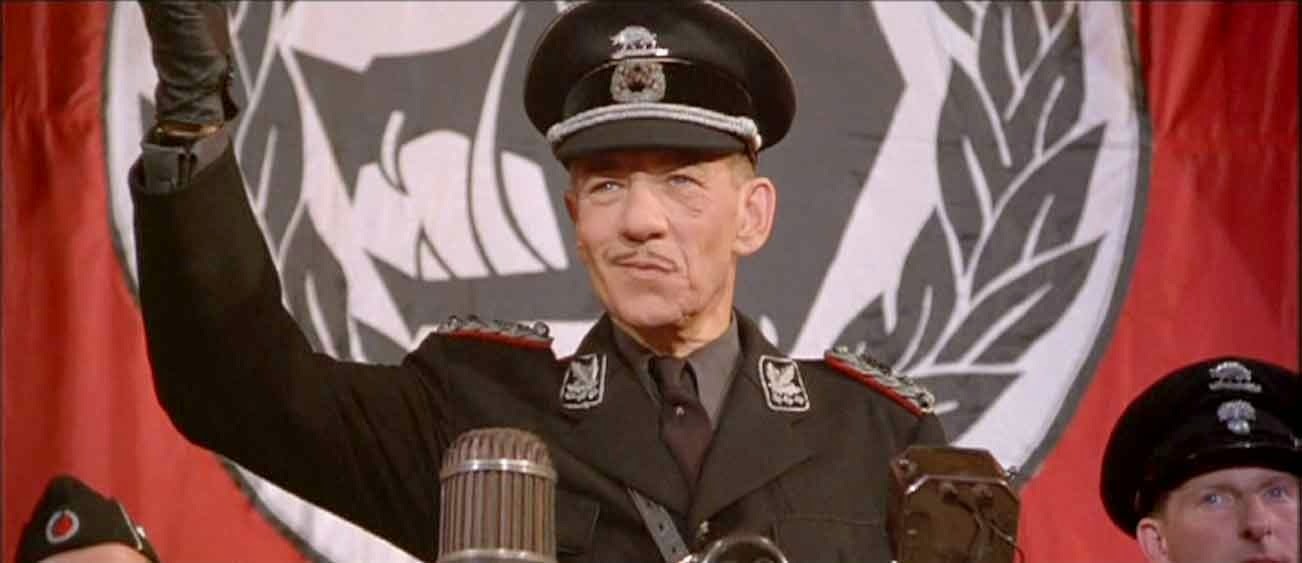
The Richard as fascist dictator theme is not new - the last modern dress version that I saw was Sir Ian McKellen's iconic production twenty five years ago at the National Theatre where he played the part as Moseley - but that's because it works very well. So too does the stark stage design and the sound effects and intermittent background music. Less happy is having parts of the dialogue literally telephoned in from offstage, and some of the doubling up of parts caused a little confusion. Overall though it provided an excellent finale to my late summer and autumn of Shakespeare.

Tuesday, 6 October 2015

Velleity no more

I have tried twice before to write a review of the Derby show, but have continually been sidetracked by a cacoethes of making unsolicited observations - both good and bad - about other peoples' appearance and also some frankly delusional ones about my own. In the meantime everyone else has cracked on and done the job properly, usually with photos. Even James has broken radio silence to post on his blog about it. His is a fairly comprehensive run through of what happened, albeit excluding the fact that the reason we played it twice was that we got the rules wrong the first time. He also rather glosses over what he shouted out when it was announced that he'd won.

So, there isn't much left to say. The one game that I would like to mention myself is the participation game set in Tobruk. The notable point was the terrain cloth which was a piece of Hessian sack covered with scattered sand and scenic green stuff. Simple but effective. The chap who was running the game was not only very friendly and keen to explain the creation of his scenery, but was also - if I might be allowed one last comment on the physical stature of the wargaming sodality - about seven feet tall.

All that I actually bought - apart from a sausage sandwich on the first day and a full English on the second - were some playing card tokens from Warbases for use with To the Strongest!. I bought four 'decks' worth and am currently painting the backs of each in different colours to allow easy separation.

Monday, 5 October 2015

Wargamers, beards and bellies

"There is always a period when a man with a beard shaves it off. This period does not last. He returns headlong to his beard." - Jean Cocteau


Although, as can be seen from Modigliani's portrait above, not in Cocteau's own case. I seem to have been mistaken for a pognophobe, but nothing could be further from the truth. I recognise that, as Craig Brown wrote, "A decent beard has long been the number one must-have fashion item for any fugitive from justice".


I was intending to write a full review of Derby yesterday, but not for the first time was diverted by a pretty face, or in this case - and again not for the first time - two pretty faces. But, to slightly recap, I really enjoyed it. Great venue (once it warmed up) and very helpful and friendly organisers, contarsting favourably with the miserable jobsworths at Sheffield last year. All the gamers and traders that I spoke to were enthusiastic, friendly and polite. James did return to the table to report having witnessed someone directing racist abuse at the bar staff; completely unacceptable of course, but noteworthy in part because that one person and incident seemed so completely at odds with the rest of the event. Undeniably though, the attendees as well as being all white were overwhelmingly male and this may account for the neutral observer - me - thinking that there were a higher proportion of beards than usual. These ranged in design from the stubbly, few days unshaved type (the boyfriend of the young lady mentioned yesterday actually had one of these), through the lumberjack /hipster type to the chap that I saw playing Gates of Antares who appeared to have come in Rasputin fancy dress. My own clean shaven appearance has much to do with an inability to grow any of those, although - even if I say so myself - I do have an air of Ronald Colman about me when I grow a moustache.


A rule clarification leaves your bloggist puzzled

If you had asked me on Friday I would have admitted to carrying some extra weight round the middle. But having been at Donnington for two days I now realise that I am positively svelte and athletic. I am, as you know, a bit of a flâneur and am often to be found in large groups at the theatre or opera, in political salons, watching ladies tug-of-war or generally among the bon ton. In none of these places (NONE!) are there as many grotesquely obese men as there are at wargames shows. So, beards are OK (and cause a certain amount of envy on my part); huge great bellies, no, no , no, for god's sake no.