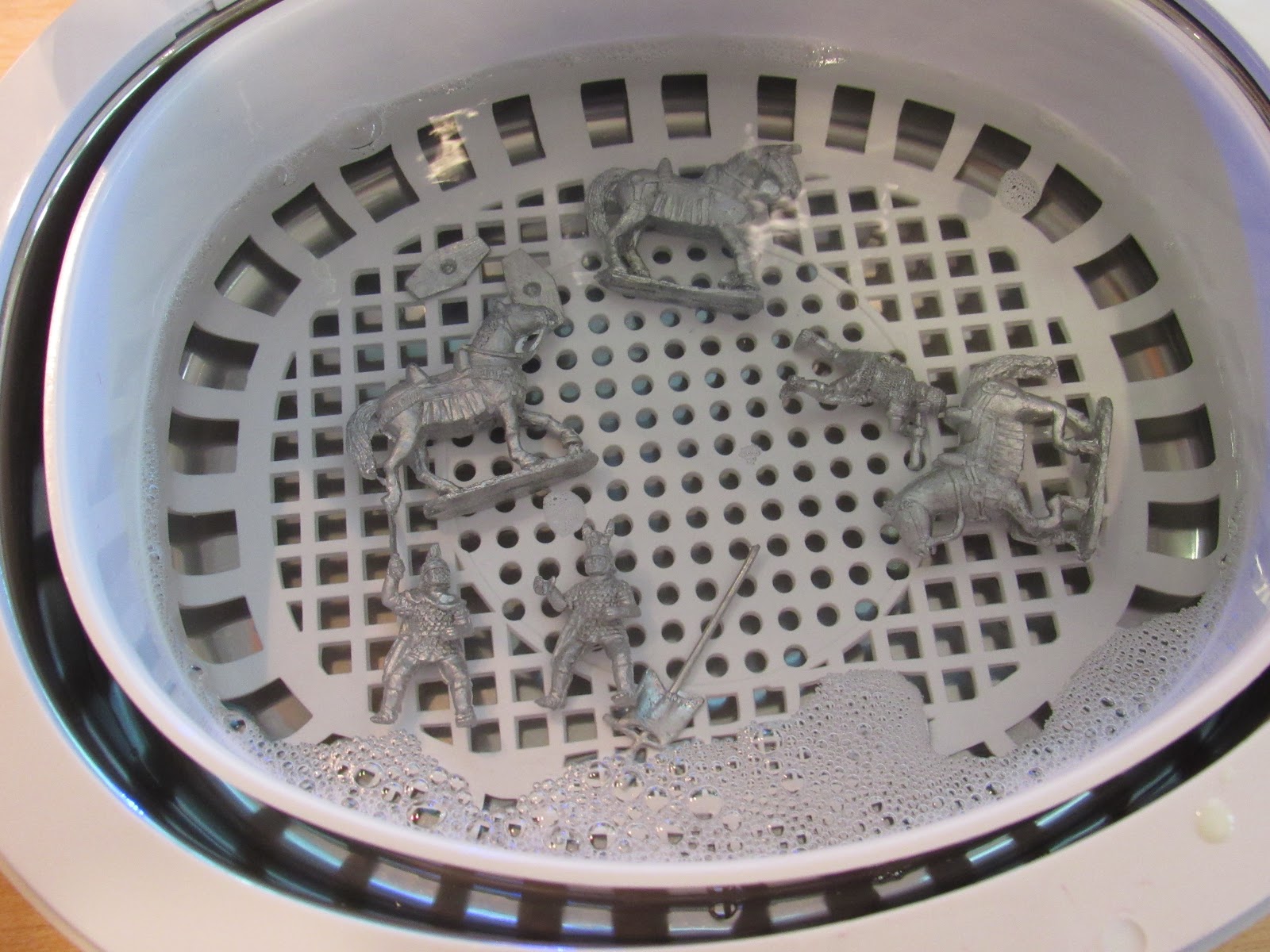
I have acquired an ultrasonic bath. While my reasons for purchasing it were not wargaming related, it would have been remiss of me not to try it out on some figures as a method of cleaning them prior to painting. These is the Early Imperial Roman Auxiliary Cavalry Command pack from Newline Designs.
Whilst I have no way of objectively measuring it, my best guess is that it has made no difference when compared with just soaking them in some warm soapy water for a while. Still, what's the point in having toys if you don't use them.
Saturday, 4 July 2020
Thursday, 2 July 2020
Actual Arrival of New Rules
I have received my pre-ordered copy of 'Infamy, Infamy', the latest rules from the Too Fat Lardies, complete with pack of cards and some game markers.
I haven't read much of them yet, having been distracted by the credit and name check given on page 1 to Don, my first ever wargaming opponent from fifty plus years ago. Fortunately there is no photograph; the poor old sod hasn't aged well at all. I wonder if it's him that's to blame for the typo on page 6.
I shall definitely give them a go and, given that I know Peter has also bought a copy, there may be some support in getting it into the schedule. However, no one knows when wargaming is likely to start up again and the longer the delay the more figures that James will have added to his Peninsular War set up; it would, of course, be rude not to christen those.
Anyway, that all gives more time to ponder the question of basing.The sabot bases which I already have aren't for the same size as the units specified here. My initial reaction was to bodge it some way, but on the other hand I do have access to a laser cutter....
I haven't read much of them yet, having been distracted by the credit and name check given on page 1 to Don, my first ever wargaming opponent from fifty plus years ago. Fortunately there is no photograph; the poor old sod hasn't aged well at all. I wonder if it's him that's to blame for the typo on page 6.
I shall definitely give them a go and, given that I know Peter has also bought a copy, there may be some support in getting it into the schedule. However, no one knows when wargaming is likely to start up again and the longer the delay the more figures that James will have added to his Peninsular War set up; it would, of course, be rude not to christen those.
Anyway, that all gives more time to ponder the question of basing.The sabot bases which I already have aren't for the same size as the units specified here. My initial reaction was to bodge it some way, but on the other hand I do have access to a laser cutter....
Sunday, 28 June 2020
Bring me sunshine
"If I had to choose a religion, the sun as the universal giver of life would be my choice."
- Napoleon Bonaparte
As those readers in the UK will know, it has once again been what the Met Office refer to as 'well hot'. At such times it is custom and practice at the Casa Epictetus to abandon wargaming, blogging and the like in order to frolic outside. And so, with due regard to social distancing and no regard whatsoever to social decorum, that's what has been happening for a few days. The reason that we in this country drop everything and rush off into the sunshine is that we know perfectly well that it won't last long, and inevitably the rains have now come back, and tagging along with them is your bloggist.
Before I disappeared I had played out some more of the game currently in progress in the annexe. Although I can vaguely remember what happened I can't really bring to mind any of my associated thought processes, so basically this is a couple of photos to bring us up to date. The British rolled better dice than the Germans once again and called in a barrage which has, for the moment at least, stopped the assault on the town and destroyed a field gun into the bargain.
Unable to attack, the Germans responded in kind and for the first time one of their barrages was both called in and hit its intended target. However, it achieved very little actual damage when it got there. Elsewhere the Germans did what they should have done the previous turn and attacked in the centre, with great success.
The attackers now hold three of the four objective squares, although not the one that I seem to have flung all their strength against. No doubt there's a learning point in there somewhere. I'm not sure what options the British really have left, except to try to roll high numbers at the end of each turn and finish the game quickly. To be continued...
Monday, 22 June 2020
Urgent Arrival of New Rules
"Painting is not done to decorate apartments. It is an instrument of war." - Pablo Picasso
Both I and the stepladder have returned to the annexe. If the time spent decorating has taught me anything, it is that my previous practice of paying someone to do it for me was the entirely correct approach and one to which I should return forthwith.
When we last visited the table, the British had a big hole in their line and needed to fill it. The normal route to bring on reserves in 'Square Bashing' is the reinforcement phase, which occurs right at the end of one's turn. There is also the option, in the opening phase, to select Urgent Arrivals as one's asset. Only one asset is allowed each turn, and that is presumably to speed up game play. I'm happy with that, but it has always seemed to me that some assets give more value than others, and so the same ones - artillery barrages mainly - always end up getting selected. If one rolls well then a barrage can do damage to a number of squares and an even larger number of units. If one rolls well when choosing, say, Hasty Defences one can put some sandbags up in one square. They just don't seem comparable to me. I therefore allow a modest upside to a couple of the asset classes to reward good (i.e. lucky) dice rolls. In this case the British rolled two sixes and three fives with five dice and thus two infantry units arrived and moved into the gaps. Not much else happened on the British turn until the very end. The game starts with a clock set to 21, and the defender rolls a D6 as the last action of their go to reduce it; when it reaches zero the game is over. Six turns is therefore a reasonable forecast for the length of the game. On this occasion the British rolled a one, implying that there are most likely still six turns to go. That rather suits the Germans.
So, the Hun commander decided to take advantage of this probable extra game length by not immediately assaulting in the centre, but giving himself an extra turn of barrage. Unfortunately the German artillery, having missed everything on the first turn, failed to even fire this time. The only assault that occurred was against the town objective where, having successfully rolled to use their Higher Command ability to add to the attack, the Germans were rolling thirteen dice against nine. Perhaps inevitably they nevertheless lost the melee. My tactics of constantly assaulting built up areas doesn't seem to be the right one after all. Still, a flamethrower unit has arrived and next time perhaps they will do better. British shooting improved and one German unit, which had failed morale based on last turn's shooting casualties and therefore couldn't move, took a bit of a pasting.
Saturday, 20 June 2020
The Birth of the Cool
Apologies to those who have been waiting for an update on the Square Bashing game. The British have had a turn and got some reinforcements into their line, not least because I played a bit fast and loose with the rules. I shall pick up the narrative again shortly, I hope. In the meantime there has been a certain amount of stuff going on here to distract me, as opposed of course to the amount of going out and being distracted, which has been none whatsoever. However, reopening of the sorts of places that I like to go is at least on the horizon, and therefore I have been giving some thought to what I shall be wearing when the day comes. As a noted man-about-town in these parts I am aware that all eyes will be on me for guidance as to how the hygiene-conscious dandy will best equip himself for the world post lockdown. The answer, dear readers, is this:
I wish to offer a hat-tip (a literal hat-tip as you can see) to Peter for his advice. In one of the infrequent round-robin emails that have passed between the wargamers of the lower Wharfe valley to check whether anyone has fallen off his perch I mentioned that I intended to rock the bandana. Upon reading this, he sagely suggested that I should not forget the hat.
In the same exchange he passed on the welcome news that one of his horses had foaled. When I mentioned this in conversation to a friend (with nothing whatever happening in one's life, any subject, however irrelevant, is likely to be brought up in order to keep the conversation going) she asked a question that was obvious, but which I had unaccountably overlooked. Was this the same horse that he had been riding when he fell off and hurt his leg? I shall report back.
![]() |
| The new normal |
I wish to offer a hat-tip (a literal hat-tip as you can see) to Peter for his advice. In one of the infrequent round-robin emails that have passed between the wargamers of the lower Wharfe valley to check whether anyone has fallen off his perch I mentioned that I intended to rock the bandana. Upon reading this, he sagely suggested that I should not forget the hat.
![]() |
| You can tell that horse hasn't been able to get its hair cut for a while |
In the same exchange he passed on the welcome news that one of his horses had foaled. When I mentioned this in conversation to a friend (with nothing whatever happening in one's life, any subject, however irrelevant, is likely to be brought up in order to keep the conversation going) she asked a question that was obvious, but which I had unaccountably overlooked. Was this the same horse that he had been riding when he fell off and hurt his leg? I shall report back.
Tuesday, 16 June 2020
Let's see some more action
I said that the delivery of my rubber railway track inspired me to set up a 'Square Bashing Game', but it was also because I have been reading C.S. Forrester's 'The General', as recommended by David form Suffolk on his blog. As with his other recommendation, 'Private Angelo' by Eric Linklater, I thoroughly enjoyed it and have no hesitation in adding my praise to his. Towards the end of the book the unimaginative eponymous Lieutenant-General is astonished as his Corps is very quickly overrun when the dastardly Hun comes up with some new tactics. Crucial to these tactics were the Stoßtruppen (I'm going to call them that, not for the usual pretentious reasons which often find me using untranslated foreign languages, - vous savez parfaitement de quoi je parle - but in order to distinguish them from the Nazi thugs of a later generation) whom I mentioned the other day. So, there are two things in particular that we know about these units: they were specialised assault troops and were equipped and armed to facilitate that role; and whenever they came up against a well-defended strongpoint rather than attack it themselves they by-passed it and left it for the ordinary troops following behind to deal with. You don't need me to point out that there is a bit of a contradiction there. The rules writers at Peter Pig have opted to follow the first line of approach, presumably on the basis that if you had a special type of unit whose main objective is to rush across the board and leave by the opposite baseline then no one would choose them and even if they did then it wouldn't make for a very good game. All of which is a long-winded way of justifying my decision to charge the German's two Stoßtruppen battalions straight at a defended town.
That all happened on the special opening phase, so now we are on to the first German turn proper. This opens with the asset phase. When we played 'Square Bashing' a few times a year or so ago I came up with a number of brilliant alternatives which greatly improve this aspect of the game. Unfortunately I didn't write them down and, with one minor exception, I can't remember them, so I shall be using the rules as written. The board above shows the assets available to either side. I decide to call in a suppression barrage with the aim of pinning the units in the town while the main German attacking force comes up. I committed eight of the available twelve dice to this and succeeded.
Or, to be more precise, succeeded up to a point. The barrage came in and missed everything, a combination of overs and unders ensuring that no British units were hit. Still, those in the town can't now withdraw in their turn, which both suits the Germans and, by removing one decision, makes it easier to play solo. (By the way, there will be no overhead photos for the time being as I am doing some decorating and the stepladder is required elsewhere.) Next comes the higher command phase. This is also one that seems ripe for a tweak or two, but for this game I'm playing it straight. During their respective turns the Germans will be able to attempt to improve the fighting spirit of selected units and the British may do the same to the morale of theirs. On this occasion the Germans try to affect the less weakened of the units attacking the town, but fail. After this is the German morale phase in which the unit half way up on the left of the above photo, badly beaten in a failed assault in the opening special phase, turned tail and ran away, although it didn't rout.
Moves and assaults are next. The whole line moved up meaning that those remaining in contact with the town were now supported. I decided that they would assault again, because even though they would do so at adverse odds and probably lose (they did), it probably wouldn't suffer more casualties than they would be letting themselves be shot at (which they didn't). On top of which there was always the remote chance that they could have forced the British back into the barrage thereby inflicting heavier casualties.
In 'Square Bashing' you shoot in the opponent's turn if you haven't been assaulted. The unit above found itself in the open and targeted by two mortars and a field gun. However, the dice have swung back against the British and nothing happened. The rather odd looking deployment along the British line was caused by some dreadful dice rolling during the depletion phase of the set up. If I was the Germans - which of course I am - I would be intending to put some gas down to stop the off-table reserves moving forwards and reinforcing the line at this particular point.
Lastly, the Germans brought on their only off table unit to add to the attack along the road in case the gas ploy doesn't work.
That all happened on the special opening phase, so now we are on to the first German turn proper. This opens with the asset phase. When we played 'Square Bashing' a few times a year or so ago I came up with a number of brilliant alternatives which greatly improve this aspect of the game. Unfortunately I didn't write them down and, with one minor exception, I can't remember them, so I shall be using the rules as written. The board above shows the assets available to either side. I decide to call in a suppression barrage with the aim of pinning the units in the town while the main German attacking force comes up. I committed eight of the available twelve dice to this and succeeded.
Or, to be more precise, succeeded up to a point. The barrage came in and missed everything, a combination of overs and unders ensuring that no British units were hit. Still, those in the town can't now withdraw in their turn, which both suits the Germans and, by removing one decision, makes it easier to play solo. (By the way, there will be no overhead photos for the time being as I am doing some decorating and the stepladder is required elsewhere.) Next comes the higher command phase. This is also one that seems ripe for a tweak or two, but for this game I'm playing it straight. During their respective turns the Germans will be able to attempt to improve the fighting spirit of selected units and the British may do the same to the morale of theirs. On this occasion the Germans try to affect the less weakened of the units attacking the town, but fail. After this is the German morale phase in which the unit half way up on the left of the above photo, badly beaten in a failed assault in the opening special phase, turned tail and ran away, although it didn't rout.
Moves and assaults are next. The whole line moved up meaning that those remaining in contact with the town were now supported. I decided that they would assault again, because even though they would do so at adverse odds and probably lose (they did), it probably wouldn't suffer more casualties than they would be letting themselves be shot at (which they didn't). On top of which there was always the remote chance that they could have forced the British back into the barrage thereby inflicting heavier casualties.
In 'Square Bashing' you shoot in the opponent's turn if you haven't been assaulted. The unit above found itself in the open and targeted by two mortars and a field gun. However, the dice have swung back against the British and nothing happened. The rather odd looking deployment along the British line was caused by some dreadful dice rolling during the depletion phase of the set up. If I was the Germans - which of course I am - I would be intending to put some gas down to stop the off-table reserves moving forwards and reinforcing the line at this particular point.
Lastly, the Germans brought on their only off table unit to add to the attack along the road in case the gas ploy doesn't work.
Sunday, 14 June 2020
Stoßtruppen
Re-reading yesterday's post I find that I may have given the impression that, after setting up the terrain, I followed the official rules for setting up the game. Obviously, and as I think we now all realise, great men of history such as myself are exempt from the sort of petty constraints that are appropriate for lesser beings; in other words, that's not exactly what I did. Instead, having established that the Germans were not only attacking, but were doing so with overwhelming force, I decided to give them some stormtroopers and fiddled the rest of the force around to make the points still even. The rules, which are not always either clear or consistent, say that you have to choose your forces before determining who attacks and who defends, but rather confusingly also say that the Germans can only have stormtroopers if they attack.
On the centenary of the start of the Great War some years ago various figure manufacturers launched WWI ranges on the assumption that there was going to be lots of demand from wargamers inspired by all the commemorations. There wasn't and very few, if any, of those ranges, were ever completed. In the case of the producers of 20mm plastic sets a fair number of them seemed to start with German stormtroopers - presumably because they are exotic - and then they never got round to anything much else. That is why most of my German forces are metal whereas most of the British are plastic. I mention all this because, whilst I have some stormtroopers painted up I wouldn't bother using them for a game at this level where each unit represents a battalion. On my table the units so designated look just the same as the other German infantry.
This is also consistent with the way that Stoßtruppen are handled in 'Square Bashing'. Basically, they are infantry units that are deployed further forwards than everything else and get an extra assault phase right at the beginning of the game, during which they get to throw some extra dice. Given that the attacker moves first this effectively means that they get to attack twice in a row. After that first phase, they stop having any special abilities and count as the highest quality of infantry. They are allowed to deploy last, after the defender has both set out his units and they have been depleted to represent the initial barrage, meaning that they can attack the weakest point in the line if they so choose. I went down a different route, choosing to use them to try to seize the town that is one of the objectives. It didn't work. The British (or, to be more precise, their coin toss) decided to stay and fight and won the fight quite handily. I have clearly not only forgotten the rules, but also what tactics are best employed with them.
The Germans on the left have failed in their assault, losing one figure (half a base in terms of the rules). The casualty marker counts up losses until the next time morale is taken. The British losses were caused during the depletion rather than the assault, but in any case if you win the fight then then any casualties are ignored for morale purposes. Speaking of 'winning the fight', that's what the red token signifies, meaning that they will be able to claim extra dice in the next melee. I bought the tokens from Warbases and they're crap; unreadable in fact. When I gain access to the lasercutter once again I have a plan to make some better ones, also acrylic. The coloured beads indicate the quality of the unit.
The second unit of stormtroopers fared even worse, but my photograph of that turned out to be rather blurred. These others are now sitting in the open with two machine gun units ready to open fire on them. I think that the first German turn proper will need to open with a barrage on the town and hope that it doesn't fall short.
On the centenary of the start of the Great War some years ago various figure manufacturers launched WWI ranges on the assumption that there was going to be lots of demand from wargamers inspired by all the commemorations. There wasn't and very few, if any, of those ranges, were ever completed. In the case of the producers of 20mm plastic sets a fair number of them seemed to start with German stormtroopers - presumably because they are exotic - and then they never got round to anything much else. That is why most of my German forces are metal whereas most of the British are plastic. I mention all this because, whilst I have some stormtroopers painted up I wouldn't bother using them for a game at this level where each unit represents a battalion. On my table the units so designated look just the same as the other German infantry.
This is also consistent with the way that Stoßtruppen are handled in 'Square Bashing'. Basically, they are infantry units that are deployed further forwards than everything else and get an extra assault phase right at the beginning of the game, during which they get to throw some extra dice. Given that the attacker moves first this effectively means that they get to attack twice in a row. After that first phase, they stop having any special abilities and count as the highest quality of infantry. They are allowed to deploy last, after the defender has both set out his units and they have been depleted to represent the initial barrage, meaning that they can attack the weakest point in the line if they so choose. I went down a different route, choosing to use them to try to seize the town that is one of the objectives. It didn't work. The British (or, to be more precise, their coin toss) decided to stay and fight and won the fight quite handily. I have clearly not only forgotten the rules, but also what tactics are best employed with them.
The Germans on the left have failed in their assault, losing one figure (half a base in terms of the rules). The casualty marker counts up losses until the next time morale is taken. The British losses were caused during the depletion rather than the assault, but in any case if you win the fight then then any casualties are ignored for morale purposes. Speaking of 'winning the fight', that's what the red token signifies, meaning that they will be able to claim extra dice in the next melee. I bought the tokens from Warbases and they're crap; unreadable in fact. When I gain access to the lasercutter once again I have a plan to make some better ones, also acrylic. The coloured beads indicate the quality of the unit.
The second unit of stormtroopers fared even worse, but my photograph of that turned out to be rather blurred. These others are now sitting in the open with two machine gun units ready to open fire on them. I think that the first German turn proper will need to open with a barrage on the town and hope that it doesn't fall short.
Saturday, 13 June 2020
Let's see action
When the railway track that I had ordered prior to lockdown arrived it proved sufficient - at least once the hot weather was over - to motivate some wargaming activity. It was easy enough in the first instance to set up a Square Bashing scenario incorporating said railway. However, doing that made it clear that I had completely forgotten everything about the rules. I have now re-read them and the game is pretty much ready to go.
Although I laid out the terrain on a whim, I followed the rest of the pre-battle sequence in full. The Germans rolled exceptionally well and the British exceptionally badly, so I think we must interpret this as part of the German Spring Offensive in 1918. They have pushed through the front line and the unprepared British reserves are trying to stop them. The defenders' poor dice continued into the depletion phase so a big chunk of their force - including two thirds of their field guns - start off table. In addition their heavy artillery is presumably needed more urgently elsewhere, because their barrage assets ended up being very low.
The Germans are clearly going to win the battle, but the somewhat convoluted victory point system means that they have to win big in order to win overall, if you follow me. Added to the variable game length (a die is rolled after each turn until a target total is met and the game is over) means that they will have to get on with it. That makes it ideal for a solo game, and - always assuming my enthusiasm is maintained - I shall play it out. The main decision the British have at the beginning is whether to resist the stormtrooper attack just about to be launched on the town - which is one of the victory objectives - and risk destruction at the hands of crack troops, or to withdraw in the hope of retaking it once reinforcements arrive. I shall toss a coin I think.
Although I laid out the terrain on a whim, I followed the rest of the pre-battle sequence in full. The Germans rolled exceptionally well and the British exceptionally badly, so I think we must interpret this as part of the German Spring Offensive in 1918. They have pushed through the front line and the unprepared British reserves are trying to stop them. The defenders' poor dice continued into the depletion phase so a big chunk of their force - including two thirds of their field guns - start off table. In addition their heavy artillery is presumably needed more urgently elsewhere, because their barrage assets ended up being very low.
| The railway track |
The Germans are clearly going to win the battle, but the somewhat convoluted victory point system means that they have to win big in order to win overall, if you follow me. Added to the variable game length (a die is rolled after each turn until a target total is met and the game is over) means that they will have to get on with it. That makes it ideal for a solo game, and - always assuming my enthusiasm is maintained - I shall play it out. The main decision the British have at the beginning is whether to resist the stormtrooper attack just about to be launched on the town - which is one of the victory objectives - and risk destruction at the hands of crack troops, or to withdraw in the hope of retaking it once reinforcements arrive. I shall toss a coin I think.
Sunday, 7 June 2020
What's New Pussycat?
“There are a set of religious, or rather moral writers, who teach that virtue is the certain road to happiness, and vice to misery, in this world. A very wholesome and comfortable doctrine, and to which we have but one objection, namely, that it is not true." - Henry Fielding, The History of Tom Jones, a Foundling
My mother-in-law likes to recall the story of how she sat on Tom Jones' knee in a nightclub back in the 1960s. I think we can assume that he the incident has been forgotten by him, if the reports of his life are even remotely true. Anyway, Sir Tom - who took his stage name from the film starring Albert Finney - is eighty today, so here he is with an elegiac cover of a Leonard Cohen song:
Saturday, 6 June 2020
The Strong Poetry of Wargaming
Back before I allowed myself to get side-tracked into ranting at the incompetents and hypocrites who run the country, one of the last posts on here which actually mentioned wargaming addressed our habit of constantly changing the rules, often in mid-game, a subject which often prompts questions from readers. I have been wondering whether what we do could perhaps be explained in philosophical terms. Allow me if you will to make the sweeping, and not particularly accurate, generalisation that one can divide western philosophers since the middle ages into three types: religious believers for whom the Truth is handed down on tablets of stone; enlightenment thinkers for whom there is an external Truth which can be found by reason and science; and those influenced by romanticism who take the view that Truth is subjective and found within us. I do this because it seems to me that it might be valid to divide wargamers into three portions in the same way, except that instead of the search for Truth, we are talking about the search for the ideal set of rules.
Faith based wargaming is simply to accept what someone else has decided is the case. I went through that phase myself as a teenager; we probably all did. What was written in the book that I borrowed from the library must surely be right. This is an approach is very much still alive, in both historical and fantasy settings, and in the most ultra-orthodox of forms, even to the extent that in some environments one can only play if one has toys from the official supplier. I have no first hand experience, but presumably competition wargaming wouldn't work without starting from this premise. And I would argue that it's also what is being practised by those who succumb to marketing hype and adopt new sets of rules as soon as they are published, albeit probably to eventually drop them and move on to the next big thing.
Readers will no doubt have read rulebooks written by those who take the view that there is a definitive way to play wargames, which can be uncovered by the application of scientific investigation and rational analysis. If one is only precise enough about how quickly troops marched, fired, reloaded etc in real life; about the efficacy of weapons on the battlefield; about the mechanics of command and control; if one can only reconcile ground scale, figure size and unit strength; then one will end up with what is, surely, out there somewhere waiting to be discovered, namely the 'perfect' set of rules. In the introduction to his book 'The Napoleonic Wargame', G.W. Jeffrey explains the approach: "wargames rules should be nothing more than tables of facts, which are referred to in order to determine the result of situations on the battlefield".
Paddy Griffiths on the other hand writes in 'Napoleonic Wargaming for Fun' that "No one can be very dogmatic about wargames rules, because they are always a very personal thing"; which I think places him among the romantics. I would define these as those who are searching for a game that encapsulates the ousia, the essence, of the historical period involved rather than attempting to develop a simulation of it. What this group really want is something that represents the overall feel, rather than pedantically seeks (and fails) to recreate the mechanics of, the triple acies of the Punic Wars, the clouds of skirmishers of the Napoleonic period, or whatever other historical nuance it is that interests them.
So, what does this have to do with continuously changing the rules? Well, firstly, James' example of the evolution of Kriegspiel into Free Kriegspiel took place in Germany, which was the home of Romaticism, and therefore an unsurprising place to see a switch from objective to subjective 'truth' in wargaming. And, it seems to me anyway, that this last section - the romantics - is where I/we fit. Nietzsche defined Truth as "a mobile army of metaphors" which I think nicely sums up how we go about it. We try one way of looking at something, and if it doesn't work, or perhaps if we just have a feeling that there may be a better alternative, we try another way of looking at it. If you view it as a continuing project rather than an attempt to achieve a definitive result - somewhat akin to Freud's concept that we each spend a lifetime wrestling with our unique and idiosyncratic problems which will inevitably still remain unresolved when we die - then it all makes sense.
Faith based wargaming is simply to accept what someone else has decided is the case. I went through that phase myself as a teenager; we probably all did. What was written in the book that I borrowed from the library must surely be right. This is an approach is very much still alive, in both historical and fantasy settings, and in the most ultra-orthodox of forms, even to the extent that in some environments one can only play if one has toys from the official supplier. I have no first hand experience, but presumably competition wargaming wouldn't work without starting from this premise. And I would argue that it's also what is being practised by those who succumb to marketing hype and adopt new sets of rules as soon as they are published, albeit probably to eventually drop them and move on to the next big thing.
Readers will no doubt have read rulebooks written by those who take the view that there is a definitive way to play wargames, which can be uncovered by the application of scientific investigation and rational analysis. If one is only precise enough about how quickly troops marched, fired, reloaded etc in real life; about the efficacy of weapons on the battlefield; about the mechanics of command and control; if one can only reconcile ground scale, figure size and unit strength; then one will end up with what is, surely, out there somewhere waiting to be discovered, namely the 'perfect' set of rules. In the introduction to his book 'The Napoleonic Wargame', G.W. Jeffrey explains the approach: "wargames rules should be nothing more than tables of facts, which are referred to in order to determine the result of situations on the battlefield".
Paddy Griffiths on the other hand writes in 'Napoleonic Wargaming for Fun' that "No one can be very dogmatic about wargames rules, because they are always a very personal thing"; which I think places him among the romantics. I would define these as those who are searching for a game that encapsulates the ousia, the essence, of the historical period involved rather than attempting to develop a simulation of it. What this group really want is something that represents the overall feel, rather than pedantically seeks (and fails) to recreate the mechanics of, the triple acies of the Punic Wars, the clouds of skirmishers of the Napoleonic period, or whatever other historical nuance it is that interests them.
So, what does this have to do with continuously changing the rules? Well, firstly, James' example of the evolution of Kriegspiel into Free Kriegspiel took place in Germany, which was the home of Romaticism, and therefore an unsurprising place to see a switch from objective to subjective 'truth' in wargaming. And, it seems to me anyway, that this last section - the romantics - is where I/we fit. Nietzsche defined Truth as "a mobile army of metaphors" which I think nicely sums up how we go about it. We try one way of looking at something, and if it doesn't work, or perhaps if we just have a feeling that there may be a better alternative, we try another way of looking at it. If you view it as a continuing project rather than an attempt to achieve a definitive result - somewhat akin to Freud's concept that we each spend a lifetime wrestling with our unique and idiosyncratic problems which will inevitably still remain unresolved when we die - then it all makes sense.
Friday, 5 June 2020
In Praise of Idleness
I have been pondering on how little I have managed to achieve in the period in which I have been confined to my home. I have read a great deal, but other than that I have done nothing of any value. I was reminded of the words of Bertrand Russell, who said that he didn't mind the time he spent in prison for his pacifism during the First World War because the lack of visitors and other interruptions meant he could get on and do something useful. Later on, in 1932, Russell wrote an essay entitled "In Praise of Idleness", in which he pointed out something that, judging by the way the UK government's financial response to the crisis has been structured, is clearly still true today: the idea that the poor should have leisure has always been shocking to the rich.
In addition to his fame as a philosopher, his campaigning for nuclear disarmament, winning the Nobel Prize for Literature etc, Russell was of course a very distinguished mathematician. A while ago I formed the intention of writing a post about why so many wargamers are mathematicians; or possibly it was going to be about why so many mathematicians are wargamers. That lack of clarity about the aim might be why I never got very far with the exercise. In fact the only thing I had decided, was to preface the piece with a quote from Russell: "Mathematicians neither know what they are talking about nor care whether what they say is true". I suspect that we all know at least one wargamer like that.
Thursday, 4 June 2020
Tuesday, 2 June 2020
Late May
"I cannot tell you how it was;
But this I know: it came to pass
Upon a bright and breezy day
When May was young; ah, pleasant May!
As yet the poppies were not born
Between the blades of tender corn;
The last eggs had not hatched as yet,
Nor any bird foregone its mate.
I cannot tell you what it was;
But this I know: it did but pass.
It passed away with sunny May,
With all sweet things it passed away,
And left me old, and cold, and gray."
- Christina Rossetti
Saturday, 30 May 2020
Pot96pouri
My intentions of laying out a Square Bashing scenario in the annexe have been undermined by the absolutely glorious weather we're having. It looks like it's going to be a while before normal meteorological conditions are resumed, so in the meantime here are a couple of musical items which continue where we left off the other day:
Wednesday, 27 May 2020
Back to the No Future
"Who controls the past controls the future: who controls the present controls the past."
- George Orwell, 1984
The latest accusation levelled at DC is that he has retrospectively amended previous blog posts to make it look as if he predicted the current pandemic. On behalf of bloggists everywhere I wish to protest most strongly at his actions. If readers start assuming that items have been reworked then no one will, for example, believe my post from some years back in which I correctly forecast the result of the 2020 Grand National.
![]() |
| Dominic Cummings reflects on his current career prospects |
Somehow one gets the feeling that even if Dom's future self travelled back in time to pass on the secrets of the future, that he would reject the advice on the basis that he knew better anyway.
Tuesday, 26 May 2020
Lucius Aelius Sejanus
If any of the players in the current shenanigans had any knowledge of the classics, they may have been considering what, if any, lessons could be learned from the story of Sejanus.
In the 1976 BBC production of Robert Graves 'I, Claudius' - which I recommend most highly - Sejanus was played by the wonderful Patrick Stewart. I confess that I have been staring at the above photo for a while trying to work out if that's a wig or whether Captain Picard did at one point have blonde, curly hair.
Baldness hasn't done Stewart any harm though, as he is married to the somewhat younger Sunny Ozell. Here's a song of hers that might also have a message for the PM. It's called 'Git Gone':
In the 1976 BBC production of Robert Graves 'I, Claudius' - which I recommend most highly - Sejanus was played by the wonderful Patrick Stewart. I confess that I have been staring at the above photo for a while trying to work out if that's a wig or whether Captain Picard did at one point have blonde, curly hair.
Baldness hasn't done Stewart any harm though, as he is married to the somewhat younger Sunny Ozell. Here's a song of hers that might also have a message for the PM. It's called 'Git Gone':
Monday, 25 May 2020
Pusillanimity
"When small men begin to cast long shadows, it means the sun is about to set."
- Lin Yutang
Sunday, 24 May 2020
Do what I say, not what I do
According to Al-Nawwas ibn Sam’an, the Prophet Mohammed, may be peace be upon him, described wrongdoing as that which you dislike other people finding out about.
Saturday, 23 May 2020
Tinywargames
I don't often mention it here, to the extent perhaps that newer readers may not even be aware of it, but I am actually rather interested in toy soldiers, wargames, modelling and so on. Several weeks on one's own unable to go out or see anyone should have been the ideal opportunity to engage in the hobby, but I have been somewhat busy doing other things. One of the paradoxes of life is that in order to be properly lazy you really have to work at it.
Anyway, all that may be about to change, because I have received a package in the post. At the beginning of March I visited the Overlord show in Abingdon. Among the traders that I don't see at northern shows was Tinywargames, who make mats. Following a useful chat at the time and an exchange of emails afterwards I ordered one. Immediately after that the country went into working from home mode and so I wasn't entirely surprised when it didn't turn up. However, I definitely let it slide for too long before chasing it up, which I only did last week. They sprang into action and the replacement, or possibly the package that had never been sent in the first place, arrived promptly. Either way, and especially in the circumstances, I'm more than satisfied with both the customer service and with the product.
I have been wanting some railway track to use with Square Bashing. I thought of buying a cheap toy train set - and one can get some ridiculously cheap ones - but the track in the ones I have seen is OO/HO gauge, which while it matches my 20mm figures doesn't suit the subscale terrain that I use with them. I then looked at N gauge track, but, contrastingly, that is ridiculously expensive, even second hand. The track on the mat that I have bought is a suitable size for what I want and came in a 1.7 metre strip on thin rubber, which lays very flat on top of the Hexon. When I have cut it up I shall have over 5 metres made up of various lengths. The only downside is that they will all be straight. However, as it's a grid based game I can't see that being a problem.
So, I am now enthused to see what it looks like in action by setting up a scenario. I think I know from where I can steal one, so more details to follow in due course.
Anyway, all that may be about to change, because I have received a package in the post. At the beginning of March I visited the Overlord show in Abingdon. Among the traders that I don't see at northern shows was Tinywargames, who make mats. Following a useful chat at the time and an exchange of emails afterwards I ordered one. Immediately after that the country went into working from home mode and so I wasn't entirely surprised when it didn't turn up. However, I definitely let it slide for too long before chasing it up, which I only did last week. They sprang into action and the replacement, or possibly the package that had never been sent in the first place, arrived promptly. Either way, and especially in the circumstances, I'm more than satisfied with both the customer service and with the product.
I have been wanting some railway track to use with Square Bashing. I thought of buying a cheap toy train set - and one can get some ridiculously cheap ones - but the track in the ones I have seen is OO/HO gauge, which while it matches my 20mm figures doesn't suit the subscale terrain that I use with them. I then looked at N gauge track, but, contrastingly, that is ridiculously expensive, even second hand. The track on the mat that I have bought is a suitable size for what I want and came in a 1.7 metre strip on thin rubber, which lays very flat on top of the Hexon. When I have cut it up I shall have over 5 metres made up of various lengths. The only downside is that they will all be straight. However, as it's a grid based game I can't see that being a problem.
So, I am now enthused to see what it looks like in action by setting up a scenario. I think I know from where I can steal one, so more details to follow in due course.
Friday, 22 May 2020
Game changing
“These games sprang from their deep need to close their eyes and flee from unsolved problems and anxious forebodings of doom into an imaginary world as innocuous as possible.”
- Hermann Hesse, Das Glasperlenspiel
This front pages of this morning's newspapers are filled with news of a Covid-19 test which is apparently going to be a game changer. Now a more cynical man than me might think that this sudden announcement by the government was intended to make sure that the media did not instead lead with the embarrassing policy reversal on their immigration bill that they had been forced into by Labour leader Sir Keir Starmer; any cynicism perhaps being strengthened by the fact that they said the same thing two months ago and nothing happened. Starmer, by the way, is proving quite an effective exponent of Bismark's assertion that politics is the art of the possible. Ironically, Bismark - just as conservative as, although substantially more competent than, the current UK government - was himself forced into introducing a number of social welfare programmes in Germany under pressure from socialists.
Game changing is something we are all too familiar with in the wargaming fraternity of the lower Wharfe valley. As I have often observed in these pages, it is rare that a game in the legendary wargames room of James 'Olicanalad' Roach ends using the same rules that it starts with. Like me you have probably been thinking of the rather pertinent point that Wittgenstein made in his book "Philosophical Investigations":
"Let us recall the kinds of case where we say that a game is played according to a definite rule.
The rule may be an aid in teaching the game. The learner is told it and given practice in applying it. Or it is an instrument of the game itself. Or a rule is employed neither in the teaching nor in the game itself; nor is it set down in a list of rules. One learns the game by watching how others play. But we say that it is played according to such-and-such rules because an observer can read these rules off from the practice of the game, like a natural law governing the play. But how does the observer distinguish in this case between players’ mistakes and correct play?"
- Hermann Hesse, Das Glasperlenspiel
This front pages of this morning's newspapers are filled with news of a Covid-19 test which is apparently going to be a game changer. Now a more cynical man than me might think that this sudden announcement by the government was intended to make sure that the media did not instead lead with the embarrassing policy reversal on their immigration bill that they had been forced into by Labour leader Sir Keir Starmer; any cynicism perhaps being strengthened by the fact that they said the same thing two months ago and nothing happened. Starmer, by the way, is proving quite an effective exponent of Bismark's assertion that politics is the art of the possible. Ironically, Bismark - just as conservative as, although substantially more competent than, the current UK government - was himself forced into introducing a number of social welfare programmes in Germany under pressure from socialists.
Game changing is something we are all too familiar with in the wargaming fraternity of the lower Wharfe valley. As I have often observed in these pages, it is rare that a game in the legendary wargames room of James 'Olicanalad' Roach ends using the same rules that it starts with. Like me you have probably been thinking of the rather pertinent point that Wittgenstein made in his book "Philosophical Investigations":
"Let us recall the kinds of case where we say that a game is played according to a definite rule.
The rule may be an aid in teaching the game. The learner is told it and given practice in applying it. Or it is an instrument of the game itself. Or a rule is employed neither in the teaching nor in the game itself; nor is it set down in a list of rules. One learns the game by watching how others play. But we say that it is played according to such-and-such rules because an observer can read these rules off from the practice of the game, like a natural law governing the play. But how does the observer distinguish in this case between players’ mistakes and correct play?"
How indeed?
"….it was not due to the rules but rather in spite of them. It is doubtful if there was a single war game in the Prussian Army that was played according to the rules."
He concluded his email by saying that not much changes. It certainly doesn't.
Earlier in the lockdown I had an email from James about a quote he had found whilst reading on the history of wargaming, a quote which coincidentally once again relates to late nineteenth century Germany. It was about rigid Kriegsspiel, that is, Kriegsspiel moderated by strict written rules and dice rolls. Apparently, the game was largely dismissed by most officers prior to 1870 but afterwards gained a following in German military circles. However:
"….it was not due to the rules but rather in spite of them. It is doubtful if there was a single war game in the Prussian Army that was played according to the rules."
He concluded his email by saying that not much changes. It certainly doesn't.
Wednesday, 20 May 2020
The Mozart of the Blues
An awful lot of musicians whom I admired have died recently. Sadly another one has joined the list with the passing of Lucky Peterson, who I was privileged to see perform live a couple of times. Peterson was a direct link back to the blues greats; he was mentored by Willie Dixon, was taught organ by Jimmy Smith and played alongside Muddy Waters, B.B. King, Jimmy Reed, Otis Rush, Buddy Guy, Bobby "Blue" Bland, Etta James, Mavis Staples and many, many more. He got his nickname because he started his performing and recording career at the age of five. There's plenty of his music available on YouTube, but for now we'll just have this number recorded in his hotel room only a couple of months ago, 'The Coronavirus Blues':
Tuesday, 19 May 2020
To Hope
When by my solitary hearth I sit,
And hateful thoughts enwrap my soul in gloom;
When no fair dreams before my "mind's eye" flit,
And the bare heath of life presents no bloom;
Sweet Hope, ethereal balm upon me shed,
And wave thy silver pinions o'er my head!
Whene'er I wander, at the fall of night,
Where woven boughs shut out the moon's bright ray,
Should sad Despondency my musings fright,
And frown, to drive fair Cheerfulness away,
Peep with the moonbeams through the leafy roof,
And keep that fiend Despondence far aloof!
Should Disappointment, parent of Despair,
Strive for her son to seize my careless heart;
When, like a cloud, he sits upon the air,
Preparing on his spell-bound prey to dart:
Chase him away, sweet Hope, with visage bright,
And fright him as the morning frightens night!
Whene'er the fate of those I hold most dear
Tells to my fearful breast a tale of sorrow,
O bright-eyed Hope, my morbid fancy cheer;
Let me awhile thy sweetest comforts borrow:
Thy heaven-born radiance around me shed,
And wave thy silver pinions o'er my head!
Should e'er unhappy love my bosom pain,
From cruel parents, or relentless fair;
O let me think it is not quite in vain
To sigh out sonnets to the midnight air!
Sweet Hope, ethereal balm upon me shed,
And wave thy silver pinions o'er my head!
In the long vista of the years to roll,
Let me not see our country's honour fade:
O let me see our land retain her soul,
Her pride, her freedom; and not freedom's shade.
From thy bright eyes unusual brightness shed
Beneath thy pinions canopy my head!
Let me not see the patriot's high bequest,
Great Liberty! how great in plain attire!
With the base purple of a court oppress'd,
Bowing her head, and ready to expire:
But let me see thee stoop from heaven on wings
That fill the skies with silver glitterings!
And as, in sparkling majesty, a star
Gilds the bright summit of some gloomy cloud;
Brightening the half veil'd face of heaven afar:
So, when dark thoughts my boding spirit shroud,
Sweet Hope, celestial influence round me shed,
Waving thy silver pinions o'er my head!
And hateful thoughts enwrap my soul in gloom;
When no fair dreams before my "mind's eye" flit,
And the bare heath of life presents no bloom;
Sweet Hope, ethereal balm upon me shed,
And wave thy silver pinions o'er my head!
Whene'er I wander, at the fall of night,
Where woven boughs shut out the moon's bright ray,
Should sad Despondency my musings fright,
And frown, to drive fair Cheerfulness away,
Peep with the moonbeams through the leafy roof,
And keep that fiend Despondence far aloof!
Should Disappointment, parent of Despair,
Strive for her son to seize my careless heart;
When, like a cloud, he sits upon the air,
Preparing on his spell-bound prey to dart:
Chase him away, sweet Hope, with visage bright,
And fright him as the morning frightens night!
Whene'er the fate of those I hold most dear
Tells to my fearful breast a tale of sorrow,
O bright-eyed Hope, my morbid fancy cheer;
Let me awhile thy sweetest comforts borrow:
Thy heaven-born radiance around me shed,
And wave thy silver pinions o'er my head!
Should e'er unhappy love my bosom pain,
From cruel parents, or relentless fair;
O let me think it is not quite in vain
To sigh out sonnets to the midnight air!
Sweet Hope, ethereal balm upon me shed,
And wave thy silver pinions o'er my head!
In the long vista of the years to roll,
Let me not see our country's honour fade:
O let me see our land retain her soul,
Her pride, her freedom; and not freedom's shade.
From thy bright eyes unusual brightness shed
Beneath thy pinions canopy my head!
Let me not see the patriot's high bequest,
Great Liberty! how great in plain attire!
With the base purple of a court oppress'd,
Bowing her head, and ready to expire:
But let me see thee stoop from heaven on wings
That fill the skies with silver glitterings!
And as, in sparkling majesty, a star
Gilds the bright summit of some gloomy cloud;
Brightening the half veil'd face of heaven afar:
So, when dark thoughts my boding spirit shroud,
Sweet Hope, celestial influence round me shed,
Waving thy silver pinions o'er my head!
- Keats
Monday, 18 May 2020
Hair pollution
“One of the causes, by the way, of the apparent lack, at the present time, of great men lies in the poverty of the contemporary male coiffure. Rich in whiskers, beards, and leonine manes, the great Victorians never failed to look the part, nowadays it is impossible to know a great man when you see one.” - Aldous Huxley
Huxley was writing about the 1920s. Had he been writing about 2020, in a world where everyone's hair is getting longer, but the decisions of our politicians are getting no better, he might have had to remind himself that correlation is not causation.
Tuesday, 12 May 2020
Dos hombres calvos
OK, my question may have been as badly written as a Boris Johnson master plan, but it did provide something to think about for a few people for a short time, and even more importantly it's stopped me having to come up with a new subject to post on. Still, the fact is that even had the original question been drafted by the finest legal minds known to man it was always going to be more a case of "How long is a piece of string?" than "Who won the Derby in 1954?" (*).
The comment by the soi-disant nundanket (**) that started it all excluded colonial wars, so I'm afraid that the Zulu War wouldn't count, or the Boer War for that matter. Others must make up their own minds about the Falklands, but I certainly don't consider it a victory. A quick look at the map will suffice to show that everyone ended up exactly where they started, at the cost of much blood and much treasure along the way. Other than scale, it's not dissimilar to the Iran-Iraq war which was occurring at the same time. One of the things that always irritated me about the whole 'Thatcher won the Falklands back' business was of course that it was her that lost them in the first place; not that you should infer that I gave a toss either way. Although as it happens I did at around that time play a modest role in the building of both the new airport at Mount Pleasant and an Iraqi naval helicopter base next to the Shatt al-Arab; sadly, and as so often, these are stories which must await another day.
Coming back to the present, and having already mentioned the current Prime Minister, here is a public service announcement on his behalf:
* Lester Piggott on Never Say Die at 33/1
** There is a surprisingly long list on Wikipedia of people whose names don't contain any capital letters. Despite including such notables as a female Tibetan singer called alan, it is shamefully devoid of wargames bloggers. The only people on the list of whom I had heard previously were e.e. cummings - who has featured on this blog more than once before - and k.d. lang, who is about to feature now:
The comment by the soi-disant nundanket (**) that started it all excluded colonial wars, so I'm afraid that the Zulu War wouldn't count, or the Boer War for that matter. Others must make up their own minds about the Falklands, but I certainly don't consider it a victory. A quick look at the map will suffice to show that everyone ended up exactly where they started, at the cost of much blood and much treasure along the way. Other than scale, it's not dissimilar to the Iran-Iraq war which was occurring at the same time. One of the things that always irritated me about the whole 'Thatcher won the Falklands back' business was of course that it was her that lost them in the first place; not that you should infer that I gave a toss either way. Although as it happens I did at around that time play a modest role in the building of both the new airport at Mount Pleasant and an Iraqi naval helicopter base next to the Shatt al-Arab; sadly, and as so often, these are stories which must await another day.
Coming back to the present, and having already mentioned the current Prime Minister, here is a public service announcement on his behalf:
* Lester Piggott on Never Say Die at 33/1
** There is a surprisingly long list on Wikipedia of people whose names don't contain any capital letters. Despite including such notables as a female Tibetan singer called alan, it is shamefully devoid of wargames bloggers. The only people on the list of whom I had heard previously were e.e. cummings - who has featured on this blog more than once before - and k.d. lang, who is about to feature now:
Monday, 11 May 2020
Ask a silly question...
"Judge a man by his questions rather than his answers." - Voltaire
So, the somewhat throwaway question that I asked yesterday was: when was the last time that any nation apart from Israel won a war against a significant foe unaided?
Not being particularly busy at the moment I have pondered some more on the subject and the main conclusion I came to was that as a question it lacks a certain precision. The word 'unaided' almost inevitably opens a 'sorites paradox' type fuzziness. The question explicitly makes clear that the support which Israel definitely received from the US during its wars doesn't qualify as aid, but probably implies that the support that North Vietnam received from the Soviet Union and China does. You pays your money and takes your choice.
The sunny weather having disappeared from Yorkshire, and pouring caustic soda down the drains not having taken as long as I thought it would, I then exercised the little grey cells over tea and biscuits and had some further thoughts:
Not being particularly busy at the moment I have pondered some more on the subject and the main conclusion I came to was that as a question it lacks a certain precision. The word 'unaided' almost inevitably opens a 'sorites paradox' type fuzziness. The question explicitly makes clear that the support which Israel definitely received from the US during its wars doesn't qualify as aid, but probably implies that the support that North Vietnam received from the Soviet Union and China does. You pays your money and takes your choice.
The sunny weather having disappeared from Yorkshire, and pouring caustic soda down the drains not having taken as long as I thought it would, I then exercised the little grey cells over tea and biscuits and had some further thoughts:
- The whole of the period between 1792 and 1815 counts as one war. If you treat it as separate wars you get into all sorts of debates as to when one stops and another starts. It doesn't matter anyway as there is a later candidate.
- The Mexican-American War might qualify; I don't don't know enough about it to decide whether the Mexicans count as a significant foe for the US at that point. It doesn't matter anyway as there is a later candidate.
- The Spanish-American War doesn't count because the US were supporting, and fought alongside, local liberation fighters. The fact that they shafted their allies as soon as the war was over is irrelevant for this purpose.
Which leaves the best, heavily-caveated, answer that I can come up with to my own rather vague question as - the Russo-Japanese War. Feel free to disagree and/or tell me to get a life.
Sunday, 10 May 2020
Pot95pouri
"The only true wisdom is in knowing that you know nothing." - Socrates
During the current inconveniences there appear to be a lot of remote quizzes taking place. I haven't done any myself - my innate miserable git overcoming my love of showing off how much I know - but people have taken to using me as their "phone a friend" option. Presumably they are using the term 'friend' loosely, but I am happy to oblige if I can. Obviously some questions are more in my sphere than others. It's one thing asking me in which Shakespeare play a certain character appeared, but quite another asking what number was painted on Herbie the Love Bug. (Having said that, now I know it's 53 I don't suppose I'll ever forget.) My good nature in this has, I'm sorry to say, been abused. One lady started to ask me answers to her crossword puzzles. And I don't mean the worthwhile, cryptic kind, I mean the what's another word for 'house' kind. I began to suspect that she wasn't putting a huge amount of mental effort in herself, which was rather confirmed when she asked me for another word for 'stick', three letters 'R', something, 'D'.
"I was gratified to be able to answer promptly, and I did. I said I didn't know." - Mark Twain
Which brings me to a little quiz of my own. In a comment to yesterday's post Mr nundanket (and the lack of capital letter still bothers me) posits that the British have never won a war against a significant foe without having allies. The question that I have subsequently asked myself and to which I have not yet come up with a satisfactory answer is: when was the last time that any nation apart from Israel won a war against a significant foe unaided? Any suggestions?
Let's finish with a joke, followed by some Little Richard (with Jimi Hendrix in the backing band):
A suspected Covid-19 male patient is lying in bed in the hospital, wearing an oxygen mask over his mouth and nose. A young student female nurse appears and gives him a partial sponge bath.
"Nurse,"' he mumbles from behind the mask, "are my testicles black?"
Embarrassed, the young nurse replies, "I don't know, Sir. I'm only here to wash your upper body and feet."
He struggles to ask again, "Nurse, please check for me. Are my testicles black?"
Concerned that he might elevate his blood pressure and heart rate from worrying about his testicles, she overcomes her embarrassment and pulls back the covers.
She raises his gown, holds his manhood in one hand and his testicles gently in the other.
She looks very closely and says, "There's nothing wrong with them, Sir. They look fine."
The man slowly pulls off his oxygen mask, smiles at her, and says very slowly,
"Thank you very much. That was wonderful. Now listen very, very, closely:
"Are - my - test - results - back?"
Saturday, 9 May 2020
Spicing up V.E. Day
“History is a matter of facing the facts, however painful some of them may be. Mythology is a way of refusing to face facts. The study of history not only enlarges truth about our past, but opens the mind to ever new accessions of truth. On the other hand, the obsession with myths, and especially the more destructive myths, perpetuates the closed mind”. - Theo Moody
Among the many elements of all the mawkish sentimentality yesterday which irritated me was the implication that the nation could somehow 'remember' something that, for the overwhelming majority of us, happened before we were born. I'm old enough to be retired and even so my late parents were too young to have played any active part in the second world war. It's history, and we should treat it as such; in other words we should try to learn something from it rather than just dress up and pretend. Others have of course written better than me on both V.E. Day and the grotesque English capacity for self delusion; here and here are good places to start, but I'm sure you will find many others worth reading.
Anyway, in the spirit of proper historical investigation and to remind us what the world was actually like seventy five years ago, I have dug out some very rare archive footage of Baby Vera, Ginger Vera and Posh Vera entertaining our boys.
Among the many elements of all the mawkish sentimentality yesterday which irritated me was the implication that the nation could somehow 'remember' something that, for the overwhelming majority of us, happened before we were born. I'm old enough to be retired and even so my late parents were too young to have played any active part in the second world war. It's history, and we should treat it as such; in other words we should try to learn something from it rather than just dress up and pretend. Others have of course written better than me on both V.E. Day and the grotesque English capacity for self delusion; here and here are good places to start, but I'm sure you will find many others worth reading.
Anyway, in the spirit of proper historical investigation and to remind us what the world was actually like seventy five years ago, I have dug out some very rare archive footage of Baby Vera, Ginger Vera and Posh Vera entertaining our boys.
Friday, 8 May 2020
For you, Tommy, it's about bloody time that the war was over
"The worse things get, the more passionately the English cling to the past." - W.H Auden
Thursday, 7 May 2020
He puts a spell on you baby
"Double, double toil and trouble;
Fire burn and caldron bubble.
Fillet of a fenny snake,
In the caldron boil and bake;
Eye of newt and toe of frog,
Wool of bat and tongue of dog,
Adder's fork and blind-worm's sting,
Lizard's leg and howlet's wing,
For a charm of powerful trouble,
Like a hell-broth boil and bubble.
Double, double toil and trouble;
Fire burn and caldron bubble.
Cool it with a baboon's blood,
Then the charm is firm and good."
I write this blog because I find it mildly therapeutic to do so. Creativity (no, seriously!) helps me with my mental health and if I find that I want to chunter about something then I have a ready made forum. It does get read by a few people, although I don't know how any new readers ever find it. I take some pride in the fact that a constant presence on the list of google search terms which send people here is "beardy Branson is a twat", but beyond that I have no idea. However, someone new has clearly found it because they have left a comment on a post from last year. Rather splendidly the comment - which can be found here - is a testimonial for a witch doctor. Dr Agbazara, for it is he, specialises in bringing back ex-lovers via his powerful spell casting. Now, nothing would give me greater joy than to be reunited with the big, bouncy woman, but I confess that I am a sceptic. In truth, I have no confidence in either the powers or indeed the bona fides of the good doctor, despite his having, at least according to the anonymous reviewer, succeeded in coaxing back Jenny Williams. But, you are entitled to make up your own minds and so I won't be deleting the comment containing his contact details; the international dialling code quoted therein is for Nigeria, should that help you in forming your judgement. If you do avail yourself of his services then please let us know how things transpire.
Here's Nina Simone:
Wednesday, 6 May 2020
The world will be my lobster once again
"For the most banal event to become an adventure...you must begin to recount it." - Sartre
Jean-Paul spent some time as a prisoner-of-war, using his spell in confinement to read Heidegger and write a play. I haven't done either of those yet, but this Friday is looking fairly free, so you never know. My relative absence from blogging over the last week has not really been caused by the extreme banality of my life. Nor, contrary to suggestions, has it been because I have either fallen into a black pit of despair or eaten so many biscuits that I can no longer fit behind my desk; although, for what it's worth, one of those is closer to the truth than the other. No, the issue has been more to do with the fact that Blogger has been refusing to work properly, and not for the first time. There is probably a reason why serious bloggers use Wordpress.
Anyway, back to Jean-Paul Sartre. Apparently, in his late twenties he tried mescaline to see what would happen. What happened was that for some months afterwards he thought that he was being followed around by lobsters. However dull things may get, I shall be sticking to coffee.
Monday, 4 May 2020
In a Dark Time
In a dark time, the eye begins to see,
I meet my shadow in the deepening shade;
I hear my echo in the echoing wood -
A lord of nature weeping to a tree.
I live between the heron and the wren,
Beasts of the hill and serpents of the den.
What’s madness but nobility of soul
At odds with circumstance? The day’s on fire!
I know the purity of pure despair,
My shadow pinned against a sweating wall.
That place among the rocks - is it a cave,
Or winding path? The edge is what I have.
A steady storm of correspondences!
A night flowing with birds, a ragged moon,
And in broad day the midnight come again!
A man goes far to find out what he is -
Death of the self in a long, tearless night,
All natural shapes blazing unnatural light.
Dark, dark my light, and darker my desire.
My soul, like some heat-maddened summer fly,
Keeps buzzing at the sill. Which I is I?
A fallen man, I climb out of my fear.
The mind enters itself, and God the mind,
And one is One, free in the tearing wind.
- Theodore Roethke
Subscribe to:
Posts (Atom)


