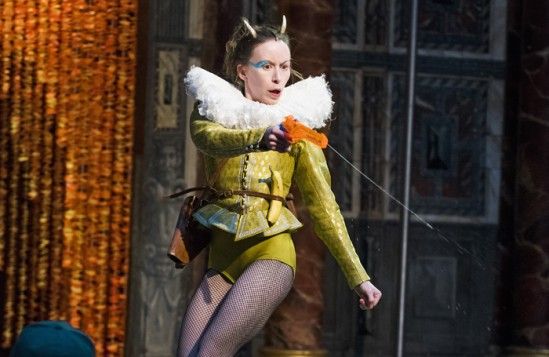
And so to the theatre. Readers may recall the film 'A Private Function' from thirty odd years ago, featuring a pig-napping of the sort which often appear in P.G. Wodehouse's Blandings novels. The film has particular resonance with this blog because the screenplay was written by one of our heroes, the thankfully still very much alive Alan Bennett; because much of it was filmed in Ilkley, the epicentre of wargaming in lower Wharfedale; and because the most sympathetic character, played by another of our heroes, the sadly no longer with us Richard Griffiths, is an accountant. I have now been to see the stage musical version, 'Betty Blue Eyes'.
I'm not really, despite what the lady in the kitchen shop may think, much of a fan of musical theatre, but I have to say that I enjoyed it enormously. In translation from the big screen to the stage and from comedy to musical some things have been added and some lost. It's a while since I have seen the film, but I don't recall dancing girls (and I mean full-on Moulin Rouge style dancing girls) appearing in anyone's front room, nor indeed cameo appearances from Princess Elizabeth and Prince Philip. And, spoiler alert, the fate of the pig has been, how shall we say, made more suitable for family audiences. But it all hurtles along nicely, there are still references to Lady Macbeth for the the intellectually inclined and fart jokes for everyone else, and the cast gave it their all.
Star of the show is the animatronic pig - how could it be otherwise - which is better behaved than one assumes a real one would be. Indeed there are stories of Dame Maggie Smith being chased round a kitchen by one of those used in the film. The pretend pig followed the script perfectly until right at the end when, after taking its bow, it suddenly careered into the scenery and knocked one of its ears off. They should have stuck to that old showbiz rule: never work with children or radio-controlled animals.
Wednesday, 6 July 2016
Tuesday, 5 July 2016
Pot58pouri
There's still no painting action chez Epictetus. The new movement trays etc got finished and put away and then so did all the modelling stuff. Perhaps my interest will pick up again when the weather isn't so good. That's a little joke for the benefit of our British readers, although it does give me an excuse to include this clip as a little tribute:
Anyway, hobby stuff has basically been the Seven Years War campaign and a bit of boardgaming. In the former, I am concerned that the Austrians may already have peaked with their rather lucky victory in the Battle of Aussig being followed by all commanders moving when asked. It has to be all downhill from here. Boardgaming for the last two weeks has taken place against a background of constant and unprecedented discussion about politics. Our Monday night group is attended on and off by Americans from the nearby 'secret' military base and it is interesting, if disheartening, to hear their views on it all. I'm not sure which is worse, their lack of understanding of the world outside the US, or their lack of awareness of the way the rest of the world regards the US. And these are people who have not only travelled abroad, but spend all day every day listening to our phone calls. Frightening.
In other news a low level of cultural intake continues. I went to see Bob Fox, folk singer and original Songman in the National Theatre production of War Horse, an evening which also featured short sets from Yan Tan Tether and Jon Palmer, the latter of whom I also saw with his band in the Junction Inn, a pub referenced in his song 'Another Friday Night in a Northern Town'.
In the cinema I saw last season's version of the 'Merchant of Venice' from the Globe plus 'Love & Friendship', the not very widely released film based on Jane Austen's epistolary novella 'Lady Susan'. They were both very funny in parts, with Tom Bennett (now there's a proper Jane Austen name) stealing the second as the clueless Sir James Martin.
Anyway, hobby stuff has basically been the Seven Years War campaign and a bit of boardgaming. In the former, I am concerned that the Austrians may already have peaked with their rather lucky victory in the Battle of Aussig being followed by all commanders moving when asked. It has to be all downhill from here. Boardgaming for the last two weeks has taken place against a background of constant and unprecedented discussion about politics. Our Monday night group is attended on and off by Americans from the nearby 'secret' military base and it is interesting, if disheartening, to hear their views on it all. I'm not sure which is worse, their lack of understanding of the world outside the US, or their lack of awareness of the way the rest of the world regards the US. And these are people who have not only travelled abroad, but spend all day every day listening to our phone calls. Frightening.
In other news a low level of cultural intake continues. I went to see Bob Fox, folk singer and original Songman in the National Theatre production of War Horse, an evening which also featured short sets from Yan Tan Tether and Jon Palmer, the latter of whom I also saw with his band in the Junction Inn, a pub referenced in his song 'Another Friday Night in a Northern Town'.
In the cinema I saw last season's version of the 'Merchant of Venice' from the Globe plus 'Love & Friendship', the not very widely released film based on Jane Austen's epistolary novella 'Lady Susan'. They were both very funny in parts, with Tom Bennett (now there's a proper Jane Austen name) stealing the second as the clueless Sir James Martin.
Monday, 4 July 2016
In which my eyes are opened by a cosmic encounter
It's boardgame round up time. Hooray!
Champions of Midgard: A bit like Lords of Waterdeep, but with a more intrusive fantasy theme, which, perhaps inevitably, made no sense at all. I lucked into a win, but I'm not sure how.
Codenames: The only problem with this otherwise excellent game remains the potential for a lack of shared frame of reference between the two parts of one's team. The young people of today appear to have no knowledge of the names of fielding positions in cricket. Extraordinary.
Cosmic Encounter: The group of people I played with on this occasion, newcomers to the Leeds gaming group, obviously played the game regularly and now I understand how it should be played properly. I'd always enjoyed it previously, but this was much better. Eye-opening.
Escape from the Aliens in Outer Space: I really want to like this more, but it's a great mechanic - albeit that it's just Battleships tweaked a bit - in search of a balanced game. In fact it's almost, but not quite, a hidden identity game worth playing.
Knit Wit: I did not like this at all. Creativity under pressure is really not my thing. For the record it has nothing whatever to do with knitting, a subject with which thanks to the big, bouncy woman I am increasingly familiar.
Marrakech: I love this game. Who would think a game about rug selling could give so many opportunities to stiff one's opponents?
The Networks: I'm not entirely sure about this game about running a TV network. There wasn't a great deal of player interaction and the silly names of the shows and stars were more fun than the gameplay.
No Thanks!: A fun push-your-luck filler, simple to grasp and difficult to win. Recommended.
One Night Revolution: A mixture of One Night Werewolf and Resistance results in rubbish squared.
Puerto Rico: Morally ambiguous worker placement game (who exactly are these workers that I'm recruiting to my plantation and why are they represented by brown pieces?), but a good game nevertheless. It's a close relative of San Juan which I also enjoyed and which is quicker.
The Pursuit of Happiness: A fun game about living a full life, but much of the amusement comes from playing the theme and not the rules. The way to win is surely to become an ascetic and eschew not only relationships, but also a job. Strangely enough hobbies are a quite sensible route to success.
Skull: There is nothing more to be said. A great game which makes you see people in a very different light.
Thebes: A game of competitive archaeology, a theme which seems to have inspired quite a few games. This one is spoiled by one seemingly minor mechanic, the drawing of unearthed treasures from a bag. This brings so much luck into things that the only strategic advice I could give is to make sure that you draw good tiles.
Codenames: The only problem with this otherwise excellent game remains the potential for a lack of shared frame of reference between the two parts of one's team. The young people of today appear to have no knowledge of the names of fielding positions in cricket. Extraordinary.
Cosmic Encounter: The group of people I played with on this occasion, newcomers to the Leeds gaming group, obviously played the game regularly and now I understand how it should be played properly. I'd always enjoyed it previously, but this was much better. Eye-opening.
Escape from the Aliens in Outer Space: I really want to like this more, but it's a great mechanic - albeit that it's just Battleships tweaked a bit - in search of a balanced game. In fact it's almost, but not quite, a hidden identity game worth playing.
Knit Wit: I did not like this at all. Creativity under pressure is really not my thing. For the record it has nothing whatever to do with knitting, a subject with which thanks to the big, bouncy woman I am increasingly familiar.
Marrakech: I love this game. Who would think a game about rug selling could give so many opportunities to stiff one's opponents?
The Networks: I'm not entirely sure about this game about running a TV network. There wasn't a great deal of player interaction and the silly names of the shows and stars were more fun than the gameplay.
No Thanks!: A fun push-your-luck filler, simple to grasp and difficult to win. Recommended.
One Night Revolution: A mixture of One Night Werewolf and Resistance results in rubbish squared.
Puerto Rico: Morally ambiguous worker placement game (who exactly are these workers that I'm recruiting to my plantation and why are they represented by brown pieces?), but a good game nevertheless. It's a close relative of San Juan which I also enjoyed and which is quicker.
The Pursuit of Happiness: A fun game about living a full life, but much of the amusement comes from playing the theme and not the rules. The way to win is surely to become an ascetic and eschew not only relationships, but also a job. Strangely enough hobbies are a quite sensible route to success.
Skull: There is nothing more to be said. A great game which makes you see people in a very different light.
Thebes: A game of competitive archaeology, a theme which seems to have inspired quite a few games. This one is spoiled by one seemingly minor mechanic, the drawing of unearthed treasures from a bag. This brings so much luck into things that the only strategic advice I could give is to make sure that you draw good tiles.
Sunday, 3 July 2016
The road to Marston Moor
The whole country would have been as affected by the English Civil War as by the Great War; fighting was widespread and the death toll was proportionately higher than in either world war. Otley's part was somewhat minor. Parliamentarian troops marched through en route to Marston Moor and it is reliably documented that Cromwell held a conference with his commanders in an orchard in the nearby village of Menston. More apocryphally, these passing troops are supposed to have drunk the Black Bull - oldest of Otley's many pubs - dry. This may not be true, but it's firmly rooted in the local popular consciousness, mostly because there's a large plaque on the side of the pub facing the market square which makes the claim to everyone who walks by.
To mark the anniversary of the battle - July 2nd - the English Civil War Society visited the town to commemorate all aspects of the events of 1644. I only witnessed their attempt at the drinking task through the window as I walked up to the Yew Tree to see the Max Band (excellent, with the highlight being a cracking run through 'Born To Be Wild'), but there they were, in period costume and giving it their best shot.
I did, however, go to see their drill demonstration and display of the sort of skirmish that may have taken place in the run up to the battle. I'll let the pictures speak for themselves, but for lovers of loud bangs and the smell of gunpowder it was a cracking afternoon out.
We already know that this blog's readership contains those with a taste for women dressed in male military attire - shame on you - and there was much that would have held your interest; a significant proportion of the combat troops involved were women. Look closely at the photos and you'll see what I mean.
To mark the anniversary of the battle - July 2nd - the English Civil War Society visited the town to commemorate all aspects of the events of 1644. I only witnessed their attempt at the drinking task through the window as I walked up to the Yew Tree to see the Max Band (excellent, with the highlight being a cracking run through 'Born To Be Wild'), but there they were, in period costume and giving it their best shot.
I did, however, go to see their drill demonstration and display of the sort of skirmish that may have taken place in the run up to the battle. I'll let the pictures speak for themselves, but for lovers of loud bangs and the smell of gunpowder it was a cracking afternoon out.
We already know that this blog's readership contains those with a taste for women dressed in male military attire - shame on you - and there was much that would have held your interest; a significant proportion of the combat troops involved were women. Look closely at the photos and you'll see what I mean.
Saturday, 2 July 2016
Over the Top
And so to the theatre. The centenary of the Great War and of the Somme in particular has been marked by two plays on the stages of Leeds. First up was 'Leeds Pals' which looked at the local volunteers who volunteered together in the first weeks and months of the war and served together in July 1916. This piece was put together specifically for the anniversary and was generally well received with reviews marking it out as a tear jerker. However, I must say that I felt it had a large number of flaws which prevented any real emotional engagement. Firstly they focussed in on two individuals (spoiler alert - one survives, one doesn't), thereby ignoring the real story which was the heavy levels of casualties concentrated on small communities because of the flawed concept of 'Pals Battalions'. Secondly they framed it with story of one Tommy's great grandson's service in Afghanistan which simply diluted the whole thing further. The power of the collective memory of the First World War comes about largely because anyone whose family lived in the UK one hundred years ago has a close connection with those events and probably knows about it and, at least in outline, the part which their relatives played. Afghanistan, and I have no intention of minimising the personal tragedies of those who suffered physically and/or psychologically there, does not have the same resonance. I don't know or know of anyone who served there; since seeing the play I have asked around and haven't found anyone with any personal connection at all to that conflict. Joining the army in the autumn of 1914 was a response to a mixture of existential threat, peer pressure, emotional blackmail and god knows what else. Joining the army in the twenty first century is a career choice. It didn't work dramatically to conflate the two.
Far better was 'Barnbow Canaries' at the West Yorkshire Playhouse, which told the story of an explosion at a munitions factory in Leeds which killed 35 people and was hushed up at the time. The canaries tag was a reference both to the TNT poisoning which slowly turned the women yellow, and to their expendability both during the war, and afterwards when the men returned and took back their jobs. It's probably impossible to write about the First World War without using at least some cliches; the skill of the playwright is best shown in which ones they select and the context in which they place them. Because this is a play about women we get the girl giving herself to the boyfriend leaving for the front, we get resigned spinsterhood given the shortage of men and we get stiff upper lips as the telegrams arrive, all of which succeed where, for example, the pompous posh boy officer from a mine-owning family in command of the 'Leeds Pals' fails. 'Barnbow Canaries' is on for a while longer yet; see if it you can, but beware, this one will bring a tear to your eye.
Thursday, 30 June 2016
Charles of Lorraine comes good
There are many reasons why I would have been a terrible general, most prominently my complete unsuitability - both physical and psychological - for being a soldier in the first place. The specific failing that translates most directly to wargaming is my problem with visualising things; my brain simply doesn't work in a way to allow me to readily see things that aren't currently in front of me. This manifests itself in a variety of ways; for example you should see me struggle to assemble slopes and hills out my Hexon terrain. Over the last two weeks, in the Battle of Aussig, it caused me to fail to recognise that my artillery (that's my remaining artillery, having lost one gun immediately we started) was already ideally sited, and thus to wander it about the battlefield to no effect. In the end James - the not entirely neutral umpire - pointed out where I was going wrong, the guns came into action and the game was over shortly thereafter. For the record this in no way implies that I have reconsidered my opinion about the overall quality of James' advice and I shall forthwith revert to my normal practice of ignoring him completely.
I was actually going to win anyway. It had been a good game, really showing off the strengths of the Piquet system. At the beginning of the evening the Austrians looked like the only possible winners, and then a combination of initiative and luck of the cards swung things back to the Prussians before, just when they were close to an upset, things reverted and the Austrians finally triumphed. My initial set up wasn't so good and my tactics may have been dodgy, but I did get one thing right. Knowing that I had a huge superiority in morale chips, I challenged pretty much every time I caused a stand loss and chewed up enough of the Prussians morale to prevent them from rallying back UI when it really mattered.
This was the first encounter of the campaign and I at least am still getting used to the impact of the campaign rules on the tabletop game. Some aspects were clear, for example there were no cavalry melees as both sides kept an eye on the post battle pursuit phase. Others came more into focus as the endgame approached. The balance between firing early (and therefore inflicting stand losses which will influence the campaign) and not (being loaded and able to opportunity fire is important in Piquet) is nuanced, and one of those judgement calls that it will be very easy to get wrong. I thought that the final stage - the restriction on withdrawing until reaching zero morale and then the option to do so thereafter - worked OK, although I think it perhaps needs more constraint on when it can be triggered.
So, a rare victory for Charles and we move on to turn three.
I was actually going to win anyway. It had been a good game, really showing off the strengths of the Piquet system. At the beginning of the evening the Austrians looked like the only possible winners, and then a combination of initiative and luck of the cards swung things back to the Prussians before, just when they were close to an upset, things reverted and the Austrians finally triumphed. My initial set up wasn't so good and my tactics may have been dodgy, but I did get one thing right. Knowing that I had a huge superiority in morale chips, I challenged pretty much every time I caused a stand loss and chewed up enough of the Prussians morale to prevent them from rallying back UI when it really mattered.
This was the first encounter of the campaign and I at least am still getting used to the impact of the campaign rules on the tabletop game. Some aspects were clear, for example there were no cavalry melees as both sides kept an eye on the post battle pursuit phase. Others came more into focus as the endgame approached. The balance between firing early (and therefore inflicting stand losses which will influence the campaign) and not (being loaded and able to opportunity fire is important in Piquet) is nuanced, and one of those judgement calls that it will be very easy to get wrong. I thought that the final stage - the restriction on withdrawing until reaching zero morale and then the option to do so thereafter - worked OK, although I think it perhaps needs more constraint on when it can be triggered.
So, a rare victory for Charles and we move on to turn three.
Friday, 24 June 2016
Bugger
“The best argument against democracy is a five-minute conversation with the average voter.”
- Winston Churchill
Well I won't be the only person to quote Churchill this morning. One of the difficulties for everyone - even they aren't racist simpletons like fifty percent of the population apparently are - is wading through the various forecasts and deciding which may prove accurate. The one that at the moment seems most likely to me to come true is this from FT journalist Simon Kuper: "In 20 years, impoverished Britons will be smuggled into France in the back of lorries to pick strawberries". I always interpreted Thatcher's aim to be to create a low skill, low wage economy in the UK. Her successors appear to be determined to add 'no jobs' to that list.
Anyway, I started with a quote so let me finish with one:
"Young people, today would be a great day to pay a visit to your grandparents, and give them a fucking slap." - Dan Rebellato
Thursday, 23 June 2016
Wargaming again
Strange day. I voted of course, and got bitten on my leg by something unidentified (but presumably an insect) leading to a lot of blood and a large swelling. On top of which the country I live in may be only hours away from being taken over in a coup by an unholy alliance of the ignorant and the sinister. I shall therefore talk about wargaming.
We returned to the table for the first time in some weeks and it was just as if we had never been away: no one could remember the rules, there was endless debate about what constitutes a flank (or its modern hi-tech equivalent, the beaten zone), and Peter rolled a lot of ones. I won't go into detail about the game because you can read about it here on James' blog. But points to note would be:
- It only occurred to me shortly before the game that I had never played the Austrians before and, in particular, had no idea how to use grenzers. Following the first night's play I have plenty of ideas about how not to use them.
- Successful battlefield selection and blind deployment are not intuitive. I like the system, but am under no illusions that I'm any good at it.
- Ditto for the whole campaign system really. As the Austrians I think one has to be both cautious because one's generals often end up doing nothing, and also opportunistic on the odd occasions when the Prussian generals do the same.
- The thing that really pissed me off was when I foolishly moved a limbered gun, and invited opportunity fire which destroyed it for the second time in quick succession.
- The thing that really made me laugh was when Peter managed to fail Major Morale despite only having lost one unit.
Wednesday, 22 June 2016
Sand
Tuesday, 21 June 2016
Old campaigner
"One of the things I learned in the military is sometimes you don't know what mistakes you make for a long time." - Wesley Clark
I managed to blog every day when it was physically impossible so to do because I couldn't charge the laptop. As soon as the new charger arrives I go down with a virus and miss a day. During my very brief absence my order from Warbases arrived and, as predicted, the paintbrushes came out and the new arrivals have been painted green. There as an error in the order - the first time this has ever happened to me when ordering from them - but they have promised to immediately dispatch the correct stuff and told me to keep the incorrect. So once again excellent customer service from Warbases, who I would highly recommend. The mistake related to some stuff for the Great War project, which will hopefully now kick back into gear.
Also upon rising from my sickbed I note that the Seven Years War campaign is about to kick off again. Unlike General Clark we realised our mistakes pretty promptly and are going to have another try. I appreciate that approach won't work in the real world, but after all this is only a game. I shall write about this campaign in due course - James outlines it here - but there have been others; James seems sensibly enough to be working through the periods he collects.
Many years ago now James ran a multi-sided campaign using his Italian Wars collection. I was the Pope, but had little chance to do anything beyond declare myself a Warrior Pope (which actually gave quite a significant benefit) and ally with the Spanish before I had to go to abroad on an assignment. From memory the campaign was fought to a conclusion, but I seem also to remember the consensus was that it went on a bit. James and Peter fought a crusades campaign which is detailed on James blog, which seems to have been very successful, but I wasn't involved so I can't tell you what made it work so well; probably not all the silly names that James invented and that you have to wade through to find out what happened. Then there was the Punic Wars campaign of a couple of years ago. That was also rather extended - a bit of a theme developing here - and in the end was a dead-heat and decided on the tie-break included in the board game used for the strategic rules. The big unresolved issue for me was the translation of the outcome of battles back to the strategic level. I always felt that one was actually handicapped by managing to engineer an encounter where one heavily outnumbered the enemy, where all logic suggested that the opposite should be true. Once again write ups of this campaign are on James blog.
Now, readers of James' blog may believe, based on the steady stream of WWII western desert postings, that we fought Operation Crusader as a campaign . But no. Shane Warne famously said that Monty Panesar hadn't so much played fifty test matches as played the same test match fifty times. We didn't so much refight Cunningham's whole action as plough through Sidi Rezegh fifty times. Wikipedia quotes someone as saying that Sidi Rezegh is 'the forgotten battle of the western desert'. Not in Ilkley it isn't. Anyway, I hope that in due course we perhaps have a crack at the whole thing.
I managed to blog every day when it was physically impossible so to do because I couldn't charge the laptop. As soon as the new charger arrives I go down with a virus and miss a day. During my very brief absence my order from Warbases arrived and, as predicted, the paintbrushes came out and the new arrivals have been painted green. There as an error in the order - the first time this has ever happened to me when ordering from them - but they have promised to immediately dispatch the correct stuff and told me to keep the incorrect. So once again excellent customer service from Warbases, who I would highly recommend. The mistake related to some stuff for the Great War project, which will hopefully now kick back into gear.
Also upon rising from my sickbed I note that the Seven Years War campaign is about to kick off again. Unlike General Clark we realised our mistakes pretty promptly and are going to have another try. I appreciate that approach won't work in the real world, but after all this is only a game. I shall write about this campaign in due course - James outlines it here - but there have been others; James seems sensibly enough to be working through the periods he collects.
Many years ago now James ran a multi-sided campaign using his Italian Wars collection. I was the Pope, but had little chance to do anything beyond declare myself a Warrior Pope (which actually gave quite a significant benefit) and ally with the Spanish before I had to go to abroad on an assignment. From memory the campaign was fought to a conclusion, but I seem also to remember the consensus was that it went on a bit. James and Peter fought a crusades campaign which is detailed on James blog, which seems to have been very successful, but I wasn't involved so I can't tell you what made it work so well; probably not all the silly names that James invented and that you have to wade through to find out what happened. Then there was the Punic Wars campaign of a couple of years ago. That was also rather extended - a bit of a theme developing here - and in the end was a dead-heat and decided on the tie-break included in the board game used for the strategic rules. The big unresolved issue for me was the translation of the outcome of battles back to the strategic level. I always felt that one was actually handicapped by managing to engineer an encounter where one heavily outnumbered the enemy, where all logic suggested that the opposite should be true. Once again write ups of this campaign are on James blog.
Now, readers of James' blog may believe, based on the steady stream of WWII western desert postings, that we fought Operation Crusader as a campaign . But no. Shane Warne famously said that Monty Panesar hadn't so much played fifty test matches as played the same test match fifty times. We didn't so much refight Cunningham's whole action as plough through Sidi Rezegh fifty times. Wikipedia quotes someone as saying that Sidi Rezegh is 'the forgotten battle of the western desert'. Not in Ilkley it isn't. Anyway, I hope that in due course we perhaps have a crack at the whole thing.
Sunday, 19 June 2016
Oh yes it was
Another example of paramilitary inspired drumming in garage rock:
Saturday, 18 June 2016
An intense period of not wargaming
Sometimes, as we all know, one's mojo doesn't work, even in someone as mojolicious as Epictetus. And so it has been with painting and modelling - there has been none. I can feel the start of faint stirrings and so perhaps it won't be long before I begin again, especially if 2016 continues to be another year with no summer.
There has however been a certain amount of pottering about in the annexe. Since buying the hex terrain we have played C&C Napoleonics games on a 'proper' size board which either looked a bit lost in the middle of the wargaming table or didn't fit comfortably on the dining table. What I really want to do is to use the full space available, which implies four times the area for which the rules are designed. After a certain amount of humming and hawing I have come to the obvious conclusion that in order to know what rule changes might be necessary to cope with this increase is to play a few games with the rules as is and then see what doesn't work. So I have been playing around with converting C&C scenarios to the larger space, immediately running into a couple of issues. I chose to double the force size thereby allowing more manouevre room and tacitly acknowledging the fact that I don't actually have enough figures to increase them any more. Then it became apparent that I didn't have enough of the bases that I use for marking unit type and strength, nor of the cavalry size sabot bases. An order has been immediately dispatched to Warbases. I suspect that on the arrival of the order it will be painting and varnishing those pieces of mdf that is the trigger for moving forwards the nearly complete more complicated stuff that's been sitting there for a few weeks untouched and unloved. I also need some more trees, which I think will be the main purchase at Derby in a few months, and more artillery, about which I am going to do nothing.
Those of you that read James' blog may have noticed a campaign starting, being written about and then disappearing. This deserves its own post and one will follow shortly, laptop charger and nazis allowing.
There has however been a certain amount of pottering about in the annexe. Since buying the hex terrain we have played C&C Napoleonics games on a 'proper' size board which either looked a bit lost in the middle of the wargaming table or didn't fit comfortably on the dining table. What I really want to do is to use the full space available, which implies four times the area for which the rules are designed. After a certain amount of humming and hawing I have come to the obvious conclusion that in order to know what rule changes might be necessary to cope with this increase is to play a few games with the rules as is and then see what doesn't work. So I have been playing around with converting C&C scenarios to the larger space, immediately running into a couple of issues. I chose to double the force size thereby allowing more manouevre room and tacitly acknowledging the fact that I don't actually have enough figures to increase them any more. Then it became apparent that I didn't have enough of the bases that I use for marking unit type and strength, nor of the cavalry size sabot bases. An order has been immediately dispatched to Warbases. I suspect that on the arrival of the order it will be painting and varnishing those pieces of mdf that is the trigger for moving forwards the nearly complete more complicated stuff that's been sitting there for a few weeks untouched and unloved. I also need some more trees, which I think will be the main purchase at Derby in a few months, and more artillery, about which I am going to do nothing.
Those of you that read James' blog may have noticed a campaign starting, being written about and then disappearing. This deserves its own post and one will follow shortly, laptop charger and nazis allowing.
Friday, 17 June 2016
Morn came and went and came, and brought no day
"Darkness cannot drive out darkness; only light can do that. Hate cannot drive out hate; only love can do that."
- Martin Luther King Jr.
Thursday, 16 June 2016
Pot57pouri
I have still not received the new laptop charger ordered some weeks ago, indeed it has not yet been dispatched. I am therefore unable to post to this blog on a daily basis as I would wish. This delay is the fault of - and this is the honest truth - Elkie Brooks. I know that is going to upset her greatest fan and quondam blog reader, but I have to say it as I see it. Ms Brooks is playing the Royal Hall in Harrogate later this year and I think I might have to get myself along there and take her to task about this charger business. In the meantime various other things have occurred.
Somewhat unexpectedly, even to me, I have been on a stadium tour of White Hart Lane. The place does have vague connections - via Harry Hotspur - with things that I am actually interested in, like medieval history and Shakespeare, and I have actually been there before on numerous previous occasions as a spectator. Indeed I have very fond memories of a game against Ipswich (Spurs 5 Ipswich 3) where Carl and I happened to meet two visiting Rhodesian nurses keen to be shown the sights of London. Their country of origin is an indication of exactly how long ago it all was - living in the past, moi? Anyway, I enjoyed the tour more than I thought I would and was rather surprised at a couple of things, notably how small the dressing rooms were and how uncomfortable the chairs in the directors box. I was impressed by the medals won by the incomparable Dave Mackay during the double season of 1960-61 and, to a much lesser extent, by the hideous monstrosity that is the Costa del Sol Cup, a trophy whose size is in inverse proportion to the number of people who have ever heard of it.
I assume that everyone has, like me, been expecting 3D printed figures to become available to wargamers for some time now. I have only just become aware that they are already here (and reviewed here).That link is to the 1/72 page, but there are others, and by the nature of their design and manufacture they are of course easily scalable. They are ridiculously expensive to the point of being completely unaffordable, but what a brave new world that has such figures in it.
Anyway, in tomorrow's non-daily post there will be some non-wargaming news. Stay tuned.
![]() |
| "Where's them nurses at?" |
I assume that everyone has, like me, been expecting 3D printed figures to become available to wargamers for some time now. I have only just become aware that they are already here (and reviewed here).That link is to the 1/72 page, but there are others, and by the nature of their design and manufacture they are of course easily scalable. They are ridiculously expensive to the point of being completely unaffordable, but what a brave new world that has such figures in it.
Anyway, in tomorrow's non-daily post there will be some non-wargaming news. Stay tuned.
Wednesday, 15 June 2016
No one is alone
"Life does not cease to be funny when people die any more than it ceases to be serious when people laugh." - George Bernard Shaw
And so to the theatre. I have been to see the West Yorkshire Playhouse/Opera North joint production of Stephen Sondheim' 'Into the Woods'. The story - an intertwining and extension of several fairy tales - is structured around the quest of a baker to remove a curse. I am an fairly regular baker myself; being not only a lover of cakes and biscuits but also allergic to milk, I find it simpler to make my own. I have just made some rather fine Cranberry and Cardamom Cookies, perhaps a little heavy handed on the spice, but delicious nonetheless. My lengthy conversation with the lady who runs the local cookshop as to the best implements for extracting the cardamom seeds from the pods and then grinding them, left her even more convinced than ever that I am the gayest man in Otley.
I think that it was fair to say that I wasn't the gayest man in the theatre last night. I haven't seen so much outness and pride since Barry Humphries came to town on his farewell tour. The previous evening many of the same people would have taken part in the vigil held in solidarity with those affected by the appalling events in Orlando; hundreds attended as the LGBT area of Leeds in Lower Briggate was closed to traffic. But I always think that while there is a place for specific organised events in these circumstances, that ultimately the best response to those seeking to intimidate us is to carry on our normal daily lives as we always intended to do. And if that involves a love of musical theatre, then so be it.
Notwithstanding recently being made into a film by Disney, 'Into The Woods' is a serious and complex work with a number of themes running through it along with a rich vein of humour. On another occasion I might have pondered much on the focus on bad parenting, on which I consider myself something of a self-taught expert. But right now its important messages are surely these: accept who we are and other people for who they are, be careful of the consequences of going into the woods with no clear idea of where the path will take you (are you listening Blair and Bush?), and that it is only by standing together that we can defeat the giant. The show (which, be warned, is very long) comes in two parts: the fairy tale endings we all know and then what happens next. As Orson Welles said "If you want a happy ending, that depends, of course, on where you stop your story".
The production itself was glorious, with top notch singing and music courtesy of the chorus and orchestra of Opera North. The puppetry was a particular highlight, with the Giantess being genuinely frightening despite the mechanics behind it being clearly visible. The staging - making full use of the layout and technical capabilities of the WYP - was also noteworthy. The opening set was a primary school classroom and the characters' journeys into the woods were portrayed as the school trip from hell. Let's hope this isn't an omen for the big, bouncy woman next week.
And so to the theatre. I have been to see the West Yorkshire Playhouse/Opera North joint production of Stephen Sondheim' 'Into the Woods'. The story - an intertwining and extension of several fairy tales - is structured around the quest of a baker to remove a curse. I am an fairly regular baker myself; being not only a lover of cakes and biscuits but also allergic to milk, I find it simpler to make my own. I have just made some rather fine Cranberry and Cardamom Cookies, perhaps a little heavy handed on the spice, but delicious nonetheless. My lengthy conversation with the lady who runs the local cookshop as to the best implements for extracting the cardamom seeds from the pods and then grinding them, left her even more convinced than ever that I am the gayest man in Otley.
I think that it was fair to say that I wasn't the gayest man in the theatre last night. I haven't seen so much outness and pride since Barry Humphries came to town on his farewell tour. The previous evening many of the same people would have taken part in the vigil held in solidarity with those affected by the appalling events in Orlando; hundreds attended as the LGBT area of Leeds in Lower Briggate was closed to traffic. But I always think that while there is a place for specific organised events in these circumstances, that ultimately the best response to those seeking to intimidate us is to carry on our normal daily lives as we always intended to do. And if that involves a love of musical theatre, then so be it.
Notwithstanding recently being made into a film by Disney, 'Into The Woods' is a serious and complex work with a number of themes running through it along with a rich vein of humour. On another occasion I might have pondered much on the focus on bad parenting, on which I consider myself something of a self-taught expert. But right now its important messages are surely these: accept who we are and other people for who they are, be careful of the consequences of going into the woods with no clear idea of where the path will take you (are you listening Blair and Bush?), and that it is only by standing together that we can defeat the giant. The show (which, be warned, is very long) comes in two parts: the fairy tale endings we all know and then what happens next. As Orson Welles said "If you want a happy ending, that depends, of course, on where you stop your story".
The production itself was glorious, with top notch singing and music courtesy of the chorus and orchestra of Opera North. The puppetry was a particular highlight, with the Giantess being genuinely frightening despite the mechanics behind it being clearly visible. The staging - making full use of the layout and technical capabilities of the WYP - was also noteworthy. The opening set was a primary school classroom and the characters' journeys into the woods were portrayed as the school trip from hell. Let's hope this isn't an omen for the big, bouncy woman next week.
Labels:
big bouncy woman,
cake,
opera,
Otley,
quotations,
Sondheim,
theatre
Tuesday, 14 June 2016
What a wonderful night for a moondance
I have been to see Van Morrison, who was simply fantastic, as he was always going to be because he is, after all, Van Morrison. There was a very jazzy vibe to the evening, with the man himself looking like George Melly's less flamboyant younger brother. As with Leonard Cohen he sensibly surrounds himself with first rate musicians, although his bandleading style seems somewhat more like that of James Brown; I wouldn't like to cross him.
I must mention the opening act, the New York Brass Band who were great fun in the style of the Hot 8 Brass Band so beloved of Craig Charles. The rumour is that Sir Van agreed to their supporting him because he believed them to be from Harlem. In fact the name signifies that they are from York and haven't been going very long. Morrison was, let's be blunt, as miserable as sin. But the same behaviour that in Eric Clapton a couple of years ago came across as rudeness and contempt for his audience, somehow seemed just acceptable idiosyncrasy here. It was glorious concert and I'd happily put up with the great man's indifference in return for the sound of his voice every time.
We were treated to many highlights from a great career: Moondance, Brown Eyed Girl, Bright Side of the Road, Whenever God Shines His Light etc. It was all most excellent. Astral Weeks is without doubt my favourite album; a phrase and concept that really date me. Whilst mostly a mystical album - once again we are speaking of Van Morrison here - it is also in part about the Belfast of his childhood. But what really for me has always set Morrision in his time and place is the paramilitary drumming on his 1964 garage rock standard Gloria. If ever there was a song designed for long extended versions it is this one, and it got it here as the last number/encore.
I for one have played Gloria, very badly, in several garages. My favourite non-Morrison version is probably that by Eddie and the Hot Rods, which appeared on their Live at the Marquee EP along with 96 Tears, Satisfaction and Get Out Of Denver. I have a feeling that I might have posted this before, but what the hell - it's brilliant. Get those chairs out of here!
I must mention the opening act, the New York Brass Band who were great fun in the style of the Hot 8 Brass Band so beloved of Craig Charles. The rumour is that Sir Van agreed to their supporting him because he believed them to be from Harlem. In fact the name signifies that they are from York and haven't been going very long. Morrison was, let's be blunt, as miserable as sin. But the same behaviour that in Eric Clapton a couple of years ago came across as rudeness and contempt for his audience, somehow seemed just acceptable idiosyncrasy here. It was glorious concert and I'd happily put up with the great man's indifference in return for the sound of his voice every time.
We were treated to many highlights from a great career: Moondance, Brown Eyed Girl, Bright Side of the Road, Whenever God Shines His Light etc. It was all most excellent. Astral Weeks is without doubt my favourite album; a phrase and concept that really date me. Whilst mostly a mystical album - once again we are speaking of Van Morrison here - it is also in part about the Belfast of his childhood. But what really for me has always set Morrision in his time and place is the paramilitary drumming on his 1964 garage rock standard Gloria. If ever there was a song designed for long extended versions it is this one, and it got it here as the last number/encore.
I for one have played Gloria, very badly, in several garages. My favourite non-Morrison version is probably that by Eddie and the Hot Rods, which appeared on their Live at the Marquee EP along with 96 Tears, Satisfaction and Get Out Of Denver. I have a feeling that I might have posted this before, but what the hell - it's brilliant. Get those chairs out of here!
Monday, 13 June 2016
I came along, just to bring you this song
I've been to see Rod Clements, once of Lindisfarne and Jack The Lad performing an acoustic set accompanied only by Ian Thomson on double bass. Clements originally left Lindisfarne while I was still at school and the forming and reforming of these groups is a mystery probably even to the members themselves. I can confidently say that he wasn't a member when I saw them a couple of years ago, although I believe he is now. Thomson is, I think, their current bass player, but whether he was then is another matter.
Clements has a great track record. As well as writing 'Meet Me On The Corner' he has worked with the likes of Bert Jansch, Ralph McTell (he played on 'Streets of London') and, more recently, Thea Gilmore and Nigel Stonier, artists much admired by this blog. Indeed Nick Hall, a local singer/songwriter featured fairly regularly in these pages, was in the audience and was deep in conversation with Clements after the gig.
As well as both Lindisfarne and Jack The Lad numbers, they performed a couple of Jansch's songs, Ledbelly's 'Bourgeois Blues' and, more unexpectedly, the theme from Barry Norman's film review TV programmes which the more elderly among you may remember. He encored with an instrumental version of 'The In Crowd' as originally made famous by Dobie Gray. An eclectic mix therefore, which showed off his guitar virtuosity and demonstrated that you don't have to be a brilliant vocalist to entertain a crowd if you have guitar virtuosity to fall back on.
Clements has a great track record. As well as writing 'Meet Me On The Corner' he has worked with the likes of Bert Jansch, Ralph McTell (he played on 'Streets of London') and, more recently, Thea Gilmore and Nigel Stonier, artists much admired by this blog. Indeed Nick Hall, a local singer/songwriter featured fairly regularly in these pages, was in the audience and was deep in conversation with Clements after the gig.
As well as both Lindisfarne and Jack The Lad numbers, they performed a couple of Jansch's songs, Ledbelly's 'Bourgeois Blues' and, more unexpectedly, the theme from Barry Norman's film review TV programmes which the more elderly among you may remember. He encored with an instrumental version of 'The In Crowd' as originally made famous by Dobie Gray. An eclectic mix therefore, which showed off his guitar virtuosity and demonstrated that you don't have to be a brilliant vocalist to entertain a crowd if you have guitar virtuosity to fall back on.
Labels:
blues,
folk music,
gigs,
Lindisfarne,
Thea Gilmore
Sunday, 12 June 2016
We cannot fight for love, as men may do
And so to the theatre. It was Shakespeare's Globe for my second Midsummer Night's Dream in a few weeks. This production featured many of the tropes familiar to anyone who has been to Bankside: music, dancing, humour, the noise helicopters flying along the river, and freezing cold weather whatever the time of year. The production has been controversial, but I thought it was perfectly OK.
One of the changes introduced was that Helena became Helenus and a gay/bi subtext introduced. However, other than a joke when Snug warns the ladies "and you gays" not to be frightened because he (or in this case she) is not a real lion, the characters' gender was no more relevant than their ethnicity. More relevant was the decision to make Puck female, as the character often seems to be these days, because her performance was accompanied by a series of pelvic thrusts that would have been somewhat less acceptable if made by a man.
The mechanicals were portrayed as the staff of the Globe - which made for some amusing interaction with the audience before the play proper started - and I rather liked Starveling appearing in the final act as a fully suited astronaut, being, as she pointed out, the man on the moon rather than the man in the moon. I wasn't so bothered about the breakdancing of Pyramus; from my perch in the upper gallery it didn't look terribly proficient.
Anyway, all in all I had a good time, and I continue to very much enjoy the Globe despite the low temperatures that seem to be booked in for my visits.
One of the changes introduced was that Helena became Helenus and a gay/bi subtext introduced. However, other than a joke when Snug warns the ladies "and you gays" not to be frightened because he (or in this case she) is not a real lion, the characters' gender was no more relevant than their ethnicity. More relevant was the decision to make Puck female, as the character often seems to be these days, because her performance was accompanied by a series of pelvic thrusts that would have been somewhat less acceptable if made by a man.
The mechanicals were portrayed as the staff of the Globe - which made for some amusing interaction with the audience before the play proper started - and I rather liked Starveling appearing in the final act as a fully suited astronaut, being, as she pointed out, the man on the moon rather than the man in the moon. I wasn't so bothered about the breakdancing of Pyramus; from my perch in the upper gallery it didn't look terribly proficient.
Anyway, all in all I had a good time, and I continue to very much enjoy the Globe despite the low temperatures that seem to be booked in for my visits.
Saturday, 11 June 2016
The Hokey-Cokey
Readers may have wondered why Epictetus has not yet vouchsafed his opinion on this EU referendum malarkey. Well, partly it is of course because his computer doesn't work. But it is also partly because he can't get too excited about this once in a lifetime event as he has already in his lifetime voted in just such a referendum. For the record on that occasion I voted to leave, which was at the time official Labour Party policy; not to be confused with the official Labour government policy which was to stay in. Aren't you nostalgic for the days when the ruling party used to be completely split on such things?
Others have not been reticent in putting forward their views. Our Luxembourg correspondent has a keen interest in all this, having lived there for so long that he has lost his vote and must now be counted as Johnny Foreigner himself. He has just disseminated to our mutual acquaintances one input from a prestigious trade association which he describes as the clinching argument. Who is to say that he isn't right?
Anyway, back to your bloggist. I shall be voting on this occasion to remain, essentially because I am intelligent and well-educated. This country is splitting itself into two moieties: those who can't read without moving their lips, and those who are somewhat more sophisticated; one doesn't really have a choice as to where one belongs. I shall not address the issues in any depth or attempt to convince anyone of the error of their ways. I am content to simply stand by and mock the presumptuousness of the intellectually limited. If it transpires that the morons do in fact form the majority within the UK then who among us will really be surprised? The mouth breathers are on the march all across the world. I limit myself to the observation that pandering to the prejudices of simpletons may possibly not be the best way to develop public policy.
Others have not been reticent in putting forward their views. Our Luxembourg correspondent has a keen interest in all this, having lived there for so long that he has lost his vote and must now be counted as Johnny Foreigner himself. He has just disseminated to our mutual acquaintances one input from a prestigious trade association which he describes as the clinching argument. Who is to say that he isn't right?
Anyway, back to your bloggist. I shall be voting on this occasion to remain, essentially because I am intelligent and well-educated. This country is splitting itself into two moieties: those who can't read without moving their lips, and those who are somewhat more sophisticated; one doesn't really have a choice as to where one belongs. I shall not address the issues in any depth or attempt to convince anyone of the error of their ways. I am content to simply stand by and mock the presumptuousness of the intellectually limited. If it transpires that the morons do in fact form the majority within the UK then who among us will really be surprised? The mouth breathers are on the march all across the world. I limit myself to the observation that pandering to the prejudices of simpletons may possibly not be the best way to develop public policy.
Friday, 10 June 2016
Proverbs Chapter 19 Verse 21
"There are many devices in a man's heart; nevertheless the counsel of the Lord, that shall stand."
I do indeed have many devices, but it would appear that the counsel of the Lord is that the one most suited for writing blog posts should remain hors de combat for the time being at least. In the meantime there has been no wargaming anyway including no painting at all - for a variety of real life related reasons such as birthdays, exams and scorchio - although other activities have continued apace. Prepare yourselves for much cultural related reportage when technology allows. Indeed, prepare yourself for some wargaming related reportage as well because a Seven Years War campaign is scheduled for kick-off next week. The much delayed try of the latest C&C Napoleonics has been, well, delayed. In other printable news, I have made a rhubarb crumble loaf cake that is a triumph even if I say so myself, and also quite painfully burnt my arm. In other unprintable news, a good time has been had by all.
Tuesday, 7 June 2016
Life isn't like in the movies
Once upon a time, a king gave a feast. And there came the most beautiful princesses of the realm. Now, a soldier, who was standing guard, saw the king's daughter go by. She was the most beautiful one, and he immediately fell in love with her. But what could a poor soldier do when it came to the daughter of the king? Well, finally, one day, he managed to meet her, and he told her that he could no longer live without her. The princess was so impressed by his strong feelings that she said to the soldier: "If you can wait 100 days and 100 nights under my balcony, then at the end of it, I shall be yours." Damn! The soldier immediately went there and waited one day. And two days. And ten. And then twenty. And every evening, the princess looked out of her window, but he never moved. During rain, during wind, during snow, he was always there. The bird shat on his head, and the bees stung him, but he didn't budge. After ninety nights, he had become all dried up, all white, and the tears streamed from his eyes. He couldn't hold them back. He no longer had the strength to sleep. All that time, the princess watched him. And on the 99th night, the soldier stood up, took his chair, and went away.
Thursday, 2 June 2016
Flat battery
In yet another electrical malfunction at Casa Epictetus sparks and smoke have been seen coming from my laptop's charger. Posts will therefore be a bit intermittent until a new one arrives. What better than to use one of these scarce events to write one of those lists of boardgames that no one ever reads? What better indeed?
A Fake Artist Goes To New York: Dear, oh dear oh dear. A co-operative/ hidden role drawing game that makes no sense at all.
Agricola: This was nothing like as complex as I had assumed. I enjoyed it, but can't see why people get obsessed with it.
Barony: I'd never heard of this, which at least avoids preconceptions. It's a worker placement game that enables one to attack other people; sounds good to me. I'd play it again.
Codenames: Deservedly nominated for the Spiel des Jahres award.
Condottiere: As seems to be the way with this game it was won by a first time player. Possibly the strategy isn't as deep as I'd been telling myself. It's still a good game though.
Deus: Slightly complicated complicated worker placement, engine building, set collection, area control, you-name-it game not at all about Roman gods (and even less about only one god as the title seems to promise). I enjoyed it.
Eminent Domain: A pleasant enough deck-builder based in outer space. I'm rather proud to say that I won easily by purely peaceful means.
Greedy Greedy Goblins: Rubbish.
Imperial Settlers: This isn't a bad game although, like others in this list (Deus, Eminent Domain for example), it's very difficult to see what other people are up to.
Inhabit the Earth: Having played this for a second time my original good opinion was reinforced.
Jane Austen's Matchmaker: Theme is often wafer thin in published board, card or dice games. Indeed, knowing anything about the nominal subject can actually often be a handicap, and at best - e.g. in games such as Quartermaster General - it enhances the enjoyment without helping one in game play. This card game based on the characters of Jane Austen fell into that category for me. It doesn't require one to have read the books (although obviously I have). What the game is really about is the seduction of virtuous women by disreputable men. However a lifetime's experience proved not to be sufficient and I didn't win.
Karuba: I rather like this. It's surprising how differently people can use exactly the same resources to attempt to achieve exactly the same objectives. Also shortlisted for this year's Spiele des Jahres.
King of Tokyo: This divides opinion. I take the view that as long as one concentrates solely on biffing the other monsters then it's good enough fun.
No Thanks!: An entertaining push-your-luck game that has suddenly hit the table a few times this month. The best strategy seems to be not to have bad luck.
Notre Dame: This is a return on investment type game with very little player interaction. It passed the time OK, but is a bit simplistic for the accountants among us; and yes, that is a euphemism for me winning without much difficulty.
The Prodigals Club: A development/refinement of Last Will that improves on the original by making players balance two objectives simultaneously. It's also much friendlier to the colour blind. I rather liked it. It has various modules so should be repeatedly replayable.
Red7: A fine filler
Skull: Ditto
Splendor: A really good game, an essentially abstract mix of engine building and set collection.
Stone Age: This is one of those games - Agricola above would be another - that others are surprised to find that one hasn't yet played. Well now I have, and it is a good game. I seemed to be alone at the table in finding it odd that the stone age tribes in the game have access to gold, but that's obviously just another of my thematic hangups.
Sushi Go!: Speaking of themes, we decided to have a Japanese food based sequence of games. This one is passable and quick....
Wasabi!: ...and this one less so. There do seem to be a lot of exclamation marks involved in eating raw fish; actions available in this game include Chop!, Switch!, Spicy! and Stack!. I didn't care overmuch for this game.
A Fake Artist Goes To New York: Dear, oh dear oh dear. A co-operative/ hidden role drawing game that makes no sense at all.
Agricola: This was nothing like as complex as I had assumed. I enjoyed it, but can't see why people get obsessed with it.
Barony: I'd never heard of this, which at least avoids preconceptions. It's a worker placement game that enables one to attack other people; sounds good to me. I'd play it again.
Codenames: Deservedly nominated for the Spiel des Jahres award.
Condottiere: As seems to be the way with this game it was won by a first time player. Possibly the strategy isn't as deep as I'd been telling myself. It's still a good game though.
Deus: Slightly complicated complicated worker placement, engine building, set collection, area control, you-name-it game not at all about Roman gods (and even less about only one god as the title seems to promise). I enjoyed it.
Eminent Domain: A pleasant enough deck-builder based in outer space. I'm rather proud to say that I won easily by purely peaceful means.
Greedy Greedy Goblins: Rubbish.
Imperial Settlers: This isn't a bad game although, like others in this list (Deus, Eminent Domain for example), it's very difficult to see what other people are up to.
Inhabit the Earth: Having played this for a second time my original good opinion was reinforced.
Jane Austen's Matchmaker: Theme is often wafer thin in published board, card or dice games. Indeed, knowing anything about the nominal subject can actually often be a handicap, and at best - e.g. in games such as Quartermaster General - it enhances the enjoyment without helping one in game play. This card game based on the characters of Jane Austen fell into that category for me. It doesn't require one to have read the books (although obviously I have). What the game is really about is the seduction of virtuous women by disreputable men. However a lifetime's experience proved not to be sufficient and I didn't win.
Karuba: I rather like this. It's surprising how differently people can use exactly the same resources to attempt to achieve exactly the same objectives. Also shortlisted for this year's Spiele des Jahres.
King of Tokyo: This divides opinion. I take the view that as long as one concentrates solely on biffing the other monsters then it's good enough fun.
No Thanks!: An entertaining push-your-luck game that has suddenly hit the table a few times this month. The best strategy seems to be not to have bad luck.
Notre Dame: This is a return on investment type game with very little player interaction. It passed the time OK, but is a bit simplistic for the accountants among us; and yes, that is a euphemism for me winning without much difficulty.
The Prodigals Club: A development/refinement of Last Will that improves on the original by making players balance two objectives simultaneously. It's also much friendlier to the colour blind. I rather liked it. It has various modules so should be repeatedly replayable.
Red7: A fine filler
Skull: Ditto
Splendor: A really good game, an essentially abstract mix of engine building and set collection.
Stone Age: This is one of those games - Agricola above would be another - that others are surprised to find that one hasn't yet played. Well now I have, and it is a good game. I seemed to be alone at the table in finding it odd that the stone age tribes in the game have access to gold, but that's obviously just another of my thematic hangups.
Sushi Go!: Speaking of themes, we decided to have a Japanese food based sequence of games. This one is passable and quick....
Wasabi!: ...and this one less so. There do seem to be a lot of exclamation marks involved in eating raw fish; actions available in this game include Chop!, Switch!, Spicy! and Stack!. I didn't care overmuch for this game.
Saturday, 28 May 2016
I Guess A Man's Got To Do What He's Best At
A couple of posts ago I noted that I had some hot wargaming action to report on, but I can't for the life of me imagine to what I was referring, so we're back to music again. I have been to see Ian Siegal and Jimbo Mathus play some acoustic blues. I've seen the former before when he was backed by the Mississippi Mudbloods featuring the rather excellent Cody and Luther Dickinson, but not on that occasion Alvin Youngblood Hart. It was only three years ago or so but I don't seem to have written it up in this blog at the time. For the record: the band were excellent; I was accompanied by a rather delightful French lady that I used to knock about with (inexplicably only now making her first appearance in the blog); and the council/police closed the venue down almost immediately afterwards. It was through the Dickinson brothers that Siegal met Mathus, himself from Mississippi and a man with strong connections to the history of the blues. Indeed his childhood nanny was Rosetta Patton, daughter of Charley Patton, the man who taught Robert Johnson to play and Chester Burnett to sing. Siegal, who does a nice Howlin' Wolf type vocal tribute, comes from the deep south of Hampshire rather than the delta and tells the story of how the locals in the Mississippi hill country, having trouble pronouncing his first name, gave him a nickname based on his place of origin: 'Overseas' Siegal. Knowledge of the rest of the world has never been a strength among Americans in my experience.
Musically, they covered a wider range than strictly the blues, indeed they equalled Tom Russell's record of playing two songs referencing Pancho Villa in the lyrics; these being Russell's own 'Gallo del Cielo' and Steve Earle's 'Mercenary Song'. From the folk canon they gave us 'Casey Jones' and, of all things, 'Dirty Old Town'.
Friday, 27 May 2016
Thought for the day
"...most of all I'm scared of walking out of this room and never feeling
the rest of my whole life the way I feel when I'm with you." - Frances Houseman
Wednesday, 25 May 2016
Back on the Gambrelli case!
The late Burt Kwouk was of course too good an actor to be solely remembered for the Pink Panther films. Indeed he had previously acted alongside Epictetus' all time favourite film star. However, this blog has never been afraid of the obvious.
Sunday, 22 May 2016
Pot56pouri
I can't remember why I took up blogging in the first place, boredom presumably. Due to other boredom induced activities my life was disrupted somewhat shortly afterwards and writing the blog became a bit of vaguely creative light relief. It subsequently developed into a way of clandestinely communicating with an agent of mine currently operating undercover; I think the term is 'a sleeper'. Now it's turning into a vehicle for my OCD, whereby nothing can really have happened to me unless I include it here despite the fact that even I'm not terribly interested in hearing about it. Should I resist this? Obviously. Will I resist this? Obviously not. Therefore before we can crack on with anything else - and I have a bit of hot wargaming action to report on - I need to get all this stuff off my chest. Here goes:
Music: I have seen Nick B. Hall and the Resurrection Men (previously lauded here for their belting cover of Senor, Tales of Yankee Power), Dr Bob and the Bluesmakers (as excellent as ever; Maria was in fine voice) and The Jar Family. I went to the last of these on spec and, let's be honest, because the venue reduced the price to a fiver. However, I must report that they were bloody superb, to the extent that in a rush of blood I bought two of their CDs afterwards. They're on a UK tour and I urge anyone who gets a chance to see them to take it. They describe themselves as folk/blues/psych and to me were a melange of Dylan/Lindisfarne/Traffic. Top stuff.
Theatre: Or possibly music again. I saw 'Woody Sez', a play-with-music come music-with-a-bit-of-acting. It's about Woody Guthrie and the facts of his life can't help but make the thing poignant. I enjoyed it and so did the rest of the sadly small audience.
Days out: I have been to Fountains Abbey with the younger Miss Epictetus and the dog; and I have been to the Otley Show with the elder Miss Epictetus and the dog. The dog, far from being grateful, has left muddy paw prints all across my living room carpet. It will not be invited anywhere by me again. I avoided losing my #newnotnew camera at the Otley Show by the simple and foolproof method of not taking it with me. I am unable once again therefore to bring you photographs of the Young Farmers Ladies Tug-of-War competition, which will be disappointing for any among you who like voluptuous women getting a sweat on.
Music: I have seen Nick B. Hall and the Resurrection Men (previously lauded here for their belting cover of Senor, Tales of Yankee Power), Dr Bob and the Bluesmakers (as excellent as ever; Maria was in fine voice) and The Jar Family. I went to the last of these on spec and, let's be honest, because the venue reduced the price to a fiver. However, I must report that they were bloody superb, to the extent that in a rush of blood I bought two of their CDs afterwards. They're on a UK tour and I urge anyone who gets a chance to see them to take it. They describe themselves as folk/blues/psych and to me were a melange of Dylan/Lindisfarne/Traffic. Top stuff.
Theatre: Or possibly music again. I saw 'Woody Sez', a play-with-music come music-with-a-bit-of-acting. It's about Woody Guthrie and the facts of his life can't help but make the thing poignant. I enjoyed it and so did the rest of the sadly small audience.
Days out: I have been to Fountains Abbey with the younger Miss Epictetus and the dog; and I have been to the Otley Show with the elder Miss Epictetus and the dog. The dog, far from being grateful, has left muddy paw prints all across my living room carpet. It will not be invited anywhere by me again. I avoided losing my #newnotnew camera at the Otley Show by the simple and foolproof method of not taking it with me. I am unable once again therefore to bring you photographs of the Young Farmers Ladies Tug-of-War competition, which will be disappointing for any among you who like voluptuous women getting a sweat on.
Labels:
blues,
Dylan,
gigs,
Lindisfarne,
music,
Otley,
tug-of-war,
Woody Guthrie
Thursday, 19 May 2016
I knew Sidi Rezegh. Sidi Rezegh was a friend of mine. You're no Sidi Rezegh.
"Have no fear of perfection - you'll never reach it." - Salvador Dali
I have been avoidably absent from blogging, but not from wargaming. We have concluded a first playtest of Lobositz, the Seven Years War scenario that James intends to put on at Derby in October. I've helped him with a few such games over the last couple of years and he is very thorough in his preparation. If it was me I'd simply lay out the superbly painted figures and wonderful terrain, which, let's face it, are what wins the best-in-show accolades. (Obviously I am painfully well aware that if it were me then the figures wouldn't actually be superbly painted and the terrain wouldn't be wonderful either.) In particular, when refighting a historical battle James is keen to make it both accurate and a good game. These objectives wouldn't generally sit well together in the first place, but things are made even worse by his tendency to choose battles which involved one side making attacks that don't make any sense in hindsight. Playtesting is therefore quite a lot about figuring out how to constrain the tabletop commanders into repeating at least some of their real life predecessors' mistakes while setting victory conditions that give both sides a chance. The process can be, and often is, fun; just don't mention Sidi Rezegh.
How well this works can be judged by the fact that when playing Marignano at Derby last year we had to abandon things after the first day and restart because it wasn't going anywhere. And then there was Sidi Rezegh - which obviously we won't mention - where, after being playtested to death and beyond, a guest commander was recruited for the convention itself and his decisions turned out to be somewhat sub-optimal. So, with no great expectations on my part, we have been trying to engineer a game where Frederick the Great faces superior numbers, charges his cavalry against artillery and entrenched infantry, attacks with his own infantry through entirely unsuitable terrain against specialist light infantry, runs away himself when things start to get tough and yet somehow retains a chance of victory.
Anyway, I rather enjoyed it, despite not actually winning as such. The attack through the vineyards on the slope of the volcano caught my imagination for some reason and the swings of luck (usually) inherent in Piquet made even the Prussian cavalry charge less of a disaster than it looked likely to be at one point. I think the scenario revisions to be implemented following the post game debrief plus the tactical lessons learned will make it play better next time. I doubt anyone else will notice, but it looks good so they'll all be happy anyway. Which is probably as it should be.
How well this works can be judged by the fact that when playing Marignano at Derby last year we had to abandon things after the first day and restart because it wasn't going anywhere. And then there was Sidi Rezegh - which obviously we won't mention - where, after being playtested to death and beyond, a guest commander was recruited for the convention itself and his decisions turned out to be somewhat sub-optimal. So, with no great expectations on my part, we have been trying to engineer a game where Frederick the Great faces superior numbers, charges his cavalry against artillery and entrenched infantry, attacks with his own infantry through entirely unsuitable terrain against specialist light infantry, runs away himself when things start to get tough and yet somehow retains a chance of victory.
Anyway, I rather enjoyed it, despite not actually winning as such. The attack through the vineyards on the slope of the volcano caught my imagination for some reason and the swings of luck (usually) inherent in Piquet made even the Prussian cavalry charge less of a disaster than it looked likely to be at one point. I think the scenario revisions to be implemented following the post game debrief plus the tactical lessons learned will make it play better next time. I doubt anyone else will notice, but it looks good so they'll all be happy anyway. Which is probably as it should be.
Tuesday, 17 May 2016
Saturday, 14 May 2016
Friday, 13 May 2016
Idleness is the parent of psychology
"If you're old, don't try to change yourself, change your environment." - B.F. Skinner
If you're old, don't try to change yourself, change your environment.
B. F. Skinner
Read more at: http://www.brainyquote.com/quotes/quotes/b/bfskinne383895.html
If you're old, don't try to change yourself, change your environment.
B. F. Skinner
Read more at: http://www.brainyquote.com/quotes/quotes/b/bfskinne383895.html
I found the second act far more interesting than the first. I suspect that's because I knew far less about the experiments portrayed. Both Skinner and Milgram are on every managerial psychology course going, and believe me I've sat through a few of those. They made a big deal of the latter in particular, presumably with the hope of shocking the audience. But any feelings of surprise and disturbance that I once had have faded away through repeated exposure to the original studies and to having lived in the world as it is for so long; all of which is perhaps somewhat ironic. But the in the second part, there was much with which I am far less familiar - such as the work of Loftus on false memory and of Alexander on addiction - and so I found it more stimulating.
As a theatrical experience it was fairly ordinary. The cast rotated the parts without regard to age, sex or ethnicity (because there are those among you who have disgraced themselves previously by displaying an overfondness for woman in male military uniform I shall not mention that they all wore men's business suits), which worked well enough for the scientists, patients, participants in experiments and religious nutcases featured throughout, but less so for the rats, monkeys and sea slugs. So, a mixed bag, but it did draw my attention to Bruce Alexander's (admittedly disputed) theories on the links between addiction and societal fragmentation and inequality, which together with the work of Festinger are probably the most relevant to my life and how I live it of all the issues discussed in the play.
In other theatrical news I note that Northern Broadsides are to stage 'When We Are Married' in the autumn. J.B. Priestley is of course one of this blog's big heroes and I love this play because above all else it is very funny. Bazza has form in playing and directing the self important bourgeois so I am looking forward to this immensely. Lah-di-dah!
Tuesday, 10 May 2016
Why do I find it hard to write the next line?
"Power may be at the end of a gun, but sometimes it's also at the end of the shadow or the image of a gun." - Jean Genet
And so to the theatre. The big scorchio in Yorkshire is inevitably over and so indoor stuff is once more back on the agenda. Upon walking into the foyer I was confronted by a huge host of women of a certain age, glammed up to the eyeballs in spangly, tight-fitting clothes, drinking prosecco and obviously on a night out without their husbands. Clearly this scenario is neither unknown nor unwelcome to Epictetus; indeed groups of such ladies often congregate wherever he is to be found. ["Could it be," interrupts a Rhetorical Pedant "that it is in fact you who hang around them, uninvited and unwanted, like a bad smell?"] However, when one is destined for an evening of French absurdism in the form of Jean Genet's 'Les Bonnes', one's expectations of the audience are rather different.
![]() |
| A chap called Kemp who used to be in Eastenders |
It turned out that they were there to see Martin Kemp in the main house, a man with whom I am not very familiar, except to note that he is no relation to either Will Kempe, recently featured in this very blog, or to Ross Kemp. The relevance of the latter is that the last time that I had such an experience at the theatre was when I saw Kemp, R. give his Petruchio. I can well remember the looks of tattooed bafflement as the blank verse rolled out across the stalls. For the record, he wasn't bad at all.
![]() |
| A chap called Kemp who used to be in Eastenders |
Anyway, back in the studio theatre, two maids, sisters, were planning to murder their mistress, were acting out their fantasies or, just possibly, had already done it. I have to hedge my bets because it is not entirely clear what the hell is or is not going on. The company's fine physical theatre and excellent acting carried us along, but we were left to make up our own mind what Genet is saying. For myself, I remain as convinced as I was before that killing those who have power is probably the only way the rest of us are ever going to get our hands on it. Another audience member to whom I spoke astutely referenced Psycho (the play predates the film) and the company themselves cryptically refer to the paradox of being trapped by freedom. You pays your money and you takes your choice.
Sunday, 8 May 2016
Till the bluebells forget to bloom
There is excellent weather at the moment in Yorkshire, so everyone is outdoors seeing how red they can turn before the rain returns on Tuesday.
Saturday, 7 May 2016
Pot55pouri
Adventitious apricity has precluded blogging for a couple of days, although life has been full in many other ways. There hasn't been much painting and the only progress on the Great War project has been that the re-released British Heavy Weapons set is apparently on its way to me. It's accompanied by the also re-released Gallic Command, which due to some oversight doesn't seem to contain any chariots. It does however include druids, which has surely got to be a good thing despite me having no current use for them. Perhaps the Romans in Britain rip-off of Pony Wars could use a human sacrifice or two.
There has been some real life gaming, with the first night of Lobositz proving to be good fun and reasonably balanced. I like the varied terrain, with the vineyards on the lower slopes of the extinct volcano making for an interesting challenge for both sides. Like all of James' scenarios destined for conventions this one involves a mandatory attack that no commander in their right mind would make, with Frederick the Great here joining Rommel in the ranks of the guilty.
I have been to the Wharfedale Wool Fair, which was like a more fragrant version of a wargames convention, but with even more ridiculous prices being asked. According to the big, bouncy woman the Leeds Wool Fair features real alpacas, which sound a whole lot more fun.
Walking this week took me to the Pennines by way of a change. I took a picture showing the view from the foot of Lund's Tower on Earl Crag back across Lothersdale, with Ingleborough, Whernside and Pen-y-ghent in the far distance, but it wasn't very good so here's one of a random bit of moor instead.
You can just see Wainman's Pinnacle, the other of the Salt and Pepper Pots, towards the right of the picture.
There has been some real life gaming, with the first night of Lobositz proving to be good fun and reasonably balanced. I like the varied terrain, with the vineyards on the lower slopes of the extinct volcano making for an interesting challenge for both sides. Like all of James' scenarios destined for conventions this one involves a mandatory attack that no commander in their right mind would make, with Frederick the Great here joining Rommel in the ranks of the guilty.
I have been to the Wharfedale Wool Fair, which was like a more fragrant version of a wargames convention, but with even more ridiculous prices being asked. According to the big, bouncy woman the Leeds Wool Fair features real alpacas, which sound a whole lot more fun.
Walking this week took me to the Pennines by way of a change. I took a picture showing the view from the foot of Lund's Tower on Earl Crag back across Lothersdale, with Ingleborough, Whernside and Pen-y-ghent in the far distance, but it wasn't very good so here's one of a random bit of moor instead.
You can just see Wainman's Pinnacle, the other of the Salt and Pepper Pots, towards the right of the picture.
Wednesday, 4 May 2016
We are responsible for each other
And so to the theatre. I have been to see J.B. Priestley's brilliantly structured play about the interconnectedness of all members of society, 'An Inspector Calls', at the Alhambra in Bradford, surely the place to see it; we passed the large statue of the great man on the way to and from the theatre. Judging from the composition of the audience the play must be one of this year's GCSE set pieces. It was memories of it in the fifth form (or whatever they call it these days) that lured the elder Miss Epictetus into breaking her Shakespeare only rule; nothing could tempt the younger Miss Epictetus into breaking her 'I'm too cool to be seen with my dad' rule.
I suspect there is also a timely political imperative for this revival of this National Theatre production which was first put on in 1992. When I originally saw it many years ago it seemed an obvious riposte to the evils of Thatcherism; the fact that it was a play from the 1940s serving to highlight the backward looking nature of her pernicious philosophy. Fast forward to today and we find her disciples, born into a ruling class which the old bat herself could only envy from a distance, determined to take the UK even further back into the past; making the play's setting, 1912, even more relevant. Indeed, as others such as the legendary Keith Flett have pointed out, Jeremy Hunt's creation of the dispute with junior doctors appears to signal a wish to return to the Master and Servant act of 1823. Priestley's message is as valid today as it always has been.
Tuesday, 3 May 2016
Measurable progress in a reasonable time
"Genius begins great works, labour alone finishes them." - Joseph Joubert
My bank holiday didn't work out as I had hoped, but that - and the terrible weather - freed up a bit of painting time. I have never been one of those who are so far on top of what they have painted that they can report the monthly aggregates in detail (1). I equally admire those who paint to such a fixed schedule that they can announce to the world that they have finished, even those such as James whose self-congratulatory blog posting about completion of a project is immediately followed by another containing details of what else they are planning to buy for that self same project. I myself prefer the approach favoured by the British general staff over the years: I prepare to refight the last war. Having packed away the Romans and Celts, and bearing in mind that they are unlikely to see the light of day for quite some time, I have nevertheless interrupted the WWI production line to do some more Roman dismounted leaders, some casualty markers and another unit of legionaries. However, just to prove that there has been a little bit of progress and also as a terrain try out, here are some German infantry moving across broken ground:
Notice how the homemade hex has been cunningly painted to blend invisibly with the Kallistra stuff. I've now done perhaps two thirds of the requirements for the first scenario in the Lardies' book. I've also made a 7.6cm minenwerfer, which sadly isn't needed, but haven't done the machine gun that is. As I say, I've always admired those who can paint to a plan. The Maxim will feature after the Roman interlude along with a few more German riflemen, a section of British rifle grenadiers and some gaming aids.
There have also been a couple of comments regarding the WWI strongpoint featured here recently, with 'Caveadsum' suggesting it all looked a bit phallic. Thankfully Crumb has a purer mind and merely observed that the type of thing shown in the picture was much more to her taste than crap chariots; no doubt she was referring to the paint job.
(1) For the record, the reason I can list the boardgames that I play every month is that boardgamegeek does all the work for me. For the record I've played a couple of absolute stinkers already this month.
Monday, 2 May 2016
Told by an idiot
And so to the theatre. I have been to see Macbeth, one of the many Shakespeare productions popping up all over the place to commemorate the fact that he's dead and has been for some time. There were a couple of nice directorial touches, the main parts were well acted and overall I enjoyed it.
Shakespeare wrote for the actors whom he had in the company and there is some logic in the part of the porter being played by the same actor as played Bottom in the recent Dream. Only some because while Kempe was almost certainly the original Bottom, he had been fired (possibly for repeatedly going off script) and had danced his way to Norwich by the time Macbeth was written. Shakespeare was on top form when writing the part of Bottom the Weaver, with inspiration for his target - actors' egos - presumably all around him. The porter in Macbeth is thin stuff however, and the same comic style that proved a success the other week simply came across as one-dimensional here. It was, oddly enough for a play set in Scotland, as if being from Northern England is supposed to be funny in itself; which, take my word for it, it isn't.
The witches stayed on stage pretty much all the way through, a device which I've seen before, but one which worked particularly well here. They were also in the auditorium prior to curtain up, which didn't work anything like as well. I felt rather sorry for the ushers who were constantly moving them on from where they were so that the punters who had booked those seats could sit down. I hope this isn't a developing trend; let's not have them pulling pre-performance pints in the bar as part of a future director's vision. On a more positive note, I did like the accentuated eroticism of the Macbeths' relationship.
Shakespeare wrote for the actors whom he had in the company and there is some logic in the part of the porter being played by the same actor as played Bottom in the recent Dream. Only some because while Kempe was almost certainly the original Bottom, he had been fired (possibly for repeatedly going off script) and had danced his way to Norwich by the time Macbeth was written. Shakespeare was on top form when writing the part of Bottom the Weaver, with inspiration for his target - actors' egos - presumably all around him. The porter in Macbeth is thin stuff however, and the same comic style that proved a success the other week simply came across as one-dimensional here. It was, oddly enough for a play set in Scotland, as if being from Northern England is supposed to be funny in itself; which, take my word for it, it isn't.
Sunday, 1 May 2016
Chestnuts in blossom
"If one oversteps the bounds of moderation, the greatest pleasures cease to please." - Epictetus
6 nimmt!: Some people find it a bit random, but I don't mind that aspect so much.
Between Two Cities: Completely pointless game which takes far longer to score than it does to play.
Broom Service: Well it won an award so it must have something, but I'm stuffed if I could see what. It involves pre-programming like the previous award winner Colt Express, but where in that case it could be funny when your plans went awry, here it was just annoying.
Caylus: A complicated worker placement game that has been superseded by more recent, dare one say better, designs.
Code777: Do not play this very late at night when your brain isn't working.
Condottiere: As usual this proved very popular with those who hadn't played it before.
Epic Spell Wars of the Battle Wizards: Rumble at Castle Tentakill: What a terrible name, but it's actually quite an acceptable game. The theme is neither here nor there; it's an interesting combination of linked action and push your luck.
Ice Flow: As you know I like this game, but like it even better when I win, which I did in an astonishing comeback from nowhere. I certainly wasn't jaded with this one.
Jungle Speed: Snap. As in, this game is basically Snap.
K2: Another one that is always welcome. I think what this and Ice Flow have in common (apart from snow) is that the mechanics are unlike the standard worker placement/area control type Euro. They do have resource management, but it's deployed in an unusual manner.
Kingsburg: I thought this might have something to do with the Konigsberg Bridge Problem, but it doesn't. Shame. It's a dice game that is ultimately too random and too long.
Quadropolis: Sort of like Between Two Cities, only good.
Two Rooms and a Boom: Like all hidden role games one has to care; I don't. This one is a party game for children who are now old enough to go in pubs on their own.
Subscribe to:
Posts (Atom)