Monday, 12 April 2021

PotCIVpouri

 I had intended to carry on writing in yesterday's post, after the gratuitous smutty limerick, answering some questions that no one has yet asked. But the force was weak with me; perhaps because I am prostrated with grief. Which I suppose leads to the first question: what did you really think of HRH The People's Racist? I shall simply say that I respect and honour all those who fought against fascism, and leave it at that.

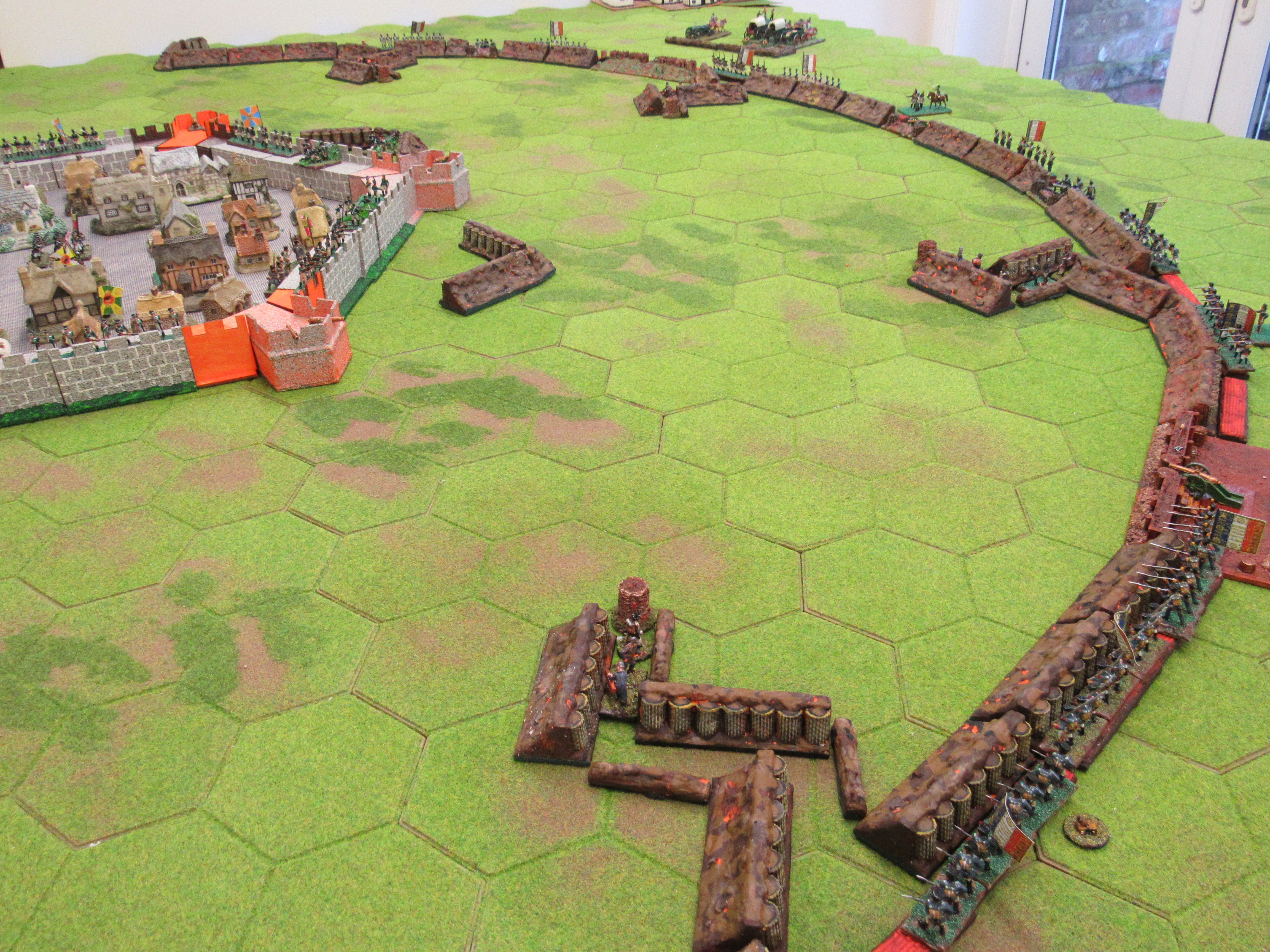
What I was going to write about yesterday was the other question not on anybody's lips: what's happening with the siege games? Well, I have been mulling it over and have decided that the way to make the game quicker is to put more forces on the table. There is some serious logic behind this counter-intuitive conclusion and will share it with you, dear readers, as soon as I set a new game up.


In the meantime, I have been making some more siege and fortress guns. These require more crew and this time I have gone for Kennington Miniatures (sold by SHQ of course), just by way of a change. 


It being April 12th I once again have access to the workshop in which I do much of all this stuff. That's the laser cutter shrouded in the orange cloth at the back. The red sheet in the foreground is some laminated acrylic, on which there will be more to report in due course I hope. Today's task is to use the heat gun to mould some Sturktur-Hartschaum. These are a tool and a material new to me, so either I shall return in triumph with photographs of a magnificent new addition to my Vauban fortress, or I shall burn my hands so badly that I shall never be able to type again.

Valete.

Sunday, 11 April 2021

PotCIIIPouri

 Well, here we are, April 11th, and there's a blizzard outside. On top of which the radio appears to have been hijacked by North Korea and is paying non-stop tribute to Kim Jong Phil, who has apparently left us at a tragically young age. 


Young people undertaking their Gold Award expedition

When I was last here it was for a book review. Trebian, over at Wargaming for Grown-ups, has now reviewed the same book, and it seems to have not gone down terribly well. I think our overall conclusions aren't that different - read the book, but make sure that it's someone else's copy - but for once I have been outintemperated (*). A suspiciously large part of his beef with the book seems to be that Dr Lewis hadn't read his (Graham Evans' aka Trebian's) book on Edgecote/Edgcote. I have read it and can confirm that it is a lot better than Dr Lewis' book, but if anyone genuinely thinks that 'Medieval Combat' is the worst book they've ever read then I can only suggest that they are not reading enough books.

According to obituaries that I have seen - not one of which, by the way, mentions the fact that he arranged the murder of Princess Diana - Baron Greenwich didn't have that problem, and in fact owned 11,000 books including many of poetry; so props to him. I am proud to say that this blog can exclusively reveal his favourite poem from among that large collection, one that befits both an old salt like him and this poignant moment in our nation's history:

There was a young sailor from Brighton
Who said to his girl "That's a tight one"
She exclaimed "Bless my soul
You're in the wrong hole
But there's plenty of room in the right one."


* This is definitely a word.


Monday, 5 April 2021

Medieval Military Combat

 I have been reading 'Medieval Military Combat' written by Tom Lewis and recently published by Casemate. In case you don't want to read any further, I'm going to give it 3 stars: not bad, worth a read, borrow rather than buy if you can.


The recently published military history that I have read all seems to have been lacking a proof reader. By way of a change, Dr Lewis could have done with an editor; someone to mould his arguments into a better structure and chop out all the repetition. He also needed someone to point out the weakness in claiming to be setting right widely held misconceptions about a quite niche subject, namely that a lot of those interested and motivated enough to read the book won't actually have those misconceptions in the first place. So, he comes to the conclusion that there weren't as many combatants or casualties at Towton as the chroniclers of the time said. Indeed. And he reveals that a fully harnessed man at arms could probably only have fought for about ten or fifteen minutes at a time because it was such hard work. Quite so.

Anyway, that aside, he is quite clear on the direction from which he approaches things. Although an  academic he is not a historian, but rather had a career in the Australian armed forces (he finds room to tell us on several occasions that he served in Iraq), has lots of experience of relevant(ish) fighting techniques such as fencing and riding, and has observed and interviewed re-enactors at length on the physical aspects of what they do. He has mashed all this together, read the secondary sources extensively - the bibliography is good - and with an added dash of Inherent Military Probability has laid down how he thinks it worked. It might be right, it might not, but it makes one think.

Despite the title, and subtitle come to that, this is mainly a book about the man at arms wearing plate armour and fighting on foot, and is none the worse for that. He believes it likely that they would have operated in a less formal version of the triplex acies used by the Romans during the Punic Wars, relieving each other in the front line turn and turn about, thus allowing them to fight for longer periods. It's certainly plausible, but he doesn't have anything specific to support it beyond the fact that it seems logical to him and, as he points out, the commanders would all have studied Vegetius. 

As I said at the top, it's worth a read.

Wednesday, 31 March 2021

The Souls of Old Men

I awoke this morning to find that, despite waiting patiently for all these years, I still have neither a bus pass nor a pension. But let's forget all the negatives and instead look forward to the good things that are yet to come:


Inside their worn, tattered bodies 
sit the souls of old men.
How unhappy the poor things are
and how bored by the pathetic life they live.
How they tremble for fear of losing that life, and how much
they love it, those befuddled and contradictory souls,
sitting - half comic and half tragic -
inside their old, threadbare skins.

                     - Constantine P. Cavafy


Sunday, 28 March 2021

Miss Lockharte's Letters

Book reviews on this blog are normally related to military history in some way; indeed as it happens there will be another Wars of the Roses related post along shortly. However, today I shall venture into a different genre and address this book, which is a Regency romance:


Now, I am very fond of Jane Austen, and can remember, when laid up with glandular fever many years ago, being grateful for my mother's Georgette Heyer collection to pass the time. But other than that, it's not exactly the sort of book that I would go for. I'm more of a hard-boiled, noir sort of chap. All the same, when this was recommended to me, with the insistence that I in particular needed to read it, I thought that I might as well give it a go.

The reason for the recommendation becomes obvious half way through chapter four. In the first three chapters we are introduced to our Heroine, the eponymous Miss Lockharte. In what I thought was a creative and amusing exposition it is explained why she has, through the ill luck and misfortune that so often seems to have befallen young ladies at that time, found herself in difficult circumstances; the very type of circumstances that cry out for her to be recued by a Hero. We meet this chap - it goes without saying that he is an aloof, saturnine, single, wealthy, peer of the realm - in chapter four, where it also becomes apparent that he has, perhaps inadvertently, played a part in bringing about our heroine's despair. He is rather unhappy when we first come across him, being under the cosh from the women in his life:  his mother, who wants him to marry, settle down and produce an heir; those debutantes having their 'come out' season and trying to trap him into marriage; his sister, who resents his refusal to accept her chosen beau; the mistress he is trying to get rid of. In fact he could literally have been any one of us in our youth, or, just possibly, some among us in the not too distant past. This similarity is something that becomes even more obvious when the author tells us:

"And all he wanted to do was play with his toy soldiers."

So, does all come right for our protagonists in the end? I think we all know the answer to that, but the journey to get there is entertaining enough. Are the toy soldiers pertinent to the plot? Astonishingly, they are.  I won't expand further on what happens, but there is one development that will strike a chill into many hearts: someone breaks in and steals some of his soldiers. I know, how evil is that?

Sunday, 21 March 2021

You Know The World Is In An Uproar

 Back before I got side tracked in to writing about wargaming and military history all the time, this blog was renowned as the home of female-fronted seventies blues-rock bands. Let's get back to basics with some Stone the Crows featuring, of course, Maggie Bell; this one's a Percy Mayfield song which sixty-odd years after being written somehow captures the zeitgeist:


Friday, 19 March 2021

Agincourt Diorama

I've mentioned the Royal Armouries talks a few times, including yesterday in fact now I come to think about it. They continue to be (mostly) excellent; my own favourite over recent months was the one on firearms forensic science. Anyway, this is not part of their normal lecture series, but next Thursday, the 25th March, at 17:00 GMT the Royal Armouries will be hosting an online discussion about the building of their splendid Agincourt diorama. The discussion will feature, amongst others, the Perry twins, whose figures those are. Booking details are here.


Because, under normal circumstances obviously, I visit the Royal Armouries several times a year I have perhaps become a tad blasé about the model, but it is very good. I do sometimes find myself standing there wishing it would move. It's a bit like one of those demonstration games at a show that manufacturers set up, but never actually play.


Thursday, 18 March 2021

The Castle in the War of the Roses

 In his - highly recommended - one volume history of the Wars of the Roses, John Gillingham writes "In the Wars of the Roses there were few sieges and only one of any consequence". Despite titling his book "The Castle in the Wars of the Roses", it is sieges with which Dan Spencer is primarily concerned. And, as seems to be the custom among academics, Dr Spencer does not agree with Professor Gillingham. According to him, he "demonstrates the significant role of siege warfare during the Wars of the Roses". So, which is it? For me, Spencer more than adequately shows that there were actually quite a lot of sieges; he names 36, and makes a persuasive case that there would have been others unrecorded by history. However, it's hard to believe that any of them really made a difference; indeed very few of them lasted beyond a few days. As will all writers on the period the author can only go on what records remain, so the book focuses on what we know about rather than what was necessarily important at the time. I would also suggest that there isn't quite enough material to make a full length book, and that there has been a certain amount of padding out with the general military and political background. Still, I enjoyed it and would recommend it to those with a particular interest in the subject, perhaps not so much to the general reader. 


Dr Spencer gave one of the talks in this winter's online lecture series from the Royal Armouries, on 'The Development of Gunpowder Weapons in Medieval England", which at the time of writing is still available on the Armouries' YouTube channel. (As an aside, if you do watch any of those lectures you need to know that nothing happens until fifteen minutes or so into the video; I have no idea why they don't edit them properly.) The things that stuck in my mind from the lecture - and which has great relevance to my ongoing siege gaming - is him saying that in the 15th century bombards would have to be placed no further than 40 paces from a wall to have a chance of creating a breach.


I can't finish without revisiting the Spofforth solecism. As reported previously, in chapter 1 this castle was incorrectly reported as being in Northumberland. However, in chapter 2 we find the Duke of Exeter and Lord Egremont raising forces in Yorkshire at a place called Spofford; Egremont of course being another of those hot-headed chaps in whom the Percy family specialised. He doesn't make it to chapter 3 - spoiler alert - having been killed at the battle of Northampton. However, he does variously feature in the text as both Egremont and Egremond. Do I detect an homage to Hergé from Dr Spencer?


"If my name's Egremont we won't get to chapter 3." "To be precise, we won't get to chapter 3 if my name's Egremond."


Friday, 12 March 2021

The Bombardment of London

 I am still reading, and enjoying, 'The Castle in the Wars of the Roses'. I shall do a full (or cursory - delete as appropriate) review in due course; watch out for more Spofforth related nit-picking. However in Chapter 5 we have reached the bombardment of London by the Bastard of Fauconberg.


A mere eight years ago I mentioned that I had been involved in a debate within the Richard III Society about which side the garrison of Calais had been during this event. It is often said that such discussions are all the more heated because there is so little at stake. I rather wish that had remained the case in the Society which has been riven by factionalism over the last year or so, leading to rather tragic events just before Christmas. Anyway, back to the book and to 1471; enter Dr Spencer with a different take on things. According to him, the Calais garrison - whom you will recall were the closest thing that England had to a standing army at that time - were with the Bastard. However, he also says that Richard Haute, appointed as Lieutenant of the Tower of London by Edward IV whilst he was in the city following his victory at Barnet, had recruited one hundred soldiers who had formerly served in the garrison. So, very neatly, they turn out to have served on both sides. If only all disputes could be resolved by compromise.


And six years ago, I declared my intention to create a scenario based on the bombardment. Perhaps now that I have a suitable amount of city walls, a castle and some siege rules which could be (heavily) adapted I should get on with it. I think part of the attraction is the surreal moment where Thomas Neville demands that the city opens its gates in the names of Prince Edward and the Earl of Warwick, the city fathers point out that those two are both dead now, and the Bastard in effect says "Don't bother me with details, just open the gates.".

Interestingly the next chapter in the book covers the siege of St Michael's Mount, another one I have always fancied doing. Maybe the blue table top in the annexe will see the light of day after all this time.

Thursday, 11 March 2021

Roll Muddy River

 I'm sure I'll be back to sieges soon enough, but in the meantime here's Norma Waterson covering the Grateful Dead. 


Wednesday, 10 March 2021

It Suffices

 I have been asked for my thoughts so far on 'Vauban's Wars'. Well, I don't like to sit on the fence, and so I am going to come right out and say that they seem "perfectly acceptable".


I shall certainly be exploring the rules further and am currently considering what I might make or paint next to facilitate this: a couple more siege guns for sure and, assuming that access to the laser cutter won't be long in resuming, some ravelines. Because, apart from anything else, I am grateful to these rules for keeping me occupied during lockdown and providing a route for me to try out resin casting. That context has undoubtedly provided a halo effect and made me feel warmer about them; on top of which, even if I say so myself, it all looked pretty good.

Nobody games sieges because...well, because they go on a long time and nothing much happens. So it is to the great credit of Eric Burgess that he has managed to develop a set of rules which extract the action from the tedium and, by moving things along fairly quickly, make it playable. Every turn represents a few days and the results of each are effectively a summation of all the digging, firing, moving about etc done during those days. Issues such as supplies of food and powder, weather, desertion, disease etc are dealt with, but at a level of abstraction that doesn't overwhelm everything else. It's a bit like a campaign fought out on a tabletop, a concept I'd never really thought about before; although if someone were to tell me that Donald Featherstone had written a book on the subject I wouldn't be that surprised.

 I enjoyed my solo run through, in which the balance between garrison and besieger tipped a few times backwards and forwards. The caveats mentioned in previous posts still apply, in particular this is all my interpretation of what is meant and how it should work. I believe that the author runs a Facebook group on the rules, but I don't have a Facebook account so that hasn't been of any help to me.

I do have one or two observations that I would be looking to confirm or otherwise in subsequent games:

  • The defender's role seems a bit reactive.
  • Many of the swings in fortune mentioned above stemmed from things other than the actions of either side; I like a random event as much as the next man, but you don't want the entire game determined by them.
  • The rules for sorties and assaults are limited and, while we never had either in my try out, my wargamer's common sense (shut up!) tells me they wouldn't work very well.
  • Some of the points and strengths ascribed to unit types - Coehorn mortars for example - look a bit odd. 
So, to sum up: passed the time perfectly pleasantly, and would seem likely to provide a sound base for the tweaks and house rules which will inevitably emerge in due course.

Monday, 8 March 2021

The Siege Is Lifted

 Those considerate chaps in Ahmedabad have once again gone out of their way to clear some space in my diary and so I have been able to bring the siege game to a conclusion. Turn 8 initially went the way of the besiegers, who won a long run of initiative, caused further damage to the wall and, to my surprise because I hadn't read the rules properly, set fire to the town. It was put out before it could either spread or do any damage.


It was never going to be enough in any event, and once the garrison got the chance to fire their artillery they quickly reduced their opponent's morale to zero and the latter were left with no choice but to withdraw.


You can just see in the photo above that the wall section being attacked had been reduced to level 5, which is still quite a long way from creating a breach. I shall be pondering the lessons learned from all this - apart obviously from "make sure that you thoroughly acquaint yourself with the rules before you start" - but my initial thought is that the besiegers should have spent more time on counterbattery fire from the second parallel before pressing further forwards. I have no suggestions as to how the defenders would best have reacted to that.


Sunday, 7 March 2021

Spofforth Castle

 I've started reading 'The Castle in the Wars of the Roses' by Dan Spencer which was published a few months ago. It's been well reviewed, and I shall no doubt bore you with my own opinions in due course. However, I was rather taken aback by an egregious geographical error in the very first chapter. Referring to the Percy Earls of Northumberland, he states that they owned a number of important castles in that county including Alnwick, Warkworth and Spofforth. Surely some mistake?


In fact, Spofforth Castle is, as any fule kno', situated between Harrogate and Wetherby in what in the 15th Century would have been the West Riding of Yorkshire. Indeed it may well be the nearest castle to where your bloggist sits typing this (*). It is of course very closely connected with the Percies, having been the seat of the family from the time that William de Percy came over with the Conqueror until the fourteenth century, when their power grew and they switched their attentions more to Northumberland and the Scottish Marches. 


Its importance to the family is indicated by the fact that Harry Hotspur, the famously impulsive Shakespearean character, was born there; unless he was born at either Alnwick or Warkworth, no one seems to know. It is also possible that Magna Carta was drafted there; but then perhaps it wasn't, once again no one really knows. The one thing I will say with absolute certainty though, is that Spofforth is not, and never has been, in the county of Northumberland (**).


* As readers will have realised long ago, this blog does not run to a team of fact checkers, and I can't be arsed to do it myself, so we shall never know. It is self-evidently nearer than Knaresborough, and intuitively closer than Skipton so I'm going to assume that it is. For the purposes of this exercise the Roman fort in Ilkley doesn't count, and nor, for obvious reasons, does Cliffe Castle. Ripley Castle would, but even as the crow flies that must be further away.

** Before the mid tenth century it would have been in the Kingdom of Northumbria, but that's different.


Thursday, 4 March 2021

Six then seven

 "And the seventh sorrow is the slow good-bye..." - Ted Hughes

Turn 6 ended before it started, with a tied dice roll. It cost the garrison one food supply, although I don't think that will come into play; feel free to throw that back in my face at some later stage. On the plus side, I found the missing card at that point. Overall turn 7 hasn't gone well for the besiegers, against whom the tide would appear to have turned.


While they were occupied repairing the sections of sap flooded by the torrential rain during Turn 5, they were driven off completely from the third parallel. Sensing an opportunity the garrison started to dig out from the covered way, aiming to seize and destroy the gun emplacements.


Before they could do so the besiegers managed to move up a couple of siege guns, surviving the opportunity fire as they did so, and, for the first time, bombarded the wall. It is, I suspect, too little too late.


The die next to the wall shows the cumulative hits against that section. When it reaches ten the section will drop from level six to level five. As you might guess it needs to reach level zero before there is a breach. It's not going to happen. The other die is showing the cumulative hits from the mortars which have been shelling the town. Once again, this isn't going to amount to anything worth talking about very soon.

Ignore what it says - it's really Turn 7

And this is why: the attackers have very little morale left. To add insult to injury one of their commanders has died of disease, meaning that they weren't able to rally any units this turn.

I've mentioned before that I'm not confident about my grasp of either rules or tactics - and that definitely still stands - but I have had a bit of an epiphany regarding the role of infantry in the game, which is progress of a sort.


Tuesday, 2 March 2021

Severe Rain

"Shortly afterwards it started raining, very innocently at first, but the sky was packed tight with cloud and gradually the drops grew bigger and heavier, until it was autumn’s dismal rain that was falling—rain that seemed to fill the entire world with its leaden beat..." - Haldor Laxness

Turn five was bookended by disaster. The first happened in real life when I knocked a whole load of stuff on to the floor. Anyone who has seen the wargaming annexe and the solidity of the table in it will be as baffled as I am as to how I managed it; my first thought was to be thankful that I did it at my house rather than someone else's. Anyway, no permanent harm was done, except that when I had picked it all up one of the cards was missing. Again, especially given the size of the room, it's a mystery as to where it might have gone. Still it will turn up, and the pack came complete with blank cards; presumably to allow for clumsy players.

After that, things proceeded smoothly, although not in the way that I expected. Instead of the besiegers moving up their siege guns and battering down the wall, it was the fortress guns which forced the retreat of both artillery and infantry from the third parallel. I'm not going to go through things in detail, but I will repeat my previous caveats: it's certainly not a good game to play solo, and it's at least possible that I'm not doing it right anyway. 


The turn ended abruptly when it started to rain very heavily; so heavily in fact that some of the siege works have flooded. Now, the players get some choice as to where the flooding occurs, but my decisions were done in the context that I hadn't (still haven't actually) read the rules for repairing them.


So what I've tried to do is to isolate the gun emplacements so as to further delay the commencement of the bombardment of the walls. 


Saturday, 27 February 2021

Turn the Fourth

 After making the observation that it wasn't much like the usual sort of Piquet game, it went out of its way to prove that it was. The besiegers got all the initiative and turned all their Sapping cards, rolling a whole bunch of 3s on their siege dice. They have reached the glacis before the garrison got a chance to make any raids this turn.


This is important because raids can't be made on besiegers once they get that close. After that the defenders have to rely on...well actually, I am struggling a bit to see what they can do after that point.


They tried a sap of their own to see if they could outflank the attackers. They couldn't, although the fortress guns did damage a heavy gun and force its withdrawal from this emplacement.


However, there are others ready to move up.


And there are mortars shelling the town.


This is the position at the end of the turn. Much of this information would be secret and would be the basis of the espionage element to the game.


Friday, 26 February 2021

The ditch is dear to the drunken man

 Following the untimely end to the cricket in Ahmedabad I have turned once again to the siege. 


I have rearranged the glacis, narrowed the covered way and put a ditch where I said a few days ago that no ditch would be.

Monday, 22 February 2021

So where does that leave us?

 I've been searching through reports of Johnson's statement, but can't find any specific mentions of playing with toy soldiers. We need to find a proxy. Do you think it's more like going to the gym, or more like going to the zoo?


Friday, 19 February 2021

Natty Rebel

 Ignore the picture, this certainly isn't Don Van Vliet; instead, it is the late Ewart Beckford at his best:


Thursday, 18 February 2021

Once More "Once More..."

 The second attempt at 'Vauban's Wars' was delayed slightly because, as I'm very pleased to be able to report, I have had a sore arm for a couple of days. In the interim I have received a parcel from Kallistra. I don't think that I had ever bought anything through the post from them before, having previously collected all my orders at shows, but it was as prompt and efficient as you would expect. The new arrivals were some half-hexes, enabling the glacis to take on a more regular form.


The photo reflects the end of the third turn, although turn two ended on a tied initiative dice roll and was very short. As you can see, the besiegers have developed a stretch of the second parallel and moved a siege gun forwards, albeit still too far away to breach the walls. The 'siege die' mechanism for sapping seems to work, although in a classic example of sod's law three of the first four rolls came up zero. The besiegers have lost half of their sappers to trench raids - by contrast, the garrison kept rolling 11 on a D12 - and may need to start using infantry as substitutes soon. Raiders also destroyed a gun emplacement, otherwise there would be two siege guns in the parallel.


I'm still not entirely sure that I'm doing it right, but it looks OK.

Tuesday, 16 February 2021

Siege Die

 It wasn't only the set-up that affected the way that the first run through went. I also indulged in a bit of false logic along the way. Like most wargames rules 'Vauban's Wars' use inches; like most people living in the twenty first century I use centimetres. The rules say that sappers can dig 6" of sap/trench per turn of the card; the saps which I made are 10 cm long. I decided that laying one length each time would be equivalent, because by adding the width of the zag to the length of the zig one came back to roughly the same thing. As I say, false logic.


The rules call for what they refer to as a 'Siege Die', a D6 with faces showing 0,1,1,2,2,3. They are used in mining and countermining (which I have excluded from my simple playtest) and when the garrison repairs the walls (which I got nowhere near in my first run through). Obviously, being a wargamer of many years standing, I have some of these dice to hand, so I intend to use them to address the above irritation. Sappers will roll the 'Siege Die' and build that many sections. You will note that the expected value is 1.5, thereby turning 10 cm into 6".

I think there is another possible benefit from this change. I found the facts that sappers would always build the same amount each time the Sapping card is revealed, and also that one is essentially guaranteed to be able to play all one's Sapping cards every turn, was not really to my taste. I prefer a bit more uncertainty in a game, and while the luck of the dice will average out in the long run (*), in the short run it will provide a bit of friction and give both the besieger and the garrison some hints as to where they might wish to direct their effort.

* Cue snorts of derision from many readers.


Monday, 15 February 2021

Once More Into The Breach (Assuming We Get That Far)

 It's time for another go at the new siege rules. One conclusion from the first run through was that the initial set-up had the two sides too far apart. I placed the first parallel at the advised distance from the walls, but the defenders need to be further forward of the walls and in greater numbers than the way I had arranged things.


I have therefore introduced a glacis, counterscarp and covered way. The last of those is - as I discovered - essential for moving troops from within the town to opposite wherever the attackers place their guns as they get closer.


I've still kept it relatively simple; there is no ditch and no ravelines. Apart from anything else I am keen to give the siege guns sight of the walls, as I never got as far as bombarding them last time.


Speaking of siege guns, the besiegers have a fourth (i.e. I have made a fourth) and have lost three infantry units to compensate. Plus, of course, both sides' artillery crews have arrived.


Sunday, 14 February 2021

Bosworth 1485

"He said, ‘Give me my battle-axe in my hand,
Set the crown of England on my head so high!
For by Him that shope both sea and land,
King of England this day will I die!"

- from The Ballad of Bosworth Field


I own some half a dozen books about Bosworth, so obviously I was in need of another. As luck would have it Osprey have just published one. It is Bosworth 1485, number 360 in their Campaign series and is written by Christopher Gravett and illustrated by Graham Turner, and not to be confused with Campaign series number 66, entitled Bosworth 1485, written by Christopher Gravett and illustrated by Graham Turner. Of course, a lot has been uncovered since their first attempt was issued, not least the location both of the battlefield and of the loser.


Astonishingly, I don't own the original version so I can't be specific about the changes in either test or pictures, except to point out that the subtitle has changed from 'Last Charge of the Plantagenets' to 'The Downfall of Richard III'. I have been teasing away at that switch, all the time clutching my copy of 'L'écriture et la différence', and must conclude that I have no idea what we are meant to understand by it.


Jacques Derrida deconstructs the bowling

The book - the one on Bosworth not the one on structuralism - starts rather poorly. In the first paragraph following the introduction the author makes the bizarre claim that John of Gaunt was Edward III's eldest son. It might, I suppose, be interesting to speculate what difference it might have made to 14th and 15th century English history if he had have been. As Derrida used to say while opening the batting for the École normale supérieure: "Posed in these terms, the question would already be caught in the assurance of a certain fore-knowledge: can “what has always been conceived and signified under that name” be considered fundamentally homogeneous, univocal, or nonconflictual?"

Anyway, back to the book. It's fine. It adequately summarises all the newly available information alongside what was always known. The maps in particular are plentiful and clear. I don't think anyone reads such a work expecting to be enlightened as to the definitive version of what happened. It was all a long time ago and, in any event, the interesting question about the events of 1483 to 1485 will always be why, rather than what or where, and that is ultimately unknowable. So, a useful addition to the bookshelf, but it still leaves room for others.

Tuesday, 9 February 2021

PotCIIpouri

 “He is a wise man who does not grieve for the things which he has not, but rejoices for those which he has.” 

                                                                - Epictetus


I took apart the siege game, via which I was trying to get my head round one of the new sets of rules that I have bought during lockdown, because I thought there would be a brief break in the weather in which to do some spraying of the bastions. There was, and it was indeed short-lived. The day afterwards my house was under a whole pile of snow, followed by several days of very heavy rain and wind, and now there is once again a blizzard outside.


"It's all my fault."

I had come to the conclusion that the initial set up was wrong, and that some more resin cast bits and pieces were required. Making them was straightforward - although there are downsides; my absolute top tip is to make sure you wear gloves - but it has been impossible to move on to priming due to ongoing external inclemency. 


"Or possibly mine."

However, although remaining bitterly cold, it did stop snowing this morning. Unlike the textured stone paint I have been using, which is sensitive to anything much less than shirtsleeves temperatures, Halfords own label plastic primer seems impervious to the air being sub-zero and so there has been some progress and I hope to be back on the table relatively soon. One positive aspect of the delay is that both sides' artillery crews should be putting in an appearance, and the guns won't have to magically fire themselves any more.


Thursday, 4 February 2021

Beans and Champagne

 In a confirmation of my suspicion that lockdown is atrophying my brain, I have been arguing with someone about whether Jack Nicholson could ever have been an opera singer. This eventually led us to his cameo in 'Tommy', which definitively proved that he couldn't. I was tempted to post that clip, but let's be honest, this is the scene we all want to see:


Which deserves to be followed by this:


I  have two questions arising from that scene. Firstly, when Elvis sings "Turn your head to the right", why do both he and Ann-Margret turn their heads to the left? Secondly, why is the blonde in the front row not wearing any trousers?


Tuesday, 2 February 2021

Sinking Force Z

 I have been reading 'Sinking Force Z 1941', a recent release from Osprey. It was written by Angus Konstam, who as well as being a prolific author on a variety of subjects - I think the last of his books I read was on the Barbary Pirates - was also the winner of the largest wargame in which I have ever played. My interest in the events covered is mainly because my uncle was present as a crew member of one of the escorting destroyers.


Although understandably focussed on the events from December 8th to 10th 1941, it also provides extensive background on how and why Force Z came to be there, and on the design and capabilities of both the Royal Navy ships involved and the Japanese bombers which attacked them. There are lavish illustrations, by Adam Tooby, and plenty of maps, diagrams and photographs. It could possibly have done with another run through by a proof reader, but overall is an impressive publication.

It forms part of Osprey's 'Air Campaign' series, and the central premise is that it marks the point that naval supremacy definitively switched from battleship to aircraft carrier. Indeed the subtitle is 'The day the Imperial Japanese Navy killed the battleship'. The argument is well made, and it was apparently the first time that more than one capital ship had been sunk at sea by aircraft alone, although as so often with history one wonders about the counterfactuals. In any event, the battleship's time had at least begun to run out by then.

There was one other interesting point for me. I knew that Pearl Harbor took place on December 7th and the invasion of Malaya on December 8th. What I had never appreciated was that events in Malaya started an hour before those in Hawaii. The explanation is, of course, the International Date Line, which, despite me being renowned for my expertise on the rotation of the earth, is something that it had never occurred to me to consider before. I feel foolish.

Monday, 1 February 2021

Amiable Indifferentism

"Having, then, once introduced an element of inconsistency into his system, he was far too consistent not to be inconsistent consistently, and he lapsed ere long into an amiable indifferentism..." - Samuel Butler

I have taken opportunistic advantage of a break in the weather to do some spray painting, including of the bastions currently being besieged. I have therefore abandoned my resolve of only a couple of days ago to play another turn of Vauban's Wars and instead I shall reset it and - once the bastions are dry - go again based on what I have learned. Speaking of which:

  • I think that there is an interesting game in there. I am aware of how patronising that sounds, given that the author spent quite a number of years developing and playtesting the rules, but it isn't meant to be. Just take it literally.
  • It's by no means the average wargame. That isn't just the asymmetry; lots of wargames - e.g. all colonial games - offer different challenges to either side. I also don't think it's just because the tactics required are unfamiliar to most of us. The game seemed to me to have a lot of similarities with some boardgames that I have played; and I don't mean board wargames, I mean boardgame boardgames. There are, for example, multiple routes to victory for both players and each has imperfect information about which is being pursued by his opponent and, often, how close the game might be to finishing.
  • It's not a solo game. That should be obvious from my previous point, but is slightly disappointing because Piquet games usually work well as such. The small card deck and the balanced initiative mean that it ends up comparatively close to being an IGo UGo game masquerading as Piquet. It would be interesting to see how it played out with a larger deck and using the initiative method from classic Piquet rather than Field of Battle. Having said that, it's almost inevitable that the defenders would get all the initiative and the thing would drag on for ever.
  • There is what looks like a well thought through and influential espionage element. Unfortunately I can't tell you any more because it's something that, as far as I can see, is unplayable solo. It is through this mechanism that players seek to understand what the other side is up to. Sadly, I think that even a Donald Featherstone tower of matchboxes wouldn't make it work for one person, so it will have to await a two player game. 
  • I still don't really know what the best tactics are for the besieger in particular. Furthering my analogy with boardgames, players have fewer actions that the things they would like to do, so prioritisation is important. This starts with assembling the forces, and I definitely went with too many infantry and too few siege guns for my run through. The surest route to victory is massing the guns close to the wall and trying to blast it down. Or is it?
  • I feel a bit more laser cutting coming on, when it is legal so to do of course. Ravelins would be straightforward enough. More difficult, but actually more important, is a glacis and counterscarp. The defenders need some secure way of moving troops around the front of the fort to mass either for a sortie or against an assault. In classic wargame blog fashion, I have some ideas.
So, another run through of a few turns will occur at some point. I have at least one small amendment which I shall make to make it slightly more solo friendly, but nothing that will distort the core game.


Saturday, 30 January 2021

Parallel to What?

 I have played a third turn, and here are a couple of photos. It would probably be appropriate to share a few words of wisdom, but I'm not sure I have any.  I am getting a better grasp of the rules, which is good, but have a feeling that both the initial set-up and the tactics followed by the besiegers were wrong, which is obviously bad. 


The main action once again revolved around trench raids (the rules of which I have been playing wrongly, although the garrison's dice rolling was so terrible that I don't think it made any difference) and the fortress guns firing at the sappers as they pushed forwards. Having said that, the garrison deputy commander has died of disease, which seems a bit harsh considering that the siege has only been in progress for about ten days, on top of which a lucky shot destroyed some of the garrison's powder.


I'm going to play at least one more turn I think before reviewing lessons learned. The besiegers are just about to move their siege guns into position from which the walls can be effectively bombarded and I'd like to run through that aspect.


Monday, 25 January 2021

Not Quite To The Second Parallel

Firstly, "Sláinte Mhath!" to you all.  

I found the turn of Vauban's Wars which I played to be rather bland. However, a brief reflection left me unable to think of any wargame that I have ever played in which the first turn was terribly exciting. It would perhaps be an odd design that placed the best bits into the first fifteen minutes and after that left the players with the prospect of a couple of hours which they knew were going to be an anti-climax. I therefore re-read the rules and pressed on with the second turn. A couple of small changes:

  • I rerated the leaders so that they are both the same. The difference between them was making it more difficult for me to gain an understanding of how the game works.
  • It turns out that the besiegers, being Napoleonic French, should have had an advantage in the composition of their deck. I hadn't done this, because I had missed it, and have left it that way, for the same reason as above.
  • I have decided to be more proactive on behalf of the garrison; this would seem to be the designer's intention.


Much of the friction in the game is exogenous to players' actions or decisions and this aspect started to kick in more this time around. On the turn of the first card it started to rain and some of the besieging forces deserted. I won't go through it in any detail - even more boring for you than for me - but I think that the garrison has had the better of it and through a combination of trench raids and artillery fire they have destroyed one unit of sappers and driven off two others for the time being. The garrison themselves have suffered no losses, although my initial disposition of their forces is doing them no favours. 


Friday, 22 January 2021

Slightly Forward From The First Parallel

 Being a Piquet game, Vauban's Wars uses cards to determine what can happen when. The decks are about half the size of those used in standard Piquet (at least the version which we play) and, for the first time that I can recall, players get some flexibility in the make up of the deck for each turn.


I rolled up for the various starting attributes and the different size dice in the picture reflect the besieging commander being superb and the garrison commander being abysmal. Having played one turn I realise that this isn't ideal for a first game and so they will wake up tomorrow substantially more equal in ability.


I quite enjoyed playing through the turn, although probably more because I was getting to grips with the rules rather than because anything actually happened. There is a espionage aspect to the game - which I can't really use because I already know exactly what both sides are doing anyway - that would probably occupy the players while these early engineering works are going on. I have so far chosen to conserve powder on behalf of the garrison (the supply rules are abstracted rather than paperwork heavy, but it is certainly possible to run out), but when the saps advance slightly further I think it will become worthwhile to have a pop and maybe try a trench raid as well.


I did fire the besiegers' mortars into the town, but achieved very little. They need to be moved further forwards, but that requires gun emplacements in the second parallel to be built. It's all down to the sappers at the moment.


Wednesday, 20 January 2021

Don't Let The Door Bang Your Arse On The Way Out

"High though his titles, proud his name,
  Boundless his wealth as wish can claim;—
  Despite those titles, power, and pelf,
  The wretch, concentred all in self,
  Living, shall forfeit fair renown,
  And, doubly dying, shall go down
  To the vile dust, from whence he sprung,
  Unwept, unhonour'd, and unsung."

                      - Sir Walter Scott


“If we could learn to look instead of gawking,
  We'd see the horror in the heart of farce,
  If only we could act instead of talking,
  We wouldn't always end up on our arse.
  This was the thing that nearly had us mastered;
  Don't yet rejoice in his defeat, you men!
  Although the world stood up and stopped the bastard,
  The bitch that bore him is in heat again.”

                      - Bertolt Brecht