Saturday, 29 September 2018

Dissecting a parrot...

A woman walked into a shop to buy a parrot, a beautiful blue-and-gold job, and she said to the man, "How much?", and he said, "Twenty quid". 
She said, "Twenty pounds? But he's so beautiful."
The shopkeeper said, "Well, I have to be quite frank with you, he's got a bit of history. He was in a brothel and, to put it delicately, he's got quite an extensive vocabulary."
She said, "I'll take a chance on that", took the parrot back to her flat, took the cover off. The parrot looked round her flat and said, "New place. Very nice".
Two daughters walked in. The parrot said, "New place. New girls. Very nice indeed."
And her husband walked in, and the parrot said, "Hello Keith."

Firstly, thanks to all those who have wished me bon voyage. As you can see I haven't actually gone yet, but have filed it all away for when I do. I have been doing the usual: wargaming, opera - you know the score by now. But if readers will excuse me breaking this blog's strict no namedropping rule (and if those overseas will excuse me writing about people they will never have heard of), I shall skip the usual rubbish and tell you about my lunch with Barry Cryer.


He was in reflective mood, having been to Denis Norden's funeral the previous day, but still immensely amusing. One of his books is entitled 'Butterfly Brain' and he seems to free associate from one anecdote to another, all which are not just funny in their own right, but remind him of jokes as well. He obviously doesn't operate a no namedropping policy because he managed to mention pretty much everyone in post war British show business; indeed, as he had a Vera Lynn anecdote, make that wartime as well. Tony Hancock, Morecambe & Wise, Bruce Forsyth, Peter Sellers, Les Dawson, Alexei Sayle, even Bernard Manning; I could go on - or at least I could if I had taken any notes. Those who know his work will be relieved to hear that he told several parrot jokes, including the one above.

His presence in Bradford, and the reason for the lunch, was because he is hosting the J.B. Priestley session at this year's Ilkley Literature Festival. He was a friend of the great man from the mid seventies, which in itself is somewhat unexpected when one first learns it. What I hadn't known before, and found even more surprising, was that it came about in part because JBP was a big Monty Python fan, and that Cryer first visited him in the company of Graham Chapman and John Cleese. 

By the way, as there is a namedropping amnesty, for completeness let me tell you that the chap in the grey suit whose back can be seen in the photo above is Austin Mitchell, the broadcaster turned Labour politician. The last time I had lunch with him was many years ago, when he was still an MP and we had gone to hear Hans Blix speak about his experiences searching for WMD in Iraq. 
Wednesday, 26 September 2018

Very flat, Norfolk

There has been a little bit of debate in the UK recently about whether it's appropriate for able-bodied actors to take parts where the character is disabled. I tend to start from the premise that acting is about pretending to be someone else, and would prefer to see the discussion focus on whether disabled actors should be regularly offered the chance to play characters where having a disability or not is irrelevant. I mention this because I have been to see 'The Merry Wives of Windsor' and it occurred to me that no one has ever campaigned for the role of Falstaff (*) to be restricted to fat blokes. So it was that David Troughton donned a fat suit and waggled his codpiece in the face of unsuspecting theatregoers, causing everyone to enjoy themselves almost as much as he did. Troughton is of course the son of the Second Doctor; perhaps only those with two hearts should be allowed to portray Time Lords.

I have also been to see 'Othello', and find myself on this occasion taking the view that it is only appropriate for the title role to be played by black actors. This could be hypocrisy, although I prefer to see it as an example of Niels Bohr's definition of a great truth, one whose opposite is also true. The Moor has to be black and Desdemona has to be white.

"Even now, now, very now, an old black ram
 is tupping your white ewe"

The only way a white actor could play it is to black up, and to do that carries such offensive overtones that it is unthinkable. It is worth pointing out that the same logic in reverse applies to every other part in the play. If a touring company turns up in town performing Shakespeare for a night or two one must assume that the piece is one of this year's set books, and sure enough the place was full of schoolchildren. I always think that adds something to the atmosphere; it's more of an event for them than it is for jaundiced old gits like your bloggist, they have studied the work, they get more involved and they react more strongly. Having said that, Epictetus leapt right out of his seat at Othello's final gesture; despite knowing what he was going to do I didn't see it coming as it were.

I didn't much care for the National Theatre's version of Strindberg's 'Miss Julie', which was updated to include similar racial overtones to Othello and by so doing lost any sense of drama. In the original the daughter of a 19th century Swedish aristocrat has an affair with a servant with tragic consequences inevitably arising from this challenging of society's strictures. In this production the spoilt 21st century daughter of a wealthy man has a quickie with her father's black chauffeur, cue a collective shrug of 'so what' from the audience and no rationale at all for the play's ending.

Coming back to disability, Sandi Toksvig's 'Silver Lining' features a character in a wheelchair - played on this occasion by an actress who was certainly able to rise for her bow at the end - but also contains some very well written and realistic older people, noteworthy enough in itself. As anyone who has ever seen Ms Toksvig would expect it also has a lot of very funny lines. Similarly funny, but sadly featuring a very badly written older person was 'Party Piece', wherein a woman appeared to be at least fifty years older than her son. Noel Coward's 'Private Lives' was also very amusing and the characters were exclusively middle aged. And, as my companion for the evening observed when I sought her opinion afterwards, they all needed a good slap; hard to disagree really.


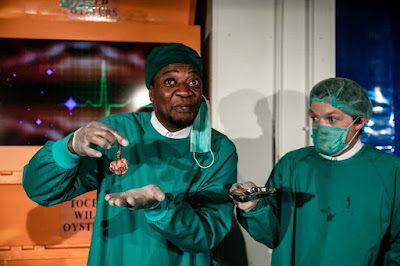
Which only leaves one more play seen in September, the very odd 'War with the Newts'. This was a totally immersive experience, with us all - audience and cast - in what was decked out as the hull of a ship; indeed all the audience except me had to sit on upturned oyster crates; I got a chair for reasons which were never explained, although I did get the word 'Leading' stamped on the back of my hand, which may or may not have something to do with it. It's based on Karel Čapek's novel, which I haven't read (and, let's be honest, am never going to either) and I sort of assumed as it went on that the human race would learn its lesson and after the many early disasters would become wiser and be able to rebuild civilisation, but better this time round. However, somewhat disconcertingly the newts won, and mankind was wiped out; the science fiction equivalent of us all getting the good slap which we no doubt deserve.


(*) A completely irrelevant piece of information that I can't resist sharing with you is that it was once seriously suggested that the SI unit for the rate of flow of a liquid should be named the Falstaff.

Monday, 24 September 2018

Schleiferei

A few photos of the table with a Square Bashing game set up on it. This is near the end of the pre-battle sequence, but before the defenders (the Germans in this instance) carry out depletion and set up their hasty defences. My preference for games in the annexe are for them to last one night; I suspect that both the initial process and the calculation of victory points will take another complete evening each if one followed them as written.


Sunday, 23 September 2018

A Song for Catherine of Aragon

I have been to see Martin Simpson perform again, and once again he was simply brilliant.

Some years ago - to celebrate being sixty in fact - I made some ginger, chocolate and rum biscuits to take along to the boardgames session in the pub, and apologised to those trying them for having been a touch heavy handed with the bottle. "Don't apologise," came the reply "there isn't anything that can't be improved by adding more rum". This video is an exception to that rule; not just for the annoying advert at the beginning, but because the cameraman gives every indication of having had a free sample or two. The music is good though:


Friday, 21 September 2018

Two D3 or not two D3

I am lucky in the wargaming resources available to me. I know that having a table that be permanently left set up is something that others envy, plus I actually do most of my gaming in the legendary wargames room. You would imagine therefore that having got the logistics and, in the latter case, the aesthetics completely sorted that I and my colleagues would play games of an appropriate standard. The reality of course is sadly different, and at the moment we are scratching around for form like any number of overpaid Premier League strikers (*).

Our basic issue is getting the rules right, Black Powder in particular. It's all a bit odd because I'm sure that we were pretty much on top of them when we last played them. There are some mitigating factors: they are still very badly written; we have moved on to a new period (the Peninsular War) and its accompanying supplement; there has been a bit of a break since we last played at all; and also the flow of the evening was interrupted when a mouse phoned up James and challenged him to a duel (**). In any event the usual (and enjoyable) post-game tradition of wondering what would have happened if one party had been a bit bolder, if another had been less cautious, if that card had turned, or that dice roll had been different was replaced by debating what would have happened if we had remembered that it's harder to save against artillery or that British infantry can fire and then countercharge etc. etc.

I was also responsible for introducing a further indavertency into the mix myself. Movement in Black Powder is driven by rolling two D6 and comparing the result with the commander's rating, usually a 7 or 8, with the result needing to be equal or lower in order to move at all. There are nuances, but essentially the lower one's roll then the further one moves. Early on in the game my forces were moving great distances; it appeared that I couldn't fail a command roll if I tried. Half way through my second turn it became apparent that it seemed that way because I literally couldn't fail; I was rolling two D3s by mistake. In my defence I was simply rolling the dice that were put in front of me, but it did rather sum up the evening.


*    Feel free to substitute a more culturally appropriate sporting simile should you so wish.

** This incident certainly happened, but I wasn't playing much attention at the time and so may have the precise details wrong.

Thursday, 20 September 2018

Amores - 41: Dissolute

Many years have I still to burn, detained
Like a candle flame on this body; but I enshine        
A darkness within me, a presence which sleeps contained    
In my flame of living, her soul enfolded in mine.     

And through these years, while I burn on the fuel of life,            
What matter the stuff I lick up in my living flame,   
Seeing I keep in the fire-core, inviolate,        
A night where she dreams my dreams for me, ever the same.           

-          D.H. Lawrence

Wednesday, 19 September 2018

And then the lighting of the lamps

We have had a request - sort of - for some T.S. Eliot, so here, because I've just watched him in 'The Charge of the Light Brigade' is Sir John Gielgud:


And here, because I've just re-read 'Tinker, Tailor, Soldier, Spy' is Sir Alec Guinness:


And here, just because, is Sir Anthony Hopkins taking 'The Love Song of Alfred J. Prufrock' at a fair old pace:


Tuesday, 18 September 2018

That is what

In response to my last post, in which I had a whinge about the latest edition of Wargames Soldiers and Strategy, a wise man has been pointed out that you can't please all the people all of the time. Fair dos, and I shall mention the matter no more. Except to point out that a more cynical man than me might point to the happy chance by which a completely unsuitable set of rules which happen to be published by Osprey are shoehorned into a series of articles which rely for their lavish illustration on pictures whose copyright is owned by that very same Osprey. Moving on...


In order to make my gridded Great War tabletop more pleasing to the eye I have had recourse to our friends in the model railway hobby, but the materials which I have ordered via the interweb haven't yet arrived. What did come in yesterday's post was a cheap second hand DVD of Tony Richardson's film 'The Charge of the Light Brigade'. My recent re-reading of the first Flashman novel, which features more than one appearance by Lord Cardigan, had brought it to mind along with the fact that it was a very long time since I had seen it. Having watched it again, I must confess that I don't think much of it. However, I won't dwell on the negatives, because the performances of Sir John Gielgud as Raglan, Harry Andrews as Lucan, and Trevor Howard as Cardigan are all very good indeed. My cynical alter ego might be tempted to note that George MacDonald Fraser's written description of Lord Cardigan, first published in 1969, is pretty much identical to Howard's performance as the man in a film released in 1968.

Monday, 17 September 2018

Pot82apouri (or possibly Pot82pouria)

I am really disappointed that having scraped the barrel for a wargaming related post in the middle of a period with no wargaming actually taking place, that I forgot something. Not something interesting, but something nonetheless.

I gave up subscribing to wargames magazines back during the time when I was of no fixed abode and have never felt the need to start again. I am however still on various mailing lists and was sufficiently tempted by an email from the publishers of Wargames Soldiers and Strategy to venture into W.H. Smith and buy a copy of the latest issue, which has a Wars of the Roses theme and promised a scenario for the Battle of Stoke Field. Sadly, it's pretty poor stuff.

As well as a perfunctory and somewhat patronising introduction to the period there are articles on running a WotR campaign, skirmish battles in the period, and the Stoke Field scenario. The 'campaign' isn't anything of the sort, it's a mechanism for generating forces for a game; NB for one game. The skirmish suggestions are at least proper skirmishes rather than punch-ups, but there is no real period detail or in fact any detail at all really. This is a direct quote: "Forces can be chosen in any form from an appropriate army list with a mix of troop types". Indeed so. And the OOBs for the Stoke Field scenario are based on Lion Rampant. Now I rather like those rules - I fully intend to pinch chunks of them for my Romans vs Celts version of Pony Wars, as I have been saying for some years now without actually doing anything about it - but they aren't what I'd choose for refighting a pitched battle.

The non-15th century stuff included in the magazine wasn't much better, although in fairness the rules reviews drew my attention to things I would have otherwise been unaware of. So, it may be quite a while before I buy another copy.

Having said all that, I do own some pikemen who have never seen any action (keep it to yourself, but the pikes aren't very good and could do with replacing) who would do very well for Martin Schwarz's mercenaries, so Stoke Field is a distinct possibility at some point; just not with Lion Rampant though.

Sunday, 16 September 2018

Pot82pouri

Your bloggist loves a coincidence and so finds it noteworthy that after he included a link to the Palouse Wargaming Journal blog in his last post that blog has subsequently announced that it is having a competition and asks that links are provided to it. So here's one directly to the post about it. It's a most interesting and colourful blog, somewhat intimidating to those of us who are slow (and crap) painters.

I have however quickly knocked out the troops necessary for a trial of Square Bashing; Great War uniforms are good for that. I have had a solo run through the extensive pre-battle process seemingly common to all Peter Pig rules and set up the table with the result. I won't include a photo just yet because I don't like the way that the squares representing built up terrain look. The grid squares are much bigger than the single hexes used for C&C terrain and that is compounded by the fact that terrain always fills two adjacent areas. I have a couple of ideas, which naturally involve spending money; what doesn't? Coming back to the rules, they are fairly clearly written, but like the other PP rules I own (Bloody Barons) seem very prescriptive about things that don't appear to affect  gameplay one way or the other. I haven't noticed any obvious holes though; Bloody Barons memorably omitted any rules at all for cavalry vs cavalry melees.

Wargaming in Wharfedale will resume this coming week. We shall be back in the Peninsular as James has been painting. What he has written about Cazadores in his blog absolutely guarantee both a mid game rule change and that they won't stay as skirmish only troops in the long run; trust me, I've known him for a number of years.

Monday, 10 September 2018

Verstärkung

We are in a bit of a wargaming hiatus, something that affects even the denizens of the Lower Wharfe Valley. This has coincided with me getting my painting mojo back. I knew that if I made enough markers and gaming accessories then eventually I'd get round to painting some figures. I did paint up a few stands of extra figures and specific commanders for the Varna game, but thereafter I have a problem. We've all read those blogs consisting of post after post of beautifully painted figures for this project or that project in this scale or that scale rolling off the production line (you know who you are Jonathan Freitag), but things don't work like that around here.

It's true that I have plenty of unpainted figures, but it's also true that for most periods that I game I already have substantially more toys than I can ever put on the table. Short of starting a completely new army (Napoleonic Austrians?) anything painted would just go in the box and stay there. The exception to this is the Great War where I have been aware that I didn't have enough Germans to try Square Bashing. A review of the troops showed that the shortfall was less than I thought. Indeed I only need twenty riflemen and two field guns and then we are in business for an infantry and artillery only game. Naturally I have those on the shelf in the annexe, and equally naturally I don't have the requisite bases and movement trays. So, the figures are on the painting table and the order has gone in to Warbases.

A couple of years ago when I started painting figures for the First World War I said to myself that I might be ready for a game in time to commemorate the armistice. I might yet make that prediction come true.

Sunday, 9 September 2018

Back Street Gig

Having declared my love for early seventies blues/rock, I need to admit to also being partial to a bit of prog rock from the same era. Reflecting this I have been to see Curved Air. There was a chap there with a t-shirt that he had obviously bought at the Allman/Betts gig the previous evening and when I spoke to him about it he said that the two concerts back to back was like being in 1975 for the weekend; ain't that the truth. They weren't playing at the Brudenell, but at a venue entirely new to me. The address which I was given was 'behind Tesco' which seemed rather unpromising, and I don't know whether I was relieved or disappointed to find that it wasn't the sort of dive that I would actively have sought out forty years ago. In fact, as a further sign of old age, I particularly liked how comfortable the seats were.


We have all changed over the years of course - even Epictetus is beginning to go a bit thin on top - and Sonja Kristina is no exception. Ever since the episode with Elkie Brooks' greatest fan I have been wary of appearing to disrespect performers of a certain demographic, and believe me I am not doing so here. Admittedly Kristina's stage moves these day are limited to waving her arms about in what could best be described as an esoteric blend of tai chi, the hand jive and a mime artist pretending to be a painter and decorator - she gave the ceiling several coats - but the voice is still there. The rest of the band - there were six including her - weren't the original members, but they were good and they looked the part. I was especially pleased to see one figure stood off to the side surrounded by banks of keyboards, including a synthesiser, and looking like Elrond; every prog band should have one.


The current line up apparently recorded an album a few years ago and they played a few tracks from that, which I rather enjoyed. They weren't melodically very inventive, but they had the ridiculous lyrics, abrupt changes of key and tempo and completely spurious virtuoso instrumental flourishes that the audience had come to see. They did play the old stuff of course, including amongst others, 'Melinda (More or Less)' - a favourite of mine - and 'Vivaldi' - sadly without the cannons. I heard Tom Robinson (the 'Glad to be Gay' one, not the racist jailbird one) say recently that two good songs were both necessary and sufficient for a band to have a long career. As if to prove his point Curved Air have two belters. They finished the first set with 'It Happened Today' and the second set with 'Back Street Luv' and we all went away happy.


Saturday, 8 September 2018

Knitted garment that opens at the front

"A younger woman who hangs around older men" -  definition of 'cardigan' according to urbandictionary.com

I have been re-reading Flashman, mainly I must admit because it was available for 99p as one of Amazon's Kindle e-books of the day and I felt like some light reading. One character who plays a prominent role at the beginning of the book is James Brudenell, 7th Earl of Cardigan. Famous of course for leading the Charge of the Light Brigade in 1854, at the time the book is set he was Commanding Officer of the 11th Light Dragoons, into which our anti-hero is commissioned. The Brudenell family owned a lot of land in what are now the Woodhouse Moor and Hyde Park areas of Leeds, to the north of the university, and local place names still reflect this. There is a Cardigan Road (indeed it's where the recent opera festival was held) and, more pertinently for today's post, there is the Brudenell Social Club, one of Leeds' most prominent music venues.

I have been there to see the Devon Allman Project. The project bit represents the fact that since I last saw Allman, his father died and he decided it would be appropriate to feature more Allman Brothers music in his act. To help with this he has recruited Duane Betts, son of Dickie and obviously named after Duane, as opening act/sideman. It certainly all hit the spot for me. You will have gathered from reading the blog that by and large my musical heart lies in the blues/rock of the early seventies, and from the second song in when Betts did a cover of 'Silver Train' from the Stones' 1973 album Goats Head Soup, I was up for it. So were the rest of the audience, especially a somewhat incongruous party of Norwegians down at the front. They stood out partly because a couple of them were around 6' 9" - for once I don't exaggerate - and partly because the availability of beer for less than £15 a pint had left them all rather exuberant. One of them called out, loudly and repeatedly, for 'Free Bird', which amused those watching quite a lot more than it did Allman himself.

A highlight was an extended version 'Blue Sky', written by Dickie Betts, so here's the original:


Friday, 7 September 2018

A thought


"You may not be able to change the world, but at least you can embarrass the guilty."

- Jessica Mitford

Wednesday, 5 September 2018

Beyond the Smoke

"H.M.S. Electra attacked through the smoke, and was seen no more..."

 -    From the first communiqué of the Battle of the Java Sea, February 1942


'Terse, though moving' is how that epitaph is described on the dust jacket of H.M.S. Electra, a monograph on the ship by the most senior officer to survive its sinking. The words have an additional resonance for me, because I can hear my mother saying them. The death of her elder brother during the war wasn't spoken about much at home, but I can remember once asking her what she knew about it and that's pretty much what she said: "They went through the smoke and no one ever saw them again". At the time of course, I didn't know where the phrase came from.

My recent involvement in helping someone to learn the details of her godfather's crash into, and rescue from, the North Sea got me thinking about all the stories that were lost because the generation who fought the war preferred not to speak of them, a train of thought which led inevitably perhaps to the uncle I never knew. A little bit of research led me a book of whose existence I was previously unaware, certainly none of my rather large family ever mentioned it. My one remaining aunt is very old and lives on the other side of the world; I doubt that I shall trouble her with the subject. The style of Lieutenant-Commander Cain's book is somewhat dated - much of which is presumably due to ghost writer A.V Sellwood; although the latter was a distinguished naval correspondent, back in the days when there was a navy big enough to warrant such things, and I think we can rely on the accuracy of the background colour - but it's a fascinating, sobering story.


I don't know when my uncle joined the ship except that it must have been before it made its final trip to the Far East, but Electra, an E-class destroyer, had an astonishing two years or so of involvement in the war. Within hours of the outbreak of hostilities she was first on the scene following the sinking with no warning of the Athenia, a liner with over a thousand civilian passengers on board and the first British ship to be lost. She escorted Ark Royal during the carrier's operations against the German invasion of Norway. She was the ship that picked up the only three survivors from H.M.S. Hood's crew of 1,400; Cain is especially good on the ten minute period between the excitement of receiving Hood's signal: "Enemy in sight. Am engaging.", and the shock following that from the Prince of Wales: "Hood sunk". Electra was senior escort on the first arctic convoy following Hitler's invasion of Russia, but was spared further such trips when, and this is still prior to Pearl Harbour, she was ordered to Singapore. She was with the Repulse and Prince of Wales when they were sunk by Japanese aircraft, left Singapore as the Japanese crossed the causeway and then formed part of the Allied (Dutch, British, US) fleet essentially wiped out over the three days of 27th February to 1st March trying to head of the invasion fleet heading for Java.


Cain's description of the battle itself is brief, and his summary of the Electra's solo, and suicidal, attack on the whole Japanese fleet in order to buy some time for the stricken cruiser Exeter is a phlegmatic as one would expect. In his eyes, and one suspects also of all his crewmates, they were simply doing what had to be done. His account of his escape, rescue, and subsequent sinking again are longer, but he understandably declines to speak at all of his years as a Japanese PoW.

So, a fascinating and, for me especially, somewhat emotional read. I feel very grateful that in this case someone took the time to document their memories. A less happy postscript is that the Electra is one of the ships which despite being designated war graves have been badly damaged by illegal salvagers recovering scrap metal.


Tuesday, 4 September 2018

In the Lands of the North

"In the land of the North, where the Black Rocks stand guard against the cold sea, in the dark night that is very long, the Men of the Northlands sit by their great log fires and they tell a tale..."

I have at last been to the Noggin the Nog exhibition. The person I arranged to go with a couple of weeks ago was taken ill rather suddenly; by which I mean that I called round to pick her up only to find her being carried out into an ambulance. It all rather put me in mind of my own trips to A&E back in 2016. Fortunately she has made a full recovery and so we went off to Cartwright Hall to see their exhibition on Smallfilms. 


It isn't a very big display and perhaps inevitably has more exhibits relating to the puppet shows than the stop frame animation. There is one of the 'real' Bagpusses - the other appears to be in the Rupert the Bear Museum in Canterbury - a number of Clangers plus the Iron Chicken, and Mr & Mrs Pogle (*). One thing I never knew before was that Clangers were developed from characters who first appeared in an episode of Noggin the Nog; one is never too old to learn something.


They did have the camera with which Noggin and Ivor the Engine were filmed compete with a trigger made from Meccano to allow one frame to be shot at a time, plus a strange spoked measuring tool that allowed Oliver Postgate to move the drawings by the same amount for each frame he shot. But it was the paintings and drawings of Peter Firmin that stole the show for me, both the exquisite backgrounds and the huge quantity of cutouts for each character: close, medium and distance; at different angles; a range of facial expressions; limbs in various positions; etc.


It certainly took me back. Ivor the Engine was on ITV and we watched the BBC in our house, but Noggin was right up my street. One thing I didn't pick up at the time was that Nogbad, the villain trying to steal the throne, was Noggin's uncle; you can't get away from Shakespeare can you? I'm also pleased to note that Groliffe the dragon was an accountant of sorts. There are many Smallfilms resources on the interweb, but make sure you don't miss this one. Be warned though, the promised Hordes of the Things army lists don't seem to exist.


Also on at Cartwright Hall at the moment is an exhibition of a century of Bradford painters. As well as the inevitable Hockney this also included  Edward Wadsworth, member of the Vorticists, and, much to my surprise, a painting by David Oxtoby of Catfish Keith, a version of which is on the cover of the blues singer's first album.


(*) Amos Pogle, the man who said "I'll be respectable when I'm dead Mrs Pogle, until then I'll shout and sing as much as I like!" is, as can be seen from the photo, a bit of a role model of mine.

Friday, 31 August 2018

Tonight, Matthew, I am going to be W.H. Auden

And so to the theatre. I have been to see 'The Habit of Art' by the very much alive, alive, oh, Alan Bennett. This production features David Yelland and Matthew Kelly. You may recognise the former as an actor (he was the Prince of Wales in 'Chariots of Fire' - the Nazi sympathising one, not the chap who speaks to plants) more than you do the latter. However though Kelly is perhaps best known for lowbrow television that was always by way of a diversion from his career on stage (*). He trained with Richard Griffiths, much esteemed by this blog and a frequent actor in Bennett's plays and films, indeed he was the originator of the part played here by Kelly.


The play is, of course, very funny and very clever; certainly too clever for me to be able to give much insight in to what it's really about, beyond the imaginary meeting portrayed between Auden and Britten in Oxford some thirty years after they fell out and stopped speaking to each other. The nuances of gay identity examined are somewhat beyond me, although I did get the impression that Bennett is more sympathetic to Auden's more straightforward approach to trade than to Britten's penchant for young boys. There was some discussion of 'Death in Venice' (astonishingly Thomas Mann turned out to be Auden's father in law; much of the surprise obviously coming from the idea of him having been married in the first place) and the judgement on the composer's intention was somewhat harsher than mine. Bennett also finds time, via a play within the play, to poke fun at actors. This mise en abyme - in which the fictitious meeting takes place - is called 'Caliban's Day' reflecting Auden's apparent view that the end of 'The Tempest' could have been improved. Interestingly the way that Bennett chooses to end his play is with what is essentially a quote from Macbeth.


I know it's from Macbeth because I've just seen that as well. I saw the remaining three plays at the pop-up Shakespeare's Rose in York. As well as the Scottish play these were A Midsummer Night's Dream and Romeo & Juliet. I and the elder Miss Epictetus, on holiday from university at the moment, rather enjoyed them all, although the critical reaction elsewhere was mixed. The place didn't have as much atmosphere as the Globe, but I rather enjoy standing up to watch Shakespeare. If I have criticism it would be that they staged the full version of each play; there is undoubtedly a good reason why an edited text is normally used.


(*) I had only seen him once before, giving his Malvolio to an audience that seemed to consist entirely of me and several hundred convent schoolgirls. It was disconcerting even for someone of my experience and sang froid, but at least I didn't have to queue for the toilet during the interval.

Thursday, 30 August 2018

Murad 1 Hunyadi 0

Peter and I had a play through the Varna scenario which has been set up in the annexe for the last couple of weeks. Naturally I hadn't got round to having a solo run through - although I had made a Janos Hunyadi command stand, and a one for King Vladislav while I was at it - but in all worked fairly well. As usual it would have worked even better had we played the rules correctly, but you can't have everything. Amongst the other things that we can't have this week are photographs because I didn't take any. Normally when we play at the Casa Epictetus I umpire, which gives me plenty of opportunity to take some, but on this occasion a a player I couldn't find the time, or find the camera, or something.

It all panned out fairly historically with Vladislav charging the Ottoman fortifications, almost getting across the barricades, but ultimately dying to no effect. I thought it might be a bit one sided as a game, but the crusaders were well-placed for much of the game. The king's demise, which meant the centre was permanently out of command, was really the turning point. Having weathered the storm the janissaries eventually advanced out of their camp and dealt the coup de grace. If I have one regret a the Christian commander it's that I didn't move the wagenburg across earlier to provide cover for the crumbling Wallachians on my left flank to hide behind.

Let's focus on the things that seemed to work:

  • The mechanism for causing Vladislav and the Papal Legate to be liable to move forward impetuously.
  • Classing jannisaries as legionaries in TtS! terms.
  • The markers behind each unit showing commands they belonged to; the reminders of saving throws were useful as well.
  • The new tokens; you can easily see what number they are, they are very unlikely to be overlooked when putting them back in the bag and they don't stick together.
All in all I thought it was a good scenario and I may well get it back on the table again sometime.

Tuesday, 28 August 2018

Ilkley, the movie

Readership of this blog has fallen to an all time low (and many thanks to both of you for persevering) which may be why no one has asked any questions about the film entitled 'Ilkley' that is being made in Ilkley and is apparently about, amongst other things, Ilkley.

Reading the programme for the upcoming Ilkley Literature Festival (no surprises that there is a session on J.B. Priestley or that I intend to go) reminded me that the film is supposedly set at the event and made me wonder if they would be shooting at any of the sessions. It turns out that they shot it in February and March and that it is currently in post-production. One can only assume that they are using CGI to add in the vast crowds who will soon flock to the Kings Hall, the Clarke-Foley centre, the Ilkley Playhouse etc etc and who weren't there earlier in the year. In fact if the dates I've seen for location shooting are correct viewers will leave the cinema with impression that there is always several feet of snow in Ilkley in late September.

As well as starring Sir Derek Jacobi, as mentioned in my previous post on the subject, it also features Roger Allam and Anna Maxwell Martin. She at least actually comes from Yorkshire; we shall have to reserve judgement on the others' accents until we hear them.

Still no news of toy soldier content, but it's not looking very promising.

Monday, 27 August 2018

Gong, but not forgotten

Mentioning the inhabitants of Planet Gong yesterday made me realise that I had unaccountably never posted any of their music on the blog. I only saw them once - in Freshers Week; god only knows who thought that was a good idea - and was too drunk to remember anything much about it. According to the Guardian they were not just silly, but 'could groove like mothers', so here they are. For the record the opening to this video is eerily similar to the way in which we commence an evening's gaming in the legendary wargames room of James 'Olicanalad' Roach.


Don't you think the lead singer looks as if he's throwing dice? I'm going to suggest that we get hats like that for conventions. It would be one up on those chaps who wear mess uniforms while refighting the Zulu war, and instead of drinking red wine like them we could drop acid. Just a thought.

I'm off to track down a copy of 'Live in Sherwood Forest'.

Sunday, 26 August 2018

La Princesse Jaune


"There is nothing more difficult than talking about music." - Camille Saint-Saëns


And so to the opera. Taking Camille at his word I won't try to describe the music of his opera 'The Yellow Princess' - although I liked it - but I must say something about the story. When I arrived the young lady on the door confided to me as she took my ticket that "it's very odd". She did not lie.

In one sense it's a straightforward plot: a Dutch girl named Lena is in love with a Dutch boy named Kornelis; Kornelis for his part loves a picture of a fictional Japanese princess named Ming, as you do. Lena realises that the object of her affections is a bit of a dick and stomps off in disgust. Kornelis decides the only thing for it is to take some mind-altering drugs, resulting in a hallucinogenic trip. Lena reappears, at which point he declares his love for her. She's not stupid and after pointing out that, being off with the fairies, he is confusing her with the imaginary Ming she stomps off for a second time. He sings a lot of nonsense including some stuff about a gong (probably not the French prog rock band, although in many ways it would be fitting if it were), and then threatens to kill himself while reflectively stroking his hipster beard (*). At this point the audience are all nodding in agreement that this would definitely be for the best, when blow me but Lena reappears and proves that she is actually stupid after all by saying she'll have him despite everything and they walk off hand in hand. Operas usually end badly for the soprano, and I'd say this one doesn't buck the trend.

The music was nice though.


(*) It's possible that the beard is just in this production and didn't form part of the composer's vision.


Friday, 24 August 2018

Chung Ling Soo

And so to the opera. I have been to see 'The Original Chinese Conjuror' by Raymond Yiu who, along with librettist Lee Warren, was at the performance, which formed part of this year's Left Bank Opera Festival.


Just to be clear, the protagonist of the opera is the not very Chinese at all chap lurking at the back of the photo. The story is that of Chung Ling Soo, real name William Robinson, an American of Scottish descent whose masquerade as a Chinese magician lasted for almost two decades without exposure (to the public at least), until he literally died on stage, and forgot himself sufficiently to expire in English. His father had been a blackface minstrel, and one could imagine all sorts of complex psychological reasons for why the family had a compulsion to impersonate other races; on the other hand perhaps they did it for the money.

I really enjoyed the piece, which musically was an effective mixture of the styles of Kurt Weill and Benjamin Britten. And despite sitting rather close to the front I was still unable to work out how the handkerchief turned into a rose and the rose into a walking stick, let alone how he managed to sing in tune at the same time. The ending contrived to be very moving despite the fact that we all knew what was going to happen, and also that the man firing the gun for the don't-try-this-at-home catching-a-bullet-in-your-teeth finale had clearly never seen a rifle before in his life.

There's an interesting discussion of the opera's inaugural production at the 2006 Aldeburgh Festival to be found here.


Thursday, 23 August 2018

Arenaceous

Wargaming has been almost as rare a blogging about it, or indeed blogging about anything. (Don't worry though; there's an opera festival in Leeds this weekend.) We did however play a game last week sometime, a second run through of the first game with James' new Peninsular War figures. James has written about it here and Mark here, so I won't say anything except perhaps to point out that I was robbed.

I will say something about the rules though. The previous week we had been somewhat rusty and, while I would not be prepared to put my hand on my heart and say that we had got things completely correct this time, we are clearly moving in the right direction. As with all rules we came across certain things that look peculiar, at least the way that we played them.

James mentions in his blog that the Break Test table seems to omit certain period specific circumstances, which was easily enough resolved. There also seems to be an oddity surrounding defending buildings, which I know I will have trouble expressing in clear terms, but let's have a go anyway. There is - at least in our interpretation - a marked difference in the likelihood of success when defending a town section from an attack from the open compared to defending it from attack from an adjacent town section. The extent of this difference seems to grow exponentially as the size of the defending unit decreases; it is not clear that this is a deliberate design feature. We had a brief correspondence on the subject subsequent to the game and I found myself resorting to the higher mathematics to make my point, which is never ideal for anyone involved.

My main dislike was the cavalry breakthrough charge. This wasn't so much with the concept - lot of rules have it - but with the fact that, if we are doing it as we should be, the rules are written such that there is actually an advantage to the cavalry unit from being on their second round of melee rather than their first. I have to say that isn't an especially intuitive approach.

Perhaps these things will be addressed in the forthcoming second edition, which will hopefully be somewhat more clearly laid out.


Monday, 20 August 2018

As I Walked Out

I have been for a few days' walking in the Cotswolds:

The River Severn in the distance

When one stays in a hotel on a Saturday in the UK there is always the possibility of sharing it with a wedding party, which will inevitably be loud, drunk and raucous. On this occasion our fellow guests turned out to be a submariners' reunion, and they were loud, drunk and raucous. Being the Royal Navy there were plenty of beards, tattoos and hip flasks full of rum. And that was just the wives.

A good time was had by all.

Wednesday, 15 August 2018

Varna

A sadly postponed visit to an exhibition about Noggin the Nog (would I lie to you?) left some unexpected free time which was utilised by having a first pass at setting up Varna. My information about the battle came mostly from the Freezywater publication on Janos Hunyadi, written by Bob Black and available from the Lance & Longbow Society, and from the Warhammer Historical book Vlad the Impaler by John Bianchi, which I suspect is out of print. A lot of online references to the battle seem to be of the lunatic, right-wing, alternate history type, but I thought this blog post from Dalauppror was very useful.

Janos Hunyadi puts himself about

The battle has some resemblances to a couple we have played in the legendary wargames room over the years. Firstly, it occurred during a crusade and, just like their predecessors three centuries earlier, the crusader commanders seem to have been totally inept at manoeuvring their armies.  On November 10th, 1444 they found themselves with their backs to the Black Sea, Lake Varda on their left flank and the impassable Franken Hills blocking the way to their right. The only way home was straight ahead, which was why the Ottomans had placed their army there and built a fortified camp. Secondly, at one point Sultan Murad II was apparently on the verge of doing a Frederick and making a run for it leaving his army behind; unlike the Prussian flautist he stayed put and, perhaps as a result, never became 'the Great'.

The view from the Franken Hills

Having quoted my sources - such as they are - I had better say that I have discounted much of what they write. I take the view that the forces were fairly evenly balanced, with the crusaders claim of being outnumbered three, or even five, to one being by way of an excuse for losing. I also don't believe the assertion in Bianchi's book that Vlad Dracul (the Impaler's father) commanded the Wallachians.


Murad's camp

The letters behind each unit are there to distinguish commands, while the numbers represent the base saving throw of the unit. White beads indicate lances, green beads are heroes, and in due course red beads will be hits. I may, or as so often may not, have a play through solo to see what happens, but there will certainly be a couple of changes. At the moment Zizka is standing in for Hunyadi, but Black's book has a Hunyadi standard and I have a mountain of unpainted plastic so I shall knock out a command stand for him. I also need a couple more stands of horse archers. Apart from that - and as long as one can cope with WotR hobilars as Wallachian light horse - we're good to go.

Thursday, 9 August 2018

Explotar el puente

We entered a new era of wargaming - or at least a new theatre - last night when James' long awaited (long, long, long awaited) Peninsular War forces took to the table for the first time. Peter and I had no advance warning of this nor, more pertinently, that we would be playing Black Powder. I'm pretty sure that it was the first time this year that we had played them, and a certain rustiness showed through. James had obviously studied the Napoleonic elements in particular (skirmishers, squares, columns of attack etc), but I think we realised fairly early on that he was in the same boat as us when he tried to slip in a rule that clearly came from Blitzkrieg Commander.

The figures are, naturally, wonderfully painted. They have appeared a number of times already on his blog and I believe that he is intending to put up some more photos following this game. Speaking of which, I think what happened last night best described as exploratory. The rather abstract way that skirmishers are dealt with is much to my taste, but took a bit of getting one's head around. I think we all agreed that riflemen were too much of a super unit (I took out a whole regiment of hussars from great distance with one small group of them) and the next step is to try to incorporate their effect into general skirmish fire rather than having them represented separately. All those years ago when I started wargaming I was at the hyper-realist, rivet counting end of the spectrum; now I lean to as abstract as possible while retaining an acceptable level of recognisable period flavour.

For the record the game, a version of that old favourite the blow the bridge scenario, was not going the way of the British when we called it a night, but I think we had all gained a better understanding of the appropriate Black Powder Napoleonic tactics, not to mention reminding ourselves how the core rules work in the first place.

Wednesday, 8 August 2018

Enough

“O Life,
How oft we throw it off and think, - 'Enough,
Enough of life in so much! - here's a cause
For rupture; - herein we must break with Life,
Or be ourselves unworthy; here we are wronged,
Maimed, spoiled for aspiration: farewell Life!'
- And so, as froward babes, we hide our eyes
And think all ended. - Then, Life calls to us
In some transformed, apocryphal, new voice,
Above us, or below us, or around . .
Perhaps we name it Nature's voice, or Love's,
Tricking ourselves, because we are more ashamed
To own our compensations than our griefs:
Still, Life's voice! - still, we make our peace with Life.” 


           -  Elizabeth Barrett Browning

Tuesday, 7 August 2018

Blood markers

"I learned to play the instruments of war, and paint in blood." - Cassandra Clare

There has been a bit of a conversation between the Don and me about Bill Boorer, which I wouldn't bother with unless you are especially keen to know who said what to whom in our home town forty years ago. Indeed possibly the most interesting thing about it is that he spells the name of the place as one word, whereas I have always favoured two.

However, it reminds me to tell you what happened to the print of a Strike Wing attack that I bought. You will recall that when it arrived it was clearly too large to fit comfortably in the annexe. Having been framed - at great expense - it has been sitting propped up in my living room. After staring at it for a while I have come to the conclusion that it is too large to fit in any sort of aesthetically pleasing way in the house itself. It has therefore, physical constraints notwithstanding, been hung in the annexe after all. I have no doubt that it will feature in due course in photos, looming out of scale over the tabletop. It has subsequently been joined on the wall by a thankfully smaller picture to provide a bit of balance. The only thing the two have in common is they both relate to periods that I don't actually game; perhaps that's the start of a theme.


The recent outbreak of modelling continues, but hasn't progressed beyond making markers and game aids. Still, one can never have enough of those and so I thought I would make some bead-carrying pins of the type often seen in photos on James' blog. Not only did this involve once again struggling with the lightweight filler, but also the use of superglue. Regular readers will know that for some reason I have never been particularly competent with the stuff; indeed I mainly use the UV hardened alternative instead these days. In this case I thought that the assembly line type process involved meant that superglue was more suitable, but still wasn't surprised when I found a piece in progress attached to my hand. I was somewhat more disconcerted to find that it wasn't because of a chemical bond forming between skin and copper, but rather because I had impaled myself on a carpet tack. By the time these things get used they will have been covered with acrylic burnt umber, but for now one of them is a tasteful reddish-brown.

Monday, 6 August 2018

Sharpie's Triumph

I forgot that I had taken some photos of the Malesov game, so here's one at random:

Spot the drunken hero

James' suggestion - and I know that you have been waiting for it - is to allocate the Victory Medals unevenly, with the warwagons getting the bulk. In order to win therefore the Imperialists will be forced to attack the wagenburg directly; historically accurate and tactically foolish. The sensible thing for me to do would be to try the idea out immediately, but naturally I won't; Varna is a different sort of battle.

One of the practical problems we encountered was the tokens sticking together in the bag as they were being drawn. This is no reflection on Warbases, but is rather due to a dodgy bottle of varnish that I had, which I applied after painting the backs to differentiate the various sets. I have therefore decided to try a different solution, namely Scrabble type plastic tiles:


As you can see the set includes a couple of symbols. I have some plans to use those for some scenario specific rules. The sixes and nines are distinguishable, but not easily without standing them side by side. Here's one bag's worth after judicious application of Sharpie pen.


Sunday, 5 August 2018

Hope was but a timid friend

Not that you would know from either James' blog or mine, but there has actually been some wargaming in the Lower Wharfe Valley. Two games in fact, very different in most ways, but what they shared was an eventual winner who had basically given up about two thirds of the way through and only carried on because there was plenty of time left.

The first was the blow the bridge scenario that we had played in the legendary wargames room two or three times a couple of years ago, and a very good game it gives. I was the Russians seeking to prevent said bridge being blown and, not remembering any details from the previous games, chose to bring the infantry on at the road entrance nearest to the bridge with the cavalry arriving later from one end of the table. When this was revealed there was much shaking of heads and sucking of teeth from Peter and James, with the strong consensus being that I'd got it all wrong. As it happens the gods of Piquet thought differently, because in the morale draw at the beginning I drew a Brilliant Leader card plus a Stratagem, which turned out to be basically another Brilliant Leader card for one command. The net effect was that that one infantry command stormed across the table and would actually have seized the bridge had I focussed on the important stuff rather than moving as many units as possible. If you ever play Piquet then that, dear reader, is the golden rule. The converse of having good cards in my deck was that I didn't have much morale. I failed major morale twice, ran out and actually started giving it to the Prussians. That basically means the game is over, but it was only about ten o'clock and my cavalry had just arrived so we carried on. The was nothing to do except act aggressively and damn the consequences; sure enough, from that point on it was a completely one sided affair and the Prussians fairly quickly succumbed.

The second game, in the less than legendary annexe, was the previously advertised Malesov. On this occasion the Imperialists gained an early advantage by immediately getting all their cavalry over the bridge - meant to be a bottleneck - and flanking the Hussites on both sides. With the warwagons' shooting achieving absolutely nothing, the Catholic crossbowmen advanced, fired and as luck would have it, killed Zizka himself; he not just being C-in-C, but also commander of the wagenburg. It didn't look good, but Peter - for it was he on this occasion - carried on because, well, the night was still young. And then, suddenly the wheels came off the Imperialists' caravan. They lost a couple of melees (although James did implausibly draw four tens in a row at one point), did very badly in the ensuing rout tests and, just like that, it was all over. The Hussites had won without moving anything off the table.

That last point does make me wonder about the quality of the scenario. James came up with a good sounding approach to force the crusaders to attack the warwagons front on, which of course is what they did at the time, but which no tabletop commander with any sense is going to voluntarily repeat. Details will be given in a future post along with those of one or two other changes to equipment that I am going to make to improve gameplay of TtS!. We are back to James' next week, but I think the next game in the annexe will be Varna, 1444. There are still warwagons, but it also gives me a chance to break out the Ottomans. And yes, I do have a Janissary marching band.

Wednesday, 1 August 2018

Malesov Redux

These are some notes regarding the scenario which has been set up in the annexe for the last month. As I think I mentioned before, one problem with playing the period is that Zizka always won, so this is less an attempt to refight the battle and more using what little is known about events to form the basis of an interesting game.


Malesov 1424

Zizka is trying to reach the castle of Malesov, which is in friendly hands, but is being pursued by Imperialist forces. He draws up his wagenburg on top of a hill and ambushes his pursuers by rolling his supply carts filled with rocks down the slope against the middle battle.

Scenario details:
·         Before the game starts the Hussites get two attempts to hit on 6+ against each unit in the ambushed battle; normal saves and rout tests apply.
·         The Imperialists move first.
·         The Hussites objective is to reach the castle, by exiting their forces off their side of the table through the road square or those either side of it (NB any units leaving the table via these squares cannot return; any units leaving the table via other squares can return as per normal rules (see p42)), while at the same time inflicting some losses on the Imperialists. In addition to gaining Victory Medals for enemy units destroyed they also gain one VM per unit leaving the table as per their objectives. Victory conditions are:
o   Hussites              20
o   Imperialists         15
·         The true cross (*) can move for free with any unit or commander in its square or it can be activated to move on its own by Zizka as per normal infantry rules except that it has no facing. It can co-exist with any number of friendly units and can interpenetrate freely. It acts otherwise as per the rules for standards (ES V6 p5) .
·         If Zizka dies or the true cross is captured then rout tests must be taken as if a unit had been lost.

War wagons:
·         Deep unit
·         Move sideways in either direction – all other moves are double difficult
·         Cannot charge or initiate melee
·         Shooting and ZOC are to the front
·         Have no flanks or rear for melee
·         Regardless of what the models show, they can fire as either handguns or field artillery (NB see ES V6 p2 rule re multiple targets) until they move and subsequently only as handguns
·         Saving throws:
o   +1 vs mounted
o   +1 vs shooting
o   -1 shot at from side or rear

Cavalry:
·         All cavalry are lance armed (see p57)
·         Later knights may rearm (see ES V6 p4 – this will be interpreted as requiring a simple activation) once per unit

Mounted Crossbow:
·         These are mounted infantry, but the rule on p57 does not apply; instead:
·         Move as cavalry, but cannot charge or fire
·         Must attempt to evade if charged
·         Must dismount to fire (requires a difficult activation as per rule on p56) and cannot remount
·         Dismounted crossbowmen have pavises

Terrain:
·         River is impassable, but is no impediment to shooting
·         Normal bridge rules (p29) are designed for both rivers and bridge occupying whole squares, not marking the boundaries between squares and so do not apply; instead
o   The square either side of the bridge is normal terrain
o   Only one unit can cross the bridge on each activation i.e. no whole square or group moves; march moves are allowed
o   crossing the bridge is a difficult move
·         Defending against anyone coming across the bridge +1 to saving throw in melee


(*) I claim no great expertise in theology, but it seems pretty unlikely to me that the Hussites would have venerated relics such as the 'true cross'. However, I wanted to give them a standard to reflect their resilience and, to be honest, the true cross is all I've actually got (for those paying attention, it's  another resin model from Valdemar). While I'm on the subject of historical accuracy, I made the standards with geese on them many years ago under the impression that the Hussites used them because it was a play on words - in Czech - on Jan Huss' name. I now think it far more likely that goose was a term of abuse used by the Catholics to taunt their opponents based on the same pun. But I'm certainly not replacing all those flags, especially when this is the first time in about ten years that they have seen the light of day anyway.