Lascivious Edward, and thou perjured George,
And thou mis-shapen Dick, I tell ye all
I am your better, traitors as ye are:
And thou usurp'st my father's right and mine.
To the surprise of absolutely no one, the next battle in our trial of 'Test of Resolve' will be Tewkesbury; indeed the only reason it wasn't the first one was that I didn't own the relevant scenario book at the time. I got into the habit of playing Tewkesbury with new rule sets because it is, in my opinion anyway, the battle from the Wars of the Roses which is most balanced and in which the inevitable treachery, subterfuge, delayed arrivals, ambushes etc are still present, but don't overwhelm things. Plus of course there is now the added attraction of being able to compare one author's scenario with another's.
Once again I am playing it as written, and will report back. My first thoughts are that I might have had Wenlock and Devon on higher ground than the approaching Yorkists, but I don't suppose it will matter much.
This time it is Edward, Prince of Wales whose demise would signal the end of the game. Can he survive for longer than his father did in our refight of 1st St Albans? We shall see.
I'm trying a different method of recording casualties and morale this time round. I originally made my markers for Command & Colours and, as I have no intention of making any more, am struggling a bit to find the best way of fitting a square peg in a round hole.
We played the 'Test of Resolve' 1st St Albans scenario featuring all the wrong nobles (*) and the rules met with a fair degree of approval. We were able to get a completely unbiased opinion as there was neither winner nor loser. Henry VI unfortunately got caught in the crossfire and perished. In the words of the victory conditions: "If he dies the game ends immediately and inconclusively as a draw! The Wars of the Roses take a surprising turn".
My main concern prior to playing a full game was whether the special period specific rules together with the game's initiative system would result in things running on rails, leaving no interesting decisions to the players. I'm pleased to say that didn't happen, although 1st St Albans is not a particularly normal battle, so perhaps no firm conclusions can be drawn. A concern that did arise came through the use of D12s, which inevitably means that luck in combat and morale testing can swing quite a bit. Still, I think we shall have another go, with a battle in the open rather than in a town next time.
The scenario itself was fine. I previously observed that one of the roads along which the Yorkists attacked is actually quite steep, but in truth had they been penalised for that they would surely have never fought their way into the town. The one area I would probably change is the 'God Save the King Test' which had to be taken by the first Yorkist units into the square. This was a straight die roll, but I think I would give them the normal bonuses for quality, attached commander etc. If the first unit fails then perhaps I would give a down to the subsequent units to reflect this. In terms of the way I laid it out, I would next time specifically mark out the areas around the square notionally occupied by houses, as well as scattering a few buildings about for aesthetic effect.
* There have been questions about how I come to have a WotR collection which doesn't include a Warwick figure; he was after all fairly prominent at the time. Well the good news is that I have found him. I definitely don't have either York or Salisbury though.
... but not necessarily at the right battles.
I decided that one sensible way to rouse myself from my wargaming inactivity was to take a look at some of the sets of rules which I have accumulated over the last couple of years. Even more logical is to start with a period for which I actually have the figures, so the Wars of the Roses it is. I have a couple of unplayed sets, but first up is 'Test of Resolve', a card based WotR specific set which I briefly described on in a previous post. They should be straightforward for me to pick up because they are derived from/an homage to/a blatant rip-off of Piquet Inc's FOB albeit in a very streamlined and simplified fashion. I like the look of the initiative allocation system, which doesn't seem that it will result in me calling on the higher mathematics in order to prove that it's no good, and I'm also rather taken with the way they have evolved the Heroic and Lull cards. However all that is just from reading and having a play about with the mechanisms. What is required is a proper game.
When I bought the rules I also bought the scenario book for the first part of the wars (the book for the second half is also now available and an order has been placed), and so from that I have chosen 1st St Albans. The scenario book is really very impressive and could, I think, be easily translated to other rules. In the same way that no one really knows how they fought at the time, there is often also uncertainty about where they fought and what happened. Whilst this ought to be less of an issue for 1st St Albans, the road layout of the centre of the city not having particularly changed since then, there are still alternative views of what occurred. In this case the authors have gone for the Yorkist left and right swinging round and charging along Holywell Hill and St Peter's Street. This leads to my one small quibble. As the name implies Holywell Hill has a slope, quite a big one actually. I was in St Albans a few months ago visiting my sister - I stayed at the White Hart which is approximately where the middle house is on this side of the road in the photo above - and I can confirm that climbing up it carrying a suitcase is bad enough; one assumes it would be worse while wearing armour. None of this gets a mention in the scenario. Anyway, be that as it may, I'm going to play it as written.
Or at least I'm going to play it as written except for one detail. Notwithstanding having said in the first paragraph that I have the figures, I don't have models of all the requisite commanders. Therefore the Yorkist attack will be led by the next generation, those who fought at Tewkesbury to be precise. The Lancastrians will mostly be present and correct - I even have a Henry VI kneeling in prayer - but Sir Andrew Trollope has kindly agreed to deputise for Buckingham.
Something - I very much assuming it's not someone - is looking at this non-descript post from six years ago (*) a dozen times a day, and has been doing so for weeks. If I had invented some sort of algorithmically driven blog reader I would be bitterly disappointed if that was all it bothered to come up with.
Anyway, in honour of what I am supposing to be a type of virtual machine let's have some 'Lothar and the Hand People', a band from the sixties who don't get anything like the recognition they deserve from most wargaming blogs.
* You know that I mean non-descript even by the low standards of this blog
A couple of months ago I posted photos of the forces laid out for the final assault in the siege game that has been clogging up the table in the annexe since the middle of last year. I have actually played it out, I just haven't written it up. The reason for that was that it became obvious fairly quickly that it was impossible for the attackers to succeed using the combination of the rules as written, the forces as chosen and the tactics which I was employing.
A small part of the problem was that the defenders had won every one of the preliminary siege rounds, forcing the besiegers to attack before they had built all the siege equipment they otherwise might have and without the level of superiority of forces they would have wished for. Possibly also I had jinxed them a bit by writing in that last post: "I don't see how the attackers can lose". However the main problem is that assault by escalade is exceedingly difficult. Now, obviously it should be, but then again one wants a balanced game. I came away with a number of thoughts as to how to tweak things, for example I think more, but smaller, defending units might work better. The attackers also need to concentrate their efforts to gain local superiority. I had held off posting about it pending trying those out, but have decided to move on and do something else completely.
So, overall I thought the rules, which you will recall were published about a year ago in Miniature Wargames, were an interesting way to represent a medieval siege. They could also provide a platform to build on to include some of the aspects which Vauban's Wars introduced effectively e.g. food, spies, disease. The part that didn't work for me was the assault, but funnily enough that's the bit that isn't handled well by VW either.
It's time for the review of the year. It was a terrible year for the world in many ways of course. In addition for me there were bereavements and funerals, but I'm afraid that is inevitable as one ages. On the plus side, the year did contain much to amuse those of us with an interest in UK politics; indeed my most read post of the year was this one. While the pandemic now seems a long time ago I found that my caution about crowded places was slow to abate. I may now be back at full flâneur level, but at the start of the year my diary wasn't so full. In any event, what did get done may be appearing here for the first time as I have been remiss in writing about culture in the blog, or indeed writing about much at all.
Opera: I saw eighteen operas this year, which is getting back close to normal levels. Top marks has to go to 'Orpheus Reimagined'. In the words of Opera North this 'melds the music of Monteverdi’s 1607 opera 'Orfeo' with brand new music by composer and virtuoso sitar player Jasdeep Singh Degun. Together, he and early music specialist Laurence Cummings lead a cast starring some of the best Indian classical and European baroque musicians in the UK'. I thought it was sensational. Also well worth a mention was Krenek's 'Der Diktator', both very timely in its subject matter and accompanied by a fascinating post-performance discussion about the nature of authoritarian leaders.
Music: I went to sixteen gigs, a big improvement on 2021's four. However the best was once again Martin Simpson, so that didn't change. The best excluding the maestro was probably Errol Linton. It goes without saying that to see Connie Kreitmeier in the flesh was a highlight as well.
Talks: I attended twenty seven talks this year, the best of which was on the subject of J.B. Priestley's time in Hollywood. Apparently his regular drinking partners whilst there were Groucho Marx and Charlie Chaplin, which would have been a pub crawl worth tagging along with I think.
Books: I have read 101 books, which is fewer than the previous year, but then again I went out more. The best fiction was Mikhail Bulgakov's 'The White Guard' with an honourable mention for 'Minty Alley', by C.L.R James. I fully appreciate that neither of those is terribly modern. Best non-fiction was 'Wagner and Philosophy' by Bryan Magee. Best non-fiction that was in any way related to the ostensible purpose of this blog was John Buckley's highly entertaining 'The Armchair General'.
Boardgames: I played 57 different games 157 times, so that's a healthy increase. I've reported on them elsewhere so I'll say no more here.
Wargames: By my reckoning I played around thirty games, many of which spread over two or three evenings. My favourite was 'Flashing Blades' at the Lard Workshop, which as I said at the time was a cracking little game. I am happy to have a go at any rules or period really and enjoyed a number of new ones this year. I found 'DBN' rather entertaining, and while I never really warmed to 'Soldiers of Napoleon' they did include some nice ideas; what they are not is a multi-player game. Probably the most disappointing new-to-me set was 'Rommel', which just didn't seem to grab any of us; perhaps it would have been better if we had used them to refight Sidi Rezegh. The rules/period which I personally would most like to revisit in 2023 is 'Jump or Burn'. Back in March James told us all to think of names for our pilots as we were just about to start a campaign, following which the planes were never seen again.
Exhibitions: The first new award category for a few years. I'm think the highlight was Walter Sickert retrospective at Tate Britain, with a special mention for the British Museum's fine exploration of the history and context of Stonehenge.
Event of the Year: There were a few contenders. Clearly returning home to find the house full of smoke and my spare bedroom in flames must be one possibility, as was the failure of International Pigeon Rescue to mobilise their Otley branch following an emergency call by one of my occasional companions after she found an injured bird in my back garden. However, I am going for the rather tasty old-school fight on the X84 bus, which transported me momentarily back to my youth, when such things were commonplace.
For 2023 I wish us all, more than ever, love in a peaceful world.
Lack of posting means lack of boardgames reviews, which is a shame because I've played one or two good ones. These are the games I played for the first time since I last did a roundup:
Concordia: In the finest tradition of the blog, having said that these are new games let's start with one I had played before a few years ago, but couldn't remember at all. It probably didn't help my memory that we played on a different map, this time Britannia. In my previous review I said that I chose a strategy and stuck to it despite the fact that it was a wrong one. This time I chose strategy, stuck to it, and it was the right one. Not a bad game.
Dandelions: This is a roll and move game, which is about as old-fashioned a mechanism as you can get. However there are a couple of simple twists which, combined with its very short length, make it a neat little game.
Dune: Imperium: This is the pick of the new games I've played and it's easy to see why it is so highly rated. I don't want to suggest that wargamers are only interested in fighting, but this game combines worker placement with a combat system. You don't have to fight every battle, but you'll have to take part in some if you want to win. The combat part reminds me of Condottiere, which is high praise, in that it's crucial to decide when to go all in and, equally, to judge when ones opponents are going to do the same. Highly recommended.
Endless Winter: Paleoamericans: Another big, heavy new game with a buzz around it. It was fine, but fell a bit short for me. In particular while the first three of the four rounds it is played over were quite meaty in terms of decisions and actions, the final round was a big anti-climax. It also takes up a vast amount of table space.
Glasgow: A game about building the second city of the empire, so lots of tenement tiles. I probably need to give this another go before passing judgement.
Kluster: A strange game, or perhaps activity, with some very strong magnets.
Lacrimosa: Based on the writing of Mozart's Requiem, so top marks for unusual theme. It's OK, quite reminiscent of Rococo, a game I like. I have a ticket for a performance of the Requiem in May next year; that will probably get a longer review than the game.
Obsession: It is seemingly obligatory to refer to this as 'Downton Abbey the board game', notwithstanding the fact that the game is set in the Victorian period whilst the soap opera - or so I understand, obviously I've never seen it - takes place between the wars. I thought it was a very average worker placement game, but perhaps that was sour grapes after I bust a gut to marry above my station only to find that it was temporary and I had to do it all again the following turn.
Spirit Island: A co-operative game, but better than a lot of others I have played. We successfully defended our island against the invaders, but no real thanks to me as it turned out I had not fully understood the victory conditions so the end came as an abrupt surprise.
Take it Easy!: Quite an old game - 1980s I think - about laying pipes and using a bingo-style mechanism. I genuinely thought I was doing very well, but it's a spatial awareness game, so it turned out that I wasn't.
Terraforming Mars: Ares Expedition: A card game version of the bigger game. I didn't really see the point.
Ticket to Ride: Amsterdam: A twenty-minute version of TtR with the same core mechanisms, but a smaller map and fewer pieces to place. The latter change in particular means there is absolutely no room to mess about; you have to be on it from the start. Very similar, and equally good, is Ticket to Ride: London.
Villagers: If the original source material for Dandelions is Ludo, then this is Happy Families with Mr Bun the Baker replaced by Lumberjacks, Speelunkers, Freemasons and, well, Bakers. It's fine.
Walkie Talkie: Passes the time until you realise that there aren't any enforceable rules, and it therefore probably isn't actually a game at all.
The actor Daniel Craig featured in the previous post. Twenty years ago he played Guy Crouchback in Channel 4's adaptation of Evelyn Waugh's 'Sword of Honour' trilogy. The book documents Crouchback's war, which paralleled Waugh's own in many respects, and has a large cast who I've always assumed were modelled on, or amalgams of, real people. Indeed I have already written about one probable source for Brigadier Ritchie Hook. I have just come across another example.
I have been reading the second volume of the diaries of Henry 'Chips' Channon. Now, don't judge me. Channon was clearly an appalling human being: shallow, snobbish, hypocritical, anti-semitic, a Tory MP - I could go on. (By the way the child in the picture is Paul Channon, who went on to become a cabinet minister under Thatcher). However, I got the book very cheaply, and that's not to be sniffed at. And the years covered are 1938 to 1943, so I thought it would be interesting to see how the events of those years were viewed at the time. As with Charles Repington's diaries from the Great War which I read earlier this year it becomes clear that many of them aren't viewed as being worth mentioning. Repington never writes about the Easter Rising or the Russian Revolution and Channon doesn't regard the battle of Stalingrad as being worth even alluding to in passing. The main amusement in Channon's case is just how wrong he was about so many things. Not merely that he was an arch-appeaser (*), but that his tips for high political office - including himself - inevitably get sacked shortly afterwards, never to rise again. At one point he predicts the imminent restoration of the monarchy in Germany, which even without the benefit of hindsight does seem as if he's been smoking something.
Waugh's novel contains a character called Lieutenant Padfield, the 'Loot', an American social phenomenon who is everywhere and knows everyone. Channon's diaries feature the 'Sarge', one Stuart Preston, who is attached to Eisenhower's HQ in some unspecified capacity, knows everyone and is at every social function. The real Preston, who went on to be art critic of the New York Times, is now understood to have been working in counter-intelligence, with the task of infiltrating high society to identify sources of indiscreet gossip; if Channon is to be believed he did so in a very hands on manner. Waugh's 'Loot' turns out to be spying one of the major characters on behalf of a firm of US lawyers, so perhaps Waugh (**), and therefore presumably everyone else as well, was fully aware of what the 'Sarge' was up to.
* After the Germans occupy the whole of Czechoslovakia in contravention of the Munich agreement, he observes that Hitler doesn't make life easy for his friends.
** Who also appears in Channon's diaries; Chips is not a fan.
I have been to the cinema to see 'Glass Onion', the second Benoit Blanc murder mystery. Whilst I didn't think it was as tightly plotted as 'Knives Out' it was nevertheless highly entertaining, not least for Daniel Craig's accent. It featured a few surprise cameos including Angela Lansbury. Lansbury of course died last month, and had the sort of career that means much information of interest to your bloggist was often left out of her obituaries. It was mentioned in a few places that her grandfather George Lansbury was the leader of the Labour Party in the early 1930s, but I don't recall reading anywhere that Oliver Postgate, the Noggin the Nog and Bagpuss supremo, was her first cousin. The blog pays its respect to them all.
Someone else who recently left us was Wilko Johnson, who I may or may not have seen with the original Dr Feelgood (*).
I went to see Eliza Carthy last week and she dedicated a song to Johnson, explaining that she had played with him and that he and her father, Martin Carthy, had been close. This threw me momentarily because Martin Carthy is, well, old. But then I remembered both that Wilko Johnson himself had also been old, and that indeed so am I. Eliza Carthy and her band, the Restitution, were great. Here's one they did:
* For anyone who followed that link, new information has come to light and it would seem that the gig in question was actually at St George's Hall in Bradford rather than at Huddersfield Poly.
I'm sure everyone is familiar with the remark attributed to a senior French civil servant after something had been explained to him: "That's all very well in practice," he said "but will it work in theory?". I feel somewhat the same about the domino method of determining initiative for games of Piquet. I'd previously been very happy with it, and then I asked myself what theoretical underpinnings it had. I should have let it lie.
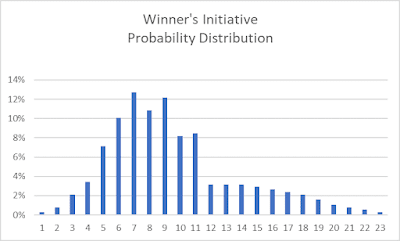
As will have been long apparent, my preferred approach to this blog is to write any old rubbish and then forget it, on the basis that no one reads it anyway. Occasionally this backfires, such as in the case of my recent post about dominos as a means of determining initiative in Piquet. I have been asked if I can justify my assertion that the result follows a normal distribution. In particular, the question was asked as to what specifically I was referring: the winner's initiative, the loser's initiative or the difference between the two? A reasonable question.
Well, the results of drawing a single domino and adding the pips follow a normal distribution. If both sides did the same then subtracting one from the other would be the difference between two independent normal distributions, which would also be a normal distribution. So far so good. But apart from the initial drawing of the dominos that's not actually how we allocate initiative. Even more importantly, what we do with the results of the draw renders the probabilities of the winner's and loser's respective initiatives non-independent. So, the answer to the question is: no, I can't justify it.
The author Michael Green wrote a series of books called 'The Art of Coarse Acting', 'The Art of Coarse Rugby' etc. He never got round to 'The Art of Coarse Mathematics' for some reason (*), but had he done so then I'm sure that he would have drawn the attention of readers to two cop-out phrases beloved of mathematicians who either can't or don't want to work everything out in detail: 'by inspection' and 'result follows'. Therefore, by inspection I'm going to assert that, under our methodology, both initiatives have a right-skewed distribution with the mean being higher than the mode. As for the net initiative - who knows?
This correspondence is now closed.
* I should point out that in geometry and topology 'coarseness' is a real and important concept
It's been over a year since The Heimatdamisch, and Conny Kreitmeier in particular, featured in the blog, but I'm glad to say that she's back.
Apologies for the poor picture quality, but I took it on my phone in the Brudenell last night, the second date of their first UK tour. They were billed as 'the ultimate live party band' and judging by the way they were received by the packed and diverse audience there was some justification in that. For those who don't know Leeds, the Brudenell is bang in the middle of the main student area and one easily can see why the band might appeal to that demographic, and indeed why Conny plus half a dozen blokes in lederhosen would attract those whose taste runs to a bit of camp. Both I and my companion for the evening thoroughly enjoyed ourselves, although she did make one or two remarks about my obvious admiration for Bavaria's finest pair of lungs. Their repertoire ranges from AC/DC to Taylor Swift; here's the latter (for the avoidance of doubt this isn't West Yorkshire):
The refight of Salamanca ended with a pretty overwhelming British victory. I came away thinking, as I often do after wargames, about probability theory. The ongoing rule changes to which I frequently refer are, as I hope you have realised all along, a feature rather than a bug. They are part of our (well James's really) Sisyphean attempt to develop the 'perfect' rules for any given period, usually but not always based on one of the Piquet family; a process which I rather enjoy and think the others do too. There are wargamers out there who indulge in a bit of Free Kriegspiel or in Matrix Games, but we in the Lower Wharfe Valley stick to the turning of cards, rolling of dice, drawing of dominos etc to establish the outcome of events. These randomisers usually involve probabilities which approximate a normal distribution (*). What we and other wargames developers are trying to do - although of course we wouldn't express it in this way - is to make sure that the centre of the bell curve is where it should be (**) on the x-axis, and that the outcomes which occur way along in the extremities of the tails don't ruin the game.
The second of those issues typically manifested itself in the original version of Piquet in the occasional very large swings of initiative leaving one set of players twiddling their thumbs while the other side got to move and fire all their units repeatedly. The second version of Piquet (i.e. FoB) got round this by giving each side the same initiative, while we adopted a domino draw mechanism that, for the most part, suits us by providing different, but mostly acceptable, initiative amounts for each side. It can occasionally go wrong though, and last night it did. The draw which one would most want is to get double six whilst one's opponent draws the six five. The chances of a particular side doing this are 1 in 784. Last night the British did it twice in an evening, say a dozen draws in total. I'll leave you to calculate how unlikely that is for yourselves (***). It did rather skew things. If I had been called in as a consultant by James, and I think you should assume that I haven't, I'd suggest taking out all the dominos with sixes on. As well as reducing the maximum initiative swing from 23:6 to 19:5 it would increase the odds of a turn ending early to 1 in 21, or virtually the same as in the original Piquet rules.
As for the other issue: is the centre of the curve for combat resolution where it ought to be? No, but it is of course still a work in progress.
* i.e. are normal in the limit
** Given both our interpretation of history and our desire for a decent game
*** I believe that the number of times that particular draw of two dominos would be repeated in any given set of twelve draws would itself follow a binomial distribution, but I really can't be arsed to work it out.
I broke my recent wargaming fast in the form of the first evening of a refight of Salamanca. I wasn't at all familiar with the battle before, but if I've understood it correctly we're playing the part of the battlefield where the main fighting occurred and the British are not constrained by having to follow Wellington's plan. The main change to the rules in my absence seemed to be to do with infantry melees. The changes sounded interesting - I thought I detected some Black Powder DNA - but we managed not to have any infantry melees so I can't really comment. I'm on the French team and all is not going well on my side of the battlefield, although my reinforcements are about to rush out of the woods, so perhaps there's hope yet.
My knowledge of Salamanca is infinitely greater than my knowledge of Elchingen, of which I had never heard before Mark invited me round to try some DBN. Even now, I couldn't tell you much more than that it involved Austrians and French. We played it through twice, swapping sides, and the Austrians won narrowly each time.
It wasn't just my first time with DBN, it was the first occasion that I had ever played any of the DB family of rules. I have to say that I rather enjoyed it. The game was much as Mark had described it: entertaining and quick. One of the things I wondered about in advance was how it would compare to C&C Napoleonics. The best point of reference is the basic C&C game rather than the expanded EPIC version that I would play in the annexe, and despite very different mechanisms there seemed to me to be similarities. They are both easy to grasp and play, avoid minutiae, but yet have sufficient chrome (e.g. unit types, national differences) to render the period recognisable. Indeed they share the same fault, namely that because victory depends on destroying a certain number of enemy units it can all get a bit cheesy at the end when on is chasing the final elimination.
A very pleasant way to spend a couple of hours.
“Oh well, bears will be bears,” said Mr Brown.” - Michael Bond
There are a surprising number of plays which call for a bear to appear on stage: 'A Winter's Tale' probably being the most well known. Usually, and for obvious reasons, they are represented by some technical trickery such as back projection. In a version of Philip Pullman's ' His Dark Materials' that I saw many years ago the actors playing the polar bears wore very large, but non-naturalistic head gear which worked well. In my review of Cavalli's 'La Calisto' I mention that they rendered the bear very effectively, without bothering to include the detail of exactly how they did it. Presumably I assumed my memory would be sufficient; it isn't. Why am I reminiscing about ursine theatrics? Because I've just seen a bear on stage that was far superior to any other that I have ever seen. I'd like at this point to include a picture of it, but I can't find one online so this one will have to do.
And the play? It was 'Guy Fawkes', guess what's in the barrels in the background there. Now, I don't claim to be an expert on the Gunpowder Plot, but I think all readers in the UK at least will be familiar with the basics of the story, which after all gets trotted out annually. Those basics have, in my case at least, until now excluded the bit about the bear. Still, thankfully one is never too old to learn something new.
The play may have been, shall we say, creative, but wasn't really very good. It did however make me laugh sufficient times to make me glad I went. And that is essentially the problem; they did it as a comedy. Which, when your subject matter is the plotting of a terrorist act intended to cause mass slaughter after which the protagonists are tortured and then hung, drawn and quartered, is to set oneself a difficult task. The author went for treating it as drunken pub talk that got out of hand; it didn't work. But, as I mentioned before, the bear was good.
Stoptober is all about giving up smoking, but I seem to have given up wargaming for the month instead. No particular reason, just the usual real life stuff getting in the way (*). Nothing particularly bad, although I had an injection in one of my legs at one point, which apart from being painful in itself left me rather immobile for a couple of days. Anyway, before the Rhetorical Pedant puts in an appearance let me acknowledge that I had a relapse mid-month, when I played out the game that had been sitting on the table in the annexe for quite a while. And that's where we pick it up again in November. Having lost a significant part of their food supply, and of course aware that help has been sent for, the besiegers have no option but to launch an assault.
One driver for playing this was to get some of my siege equipment on to the table, but due to the defenders feistiness the only one that has made it is the siege tower.
When I first read the 'Vauban's Wars' rules for 18th century sieges I had a think about whether they could be amended for the medieval period, before deciding that they probably couldn't. The little campaign from Miniature Wargames that I have been playing has been fine, but perhaps a little over-simplistic. I like the fact that there will definitely be a final assault, but would have welcomed a bit more to and fro between besieger and defender in the run up to it. For example, the besieger's bombard never got a look in. Maybe some of the relevant elements in VW - food, spies, disease all spring to mind - could be usefully incorporated.
Just looking at the table I don't see how the attackers can lose, but I shall have to wait to see how the rules for ladders etc actually work in practice. To be continued - eventually.
* For those that know me well, on this occasion it wasn't actually 'the usual'.
One of the more embarrassing elements of the recent (*) political debacle in the UK is that it turns out that Liz Truss has the same accountancy qualification as I do. To be honest, she is by no means the first example I have come across of a member of my institute who was useless, but it's annoying nonetheless. Perhaps a joke will help:
* or perhaps ongoing
"Optimus est, post malum principem, dies primus" - Tacitus
If you live in the UK then you will undoubtedly have seen this already. Still, I never like to pass up the opportunity of featuring Rowlf the Dog on the blog, or indeed of taking the piss out of the Tories.
It's a sign of the times that this video is less than 48 hours old and yet not all those featured are still in post.
Earlier this year an oblique reference to The Proclaimers led a fellow blogger to report having seen the Reid brothers in concert. I have now joined him in ticking off that feat, and whilst it wasn't my idea to go I can report that they were rather good. I remember hearing Tom Robinson say that he had made a career out of having written two good songs, and the Reids have at least three in their quiver. 'Letter from America' (as featured in that previous blog post), their most famous song (lyrics quoted in the title to this blog post) and 'Sunshine on Leith' (which is my favourite I think).
The evening also provided yet another example of how despite being well into my seventh decade I can sometimes still find myself in situations for which life has not sufficiently prepared me (feel free to compare and contrast what follows with this previous example). My companion for the evening and I were in the Kash - compulsory for a cultural outing in Bradford city centre - when we bumped into a colleague of hers. He mentioned that he had been out for lunch to say goodbye to a friend who was leaving for Switzerland. "Lucky him," says I "I'm sure he'll prefer it over there to over here".
The chap to whom we were speaking gave me a pained look and said "Well, he's been ill.."
"Even better," I replied "The air is so much cleaner and fresher in the mountains, he'll feel so much better in no time."
My companion was by now also giving me odd looks, but it was only when I heard the words "In fact, he's been so very ill that he feels that this is really the best option..." that it began to sink in that 'going to Switzerland' had, in this context, a specific, no need for a return ticket, sort of meaning.
Once again, not cool dude, not cool.
"Whatever happened to the siege you were playing using Lion Rampant?" asked absolutely no one. Well, it fell victim to the double edged sword that is having a dedicated wargames room, or in my case a dedicated wargames outhouse. The great thing about them is that you can leave stuff set up for as long as you like, whereas on the other hand if you are, like me, easily tempted away by other ways of spending your time then out of sight out of mind. Anyway, the other stuff having come to a natural and inevitable conclusion I have returned chastened to the world of toy soldiers vowing never again.
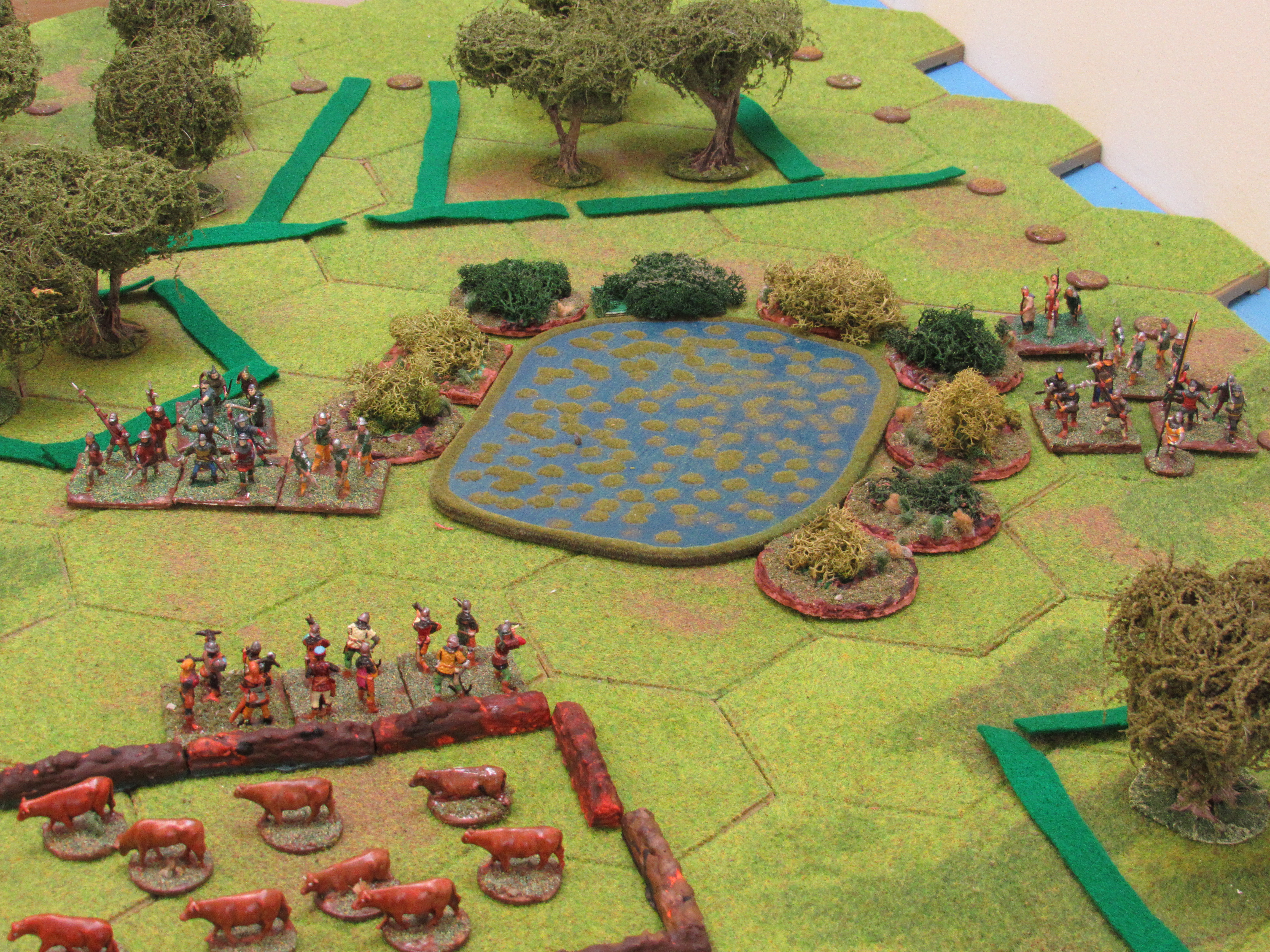
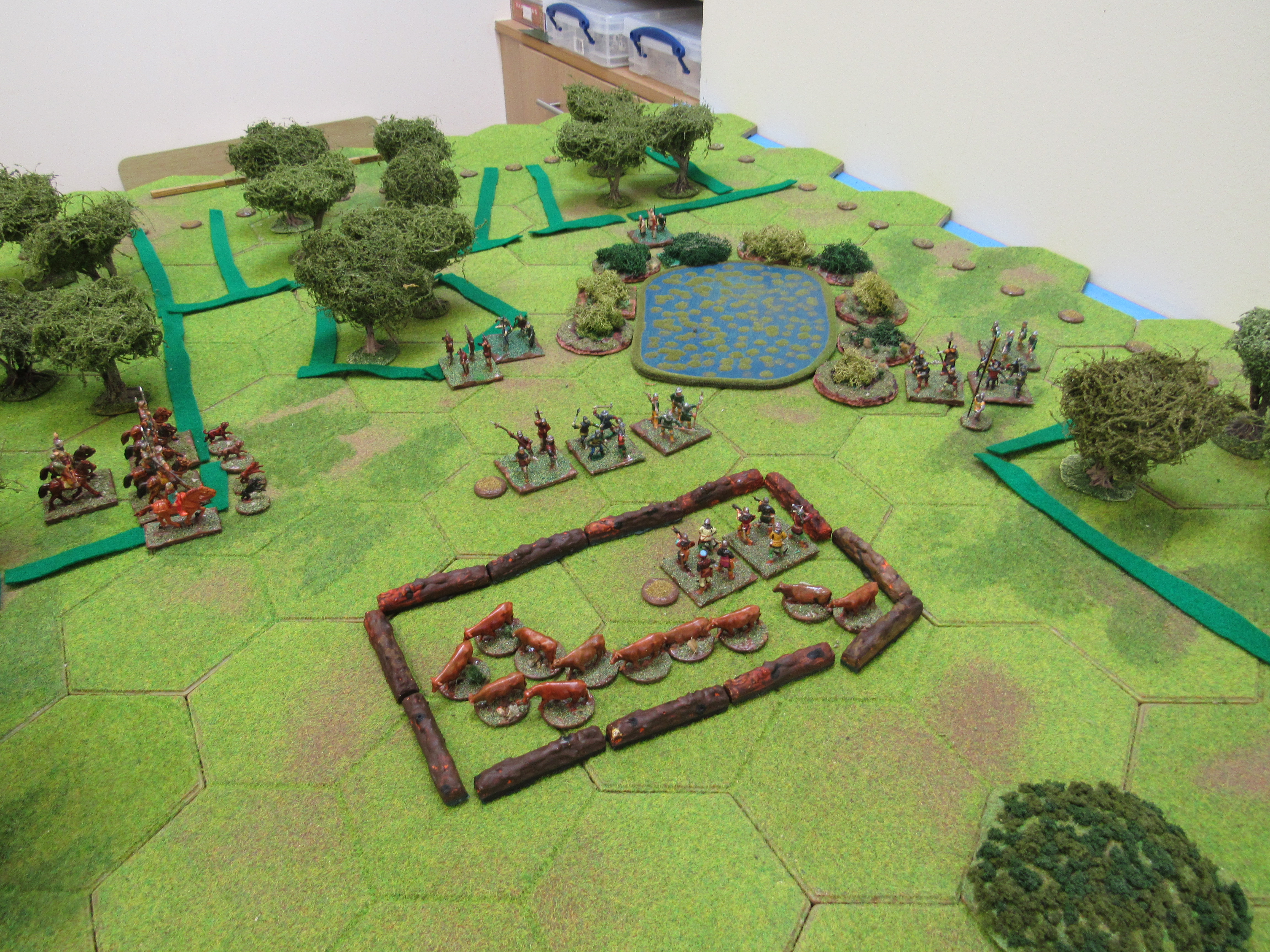
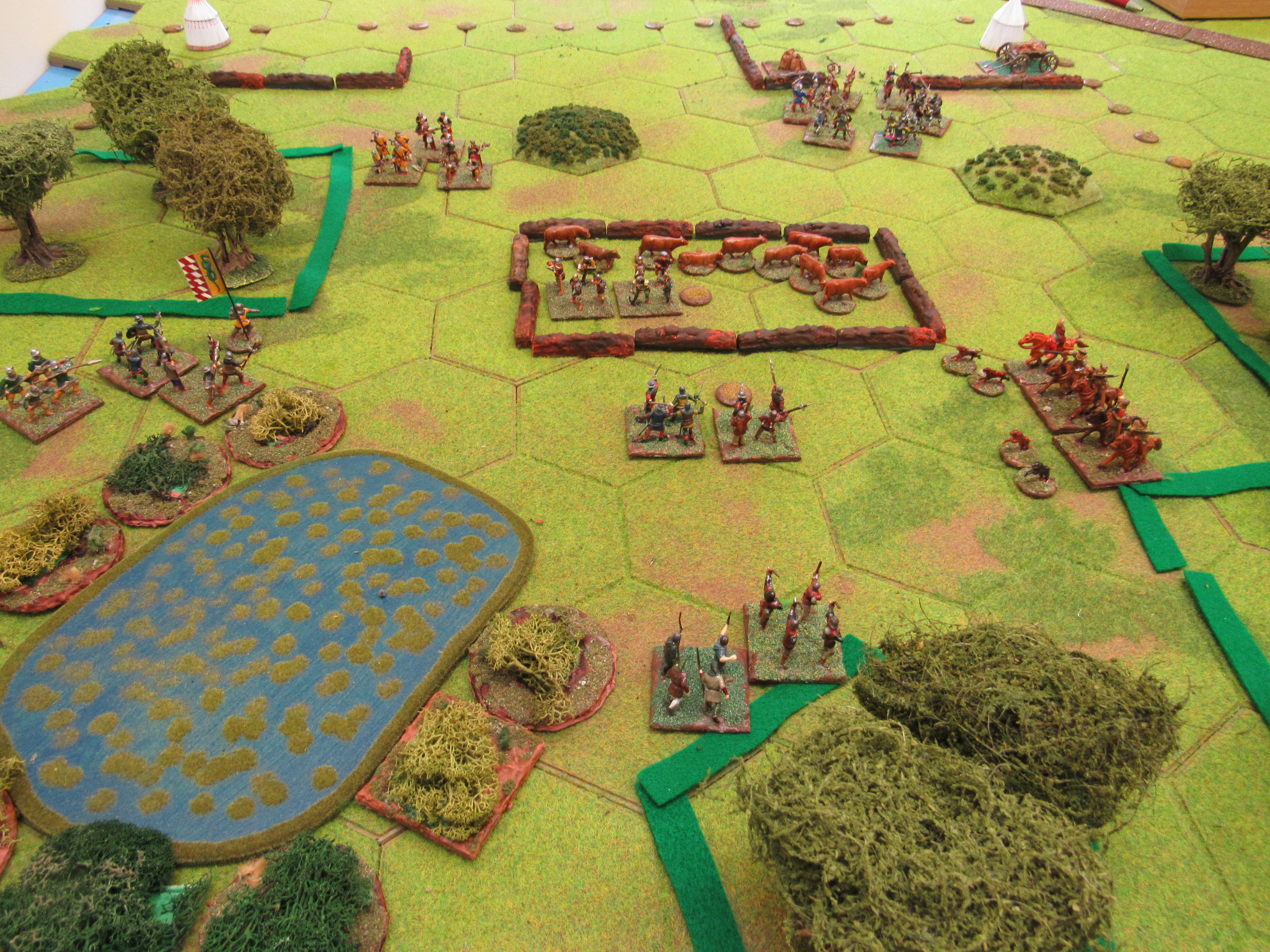
You may recall, although if you do then you're doing better than me, that the game languishing for the last couple of months was an attempt by the defenders to drive off the besiegers' cattle herd. In the photo above the raiders have been successfully guided out of the woods by their local associates, the hunting party is making its way towards them (top right) and those in the camp haven't stirred. The following notes are for my own future reference really:
I was ill for part of last week. Just a heavy cold I think, although to be honest every time I have taken a self-administered Covid test over the last couple of years I have seriously wondered whether I was doing the bloody thing properly. I eased myself back into the land of the living by going to an exhibition of photographs and I shall be easing myself back into the land of blogging by writing about it.
"Our society is run by insane people for insane objectives" - John Lennon
It seems only a couple of months ago that I described the contenders to be leader of the Tory party, and therefore prime minister, as headbangers. It would seem that I was too kind to the winner.
We finished off the game of Soldiers of Napoleon about which I was complaining here. We down graded the over-powerful British skirmishers, which certainly made things better, but the game still limped to a fairly unsatisfactory conclusion. Even before the usual post-game discussion there was clearly an unspoken consensus that SoN had run its course, at least for the time being. The rules have many good features, but things don't half take a long time to get going, and just when they do the game seems to be over because one side runs out of morale. I am quite prepared to believe that we aren't playing it in the right way, but then perhaps that in itself doesn't reflect well on the rulebook as published.
In any event, this last week we stayed in the Peninsular, but returned to Piquet with the best elements of SoN (as defined by James) incorporated. The version of Piquet now in use for this period (and indeed that used for the Seven Years War) have migrated a fair distance from the original core rules and incorporate bits and pieces that we have liked in other games; the primary influences before the latest amendments being Piquet's sister ruleset Field of Battle and Black Powder. It all seemed to gel together better than it had any right to, especially since the rest of us often didn't know what the rules actually were until we tried to do something. What it did do was produce a rather good game.
It was a Charles Grant scenario based, I am told, on Fontenoy. Given my earlier observation about games of SoN starting slowly it was perhaps just as well that, as the attacker, I got the bulk of the early initiative and was able to move forwards. I was literally one dice roll away from having one of infantry divisions broken leading to inevitable defeat, but turned the card necessary to bolster their morale and never looked back. I eventually won because the British guns in the redoubts were unable to inflict any casualties on the French cavalry as they advanced past them and then the British cavalry commander died in slightly unfortunate circumstances as he tried to rally them.
We going to swap sides and give it another go next week. Piquet always produces a different game and both sides have the advantage of learning where not to deploy (the British infantry need to be nearer the village in the centre and the French should probably not bother trying to advance through the wood), but we shall be lucky if it is as entertaining.
I have been to southern Cumbria for a couple of days, but neglected to take any photos of the Howgills themselves, features which Wainwright described as being like sleeping elephants. However, on my way up there on Monday morning I did take this one of the Ribblehead Viaduct.
An awful lot of people had obviously decided that an unexpected day off would best be spent by climbing Pen-y-ghent, Ingleborough and Whernside one after the other. Your bloggist was not among them. My companion for the trip and I took a much flatter walk for about a third of the 24 miles that the three peaks challenge requires. Then having done the aforementioned photo-free fell walking north of Sedbergh we paused on the way back to walk around Semer Water
One thing that took me north was the opportunity to stop off in Settle and see Maggie Bell and Dave Kelly perform. They have both featured here before: Dave as part of The Blues Band and Maggie as the lead singer with Stone the Crows, whose videos I have posted on several occasions. I have sometimes mentioned acts I wish I had seen forty years ago; in Maggie Bell's case it was actually fifty years ago. Bell didn't hark back to those days much, although she referenced in passing the band's support slot on Joe Cocker's 'Mad Dogs and Englishmen' tour (sadly neither they nor Freddie King feature in the film). One track she and Kelly did perform was this:
It was well worth the long wait. She may be 77, but she can still belt out the blues.
"Ignorance gives one a large range of probabilities." - George Eliot
I've been doing August stuff, including a trip here:
But there has been some wargaming in the background. We had a somewhat bizarre game of To the Strongest!, with some very lopsided luck, which was clearly just that - luck - and not something inherent in the rules. Soldiers of Napoleon, however is a different matter.
I am definitely cooling on this game and considering that I started off lukewarm that is not exactly a ringing endorsement. Part of the problem undoubtedly stems from the fact that it is not designed as a multi-player game, but there are four of us. We seem to have ended up playing the author's suggested approach, which is basically two games side by side. It's crap (*). We seem to be sacrificing much of the pleasure of social interaction - which is for me at least a big part of why I do this in the first place - for the sake of the purity of the rules. It all seems a bit arse about face to me.
My main problem though is with the flawed arithmetic implicit in the rules. James recently passed me a copy of WRG 6th edition so that I could look at the siege rules. The writers of these appear, to me at least, to have attempted to achieve 'realism' and bugger the playability. Thankfully authors of more modern games tend to do it the other way round, concentrating on finding mechanisms that are easy to use and which move things along smoothly. I play a lot of boardgames and in that sphere one need do no more; it's usually all abstract anyway. When wargaming though one needs/wants to add chrome to make it a reasonable facsimile of what one imagines the historical period was like. Authors don't always seem to me to be able to manage the interface between their neat, simple mechanisms and the chrome. I previously wrote about some nonsensical effects of this in Blitzkrieg Commander 4.
One example from SoN relates to skirmish fire. Now skirmish fire is hard to get right in a set of rules. We tried any number of ways with Piquet and never produced anything particularly worthwhile. The version we ended up with had the sole merit that it sometimes allowed French columns to close with British lines. In SoN units can throw out their light company which then appear as two skirmish stands . You can then fire these with a dice per stand at a longer range than volley fire. If you fire at another unit which also has its light company out then you lose a dice. So far so good. Standard units hit on 4,5,6 and save on 4,5,6, so two units skirmishing against each other would both have an expected value of damage caused of 0.25 disruptions (the term for damage caused in SoN) each time they fire. It's not very effective, but worth doing because units with no disruptions get a bonus in combat.
Some units, for example those of the British Light Division, qualify for a third skirmish stand. This seems reasonable; specialist troops get a 50% bonus. In practice of course it means they get two dice when firing at a line unit with skirmishers, so that's actually a 100% bonus. And this is where another rule comes into play. One can only save the first hit caused, so the ability to cause two hits is very powerful. I'll let you do the arithmetic for yourself, but it turns the expected hits of these units against a standard unit to 0.625, i.e. a 150% increase. What makes it worse is that these units also tend to be elite (not the term used in the rules) and can both hit and save on 3,4,5,6. If we consider our match up of one of these units versus a standard unit, both with skirmishers out, we find the standard unit's expected hit has dropped to 0.167, while the specialists' has increased to 0.889. Were these units really five times better? It seems unlikely to me.
Add in other facets of the rules, in particular the ability to concentrate of multiple units' fire on one target, and you end up with a game that is dominated by the skirmish fire of certain formations - I'm looking at you again Light Division - and frankly isn't that much fun.
* And, incidentally, quite a lot worse than our own quickly cobbled together approach which we tried first.